

PIB PRiSM Monthly Magazine 2026, Download PDF, Benefits
By Vajiram Content Team -
06-10-2026
12:22 PM
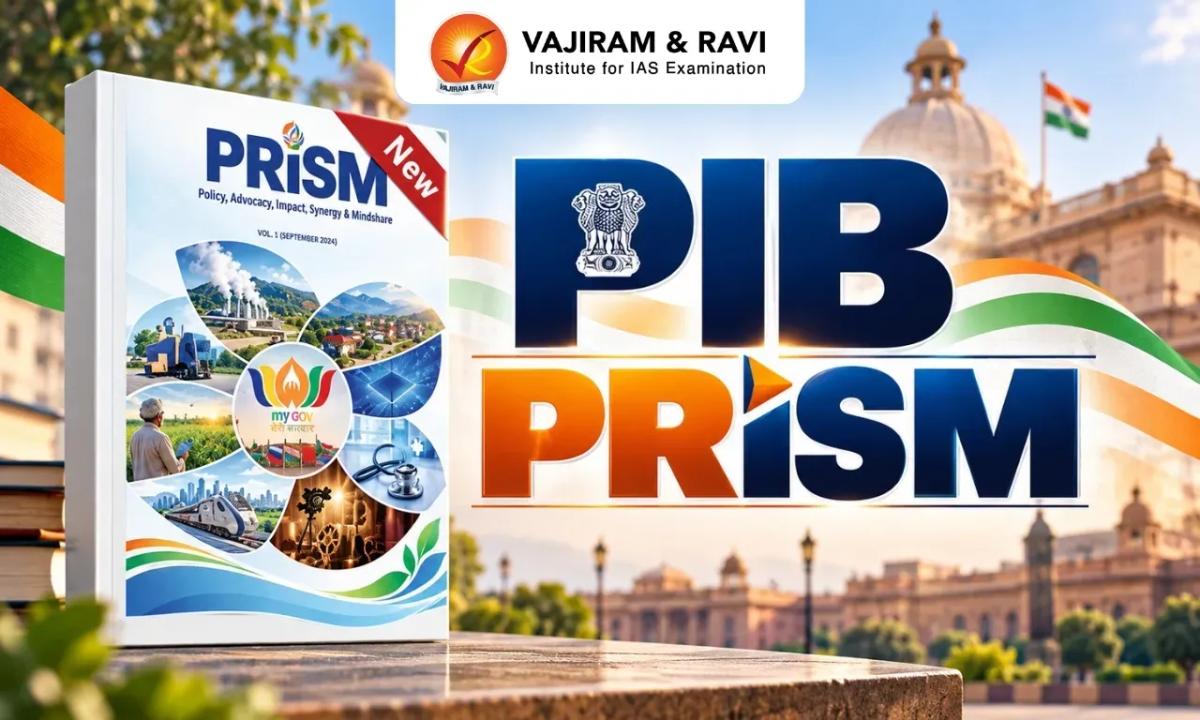
Table of Contents
PIB PRiSM Magazine 2026 is a monthly publication of the Press Information Bureau (PIB), Government of India, covering important government policies, schemes, reforms, initiatives, achievements and developments across different sectors.
For aspirants preparing for the Civil Services Examination, PIB PRiSM 2026 can serve as an important source of authentic government information. PIB PRiSM 2026 is currently available in the July, August, and September 2026 editions.
PIB PRiSM Magazine 2026 PDF Download
The latest editions of PIB PRiSM Magazine 2026 can be accessed through the official PIB E-Booklets section or from the direct link provided below in the table.
PIB PRiSM Magazine 2026 PDF Download | |
Edition | |
PIB PRiSM September 2026 | |
PIB PRiSM August 2026 | |
PIB PRiSM July 2026 | |
PIB PRiSM Magazine 2026 Benefits
PIB PRiSM Magazine 2026 helps aspirants understand important government policies, schemes, initiatives and developments from an authentic government source. Its major benefits include:
- Authentic information: Provides official information on government schemes, policies, programmes and achievements.
- Current affairs coverage: Covers important developments across governance, economy, agriculture, environment, science and technology, and social issues.
- Prelims preparation: Helps identify important facts, schemes, institutions, reports, data and government initiatives.
- Mains answer enrichment: Provides government data, examples, initiatives and policy measures that can strengthen answers.
- Syllabus linkage: Current developments can be connected with different topics of the syllabus for better conceptual understanding.
- Government perspective: Helps understand the government's approach towards major economic, social and governance issues.
- Revision support: Monthly editions make it easier to organise and revise important current affairs.
- Useful examples: Government initiatives and success stories can be used as examples in answers and essays.
PIB PRiSM Magazine 2026 Preparation Strategy
PIB PRiSM should be read selectively rather than cover to cover. Focus on information that has a clear connection with the syllabus and Previous Year Questions.
- Identify relevant topics: Prioritise schemes, policies, reports, government initiatives, important data and major developments.
- Link with static topics: Connect PRiSM content with subjects already covered from standard books and study material.
- Make short notes: Note only important facts, objectives, beneficiaries, achievements, challenges and government measures.
- Focus on Prelims facts: Pay attention to new schemes, ministries, institutions, programmes, terminology, environmental developments and scientific developments.
- Use it for Mains: Extract data, examples, government initiatives, challenges and solutions that can improve answer quality.
- Follow the 3-question approach: While reading an issue, identify What is the issue? What has the government done? What more can be done?
- Use PYQs for filtering: Give more importance to topics that are related to previous questions and recurring themes.
- Revise regularly: Convert monthly PRiSM content into short revision notes instead of repeatedly reading the complete magazine.