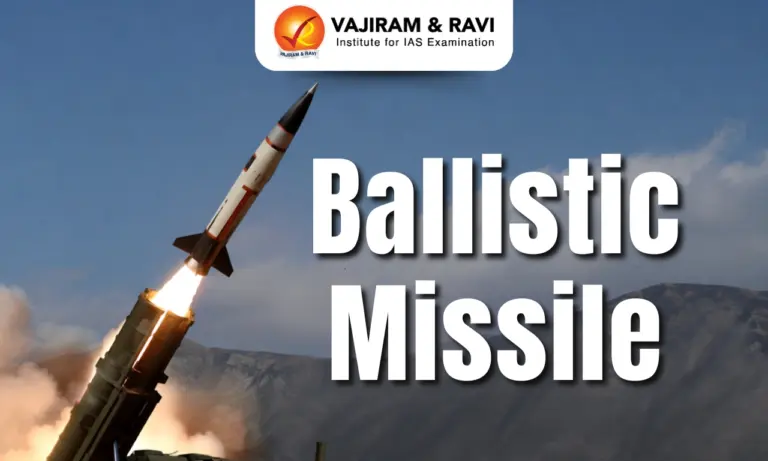
The ongoing Russia-Ukraine conflict witnessed another significant development after reports indicated that Ukraine launched its first reported ballistic missile strike targeting Moscow. According to available reports, Russia’s S-400 Triumph air defence system intercepted and destroyed the incoming missile before it reached its target.
What Is a Ballistic Missile?
A ballistic missile is a guided missile that is powered during its initial launch phase and then follows a ballistic trajectory under the influence of gravity until it reaches its target. These missiles can carry either conventional or nuclear warheads and are primarily used for strategic deterrence and long-range military operations.
Key Features of Ballistic Missiles
- Powered only during the boost phase; after engine burnout, it follows a ballistic path.
- Travels at very high or hypersonic speeds, making interception difficult.
- Can carry conventional, nuclear, chemical, or biological warheads (depending on the country’s doctrine).
- Operates in three phases: Boost Phase, Midcourse Phase, and Terminal Phase.
- Used for strategic deterrence, battlefield operations, and precision strikes.
- Can be launched from land-based silos, mobile launchers, aircraft (limited), submarines, and naval vessels.
- Generally have a much longer range than cruise missiles.
- Advanced ballistic missiles may feature Multiple Independently Targetable Reentry Vehicles (MIRVs) and manoeuvrable re-entry vehicles.
Classification of Ballistic Missiles
Ballistic missiles are classified based on their maximum operational range. Each category serves different military and strategic objectives.
| Classification of Ballistic Missiles | ||
|
Missile Type |
Range |
Primary Role |
|
Short-Range Ballistic Missile (SRBM) |
Up to 1,000 km |
Tactical battlefield operations |
|
Medium-Range Ballistic Missile (MRBM) |
1,000–3,000 km |
Regional strategic strikes |
|
Intermediate-Range Ballistic Missile (IRBM) |
3,000–5,500 km |
Long-distance strategic missions |
|
Intercontinental Ballistic Missile (ICBM) |
Above 5,500 km |
Intercontinental nuclear deterrence |


Russia’s S-400 Air Defence System
The S-400 Triumph is Russia’s advanced long-range air defence missile system designed to intercept a wide range of aerial threats, including aircraft, drones, cruise missiles, and certain ballistic missiles. It is regarded as one of the world’s most capable integrated air defence systems.
- Developed by Russia’s Almaz-Antey defence company.
- Maximum engagement range of up to 400 km (depending on missile variant).
- Can intercept targets at altitudes of up to 30 km.
- Capable of engaging aircraft, stealth fighters, UAVs, cruise missiles, and ballistic missiles.
- Tracks hundreds of targets simultaneously and can engage multiple targets at once.
- Uses multiple interceptor missile types for different threat ranges.
- Equipped with advanced phased-array radar for long-range detection.
- Provides layered air defence by integrating with shorter-range missile systems.
Cold Launch Technology
Cold Launch Technology is a missile-launch method in which the missile is first ejected from its launch tube using compressed gas or a gas generator before its main rocket engine ignites. This technique protects the launch platform from the extreme heat and pressure produced by the rocket motor.
- Missile is expelled from the launch tube before engine ignition.
- Uses compressed gas or a gas generator instead of immediate rocket ignition.
- The rocket engine starts only after the missile safely clears the launcher.
- Significantly reduces the risk of damage to submarines and launch platforms.
- Improves crew safety during underwater missile launches.
- Enhances launch reliability and operational efficiency.
- Allows multiple missile launches with minimal structural stress.
- Has become the global standard for submarine-launched ballistic missiles.
- Used by major naval powers, including India, the United States, Russia, France, and China.
Submarine-Launched Ballistic Missiles (SLBMs)
Submarine-Launched Ballistic Missiles (SLBMs) are long-range ballistic missiles launched from specially designed ballistic missile submarines, providing a highly survivable and credible strategic deterrent capability.
- Form one of the three components of the Nuclear Triad (land, air, and sea-based nuclear forces).
- Provide a credible second-strike capability, ensuring retaliation even after a first attack.
- Generally launched using Cold Launch Technology, where the missile is ejected before its rocket engine ignites.
- Capable of carrying conventional or nuclear warheads, depending on mission requirements.
- Possess long operational ranges, enabling strikes on distant strategic targets.
- Submarines can remain hidden underwater for extended periods, making SLBMs difficult to detect and intercept.
- Enhance a nation’s strategic deterrence, maritime security, and nuclear stability.
- Require advanced navigation, communication, and underwater launch systems for accurate deployment.
- Operated by major naval powers, including India, the United States, Russia, France, China, and the United Kingdom.

 Last updated on July, 2026
→ UPSC Prelims Result 2026 is now out.
→ UPSC IFoS Prelims Result 2026 is now out.
→ Enroll in Vajiram & Ravi’s UPSC Mains Test Series 2026 for structured answer writing practice, expert evaluation, and exam-oriented feedback.
→ Join Vajiram & Ravi’s UPSC Mentorship Program 2026 for personalized guidance, strategy planning, and one-to-one support from experienced mentors.
→ Join Vajiram & Ravi’s UPSC Mentorship Program 2027 for personalized guidance, strategy planning, and one-to-one support from experienced mentors.
→ UPSC Prelims Provisional Answer Key 2026 out for GS Paper 1 and CSAT.
→ UPSC Prelims Question Paper 2026 Out, Download GS Paper 1 PDF conducted on 24th May 2026.
→ UPSC Mains 2026 will be conducted from 21st August 2026 onwards, and UPSC Prelims 2027 will be held on 23rd May 2027.
→ UPSC Final Result 2025 is now out.
→ UPSC has released UPSC Toppers List 2025 with the Civil Services final result on its official website.
→ Anuj Agnihotri secured AIR 1 in the UPSC Civil Services Examination 2025.
→ UPSC Notification 2026 & UPSC IFoS Notification 2026 is now out on the official website at upsconline.nic.in.
→ UPSC Calendar 2027 has been released.
→ Check out the latest UPSC Syllabus 2026 here.
→ The UPSC Selection Process is of 3 stages-Prelims, Mains and Interview.
→ Shakti Dubey secures AIR 1 in UPSC CSE Exam 2024.
→ Also check Best UPSC Coaching in India
Ballistic Missile FAQs
Q1. What is a ballistic missile?+
Q2. What are the main types of ballistic missiles?+
Q3. How is a ballistic missile different from a cruise missile?+
Q4. What is Cold Launch Technology?+
Q5. Why are SLBMs important?+
Q6. Which countries use Cold Launch Technology?+
Q7. Why are ballistic missiles difficult to intercept?+
Tags: ballistic missile current affairs