

Date of Commencement
10th July 2026

Mode
Online/Offline
Duration
4 Months

Fee
Rs. 17,000 (Incl. GST)
History Optional Enrichment and Mentorship Course
History Optional Enrichment and Mentorship Course for UPSC CSE 2026
Revise with direction. Write with confidence. Prepare with historical depth.
History is rarely made in one dramatic moment. It is shaped through discipline, repetition, and the ability to connect scattered events into a larger pattern. Civilizations are not built in a day; neither is a strong History Optional score.
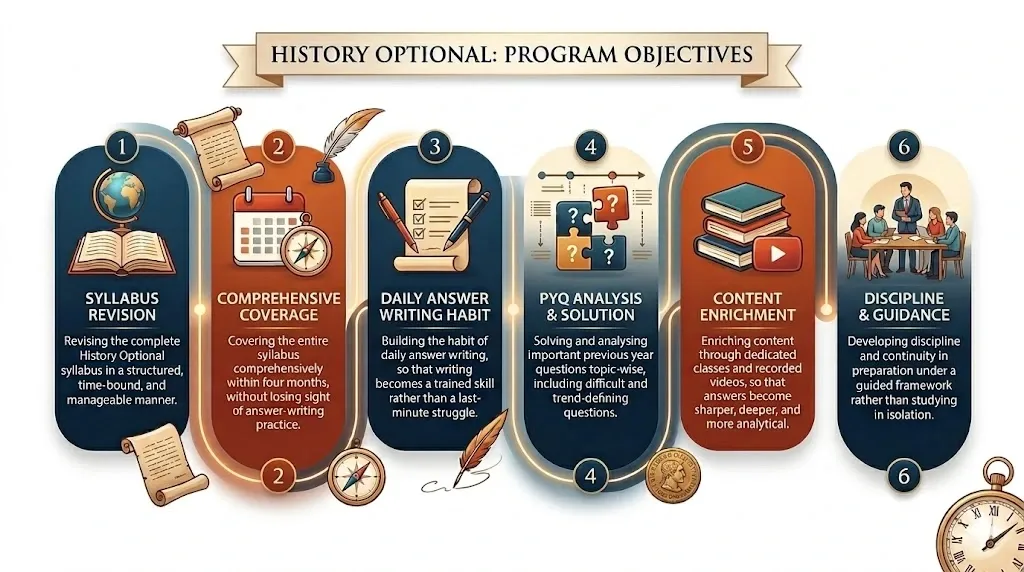
The History Enrichment Program 2026 is a focused four-month revision and enrichment program designed for 2027 appearing students who want to prepare for History Optional in a systematic, disciplined, and exam-oriented manner. The program combines complete syllabus revision, daily answer-writing practice, topic-wise PYQ work, enrichment classes, and recorded support material so that students are not merely “covering” the syllabus, but learning how to think, organise, and write like a serious History Optional candidate.
In many ways, preparation for History Optional resembles what the historian does with the past: not simply collecting facts, but arranging them into a meaningful argument. This program is built to help you do exactly that.
Who Should Join?
Programme Features
- A Detailed Study Plan with Continuous Mentor Guidance
- One of the biggest challenges in History Optional is not simply the vastness of the syllabus, but the
- absence of a clear sequence for revising it. Students often know what to read, but not when, how much, or in what order.
- To solve this, the programme will provide a carefully designed four-month study plan that breaks
- the syllabus into manageable segments and aligns reading with revision, PYQ work, and writing practice.
- Students will also receive mentor guidance to help them maintain consistency, clarity, and direction throughout the programme.
- Daily Answer-Writing Practice
- No optional subject rewards passive preparation.
- History Optional, in particular, is a subject in which knowledge must be translated into arguments, structure, and presentation.
- A student may know the material, but unless that knowledge is regularly expressed in answer form, performance remains uncertain.
- For this reason, the programme places strong emphasis on daily answer writing.
- Students will be given daily questions to practise:
- Important syllabus-based themes,
- Conceptual questions,
- Difficult and high-value PYQs,
- Areas where students commonly struggle with structure or interpretation.
- This daily practice is meant to build:
- Speed,
- Clarity of thought,
- Answer structure, and
- The confidence to write under exam conditions.
- Sectional Tests for Revision and Self-Assessment
- Preparation improves when it is measured. Sectional tests will therefore form a key part of the programme.
- These tests are designed to help students:
- Assess how well they have revised a particular segment of the syllabus,
- Identify weak areas early,
- Improve retention through active recall, and learn how to write with balance, relevance, and time discipline.
- Rather than treating tests as isolated events, the programme treats them as checkpoints in the revision journey, moments where the student pauses, assesses, recalibrates, and moves forward with greater clarity.
- Value Addition Classes and Recorded Videos
- Many students complete the syllabus, but their answers remain ordinary because they lack analytical depth, historiographical perspective, sharper examples, and the ability to connect themes across topics.
- To address this, the programme will include dedicated enrichment classes and recorded videos wherever required.
- These sessions will focus on strengthening the quality of content by adding:
- Analytical frameworks
- Historiographical perspectives
- Better examples and illustrations
- Interlinkages across topics
- Factual support for precision in answers
- Clarity on difficult themes and recurring areas of confusion
- This enrichment component is intended to help students move from “I know the topic” to “I can write a strong answer on the topic.”
- Guidance on Standard Texts
- A common problem among aspirants is not the absence of books, but the inability to use them efficiently.
- Many students read standard works sincerely but do not know how to extract exam relevant themes, prioritise material, or convert reading into notes and answers.
- The programme will therefore include focused guidance on how to read and use standard texts such as:
- Upinder Singh
- B.A. / IGNOU material for Medieval India
- Shekhar Bandhopadhyaya
- B.L. Grover
- Students will be guided on:
- What to prioritise,
- What to skip,
- How to connect reading with the syllabus,
- And how to convert bulky material into concise, revision-friendly understanding.
- In other words, the aim is not to make you read more, but to help you read better.
- Complete Revision of the Syllabus in Four Months
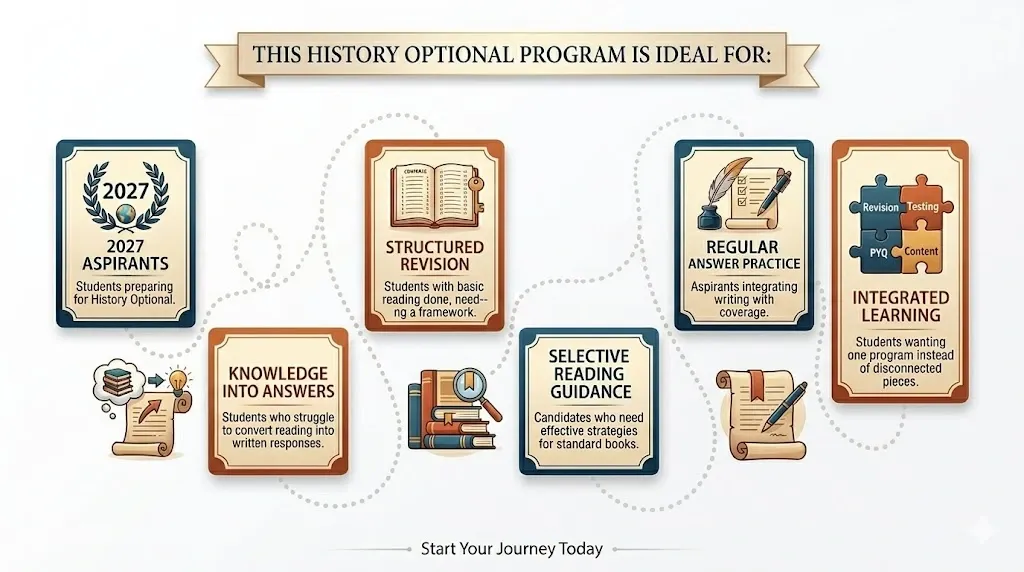
- The central promise of this programme is straightforward: to help students revise the complete History Optional syllabus in four months in a serious, structured, and sustainable manner.
- This does not mean rushing through topics mechanically. It means revising them in a way that
- balances:
- Coverage
- Retention
- Answer-writing practice
- Testing
- Content enrichment
- The idea is to create a rhythm of preparation where each week contributes to a larger design, and each month leaves the student stronger than before.
Learning Approach
- The learning approach of this program is practical, disciplined, and examination-oriented.
- It is based on a few simple principles:
- Syllabus coverage must serve revision, not just completion.
- Answer writing should be integrated into preparation, not postponed to the end.
- PYQs should be used to understand the examiner’s mind, not merely as practice material.
- Tests should reinforce revision and reveal weaknesses early.
- Enrichment should improve answer quality, not overwhelm students with excess information.
- In short, the program attempts to combine breadth with control, revision with writing, and content with exam application.
Expected Outcomes
By the end of theprogram, students should be able to:
- Complete one full structured revision of the History Optional syllabus.
- Write answers more regularly, confidently, and with better organisation.
- Handle PYQs with improved thematicunderstanding and sharperinterpretation.
- Use standard books more selectively and effectively.
- Add better examples, arguments, and historiographical depth to their answers.
- Approach the examination with a stronger revisionbase, clearer strategy,and greater writing confidence.
Location
Still unsure about the course? Secure your spot now.
Get a free counselling session from our experts
Name*
Email ID*
Phone Number*