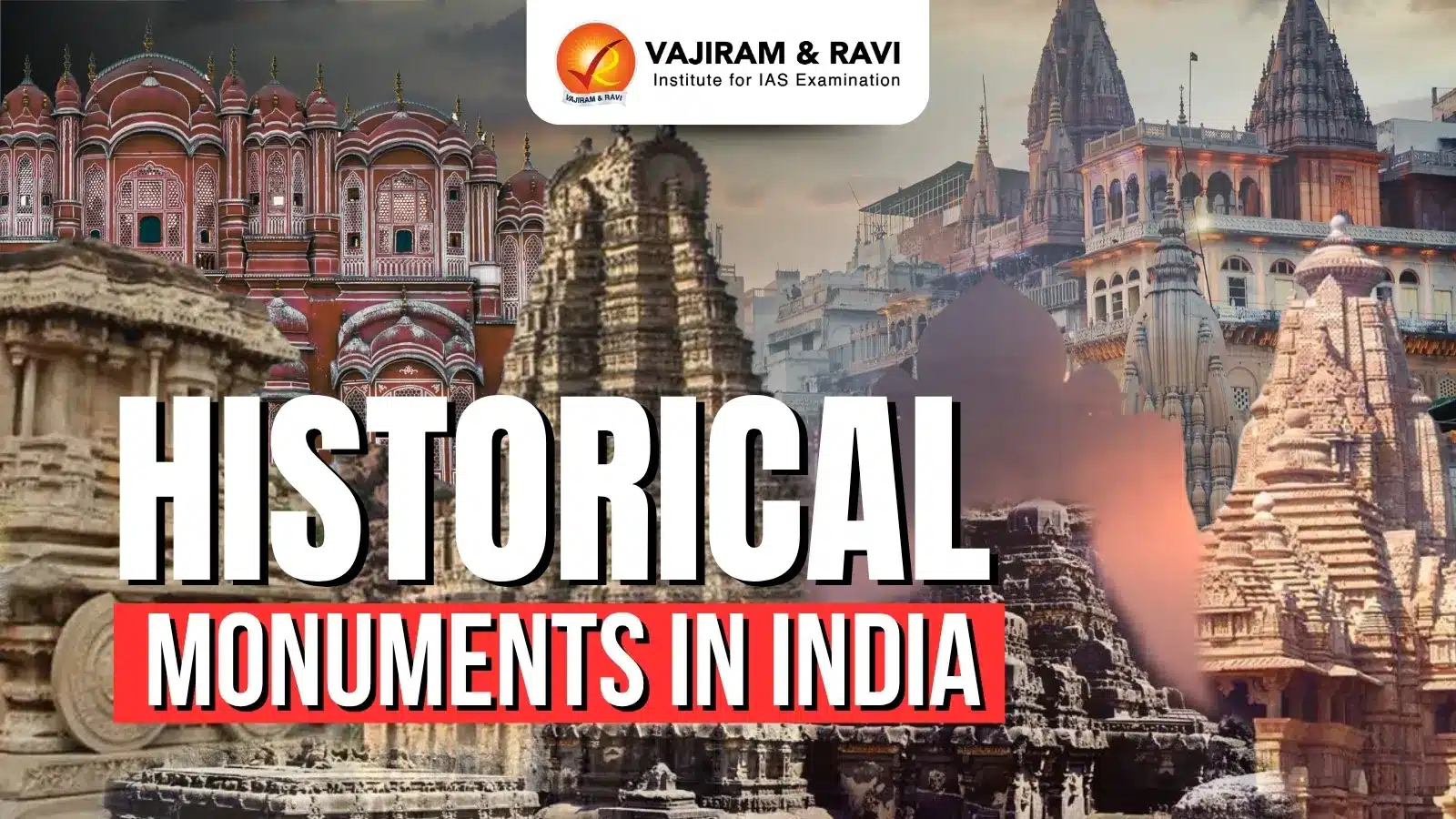
Top 10 Historical Monuments of India 2026, List, Location, Photos

Historical Monuments in India

India is a land of Historical Monuments that narrate stories of dynasties, religions, and cultures. These Historical Monuments in India not only attract various tourists each year but also stand as symbols of India’s glory. The List of Historical Monuments of India is preserved under the Archaeological Survey of India (ASI) and many are UNESCO World Heritage Sites. This article provides details regarding Top 10 Historical Monuments of India 2026.

Historical Monuments of India 2026

The Historical Monuments of India are spread across its states and represent different time periods, rulers, and religions. These include Buddhist stupas, Hindu temples, Islamic forts, and Jain rock-cut caves. Each monument tells a unique story and showcases the craftsmanship of ancient Indian artisans.

The list of major Historical Monuments in India has been provided below:

  • Red Fort: Located in Delhi, the Red Fort was built by Shah Jahan in the mid-17th century. It is one of India's most important historical monuments and Mughal architectural landmarks.
  • Meenakshi Temple: Situated in Madurai, Tamil Nadu, Meenakshi Temple was built by the Pandya Dynasty during the 7th century. It is a renowned historical monument and significant temple complex.
  • Sanchi Stupa: Located in Sanchi, Madhya Pradesh, Sanchi Stupa was built by the Maurya Empire between the 1st and 3rd centuries BCE. It is among India's oldest historical monuments.
  • Mahabalipuram: Situated in Tamil Nadu, Mahabalipuram was built by the Pallava Dynasty during the 7th century. It is an important historical monument known for its ancient architectural heritage.
  • Elephanta Caves: Located in Maharashtra, the Elephanta Caves were built by the Rashtrakuta rulers between the 5th and 6th centuries. They are among India's prominent ancient historical monuments.
  • Rani ki Vav: Situated in Patan, Gujarat, Rani ki Vav was built by the Chalukya Dynasty during the 11th century. It is a remarkable historical monument showcasing medieval architectural excellence.
  • Charminar: Located in Hyderabad, Telangana, Charminar was built by Muhammad Quli Qutb Shah in 1591. It is one of India's most famous historical monuments and iconic city landmarks.
  • Qutb Shahi Tombs: Situated in Hyderabad, Telangana, the Qutb Shahi Tombs were built by the Qutb Shahi dynasty during the 16th and 17th centuries. They are notable historical monuments of the Deccan.
  • Golconda Fort: Located in Hyderabad, Telangana, Golconda Fort was built by the Bahmani Sultanate during the 13th century. It is one of India's significant medieval historical monuments.
  • Brihadeeswara Temple: Situated in Thanjavur, Tamil Nadu, Brihadeeswara Temple was built by Rajaraja Chola I during the 11th century. It is a renowned Chola-era historical monument.
  • Mahabodhi Temple: Located in Bodh Gaya, Bihar, Mahabodhi Temple was built by Ashoka during the 3rd century BCE. It is one of India's oldest and most significant historical monuments.

Top 10 Historical Monuments of India 2026

Top 10 famous Historical Monuments in India are globally recognized for their heritage value. These include museums, temples, forts, and rock-cut caves that span centuries of Indian history. Each of these monuments has been recognized for its historical relevance.

Top 10 Famous Historical Monuments in India 2026

Images

Monument

Location

Built Year

Description

File:Taj Mahal (Edited).jpeg - Wikipedia

Taj Mahal

Agra, Uttar Pradesh

1648

A global symbol of love built by Mughal Emperor Shah Jahan for Mumtaz Mahal. Crafted in white marble and counted among the Seven Wonders of the World.

2,800+ Architectural Details Of Qutub Minar Stock Photos, Pictures & Royalty-Free Images - iStock

Qutub Minar

Delhi

1193

World’s tallest brick minaret at 73 meters, showcasing Indo-Islamic design with detailed carvings and inscriptions.

Ajanta Caves - Free Photos, Vectors, Icons, Graphics, Illustrations, 3D graphics, and Photoshop PSD, Generative AI Images for Personal and Commercial Use | FreePixel

Ajanta Caves

Maharashtra

2nd Century BCE – 6th Century CE

Rock-cut caves featuring intricate Buddhist paintings and sculptures; designated as a UNESCO World Heritage Site.

Ellora Caves Pictures | Download Free Images on Unsplash

Ellora Caves

Maharashtra

6th – 10th Century CE

Houses temples and monasteries of Hinduism, Buddhism, and Jainism. The Kailasa Temple is especially famous for its architectural excellence.

Konark sun temple Images - Free Download on Magnific (formerly Freepik)

Sun Temple

Konark, Odisha

1250 CE

Designed like a colossal chariot dedicated to the Sun God, adorned with exquisitely carved wheels and panels.

Khajuraho - Wikipedia

Khajuraho Temples

Madhya Pradesh

950 – 1050 CE

Known for their detailed sculptures and symbolic carvings. Built by the Chandela dynasty, listed as a UNESCO World Heritage Site.

Hampi Images - Free Download on Magnific (formerly Freepik)

Hampi Monuments

Karnataka

14th – 16th Century CE

Former capital of the Vijayanagara Empire, featuring ruins, palaces, and temples that reflect Dravidian architecture.

Great Living Chola Temples - Wikipedia

Great Living Chola Temples

Tamil Nadu

11th – 12th Century CE

Examples of Chola dynasty brilliance, including Brihadeeswarar Temple, with towering gopurams and detailed stone carvings.

Humayun Tomb Photos, Download The BEST Free Humayun Tomb Stock Photos & HD Images

Humayun's Tomb

Delhi

1570

A garden-tomb that set the precedent for later Mughal architecture, including the Taj Mahal. Features Persian-style layouts.

Fatehpur sikri Images - Free Download on Magnific (formerly Freepik)

Fatehpur Sikri

Uttar Pradesh

Late 16th Century

Once the Mughal capital under Akbar. Constructed in red sandstone, blending Islamic and Hindu architectural styles.

UNESCO Recognized Historical Monuments of India 2026

As of 2026, India has 44 UNESCO World Heritage Sites, including 36 Cultural, 7 Natural and 1 Mixed properties. The following are Famous UNESCO recognized Historical Monuments of India:

  • Agra Fort (1983): A massive 16th century Mughal red sandstone fortress near the Taj Mahal, featuring imperial palaces, audience halls, beautiful mosques and the historic Mughal royal city.
  • Ajanta Caves (1983): Ancient Buddhist cave monuments dating from the 2nd century BCE, renowned for exceptional paintings and sculptures that became masterpieces of Buddhist religious art.
  • Archaeological Site of Nalanda Mahavihara, Bihar (2016): Ancient monastic university with stupas, shrines, viharas and artworks, representing nearly 800 years of continuous knowledge, education and Buddhist learning.
  • Chhatrapati Shivaji Terminus (2004): Mumbai's iconic railway terminal blends Victorian Gothic Revival architecture with traditional Indian craftsmanship, symbolizing the city's historic commercial importance.
  • Churches and Convents of Goa (1986): Historic Portuguese era churches and convents, including the Church of Bom Jesus, showcasing Manueline, Mannerist and Baroque architectural influences across Asia.
  • Group of Monuments at Hampi (1986): Ruins of the Vijayanagara Empire's last capital, known for impressive Dravidian temples, palaces and architectural grandeur before its destruction in 1565.
  • Group of Monuments at Mahabalipuram (1984): Pallava era rock cut temples, cave sanctuaries, monolithic rathas, open air reliefs and Shore Temple showcasing remarkable stone craftsmanship along the Coromandel Coast.
  • Group of Monuments at Pattadakal (1987): Chalukya temple complex displaying a harmonious blend of northern and southern Indian architectural traditions, including the famous Virupaksha Temple.
  • Hill Forts of Rajasthan (2013): Six majestic Rajput forts featuring palaces, temples, urban settlements and advanced water harvesting systems, reflecting Rajput military and cultural achievements.
  • Kakatiya Rudreshwara (Ramappa) Temple, Telangana (2021): Kakatiya period Shiva temple featuring carved pillars, floating bricks, intricate sculptures and architecture harmoniously integrated with its natural surroundings.
  • Rani ki Vav, Patan, Gujarat (2014): Magnificent 11th century stepwell featuring seven levels, elaborate sculptures and Maru-Gurjara architecture, symbolizing the sacred importance of water conservation.
  • Sacred Ensembles of the Hoysalas (2023): Three Hoysala temple complexes distinguished by detailed stone carvings, sculptural excellence and unique architectural identity from the 12th and 13th centuries.
  • Santiniketan (2023): Educational and cultural centre founded by Rabindranath Tagore, promoting ancient Indian traditions, artistic learning and the ideal of universal human unity.
  • The Jantar Mantar, Jaipur (2010): Historic astronomical observatory featuring monumental masonry instruments designed for precise naked eye observations and remarkable scientific innovation.
  • Victorian Gothic and Art Deco Ensembles of Mumbai (2018): Historic urban precinct showcasing Victorian Neo Gothic public buildings and Indo Deco architecture reflecting Mumbai's modernization during the 19th and 20th centuries.


Historical Monuments in India FAQs

Q1: How many UNESCO World Heritage Sites are in India 2026?

Ans: India has 44 UNESCO World Heritage Sites, many of which are historical monuments of global significance.

Q2: Which monument is known as the "Crown of Palaces"?

Ans: The Taj Mahal is famously referred to as the "Crown of Palaces" due to its magnificent white marble design.

Q3: What is the Oldest Monument of India 2026?

Ans: The Sanchi Stupa, dating back to the 3rd century BCE, is considered one of India’s oldest stone structures.

Q4: Which Indian monument is a blend of Hindu and Islamic architecture?

Ans: Fatehpur Sikri, built by Akbar, represents a unique blend of Hindu and Islamic architectural styles.

Q5: How many Cultural Sites in UNESCO World Heritage Sites as of 2026?

Ans: There are total 36 cultural sites in the list of UNESCO World Heritage Sites lists which include several historical and cultural monuments of india.

PM-eBus Sewa Scheme

PM-eBus Sewa Scheme

PM-eBus Sewa Scheme Latest News

The Centre’s PM e-Bus Sewa scheme is gathering pace, with more than 500 electric buses now operational across 23 cities and daily ridership crossing one lakh. 

About PM-eBus Sewa Scheme

  • It aims to strengthen the urban transport system by deployment of 10,000 air-conditioned electric buses to urban cities.
  • Eligible Cities: Cities have a population ranging 3-40 lakh and state capitals including North Eastern and Hilly Regions below three lakh population as per 2011 census are eligible for the scheme. 
  • It is being implemented by the Ministry of Housing and Urban Affairs (MoHUA).

Features of PM-eBus Sewa Scheme

  • It focuses on cities with limited public transport capacity and largely covers smaller cities including those where organised city bus services have either been absent or inadequate.
  • Under this scheme, city bus operations will be done on a Public Private Partnership (PPP) model.
  • This scheme will support bus operations for 10 years.
  • States/Cities shall be responsible for running the bus services and making payments to the bus operators.
  • The Central Government will support these bus operations by providing subsidies to the extent specified in the proposed scheme.
  • It covers development of depots, charging infrastructure, green mobility initiatives including accessible bus stops, last mile connectivity Intelligent Transit Management System (ITMS) and National Common Mobility Card (NCMC)-based ticketing.

Source: NIE

PM e-Bus Sewa scheme FAQs

Q1: What is the nodal ministry of PM e-Bus Sewa scheme?

Ans: Ministry of Housing & Urban Affairs.

Q2: .What is th e PM e-Bus Sewa total cost and Central share?

Ans: 57,613 cr total, 20,000 cr Central

Barrier Lake

Barrier Lake

Barrier Lake Latest News

The newly formed barrier lake on the Nepal-Tibet border poses an immediate, catastrophic threat to Nepal. 

About Barrier Lake

A barrier lake is more commonly known as a landslide dam or lake.

Formation of Barrier Lake

  • It is created in a river valley when landslide debris completely blocks a stream or river.
  • The displaced material effectively becomes a natural dam, trapping water upstream and creating a temporary reservoir.
  • It is commonly formed in places with high, steep mountains and narrow river valleys that witness activity such as rock, soil and mud avalanches, slides, or flows. 
  • This instantly plugs the river flow. Water rapidly accumulates behind this natural blockage.
  • As water pressure mounts, the loose debris dam can erode or suddenly collapse.
  • This triggers the lake burst, sending a catastrophic wall of water downstream.
  • The timescale of a breach can vary from days to even decades after the formation of a dam.

Impact of Barrier Lake Failure

  • A failure of the dam can potentially release millions of cubic metres of water in a short period, causing catastrophic flooding downstream.
  • This flooding can carry debris and also create secondary landslides downstream, compounding its effect. 

Source: IE

Barrier Lake FAQs

Q1: How does Barrier Lake form?

Ans: By Landslide debris blocking river valley.

Q2: Where does Barrier Lake form?

Ans: It is commonly formed in places with high, steep mountains and narrow river valleys that witness activity such as rock, soil and mud avalanches, slides, or flows.

Argentina

Argentina

Argentina Latest News

Recently, the Fourth Meeting of the India–Argentina Joint Trade Committee (JTC) was held at Palacio San Martín, Buenos Aires.  

About Argentina

  • It is a large country occupying the southern part of South America.
  • Bordering Countries: It shares its borders with 5 countries: Chile (south and west), Bolivia and Paraguay (north), and Brazil, Uruguay (east)
  • Maritime boundaries: It is also bounded by the South Atlantic Ocean to the east and the Drake Passage to the south.
  • Capital City: Buenos Aires

Geographical Features of Argentina

  • Terrain: Argentina’s landmass can be divided into four general topographical regions: the Andean region, the Pampas, the Patagonian plateau, and the Gran Chaco.
  • Climate: Mostly temperate; arid in southeast; subantarctic in southwest
  • Major rivers: Parana, Paraguay, Uruguay, etc.
  • Highest Point: Cerro Aconcagua
  • Lakes: Lake Mar Chiquita and Lake Argentino
  • Water Falls: Northeast Argentina features rain forests and Iguazù Falls.
  • Natural Resources: It mainly consists of lead, zinc, tin, copper, iron ore, manganese, petroleum, uranium and Lithium.

Source: PIB

Argentina FAQs

Q1: What is the capital of Argentina?

Ans: Buenos Aires

Q2: What is the highest peak of Argentina?

Ans: Cerro Aconcagua

CosmoCube Mission

CosmoCube Mission

CosmoCube Mission Latest News

Recently, an international team of astronomers announced that the CosmoCube mission will study faint radio signals from the early universe.

About CosmoCube Mission

  • It is a proposed suitcase-sized satellite that will study the universe’s earliest stages by listening for faint radio signals from more than 13.5 billion years ago.
  • It is being developed by a team of scientists led by the University of Cambridge in the United Kingdom.
  • Working
    • It would operate near the Moon and use the lunar far side as a natural shield against radio interference from Earth. 
    • Observation Period: It will spend around 40 minutes on the far side during every two-hour orbit. 
    • Time Period: Over a proposed two-year mission, the satellite could collect roughly 1,000 hours of data at extremely low radio frequencies.
    • The satellite would use a lightweight radio antenna to detect the early-universe signal.
    • It would also repeatedly determine its own position using onboard information and observations of its surroundings.
  • Significance: This mission concept could help scientists study the poorly understood period between the Big Bang and the formation of the first stars. 
  • The measurements could offer scientists a clearer picture of the cosmic dark age and the transition towards the formation of the first stars and galaxies.

Source: IE

CosmoCube Mission FAQs

Q1: What is the objective of CosmoCube Mission ?

Ans: Study the universe’s earliest stages by listening for faint radio signals from more than 13.5 billion years ago.

Q2: Who is developing CosmoCube Mission ?

Ans: It is being developed by a team of scientists led by the University of Cambridge in the United Kingdom.

Oriental Darter

Oriental Darter

Oriental Darter Latest News

Recently, it was seen that Oriental Darters (Anhinga melanogaster) are getting affected by garbage dumping in Bengaluru’s lake. 

About Oriental Darter

  • It is also known as the snakebird or Indian darter.
  • Appearance: It is a tropical water bird with a long, slender neck and a sharp, spear-like beak that it uses to impale fish.
  • It has a very long, slender, snakelike neck and a long, pointed bill.
  • Its neck has strongly developed muscles about a kink in the neck at the 8th and 9th vertebrae that allows it to be flexed and darted forward with rapid force to stab fish underwater.
  • Distribution: It is a water bird of tropical South Asia and Southeast Asia.
  • Habitat: It is found mainly in freshwater lakes and streams.
  • They usually forage singly, with the entire body submerged. It darts its neck to impale fish and then brings them out of water.
  • Diet: It is an omnivorous species.
  • Conservation Status

Source: TH

Oriental Darter FAQs

Q1: What is the IUCN status of Oriental Darter?

Ans: Near Threatened

Q2: What are threats for Oriental Darter?

Ans: Habitat loss wetland drainage deforestation, Pollution pesticide industrial, Egg collection etc.

Dung Beetle

Dung Beetle

Dung beetle Latest News

A report published in Ecology and Evolution said that dung beetles are vulnerable to a previously unforeseen risk like dogs. 

About Dung beetle

  • It is scientifically known as the Scarabaeidae family within the Animal Kingdom’s order Coleoptera.
  • Appearance
    • They are robust, compact insects known for their hard, protective exoskeletons and strong, clawed legs adapted for digging and rolling dung.
    • They vary in color, with some species displaying dull, black or brown hues, while others exhibit metallic shades of blue, green, or copper.
  • Habitat: They live in habitats that range from desert to forest.
  • Distribution: Dung beetles are found worldwide, on every continent except Antarctica.
  • They feed on the feces of large herbivores during both their larval and adult stages. 
  • Dung beetles span three main lifestyles: rollers (ball-makers), tunnelers (bury beneath), and dwellers (live in the pat).
  • Several dung beetles navigate using celestial cues; some use the Milky Way as an orientation reference during straight-line rolling.
  • Many scarabs have fan-like (lamellate) antennae that open to sample odors-useful for locating fresh dung fast.
  • Ecological Role: They play major ecological roles in nutrient cycling, soil aeration, seed dispersal, and parasite/flies suppression.

Source: TH

Dung beetle FAQs

Q1: Dung beetles belong to which insect family?

Ans: Scarabaeidae family

Q2: What is unique about Dung beetle?

Ans: Several dung beetles navigate using celestial cues; some use the Milky Way as an orientation reference during straight-line rolling.

Index of Industrial Production (IIP)

Index of Industrial Production

Index of Industrial Production (IIP) Latest News

India’s industrial activity remained resilient in July 2026, with the overall Index of Industrial Production (IIP) standing at 124.8, unchanged from the revised level recorded in June. 

About Index of Industrial Production (IIP)

  • It is a composite indicator designed to measure the changes in the volume of the production of an item basket over a period of time with respect to its base year.
  • It provides insight into the growth or contraction of industrial activity over a given period, making it a crucial economic performance indicator.
  • It is compiled and released by the National Statistics Office (NSO), Ministry of Statistics and Programme Implementation (MoSPI).
  • It is released every month with a time lag of 28 days from the reference month.
  • Base Year: It is 2022-23.
  • The first IIP was prepared with base year 1937 and thereafter the base year has been revised successively to 1946, 1951, 1956, 1960, 1970, 1980-81, 1993-94, 2004-05 and 2011-12.
  • The base year is a chosen year taken as a reference point (index = 100) to compare production over time.

Source: DD News

Index of Industrial Production FAQs

Q1: What is the base year of Index of Industrial Production?

Ans: 2022-23

Q2: Who publishes Index of Industrial Production?

Ans: National Statistics Office (NSO), Ministry of Statistics and Programme Implementation (MoSPI).

National Health Claim Exchange (NHCX)

National Health Claims Exchange

National Health Claim Exchange (NHCX) Latest News

A sub-committee on health insurance headed by Insurance Regulatory and Development Authority of India (IRDAI) Chairman considered measures that will encourage insurers and hospitals to join the National Health Claims Exchange (NHCX). 

About National Health Claim Exchange (NHCX)

  • It is developed under the Ayushman Bharat Digital Mission (ABDM).
  • It is developed by the National Health Authority (NHA) in consultation with the Insurance Regulatory and Development Authority of India (IRDAI).
  • It the 
  • NHCX serves as a gateway for exchanging health claim information among insurers, third-party auditors, healthcare providers, beneficiaries, and other relevant entities.
  • Purpose: To streamline and standardize the processing of health insurance claims across the country, leveraging the Fast Healthcare Interoperability Resources (FHIR) standards to ensure interoperability across diverse systems.

Features of National Health Claim Exchange (NHCX)

  • Checking Coverage Eligibility: Providers can verify if a treatment is covered by insurance to avoid unexpected costs.
  • Pre-Auth Request Submission: Hospitals can request approval from insurers before starting treatment.
  • Predetermination Request Submission: Providers can ask for an estimate of benefits for a treatment before it begins.
  • Claim Submission: Hospitals submit claims in a standard format for easier processing by insurers.
  • Payment Status: Hospitals can check the payment status of submitted claims, ensuring everyone stays informed.
  • Communication Request: Providers can send questions or requests for more information through NHCX.
  • Reprocess Request: If a claim has issues, providers can request a review for a solution.

Source: TH

National Health Claims Exchange FAQ's

Q1: What is aim of National Health Claims Exchange?

Ans: aims to streamline and standardize health insurance claim processing, enhancing efficiency in the insurance industry and improving the patient experience.

Q2: Who developed the National Health Claims Exchange?

Ans: It is developed by the National Health Authority (NHA) in consultation with the Insurance Regulatory and Development Authority of India (IRDAI).

FSSAI Food Regulation: Misleading Claims and Warning Labels

FSSAI Food Regulation

FSSAI Food Regulation Latest News

  • The Food Safety and Standards Authority of India (FSSAI) is tightening its regulatory grip on how packaged foods are marketed and labelled. 
  • Two parallel developments illustrate this shift: a crackdown on misleading health and nutrient claims — exemplified by:
    • Mondelez India's withdrawal of such claims around Bournvita — and 
    • a Supreme Court-prompted proposal to introduce red hexagonal warning labels on unhealthy packaged snacks.

The Scale of the Crackdown

  • FSSAI has issued more than 150 notices to food companies in recent months over misleading advertisements, false claims, and labelling non-compliance. 
  • The list includes major packaged-food and beverage companies — Nestlé India, PepsiCo, Coca-Cola India, Abbott India, Red Bull India, Danone India, Mondelez India, Ferrero India, and Kenvue.

The Bournvita Case

  • Bournvita has drawn particular scrutiny because its marketing has historically been closely tied to children's nutrition, coming under public criticism in 2023 over its sugar content and nutritional claims.
  • Importantly, FSSAI's action does not establish that Bournvita is unsafe. The regulatory concern is narrower:
    • Whether specific health or nutrient-comparison claims are adequately substantiated;
    • Whether their presentation could mislead consumers about health outcomes.
  • Analysts explained that food regulation extends beyond checking permitted ingredients to governing how a product's benefits are communicated — since claims suggesting specific health outcomes can create expectations beyond what the evidence supports. 
  • Mondelez has since withdrawn the flagged claims and removed related advertisements from e-commerce platforms.

The Problem with "100%" and Similar Terms

  • A related concern involves absolute-sounding terms like "100%." In May 2025, FSSAI advised food businesses to stop using such language on labels and promotional material, reasoning that it could convey a "false sense of absolute purity or superiority."
  • Words like "pure," "natural," "healthy," and "immunity-boosting" function as powerful marketing devices that can influence purchases even before consumers examine nutrition panels. 
  • Recent corrective actions include:
    • Amway India: removed "100%" from its coconut oil packaging and dropped the "Energy Drink" label from its caffeinated products
    • Juza Foods (Kerala): withdrew immunity and bone-strength claims from its baby-food products

Extending Scrutiny to E-Commerce

  • Enforcement has extended beyond physical packaging to e-commerce platforms and food-service establishments. 
  • This matters because online product pages often carry claims, images, and promotional language that differ from what appears on physical packages — and consumers increasingly make purchase decisions based on online banners rather than in-store labels.

The Underlying Goal — and Its Limits

  • At its core, this campaign aims to shift food marketing from broad, unverifiable language toward demonstrable claims — a push FSSAI has linked to India's rising concerns over obesity and unhealthy diets.
  • However, questions remain about effectiveness: companies can remove a claim after receiving a notice, but consumers may have already encountered it for years, and similar messaging can persist elsewhere even as one platform complies. 
  • This makes sustained monitoring, not just notice-issuing, critical to ensuring compliance becomes routine rather than a one-time reaction to scrutiny.

Proposed Warning Labels for Unhealthy Snacks

  • Prompted by the Supreme Court, FSSAI has proposed introducing a red hexagonal front-of-pack warning label for packaged foods high in salt, added sugar, or added fat. 
  • The goal is to provide a "simple, prominent and easily comprehensible warning" to consumers. 
  • The apex court is hearing this matter in response to a plea by Kerala-based non-profit 3S and Our Health Society.

Design and Format

  • While no formal notification or implementation timeline exists yet, FSSAI's affidavit specifies:
    • The label will appear in English.
    • Font size will be one point larger than the nutritional information table at the back of the pack.
    • Declarations will include "high fat," "high sugar," "high salt," or "highly sweetened beverage," as applicable.
    • Thresholds are based on the Dietary Guidelines for Indians, 2024, issued by ICMR-National Institute of Nutrition.

Phased Implementation

  • Implementation will occur in two phases:
    • Phase I: Only products high in at least two of the specified ingredients will require the warning label
    • Phase II: Coverage will extend to products high in even a single ingredient
  • Single-ingredient products and foods inherently rich in fat, sugar, or salt — such as ghee, edible oil, sugar, jaggery, and honey — will be exempted, subject to other labelling regulations. 
  • FSSAI says the phased approach aims to build consumer acceptability while giving industry time for reformulation.

Expert Concerns

  • Nutrition experts have welcomed the initiative in principle but flagged significant implementation concerns:
    • The two-nutrient threshold: Many unhealthy products are high in just one nutrient and would escape the Phase I requirement, potentially rendering the label ineffective.
    • No Phase II timeline: FSSAI has not specified when the stricter single-nutrient threshold will apply.
    • The "added" ambiguity: Warnings apply only to added sugar or added fat, which is difficult to estimate — and naturally high sugar levels can be equally harmful.
    • Accessibility gaps: The proposed font size is too small, and the warning should also be available in Hindi.

Conclusion

  • Together, these developments signal a broader FSSAI effort to move Indian food regulation beyond ingredient safety toward truthful communication and consumer protection — addressing both misleading marketing language and the need for clear, upfront nutritional warnings. 
  • However, the effectiveness of both initiatives hinges on rigorous, sustained enforcement and closing loopholes such as narrow nutrient thresholds and ambiguous terminology, ensuring that regulatory intent translates into meaningful consumer protection rather than symbolic compliance.

Source: IE | TH

FSSAI Food Regulation FAQs

Q1: What is the focus of FSSAI Food Regulation's latest push?

Ans: FSSAI Food Regulation increasingly focuses on truthful food marketing, substantiated health claims, accurate labelling and clearer nutritional information to strengthen consumer protection.

Q2: Why is FSSAI scrutinising misleading food claims?

Ans: FSSAI Food Regulation aims to prevent claims such as “100%,” “natural” and “immunity-boosting” from creating misleading impressions about products and their health benefits.

Q3: What happened in the Bournvita case under FSSAI Food Regulation?

Ans: Under FSSAI Food Regulation, scrutiny focused on whether Bournvita's health and nutrient-comparison claims were adequately substantiated, rather than establishing that the product was unsafe.

Q4: What warning labels has FSSAI proposed?

Ans: FSSAI Food Regulation proposes red hexagonal front-of-pack warnings identifying packaged foods high in added sugar, salt or fat, using specified nutritional thresholds.

Q5: What challenges could affect FSSAI Food Regulation warning labels?

Ans: FSSAI Food Regulation faces concerns over the two-nutrient threshold, absent Phase II timelines, ambiguity around “added” nutrients, small fonts and limited language accessibility.

Epidermolysis Bullosa

Epidermolysis Bullosa

Epidermolysis Bullosa Latest News

Recently, a medical college in Karnataka has received a ₹5.5-crore research grant from the Indian Council of Medical Research (ICMR) to develop affordable diagnostic and precision treatment approaches for epidermolysis bullosa (EB).

About Epidermolysis Bullosa

  • It is a rare genetic disorder that causes extreme skin fragility.
  • It comprises a group of inherited disorders in which minor friction or trauma can cause blistering and wounds.
  • Patients can develop chronic wounds, scarring, nutritional complications and an increased risk of skin cancer.
  • There are four types of epidermolysis bullosa (EB), all caused by different genetic mutations: 
    • EB simplex (EBS)
    • Junctional EB (JEB)
    • Dystrophic EB (DEB)
    • Kindler's syndrome
  • EB simplex is the mildest and most common form of EB, while Junctional EB and Dystrophic EB are relatively less common and affect the patient more severely. 
  • Kindler's syndrome is a mix of the other types of EB.
  • Cause: It is caused by an inherited gene. One may inherit the disease gene from one parent who has the disease (autosomal dominant inheritance) or from both parents (autosomal recessive inheritance).
  • Symptoms
    • Fragile skin that blisters easily, especially on the palms and feet
    • Nails that are thick or unformed
    • Blisters inside the mouth and throat
    • Scalp blistering and hair loss (scarring alopecia)
    • Tiny pimple-like bumps (milia)
    • Itchy, painful skin
  • Treatment: There's currently no cure for EB, so treatment aims to relieve symptoms and prevent complications developing.

Source: TH

Epidermolysis Bullosa FAQs

Q1: What is Epidermolysis Bullosa ?

Ans: Rare genetic fragile skin disease

Q2: What are the causes of Epidermolysis Bullosa ?

Ans: It is caused by an inherited gene.

IBC and the “Haircut” Debate – Recovery, Resolution and Creditor Rights

IBC and the “Haircut” Debate

IBC and the “Haircut” Debate Latest News

  • A recent National Company Law Tribunal (NCLT) order concerning Zee Group founder Subhash Chandra has revived concerns over deep haircuts under the Insolvency and Bankruptcy Code (IBC), 2016, as well as the integrity of the creditor-voting process.
  • The NCLT approved a repayment plan offering only ₹6.25 crore against admitted claims of about ₹22,006.57 crore, apart from ₹25 lakh towards process costs. 
  • The case has raised questions about asset valuation, admission of claims, related-party creditors, voting rights and the balance between resolution and recovery.

IBC - How Does the Resolution Process Work?

  • The IBC, 2016 created a time-bound framework for dealing with financially distressed companies through either resolution or liquidation.
  • Broad process:
    • A financial/defaulting creditor approaches the NCLT for initiation of insolvency proceedings.
    • A Resolution Professional (RP) takes charge of the process.
    • At least two registered valuers assess the debtor's assets.
  • They determine -
    • Fair value: Estimated value of assets under their present condition.
    • Liquidation value: Expected realisation if assets are sold, generally through liquidation.
    • Enterprise value: Economic worth of the business as a going concern.
  • Prospective resolution applicants submit plans. The Committee of Creditors (CoC) evaluates and votes on the plan. A plan approved by the requisite majority is submitted to the NCLT for final approval.
  • Thus, IBC seeks to preserve the value of a viable enterprise rather than merely maximise immediate recovery.

The “Haircut” Problem

  • Haircut is not defined in the IBC. In banking terminology, it broadly denotes the reduction in the value recognised against a lender's claim or collateral.
  • MCA data show that during FY2021-22 to FY2025-26, 1,077 cases were resolved under IBC, with creditors recovering around ₹2.47 lakh crore—an average recovery of roughly 29% of admitted claims.
  • The 20% recovery in FY26, the lowest in the five-year period, has intensified the debate over whether IBC is adequately protecting creditors.

Resolution vs Recovery - Government’s Position

  • The government maintains that “resolution, not recovery” is the primary objective of the IBC.
  • A creditor's admitted claim may include accumulated interest on NPAs; loans that have already substantially lost economic value; guarantees relating to such loans; and liabilities that do not correspond to currently recoverable assets.
  • Therefore, comparing realisation mechanically with the total admitted claim may exaggerate the apparent haircut.
  • The government also argues that IBC has improved credit discipline and contributed to the decline in banks' Gross NPAs, while post-resolution equity value may not be captured fully in conventional recovery calculations.

Banks’ Concerns - Valuation and Transparency 

  • Banks have nevertheless highlighted concerns about excessive haircuts, particularly deficiencies in asset valuation.
  • Key concerns:
    • Inadequate identification of assets.
    • Lack of uniform valuation methodologies.
    • Excessive reliance on liquidation value rather than enterprise/going-concern value.
    • Divergence between valuation reports.
    • Insufficient transparency in the conduct of valuers and auditors.
  • SBI has argued for systems capable of better reflecting enterprise value, while Bank of Baroda emphasised that accurate and timely valuation is crucial for both creditor recovery and successful revival.
  • Indian Overseas Bank has pointed to the absence of uniform sector-specific valuation standards, which can produce substantially different estimates of the same company's worth.

IBC Still Performs Better Than Other Recovery Mechanisms

  • Despite low recoveries, IBC has generally outperformed conventional debt-recovery mechanisms.
  • In FY2024, recovery rates were 2% in Lok Adalats, 9.9% in Debt Recovery Tribunals (DRTs), 27.8% in SARFAESI, and 39% in IBC.
  • In FY2024, it was 1.8% in Lok Adalats, 15.2% in DRTs, 24.7% in SARFAESI, and 28.3% in IBC.
  • This distinction is important: IBC is primarily a resolution mechanism, whereas DRTs, Lok Adalats and SARFAESI are predominantly oriented towards enforcement and recovery.

Subhash Chandra Case - Why Is It Controversial?

  • The controversy goes beyond the size of the haircut. Of 23 creditors participating in voting, the repayment plan received 80.814% of the votes, while banks opposing it collectively held only 19.186%.
  • Banks alleged that at least five entities supporting the plan were associate/related parties of Chandra and therefore their votes should not have been counted.
  • Chandra's office rejected the allegation, arguing that certain entities were connected to Jawahar Goel and that their business interests had been separated from Chandra's through a family business restructuring in 2008-09.

NCLT’s Serious Findings on Claim Verification

  • The NCLT identified significant deficiencies in the admission of claims.
  • 1,260 questionable individual claims:
    • Claims filed through Anil Kumar and Sunil Jain, representing 960 and 300 individuals respectively, were admitted despite apparently inadequate documentary evidence. 
    • The tribunal criticised the RP for admitting such claims without adequate due diligence and verification.
  • Alleged related-party claims:
    • The tribunal also questioned claims associated with several entities, particularly where relationships with the personal guarantor appeared significant.
    • The NCLT also flagged allegations that some guarantees could have been collusive arrangements designed to create artificial liabilities.

Way Forward

The case highlights the need to strengthen the IBC ecosystem through -

  • Transparent and standardised valuation methodologies across sectors.
  • Greater emphasis on going-concern/enterprise value where businesses remain viable.
  • Stronger scrutiny of related-party and associate-party claims.
  • Robust documentary verification before admitting claims.
  • Greater accountability of Resolution Professionals and valuers.
  • Safeguards against artificial or collusive liabilities.
  • Faster resolution to prevent further erosion of stressed assets.
  • Better monitoring of creditor voting to preserve the integrity of the CoC process.

Conclusion

  • The central issue is not simply whether a particular haircut is “high”. 
  • The real question is whether the IBC process maximises the economic value of a distressed enterprise while ensuring fair treatment of creditors and preventing manipulation of claims and voting rights. 
  • A credible insolvency regime must therefore balance resolution, value maximisation, recovery, transparency and credit discipline.

Source: IE | IE

IBC and the “Haircut” Debate FAQs

Q1: What is a “haircut” under the IBC, and why has it become controversial?

Ans: A haircut refers to the reduction in value realised against a creditor’s claim, and its controversy stems from low recoveries.

Q2: Why does the government emphasise “resolution, not recovery” as the primary objective of the IBC?

Ans: To preserve viable enterprises as going concerns and maximise their economic value rather than merely recovery.

Q3: How can valuation reforms reduce excessive haircuts under the IBC?

Ans: Standardised methodologies, transparent asset identification and greater emphasis on enterprise/going-concern value.

Q4: How does the IBC compare with conventional debt-recovery mechanisms in India?

Ans: Despite relatively low recoveries, IBC has generally achieved higher recovery rates than Lok Adalats, DRTs and SARFAESI.

Q5: What concerns has the Subhash Chandra insolvency case raised about the IBC process?

Ans: It highlights the need for rigorous verification of claims, scrutiny of related-party creditors, transparency in creditor voting, etc.

FIR Access Rights: What the Law Says About an Accused’s Entitlement

FIR Access Rights

FIR Access Rights Latest News

  • Recently, the Supreme Court ordered the Ghaziabad Police to provide independent journalist Abhishek Upadhyay with a copy of the FIR and CCTV footage in a road-rage case registered against him. 
  • Upadhyay, who had reported on alleged irregularities in donations to the Ram Mandir in Ayodhya, claimed he was being falsely implicated over his reportage and that police had repeatedly denied him access to the FIR.

Background: Why the Court Had to Intervene

  • The sequence of events leading to the Supreme Court's intervention:
    • Upadhyay alleged that a police team arrived at his residence, informing him of a case registered at Indirapuram police station over road rage and abusive behaviour.
    • Despite repeated requests, police initially sent him a page containing neither the sections invoked nor details of the alleged offence.
    • Police later shared an older, unrelated FIR registered against him in Lucknow instead.
    • Upadhyay approached the Supreme Court, alleging the case was based on concocted allegations intended to harass him for his journalism.
    • He sought a copy of the FIR and quashing of proceedings, or alternatively, transfer of the probe to an independent agency.
  • A three-judge Bench headed by Chief Justice of India Surya Kant directed the Ghaziabad Police Commissioner to provide the FIR and CCTV footage, and file a compliance report by September 7. 
  • The Court also protected Upadhyay from arrest and permitted him to approach the jurisdictional High Court for further relief.

What Do Statutory Provisions Say?

  • The Bharatiya Nagarik Suraksha Sanhita, 2023 (BNSS) does not require police to furnish an FIR to the accused immediately upon registration:
    • Section 173(2): Requires a copy to be given "forthwith" and free of cost — but only to the informant or victim, not the accused.
    • Section 230: Requires the magistrate to furnish the accused with copies of prosecution documents, including the FIR and chargesheet, within 14 days of their appearance or production before the court.
  • The BNSS is silent on an accused's right to access the FIR at any earlier stage, including during investigation
  • Judicial precedents, however, have stepped in to recognise this right.

FIR Access: Judicial Precedents

  • Court on its Own Motion v. State (Delhi HC, 2010): Laid down a mechanism for an accused to obtain an FIR during investigation, before the Section 230 stage. Directed Delhi Police to upload FIRs online within 24 hours of registration, with sensitive offences exempted via a reasoned decision by an officer not below DCP rank.
  • Rama Nand Rathore v. State of Himachal Pradesh (HP HC, 2014): Held that a person who suspects they are named in an FIR can seek a certified copy, which police must supply within 24 hours; also mandated online publication within the same period, barring sensitive cases.
  • Youth Bar Association of India v. Union of India (SC, 2016): Extended these directives pan-India, reiterating that an accused is entitled to access the FIR before the Section 207 CrPC (now Section 230 BNSS) stage. The Court mandated: 
    • FIRs uploaded on police websites within 24 hours of registration, or on the State government's official website where no police website exists.
    • Extension to 48 hours where unavoidable delays occur, or up to 72 hours for geographical connectivity issues.

The 'Sensitive Offence' Exemption

  • The 2016 ruling carved out an exception to online publication for FIRs involving "sensitive" offences:
    • The Supreme Court identified sexual offences, cases under the POCSO Act, 2012, and terror offences as examples — clarifying the list is not exhaustive.
    • The decision to withhold an FIR cannot be taken by an officer below the rank of Deputy Superintendent of Police (DSP) or equivalent.
    • An aggrieved person can approach the Superintendent of Police or equivalent, who must constitute a three-member committee to decide the grievance within three days.
    • Even where withheld on sensitivity grounds, the accused or an authorised representative can apply to the magistrate (to whom the FIR has been forwarded) for a certified copy, which must be provided within three days.

Why This Matters: Implications for the Accused

  • Police officials routinely fail to comply with the Supreme Court's directive to upload FIRs through the Crime and Criminal Tracking Network and Systems (CCTNS). 
  • Once an FIR is registered and criminal law is set in motion, the accused becomes entitled to pursue pre-trial remedies such as quashing of the FIR or anticipatory bail — but without access to the FIR, these remedies cannot be effectively exercised.
  • The Supreme Court's ruling recognised a crucial principle: an accused cannot be made to wait until the framing of charges to learn the offences alleged against them, as this would undermine the right to a fair trial and principles of natural justice.

Source: TH

FIR Access Rights FAQs

Q1: What are FIR Access Rights for an accused?

Ans: FIR Access Rights allow an accused to obtain information about allegations and pursue legal remedies, including quashing proceedings or seeking anticipatory bail.

Q2: Does the BNSS immediately require police to provide FIR Access Rights?

Ans: The BNSS does not expressly require immediate FIR Access Rights for accused persons; Section 230 requires prosecution documents, including FIRs, after appearance before magistrates.

Q3: What did the Supreme Court say about FIR Access Rights?

Ans: The Supreme Court recognised FIR Access Rights before the Section 230 stage, requiring FIRs generally to be uploaded online within prescribed timelines.

Q4: Are there exceptions to FIR Access Rights?

Ans: Yes, FIR Access Rights can be restricted for sensitive offences, including sexual and terror-related cases, subject to safeguards and magistrate access.

Q5: Why are FIR Access Rights important for a fair trial?

Ans: FIR Access Rights enable accused persons to understand allegations and effectively pursue pre-trial remedies, supporting natural justice and the constitutional principle of a fair trial.

India Uzbekistan Relations – Strategic Partnership and Growing Engagement in Central Asia

India Uzbekistan Relations

India Uzbekistan Relations Latest News

  • Prime Minister Narendra Modi began a two-day state visit to Uzbekistan on August 29, 2026, before travelling to Bishkek for the 26th Shanghai Cooperation Organisation (SCO) Summit.

India Uzbekistan Relations

  • India and Uzbekistan share historical links extending back to the Silk Road, which connected the Indian subcontinent with Central Asia. Cultural exchanges, trade and the movement of ideas have historically connected the two regions.
  • Modern diplomatic relations were established after Uzbekistan became independent in 1991. Since then, bilateral ties have expanded from political engagement to cooperation in trade, investment, defence, healthcare, education, culture and technology.
  • The relationship was elevated to a Strategic Partnership, reflecting the growing importance of Uzbekistan in India's engagement with Central Asia.

Economic and Trade Relations

  • Economic engagement has expanded steadily, although there remains considerable scope for diversification.
  • India is among Uzbekistan's top 10 trading partners, with bilateral trade reaching US$ 1.3 billion in 2025 (growth of 33.3% over the previous year). 
  • Uzbekistan’s exports to India stood at US$ 164.6 million (growth of 25.4%), while its imports from India reached US$ 1.15 billion.
  • Indian investments in Uzbekistan are also close to US$1 billion, covering sectors such as:
    • Renewable energy, Construction, Pharmaceuticals, Mining, Information technology, Healthcare, Textiles, Agriculture, Engineering. 
  • The latest discussions are expected to focus on increasing trade and investment and strengthening business-to-business engagement. 

Healthcare and Education

  • Healthcare has emerged as an important area of cooperation. Nearly 14,000 Uzbek nationals visited India for medical treatment, making Uzbekistan the third-largest source country for medical tourism to India.
  • Indian hospital groups also operate in Uzbekistan and conduct medical camps in areas such as cardiology, oncology and neurology.
  • Education and skill development form another important pillar. More than 2,700 Uzbek nationals have received training through various programmes, while 426 candidates have benefited from Indian Council for Cultural Relations (ICCR) scholarships.
  • Four Indian universities are also present in Uzbekistan: Amity University in Tashkent, Sharda University in Andijan, Sambhram University in Jizzakh and Acharya University in Bukhara. 

Cultural and People-to-People Relations

  • The Indian diaspora in Uzbekistan numbers about 20,000 people, consisting mostly of Indian citizens, students, and professionals. 
  • The Yoga Federation of Uzbekistan, established in 2018, was supported by the ICCR, including through the deputation of an Indian yoga teacher.
  • Uzbekistan became the first Central Asian country to conduct yoga certification examinations under India's Yoga Certification Board. So far, 528 Uzbeks have obtained yoga certifications.

News Summary

  • During the latest visit, Prime Minister Modi and President Shavkat Mirziyoyev are seeking to deepen cooperation across a broad range of sectors. 
  • The discussions are expected to cover trade and investment, critical minerals, healthcare, education, space, technology, culture and people-to-people exchanges.
  • PM Modi described the visit as reflecting the depth and growing momentum of bilateral relations. 
  • It is his fourth visit to Uzbekistan and his second bilateral visit to the country.

Strategic Areas of Cooperation

  • India's engagement with Uzbekistan has acquired greater importance because of the country's location in Central Asia and its relevance to India's interests in security, connectivity and energy.
  • The two countries are expected to explore cooperation in critical minerals, alongside existing areas such as defence, energy and technology. For India, stronger engagement with Central Asia can also support efforts to diversify sources of energy and strategic resources.
  • India's connectivity interests include projects such as the International North-South Transport Corridor (INSTC), while regional security cooperation has acquired greater importance following developments in Afghanistan. 

Multilateral Cooperation

  • India and Uzbekistan cooperate through several multilateral platforms, including the United Nations, G20, BRICS and SCO.
  • At the regional level, both countries participate in the India-Central Asia Summit and the India-Central Asia Dialogue. The first India-Central Asia Summit was held in 2022. Uzbekistan also participated in BRICS activities organised under India's 2026 chairship. 

Conclusion

  • India-Uzbekistan relations have evolved into a broad strategic partnership encompassing economic, security, technological, cultural and human connections. 
  • The latest engagement seeks to build on this foundation by expanding cooperation in emerging areas such as critical minerals, digital connectivity and space, while strengthening established partnerships in healthcare, education and culture. 
  • For India, Uzbekistan remains an important partner in advancing its wider Central Asia strategy.

Source: IE

India Uzbekistan Relations FAQs

Q1: When did India and Uzbekistan establish diplomatic relations?

Ans: India and Uzbekistan established diplomatic relations in 1991, following Uzbekistan's independence.

Q2: What is the current level of bilateral trade between India and Uzbekistan?

Ans: Bilateral trade between India and Uzbekistan is approaching US$1 billion in 2025-26, with scope for further diversification and expansion.

Q3: Why is healthcare an important area of India-Uzbekistan cooperation?

Ans: Healthcare is a significant area of cooperation, with nearly 14,000 Uzbek nationals visiting India for medical treatment, making Uzbekistan the third-largest source of medical tourists to India.

Q4: How have India and Uzbekistan strengthened cultural cooperation through yoga?

Ans: Uzbekistan has developed a strong yoga ecosystem with Indian support, and 528 Uzbek nationals have obtained certifications under India's Yoga Certification Board.

Q5: Why is Uzbekistan strategically important for India?

Ans: Uzbekistan is an important Central Asian partner for India because of its relevance to regional connectivity, security, energy, critical minerals and India's wider engagement with Central Asia.

Enquire Now