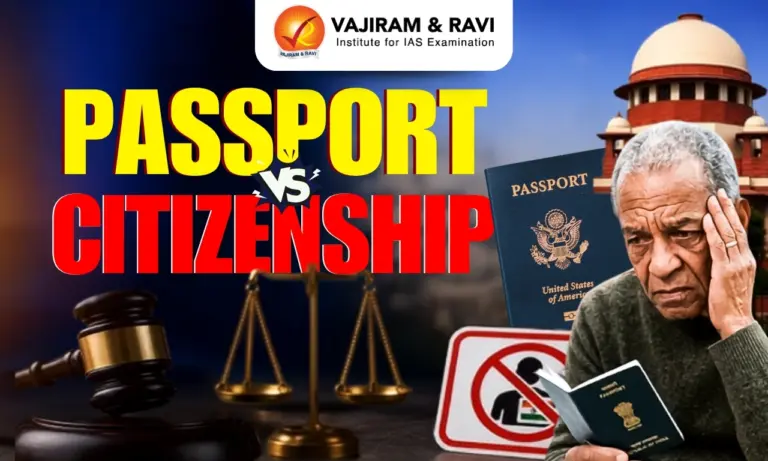
Many people think that an Indian passport is the final proof of Indian citizenship. This belief became a topic of discussion after the Ministry of External Affairs (MEA) clarified on Passport Seva Divas 2026 that a passport is mainly a travel document and not a standalone legal proof of citizenship.
The clarification surprised many people because a passport is one of the most trusted government-issued documents. It carries the name of the Republic of India, is accepted worldwide, and is issued only after proper government verification. However, under Indian law, citizenship and passport are two different concepts. A passport is issued because the government believes a person is an Indian citizen, but it does not itself create or permanently prove citizenship if that status is challenged in a court.
Passport vs Citizenship
On Passport Seva Divas 2026, the Ministry of External Affairs (MEA) stated that: An Indian passport is primarily a travel document and should not be treated as conclusive proof of Indian citizenship. This statement led to confusion among the public because many people consider a passport to be the strongest identity document issued by the Government of India.
What is Citizenship?
Citizenship is the legal status that makes a person a member of a country. It gives individuals certain rights, protections, and responsibilities under the law. In India, citizenship is governed by the Constitution of India and the Citizenship Act, 1955. Indian citizens enjoy rights such as voting, contesting elections, obtaining an Indian passport, and receiving constitutional protection.


Passport vs Citizenship Key Differences
Although a passport and citizenship are closely related, they are not the same. A passport is an official travel document, while citizenship is a legal status that gives a person rights and responsibilities as a member of a country.
| Passport vs Citizenship Key Differences | ||
|
Basis of Difference |
Passport |
Citizenship |
|
Meaning |
An official document used for international travel. |
A legal status that makes a person a citizen of a country. |
|
Purpose |
Allows a person to travel abroad and serves as proof of identity during international travel. |
Gives a person legal rights, duties, and protection under the Constitution. |
|
Governed By |
Passports Act, 1967 |
Constitution of India (Articles 5–11) and Citizenship Act, 1955 |
|
Issued/Granted By |
Issued by the Ministry of External Affairs (MEA). |
Acquired under the Citizenship Act through birth, descent, registration, naturalisation, or incorporation of territory. |
|
Nature |
A government-issued travel document. |
A legal relationship between an individual and the country. |
|
Rights Provided |
Does not provide voting or political rights. |
Provides rights such as voting, contesting elections, and eligibility for certain government jobs. |
|
Validity |
Has a fixed validity period and must be renewed after expiry. |
Generally remains valid for life unless renounced, terminated, or deprived under law. |
|
Proof of Citizenship |
Strong evidence of citizenship, but not conclusive legal proof if citizenship is challenged. |
Citizenship itself is the legal status recognised under Indian law. |
|
Can It Be Cancelled? |
Yes, under the Passports Act for specific legal reasons. |
Yes, but only under the provisions of the Citizenship Act, 1955. |
Constitutional Provisions Related to Citizenship
The Constitution of India deals with citizenship under Articles 5 to 11 in Part II. These Articles explain who became an Indian citizen at the commencement of the Constitution and give Parliament the power to make laws relating to citizenship.
- Article 5 – Citizenship at the Commencement of the Constitution: Grants citizenship to persons who had their domicile in India on 26 January 1950 and fulfilled the prescribed conditions.
- Article 6 – Rights of Migrants from Pakistan: Provides citizenship to certain persons who migrated from Pakistan to India before or after the Partition, subject to specified conditions.
- Article 7 – Rights of Migrants to Pakistan: Deals with persons who migrated to Pakistan after 1 March 1947 but later returned to India under a permit for resettlement.
- Article 8 – Citizenship of Indians Living Abroad: Grants citizenship to persons of Indian origin residing outside India who registered themselves with an Indian diplomatic or consular representative.
- Article 9 – Voluntary Acquisition of Foreign Citizenship: States that a person who voluntarily acquires the citizenship of another country cannot continue to be an Indian citizen.
- Article 10 – Continuance of Citizenship: Ensures that every person recognised as an Indian citizen shall continue to be a citizen, subject to laws made by Parliament.
- Article 11 – Parliament’s Power: Empowers Parliament to make laws regarding the acquisition, termination, and all other matters related to Indian citizenship.
Citizenship Act, 1955
The Citizenship Act, 1955 is the main law that governs the acquisition, determination, and termination of Indian citizenship. Enacted by Parliament under Article 11 of the Constitution, the Act explains who can become an Indian citizen, the different ways citizenship can be acquired, and the circumstances under which it can be renounced, terminated, or deprived.
| Citizenship Act, 1955 | |
|
Mode |
Description |
|
By Birth |
A person born in India can acquire citizenship, subject to the conditions specified in the Act. |
|
By Descent |
A person born outside India can acquire Indian citizenship if one or both parents are Indian citizens, as per the applicable provisions. |
|
By Registration |
Certain eligible persons, such as Persons of Indian Origin (PIOs) or spouses of Indian citizens, can obtain citizenship through registration after meeting the prescribed conditions. |
|
By Naturalisation |
A foreign national can become an Indian citizen after fulfilling the residency and other eligibility conditions laid down in the Act. |
|
By Incorporation of Territory |
People living in a territory that becomes part of India automatically become Indian citizens as notified by the Government. |

 Last updated on Sep, 2026
→ UPSC 2027 Notification will be released on 13 January 2027 at upsconline.nic.in.
→ Asian Games 2026 are being held in Aichi-Nagoya, Japan, from 19 September to 4 October.
→ Check out the latest UPSC Syllabus here.
→ Download UPSC Model Answers for Mains 2026
→ UPSC Mains Question Paper 2026 is out now for Essay & GS Paper 1, 2, 3 & 4.
→ UPSC Calendar 2027 has been released.
→ Enroll in Vajiram & Ravi’s UPSC Mains Test Series 2027 for structured answer writing practice, expert evaluation, and exam-oriented feedback.
→ Join Vajiram & Ravi’s UPSC Mentorship Program 2027 for personalized guidance, strategy planning, and one-to-one support from experienced mentors.
→ Go through the UPSC Mains Previous Year Papers to enhance your preparation.
→ UPSC has released UPSC Toppers List 2025 with the Civil Services final result on its official website.
→ Also check Best UPSC Coaching in India
Passport vs Citizenship FAQs
Q1. What is the difference between a passport and citizenship?+
Q2. Is an Indian passport proof of citizenship?+
Q3. Which law governs Indian citizenship?+
Q4. Does an Aadhaar Card prove Indian citizenship?+
Q5. Can a non-citizen be issued an Indian passport?+
Q6. How can a person acquire Indian citizenship?+
Q7. Why did the Ministry of External Affairs clarify that a passport is not proof of citizenship?+
Tags: passport vs citizenship