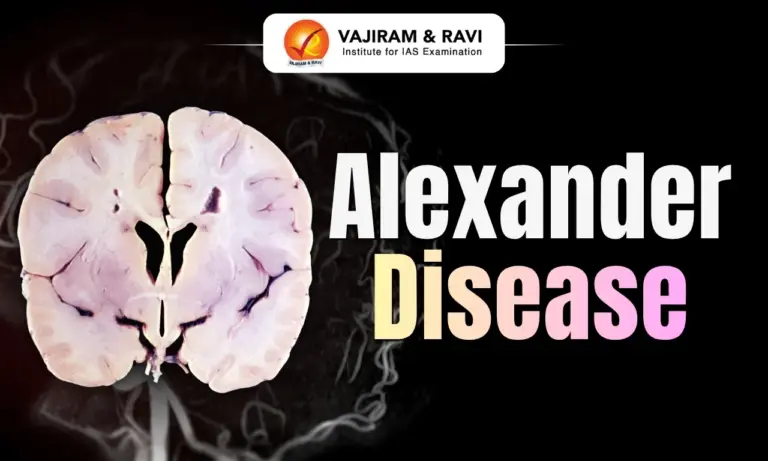
Alexander Disease Latest News
Ionis Pharmaceuticals recently said it would price its newly approved therapy to treat Alexander disease at $285,000 per dose, a day after the U.S. FDA cleared the injectable drug, making it the first approved treatment for the genetic disorder in adults and children.
About Alexander Disease
- It is a rare genetic disorder that progressively damages the nervous system.
- It is a type of leukodystrophy, a group of conditions that affect the white matter of the brain.
- These diseases damage the myelin sheath, which surrounds and protects the nerve cells in the brain and spinal cord and speeds transmission of messages between cells.
- In Alexander disease, the myelin insulating the nerve fibers in the brain deteriorates over time, and abnormal clumps of protein, called Rosenthal fibers, accumulate in the brain.
- This causes the nervous system to stop working properly.


Alexander Disease Cause
- Most cases of Alexander disease are caused by a mutation in the GFAP gene, which directs the body’s production of a glial fibrillary acidic protein (GFAP).
- At normal levels, GFAP supports the brain’s white matter (the myelin sheath).
- The mutation of this gene in Alexander disease causes this protein to accumulate.
- Instead of helping maintain the brain’s white matter, the extra GFAP does the opposite, killing other cells and damaging the myelin.
- In most cases, the gene mutation associated with Alexander disease is not inherited from a parent.
- It is simply a random mutation and is new in the person who develops the syndrome.
- In some cases, Alexander disease is inherited from a similarly affected parent.
Alexander Disease Symptoms
- Most cases of Alexander disease begin before age 2 and are described as the infantile form.
- Signs and symptoms of the infantile form typically include an enlarged brain and head size (megalencephaly), seizures, stiffness in the arms and/or legs (spasticity), intellectual disability, and developmental delay.
- Less frequently, onset occurs later in childhood (the juvenile form) or in adulthood.
- Common problems in juvenile and adult forms of Alexander disease include speech abnormalities, swallowing difficulties, seizures, and poor coordination (ataxia).
- Rarely, a neonatal form of Alexander disease occurs within the first month of life and is associated with severe intellectual disability and developmental delay, a buildup of fluid in the brain (hydrocephalus), and seizures.
Alexander Disease Treatment
- There is no complete cure for Alexander disease, but the U.S. FDA recently approved Zanvastro (zilganersen), which is the first disease-modifying therapy that directly targets the underlying protein buildup driving the condition.
- The disease is often fatal.
News: REUT

 Last updated on Sep, 2026
→ UPSC 2027 Notification will be released on 13 January 2027 at upsconline.nic.in.
→ Check out the latest UPSC Syllabus 2026 here.
→ Download UPSC Model Answers for Mains 2026
→ UPSC Mains Question Paper 2026 is out now for Essay & GS Paper 1, 2, 3 & 4.
→ UPSC Calendar 2027 has been released.
→ Enroll in Vajiram & Ravi’s UPSC Mains Test Series 2027 for structured answer writing practice, expert evaluation, and exam-oriented feedback.
→ Join Vajiram & Ravi’s UPSC Mentorship Program 2027 for personalized guidance, strategy planning, and one-to-one support from experienced mentors.
→ Go through the UPSC Mains Previous Year Papers to enhance your preparation.
→ UPSC has released UPSC Toppers List 2025 with the Civil Services final result on its official website.
→ Also check Best UPSC Coaching in India
Alexander Disease FAQs
Q1. What is Alexander disease?+
Q2. What type of disorder is Alexander disease?+
Q3. What part of the nervous system is primarily affected by Alexander disease?+
Q4. Which gene is most commonly associated with Alexander disease?+
Q5. Is Alexander disease usually inherited from a parent?+
Tags: alexander disease prelims pointers upsc current affairs upsc prelims current affairs