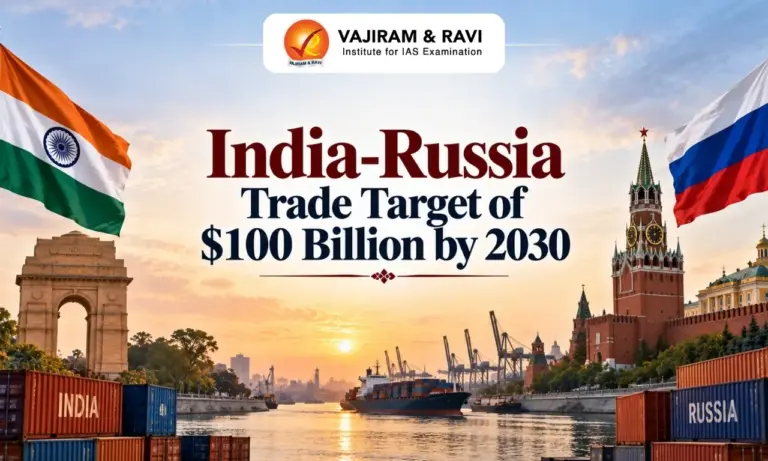
India and Russia have renewed their commitment to expand bilateral trade to $100 billion by 2030, with both sides seeking to diversify trade beyond energy and increase investment, manufacturing and technology cooperation. The target has gained fresh importance during India’s BRICS Chairship in 2026 and the ongoing 18th BRICS Summit in New Delhi.
Why in News?
India and Russia have renewed focus on expanding bilateral economic ties and achieving the $100 billion trade target by 2030. The issue gained fresh attention during the 18th BRICS Summit 2026 in New Delhi, where India and Russia discussed strengthening trade, investment, energy, connectivity and strategic cooperation.
Major Areas of India-Russia Economic Cooperation
The $100 billion target requires both countries to expand trade into sectors beyond traditional energy cooperation. Several sectors have been identified as having strong potential for future growth.
- Energy: Russian crude oil, petroleum products and other energy resources remain central to bilateral trade.
- Pharmaceuticals: Indian generic medicines have significant potential in the Russian market.
- Engineering goods: Machinery, industrial equipment and engineering products can increase India’s exports.
- Automobiles: Auto components and other automobile-related products offer opportunities for Indian manufacturers.
- Agriculture: Indian agricultural and food products can gain greater access to Russian consumers.
- Fertilizers: Russia remains an important supplier of fertilizers to India, supporting agricultural and food security needs.
- Critical minerals: Cooperation can support India’s requirements for minerals important for advanced manufacturing and clean technologies.
- Nuclear energy: Russia remains an important partner in India’s civil nuclear energy programme.


Measures to Achieve the $100 Billion Trade Target
India and Russia need to diversify their trade relationship and improve market access to achieve the ambitious target. Increasing Indian exports and Russian investment in India will be particularly important.
- Increase Indian exports: Promote pharmaceuticals, engineering goods, chemicals, textiles, food products and automobile components.
- Expand manufacturing cooperation: Encourage Russian companies to establish manufacturing facilities in India.
- Improve payment mechanisms: Develop efficient systems for bilateral trade using national currencies.
- Strengthen connectivity: Utilise the International North-South Transport Corridor (INSTC) and other emerging trade routes.
- Promote investment: Work towards the target of $50 billion in two-way investment by 2030.
- Improve market access: Address regulatory, certification and customs-related barriers faced by exporters.
- Strengthen the India-EAEU trade framework: Greater market access through the proposed India-Eurasian Economic Union FTA can support wider trade with the Eurasian region.
Challenges in Achieving the $100 Billion Target
Although political relations between India and Russia remain strong, several economic and geopolitical challenges could make the target difficult to achieve.
- Large trade deficit: India’s imports from Russia significantly exceed its exports.
- Dependence on energy: Bilateral trade is heavily concentrated in crude oil and other commodities.
- Western sanctions: Sanctions can create difficulties in payments, shipping, insurance and logistics.
- Payment challenges: Rupee-rouble settlement mechanisms need greater efficiency and scale.
- Logistical constraints: Long-distance transportation can increase costs and delivery times.
- Limited export presence: Indian companies need to expand their presence in the Russian consumer and industrial markets.
- Geopolitical uncertainty: Global conflicts and changing sanctions regimes can affect trade flows and investment decisions.
Significance and Way Forward
The $100 billion India-Russia trade target by 2030 is important not only for economic growth but also for India’s broader strategic and economic interests. A more diversified trade relationship can reduce India’s dependence on a few commodities while creating new opportunities for Indian businesses.
- India can use the Russian market to expand its pharmaceutical, engineering, agricultural and manufacturing exports.
- Russian investment can support manufacturing, energy, mining and advanced technologies in India.
- Better payment mechanisms can facilitate smoother bilateral trade.
- Improved connectivity through the INSTC and other trade corridors can strengthen access to Eurasian markets.
- Greater cooperation in critical minerals, nuclear energy and emerging technologies can support long-term economic security.
- The BRICS framework can help both countries strengthen local-currency trade and financial connectivity.

 Last updated on Sep, 2026
→ UPSC 2027 Notification will be released on 13 January 2027 at upsconline.nic.in.
→ Check out the latest UPSC Syllabus here.
→ Download UPSC Model Answers for Mains 2026
→ UPSC Mains Question Paper 2026 is out now for Essay & GS Paper 1, 2, 3 & 4.
→ UPSC Calendar 2027 has been released.
→ Enroll in Vajiram & Ravi’s UPSC Mains Test Series 2027 for structured answer writing practice, expert evaluation, and exam-oriented feedback.
→ Join Vajiram & Ravi’s UPSC Mentorship Program 2027 for personalized guidance, strategy planning, and one-to-one support from experienced mentors.
→ Go through the UPSC Mains Previous Year Papers to enhance your preparation.
→ UPSC has released UPSC Toppers List 2025 with the Civil Services final result on its official website.
→ Also check Best UPSC Coaching in India
India-Russia Trade Target of $100 Billion by 2030 FAQs
Q1. What is the India-Russia trade target for 2030?+
Q2. What is the current value of India-Russia trade?+
Q3. What are the major items traded between India and Russia?+
Q4. Why is India-Russia trade heavily imbalanced?+
Q5. How can India increase exports to Russia?+
Tags: india-russia trade target of $100 billion by 2030