Tata Sons Boardroom Battle Latest News
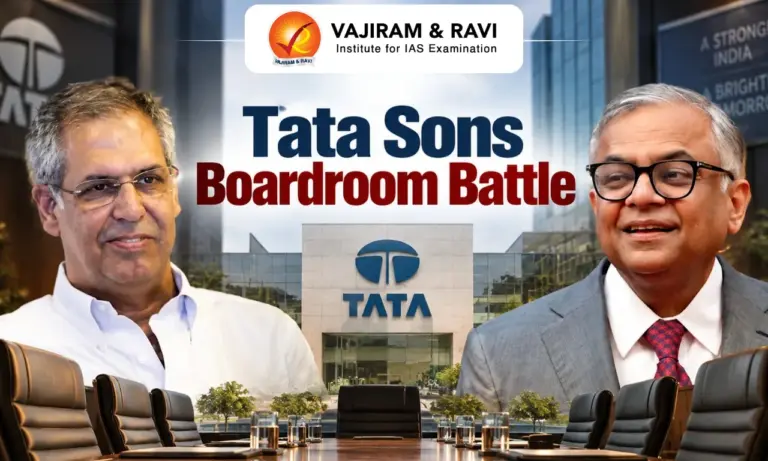
- The Tata Sons board meeting was expected to settle the two biggest questions facing the holding company of the Tata group: its leadership and whether it remains private.
- Instead, it opened a new chapter in an increasingly bitter power struggle.
- The board approved a fresh five-year term for N Chandrasekaran as Executive Chairman despite opposition from Tata Trusts Chairman Noel Tata.
- It also decided to proceed with listing after the Reserve Bank of India rejected the company’s request to surrender its registration as a Core Investment Company.
- Both decisions now move to the shareholders’ meeting, where Tata Trusts hold 66 per cent of Tata Sons.
What Happened at the Board Meeting
- On August 12, 2026, Chandrasekaran told the board he would not seek another term after his tenure ends on February 20, 2027.
- Later, the Nomination and Remuneration Committee unanimously recommended that he reconsider, citing his contribution and the group’s larger interests.
- On September 17, Chandrasekaran agreed to reconsider, and the board voted 4–1 to reappoint him for five years. Venu Srinivasan, Harish Manwani, Anita M George and Saurabh Agrawal backed him; Noel Tata opposed; Chandrasekaran did not vote.
- The same four directors backed listing, while Noel Tata opposed it.
- The decisions carry a clear majority of the six-member board but not consensus.
- Notably, Venu Srinivasan, the other Tata Trusts nominee, supported both decisions, exposing a split within the Trusts’ representation.


The Legal Challenge
- Noel Tata has challenged the legality of the board’s decision itself.
- Tata Trusts say the Articles of Association require the support of the Trusts’ nominee directors for the appointment or reappointment of the chairman.
- Noel Tata placed before the board a legal opinion from former Chief Justice of India D Y Chandrachud supporting this position.
- The September 17 resolution may therefore become the subject of further corporate and legal proceedings.
Why the AGM Is Crucial
- The board can recommend a reappointment, but shareholders at the annual general meeting can accept or reject it. Chandrasekaran’s directorship itself is due for renewal at the AGM, and he must remain a director to continue as chairman.
- The complication is that no AGM date is fixed. The AGM scheduled for August 18 failed for lack of quorum. Under the Articles of Association:
- At least five members must be personally present.
- The quorum must include an authorised representative jointly nominated by the Sir Dorabji Tata Trust and the Sir Ratan Tata Trust (SRTT).
- A Charity Commissioner’s order in May restricted the SRTT from conducting board proceedings. Without a properly convened SRTT board meeting, the joint nomination cannot be made. Until this deadlock is resolved, shareholders cannot vote.
- When the AGM does take place, the arithmetic changes dramatically. Noel Tata lost the board vote 4–1, but Tata Trusts’ 66 per cent shareholding makes the AGM potentially the most consequential in Tata Sons’ history.
The Listing Question
- Tata Sons has been classified as an upper-layer NBFC since September 2022. It sought to surrender its Core Investment Company registration and remain a private, unlisted company.
- The RBI rejected this recently and directed the company to comply with applicable requirements, including the implications for listing.
- The board has chosen to proceed with listing rather than challenge the RBI. However, an IPO is not imminent; listing involves a long regulatory and corporate process covering structure, timing, disclosures and shareholder approvals.
Noel Tata’s Case Against Listing
- Noel Tata argued that:
- Tata Sons is majority-owned by charitable trusts whose dividends fund hospitals, universities and research.
- A listed company would answer to institutional and foreign shareholders focused on financial returns.
- Such shareholders may not support capital deployment into distressed group companies or greenfield projects with long payback periods.
- Listing would fundamentally alter the character of Tata Sons.
- Tata Trusts want the company to explore all permissible avenues to avoid listing.
The Shapoorji Pallonji Factor
- The Shapoorji Pallonji group owns about 18.37 per cent of Tata Sons and favours listing. A public listing would create a market for its stake and provide liquidity.
- The listing issue is thus intertwined with the larger battle over control and governance.
What Happens Next
- Three parallel processes will dominate:
- AGM deadlock: The quorum issue involving the SRTT must be resolved before shareholders can decide anything.
- Succession battle: The board backs Chandrasekaran, but Noel Tata rejects the decision and questions its legality.
- RBI-driven listing: The board is moving towards listing while Tata Trusts seek to remain private.
Risk to Group Decision-Making
- The rift between management and controlling shareholders threatens to stall long-pending strategic priorities, including capital allocation, restructuring of underperforming unlisted ventures and a unified approach to regulatory mandates.
- Insiders report growing suspicion and uncertainty among senior directors, with weakened communication and coordination.
- Noel Tata has warned that a premature decision on chairmanship would be legally vulnerable and expose the group to litigation while regulatory issues remain pending before the RBI.

 Last updated on Sep, 2026
→ UPSC 2027 Notification will be released on 13 January 2027 at upsconline.nic.in.
→ Check out the latest UPSC Syllabus here.
→ Download UPSC Model Answers for Mains 2026
→ UPSC Mains Question Paper 2026 is out now for Essay & GS Paper 1, 2, 3 & 4.
→ UPSC Calendar 2027 has been released.
→ Enroll in Vajiram & Ravi’s UPSC Mains Test Series 2027 for structured answer writing practice, expert evaluation, and exam-oriented feedback.
→ Join Vajiram & Ravi’s UPSC Mentorship Program 2027 for personalized guidance, strategy planning, and one-to-one support from experienced mentors.
→ Go through the UPSC Mains Previous Year Papers to enhance your preparation.
→ UPSC has released UPSC Toppers List 2025 with the Civil Services final result on its official website.
→ Also check Best UPSC Coaching in India
Tata Sons Boardroom Battle FAQs
Q1. What is the Tata Sons boardroom battle about?+
Q2. Who opposed Chandrasekaran’s reappointment in the Tata Sons boardroom battle?+
Q3. Why is the AGM important in the Tata Sons boardroom battle?+
Q4. Why does the Tata Sons boardroom battle involve listing?+
Q5. How does the Shapoorji Pallonji group affect the Tata Sons boardroom battle?+
Tags: mains articles Tata Sons Boardroom Battle upsc current affairs upsc mains current affairs