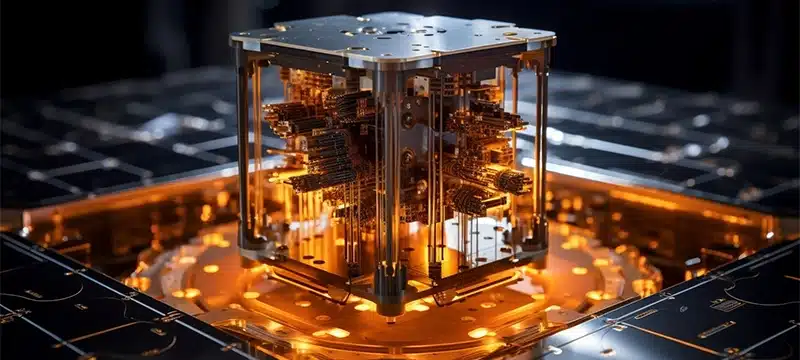
About Quantum Computing
- Quantum computing is a cutting-edge technology leveraging the principles of quantum mechanics to solve problems too complex for traditional computers.
Quantum Mechanics
- A branch of physics deals with the behaviour of particles such as atoms, electrons, and photons at molecular and sub-molecular levels.
- It introduces phenomena like superposition and entanglement, enabling quantum computing’s revolutionary capabilities.


Key Features
- Fundamentally Different from Classical Computing: Classical computers process information in binary bits (0 or 1).
- Quantum computers use quantum bits (qubits), which can exist in states 0, 1, or both simultaneously (superposition).
- Superposition: It enables qubits to hold multiple states at once, allowing quantum computers to perform exponentially more calculations compared to classical systems.
- Example: Like a spinning coin, a qubit can represent both heads and tails until measured.
- Entanglement: A phenomenon where qubits remain intrinsically linked, regardless of distance.
- Changing the state of one qubit instantly affects its entangled counterpart, enhancing computational speed.
- Unprecedented computational power: Quantum computers can solve problems that are impossible or time-prohibitive for classical systems, such as cryptographic algorithms, simulations, and optimization tasks.
Milestones in Quantum Computing
- Origin: Proposed in 1982 by Richard Feynman to simulate quantum systems, as classical computers struggled with such complexity.
- Breakthrough algorithms: Shor’s Algorithm (1994): Revolutionized cryptography by factoring large numbers exponentially faster than classical methods.
- Technological advancements
- IBM Q System One (2019): The first circuit-based commercial quantum computer.
- Google Sycamore Processor (2019): Demonstrated quantum supremacy by solving a task in 200 seconds, which would take classical supercomputers 10,000 years.
- Google Willow Quantum Chip (2023): Introduced scalable error-corrected qubits, finishing calculations in minutes that would otherwise take billions of years for classical systems.
Q1. What is Quantum Technology?
Quantum technology leverages the principles of quantum mechanics, such as superposition, entanglement, and quantum tunnelling, to develop advanced tools and applications.

 Last updated on Oct, 2026
→ UPSC 2027 Notification will be released on 13 January 2027 at upsconline.nic.in.
→ Check Nobel Prize 2026 Winners List here.
→ Download PIB PRiSM Monthly Magazine 2026 here.
→ Check UPSC Monthly Current Affairs Magazine The Recitals here.
→ Check out the latest UPSC Syllabus here.
→ Download UPSC Model Answers for Mains 2026
→ UPSC Mains Question Paper 2026 is out now for Essay & GS Paper 1, 2, 3 & 4.
→ UPSC Calendar 2027 has been released.
→ Enroll in Vajiram & Ravi’s UPSC Mains Test Series 2027 for structured answer writing practice, expert evaluation, and exam-oriented feedback.
→ Join Vajiram & Ravi’s UPSC Mentorship Program 2027 for personalized guidance, strategy planning, and one-to-one support from experienced mentors.
→ Go through the UPSC Mains Previous Year Papers to enhance your preparation.
→ UPSC has released UPSC Toppers List 2025 with the Civil Services final result on its official website.
→ Also check Best UPSC Coaching in India
Tags: prelims pointers quantum computing upsc current affairs upsc prelims current affairs