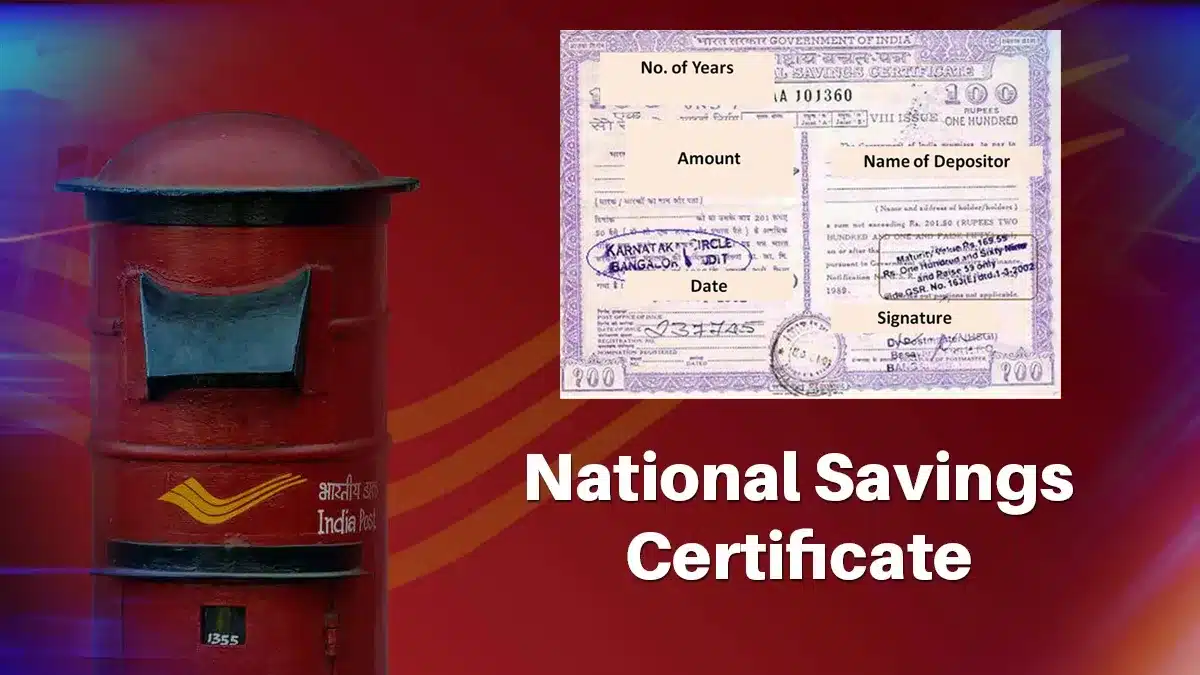
About National Savings Certificate (NSC):
- It is a fixed-income investment scheme launched by the government of India.
- It aims at encouraging users, who are primarily low- to mid-income investors, to invest as well as save taxes.
- You can invest in NSC from the nearest post office in your name, for a minor or with another adult as a joint account.
- Features:
- Interest Rates: The certificates earn an annual fixed interest, which is revised every quarter by the government, thus guaranteeing a regular income for the investor.
- Maturity Period: Five years.
- The amount of NSCs that can be purchased has no upper limit.
- Tax Saver: As a government-backed tax-saving scheme, the principal invested in NSC qualifies for tax savings under Section 80C of the Income Tax Act up to Rs. 1.5 lakhs annually.
- Accessible: It can be easily bought from any post office on submission of the required KYC documents. Also, it is easy to transfer the certificate from one PO to another, as well as from one person to another, without impacting the interest accrual/maturity of the original certificate.
- Loan Collaterals: NSC certificates are accepted as collateral or security for secured loans in Banks and NBFCs.
- Nomination: The investor can nominate any family member (even a minor) so that they can inherit it in the unfortunate event of the investor’s demise.
- Premature Withdrawal: Generally, one cannot exit the scheme early except on the death of an investor, on a court order, or on forfeiture by a pledgee who is a Gazetted Government Officer for it.
- Eligibility Criteria for NSC:
- Hindu Undivided Families (HUFs), Trusts, and Private and public limited companies are not eligible to invest in NSC.
- The individual must be a resident Indian citizen. Non-resident Indians (NRIs) are not eligible to invest in NSC.
- There is no age limit for individuals to purchase an NSC.
Q1 What is Section 80C of the Income Tax?
Section 80C of the Income Tax Act allows for certain expenditures and investments to be exempt from income tax.
Source: PM Modi Invests In This Post Office Scheme: Check All Major Schemes At Post Offices


 Last updated on Oct, 2026
→ UPSC 2027 Notification will be released on 13 January 2027 at upsconline.nic.in.
→ Check Nobel Prize 2026 Winners List here.
→ Download PIB PRiSM Monthly Magazine 2026 here.
→ Check UPSC Monthly Current Affairs Magazine The Recitals here.
→ Check out the latest UPSC Syllabus here.
→ Download UPSC Model Answers for Mains 2026
→ UPSC Mains Question Paper 2026 is out now for Essay & GS Paper 1, 2, 3 & 4.
→ UPSC Calendar 2027 has been released.
→ Enroll in Vajiram & Ravi’s UPSC Mains Test Series 2027 for structured answer writing practice, expert evaluation, and exam-oriented feedback.
→ Join Vajiram & Ravi’s UPSC Mentorship Program 2027 for personalized guidance, strategy planning, and one-to-one support from experienced mentors.
→ Go through the UPSC Mains Previous Year Papers to enhance your preparation.
→ UPSC has released UPSC Toppers List 2025 with the Civil Services final result on its official website.
→ Also check Best UPSC Coaching in India