Newcastle Disease Latest News
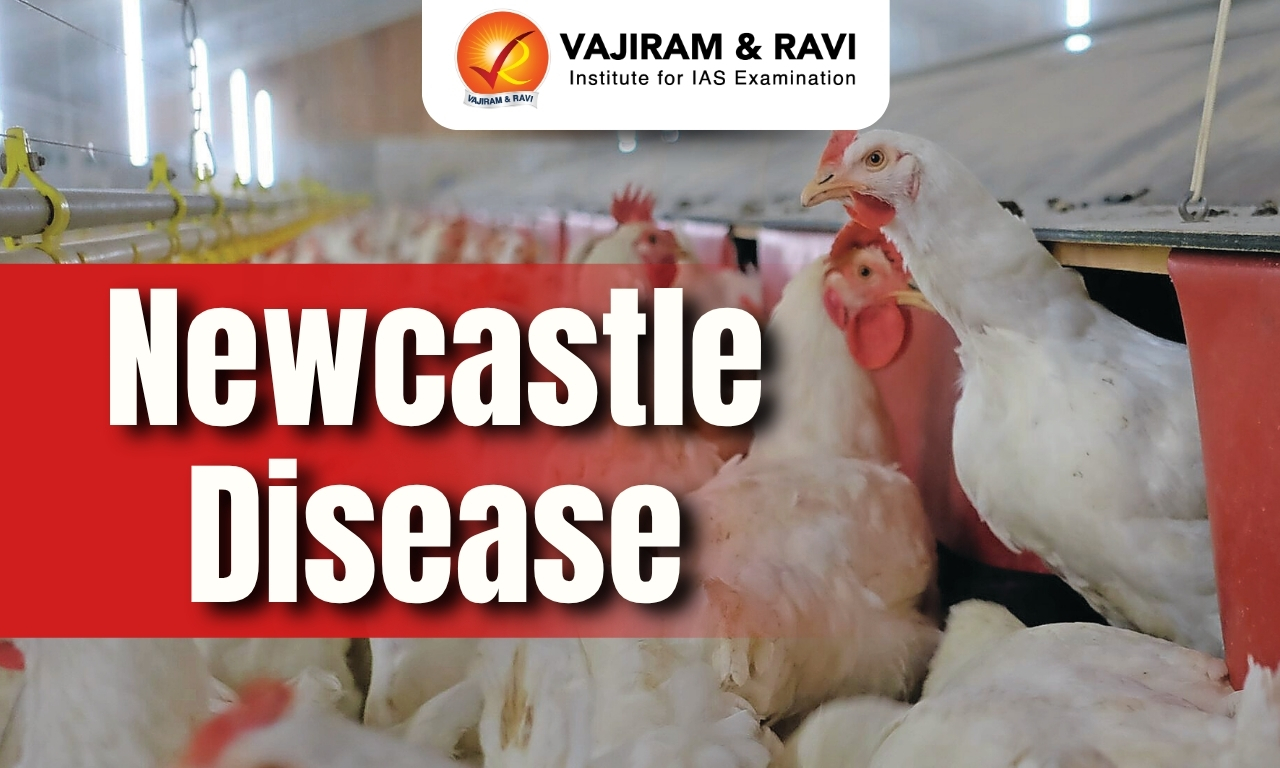
Recently, reports of Newcastle disease circulating across Europe, poultry producers across the UK are being urged to step up vigilance as the virus continues its westward spread.
About Newcastle Disease
- It is caused by avian paramyxovirus serotype 1, affects chickens and a wide range of other birds.
- It is a highly contagious and often severe disease found worldwide that affects birds including domestic poultry.
- The disease appears in three forms: lentogenic or mild, mesogenic or moderate and velogenic or very virulent.
- The lentogenic strains are very widespread but cause few disease outbreaks.
- Transmission: Infected birds shed virus in exhaled air, respiratory discharge, and feces.
- The virus can remain alive in manure for up to 2 months and in dead carcasses for up to 12 months, however, it is easily killed by disinfectants, fumigants and direct sunlight.
- Symptoms
-
- It usually presents as a respiratory disease, but depression, nervous manifestations, or diarrhoea may be the predominant clinical form.
- Respiratory signs – gasping, coughing, sneezing and rales
- Nervous signs – tremors, paralyzed wings and legs, twisted necks, circling, spasms, and paralysis
- Apartial or complete drop in egg production may occur. Eggs may be abnormal in color, shape, or surface, and have watery albumen
- Treatment: There is no treatment for Newcastle Disease, although treatment with antibiotics to control secondary infections may assist.
Source: PW


 Last updated on Oct, 2026
→ UPSC 2027 Notification will be released on 13 January 2027 at upsconline.nic.in.
→ Check Nobel Prize 2026 Winners List here.
→ Download PIB PRiSM Monthly Magazine 2026 here.
→ Check UPSC Monthly Current Affairs Magazine The Recitals here.
→ Check out the latest UPSC Syllabus here.
→ Download UPSC Model Answers for Mains 2026
→ UPSC Mains Question Paper 2026 is out now for Essay & GS Paper 1, 2, 3 & 4.
→ UPSC Calendar 2027 has been released.
→ Enroll in Vajiram & Ravi’s UPSC Mains Test Series 2027 for structured answer writing practice, expert evaluation, and exam-oriented feedback.
→ Join Vajiram & Ravi’s UPSC Mentorship Program 2027 for personalized guidance, strategy planning, and one-to-one support from experienced mentors.
→ Go through the UPSC Mains Previous Year Papers to enhance your preparation.
→ UPSC has released UPSC Toppers List 2025 with the Civil Services final result on its official website.
→ Also check Best UPSC Coaching in India
Newcastle Disease FAQs
Q1. What is Newcastle Disease?+
Q2. What is the causative agent of Newcastle Disease?+
Tags: newcastle disease