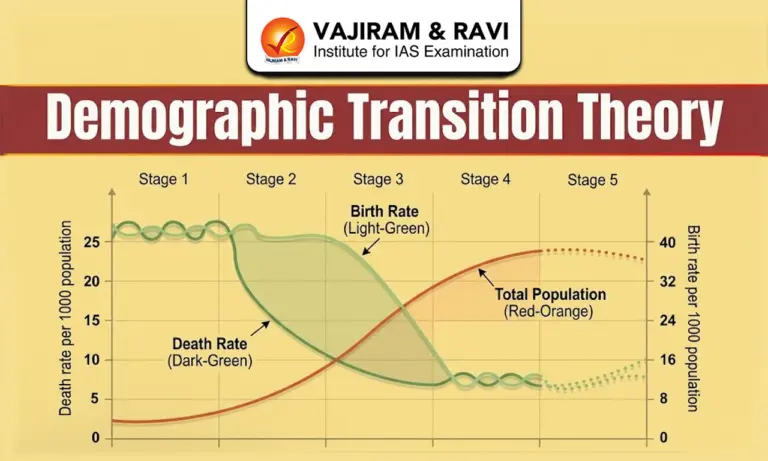
Demographic Transition Theory is a simple way to understand how a country’s population changes over time as it develops. It explains how birth rates and death rates gradually shift due to improvements in factors like healthcare, education, and living conditions. In general, societies move from having high birth and death rates to lower and more stable population growth as they progress economically and socially.
About Demographic Transition Theory
- Demographic Transition Theory explains how a country’s population changes over time as it develops economically and socially.
- The idea was first introduced by Warren S. Thompson (1929) and later explained in detail by Frank W. Notestein (1945).
- It mainly studies changes in birth rates, death rates, and overall population growth.
- The theory is based on the experience of European countries, where these changes started around the late 18th century.
- It is not a fixed rule but a general model used to understand population trends in different countries.
- According to this theory, societies move from a rural and agricultural stage to a more urban, industrial, and modern stage, and this shift changes population patterns.
- In the early stage, both birth rates and death rates are high, so population growth is slow.
- As development begins, death rates start to fall first due to better healthcare, sanitation, and food supply.
- After some time, birth rates also begin to decline, leading to slower population growth.
- Eventually, both birth and death rates become low and stable, resulting in little or no population growth.
- The theory also shows that population changes are closely linked with social and economic development like education, urbanization, and improved living standards.
- Stages of Demographic Transition
- Pre-Transition Stage: High birth and death rates with very slow population growth.
- Early Expanding Stage: Birth rates remain high, but death rates fall, causing rapid population growth.
- Late Expanding Stage: Birth rates start declining along with low death rates, so growth begins to slow.
- Low Stationary Stage: Both birth and death rates are low, leading to stable population growth.
- Declining Stage (in some models): Birth rates fall below death rates, causing a decline in population.
First Stage of Demographic Transition
The features of the first stage of the Demographic Transition Theory are highlighted as follows:
- The first stage is called the stage of high birth rate and high death rate, where population growth remains slow and nearly stable.
- Countries in this stage are at a very low level of development, with most people depending on traditional agriculture and living a subsistence lifestyle with little or no surplus.
- The standard of living is poor, with low income, low productivity, and limited use of modern technology; most people are illiterate and live in rural areas.
- Medical facilities are inadequate, leading to frequent diseases, epidemics, famine, hunger, and poor sanitation, which keep the death rate very high and life expectancy low.
- At the same time, birth rates remain high due to social and economic reasons such as early marriages, lack of education, and the need for more working hands, making large families common and useful.
- The population structure shows many young people and very few elderly, with a broad-based population pyramid.
- Society is largely traditional and influenced by religious beliefs, with very little urbanization.
- Around 200 years ago, almost all countries were in this stage, while today only a few countries like Sierra Leone and Somalia show similar characteristics.
Also read: Social Issues in India


Second Stage of Demographic Transition
The features of the second stage of the Demographic Transition Theory are highlighted as follows:
- The second stage is known as the stage of high birth rate and low death rate, often called the population explosion stage, where population grows very rapidly.
- The death rate falls quickly due to improvements in healthcare, sanitation, and food supply, which increases life expectancy and reduces deaths from diseases.
- The birth rate remains high in the beginning because of traditional beliefs, low awareness, and limited use of contraceptives, but it starts declining gradually over time.
- The wide gap between high birth rates and low death rates leads to a very high natural increase in population.
- The population pyramid expands rapidly at the base, showing a large number of children and young people, along with a decline in infant mortality.
- Economic conditions begin to improve, with rising incomes and a shift from a rural agricultural society to a more urban and industrial one.
- Modernization increases, including better education, healthcare, and living standards, and large families slowly become less important.
- This stage has two phases:
- Early phase: High birth rate and sharply falling death rate
- Later phase: Birth rate begins to fall while death rate remains low
- Population growth is very fast at first but slows down gradually towards the end of this stage.
- Today, many developing countries such as India, Bangladesh, Pakistan, Nepal, Kenya, Indonesia, Malaysia, Iran, and Yemen are in this stage.
Third Stage of Demographic Transition
The features of the third stage of the Demographic Transition Theory are highlighted as follows:
- The third stage is marked by a declining birth rate and a low death rate, leading to slow and stable population growth.
- As countries develop economically and urbanization increases, people begin to prefer smaller families, seeing large families as a burden.
- Birth rates fall rapidly, while death rates remain low, reducing the gap between the two and slowing population growth.
- Improvements in healthcare, sanitation, and living conditions keep death rates low and increase life expectancy.
- Women Empowerment through education and employment opportunities improved, leading to delayed marriages and fewer children.
- Greater awareness and access to family planning methods further reduce fertility rates.
- The society becomes more urban, industrial, and modern, moving away from traditional agricultural systems.
- The population structure becomes more balanced, with a rising number of older people and a stationary population pyramid.
- Economic growth leads to higher incomes, reduced poverty, and better standards of living, along with improved and diverse food choices.
- This stage provides an opportunity for countries to build a strong and stable economic base.
- Countries like India, Mexico, South Africa, UAE, and several European nations are currently in this stage.
Fourth Stage of Demographic Transition
The features of the fourth stage of the Demographic Transition Theory are highlighted as follows:
- The fourth stage is known as the stage of low birth rate and low death rate, where population becomes stable or grows very slowly.
- Due to rapid economic development, the standard of living is high, and people focus more on quality of life rather than large family size.
- Both birth rate and death rate remain low, and the birth rate is almost equal to the death rate, leading to population stabilization.
- The fertility rate is low, usually around or below the replacement level (about 2.1).
- Life expectancy is high, and the number of elderly people increases due to better medical facilities, technological progress, and government support systems.
- The population pyramid becomes contracting, showing fewer children and more older people.
- Society becomes highly urbanized, educated, and technologically advanced, and people deliberately control family size.
- This stage creates an ideal condition for economic development due to a stable population and better resources.
- Countries in this stage include China, Argentina, Canada, Australia, Brazil, Singapore, and most European countries.
Demographic Profile of India
- The demographic profile of India shows details about its population like age, sex, place of living, structure, and distribution. Population growth plays a key role in shaping it.
- India is one of the most populous countries in the world. Its growth rate was 2.15% (1991-2001) and later decreased to 1.64% (2001-2011).
- India has only 2.4% of the world’s land area but supports about 16.7% of the world’s population, which shows high population pressure.
- Although the population is large, only one-third are working people, while two-thirds are dependents, which affects economic development.
- India is the 7th largest country in area, but in terms of population, it has become the largest country (by 2023).
- Population has generally increased over time, except in 1921, when a negative growth rate was recorded (called the demographic divide).
- Before the 20th century, population growth was slow, but it started increasing rapidly later.
- India’s population history is divided into four phases:
- Stagnant Population (1901-1921)
- Steady Growth (1921-1951)
- Rapid High Growth (1951-1981)
- High Growth with Slowing Down (post 1981)
- Phase of Stagnant Population (1901-1921)
- Population growth was very slow and irregular because the high birth rate was balanced by high death rate.
- Death rate was very high due to diseases like influenza, plague, cholera, smallpox, along with famines and poor food supply caused by droughts.
- 1921 recorded a negative growth rate (-0.31%), the only time in India’s history, so it is called the demographic divide.
- Deaths also increased due to World War I (1914-1918).
- Phase of Steady Growth (1921-1951)
- The population started growing steadily due to a decline in the death rate, while birth rate remained high.
- Improvements in healthcare, sanitation, water supply, and transport helped control diseases and reduce deaths.
- Death rate dropped from 47 to 27 per thousand, while birth rate stayed high (around 40 per thousand).
- Growth during this phase is called mortality-induced growth (growth due to falling death rate).
- Phase of Rapid High Growth (1951-1981)
- The population increased very rapidly, from 361 million (1951) to 683 million (1981).
- Death rate declined sharply due to better medical facilities, but birth rate decreased only slightly, leading to a population explosion.
- This created a large gap between birth and death rates, causing fast population growth.
- Phase of High Growth with Slowing Down (post 1981)
- The population continued to grow, but the growth rate started declining.
- The total population increased by about 34.37 crore in 20 years, but the annual growth rate fell from 2.2% (1981) to 1.93% (2001).
- This phase shows clear signs of slowing population growth, although the population size is still increasing rapidly.
Also Read : Demographic Dividend
Criticism of Demographic Transition Theory
Demographic Transition Theory has been criticised for the below discussed reasons:
- The theory is mainly based on the experience of Western countries like Europe, America, and Australia, so it may not fully apply to all countries, especially developing ones.
- It is not a perfect predictive theory, as it cannot clearly tell how or when a country will move from one stage to another.
- The stages are not always followed in a fixed order. Some countries have shown unexpected changes, like rising death rates due to political or economic problems.
- The theory does not clearly explain why birth rates fall, and it ignores many important factors like culture, traditions, and personal choices.
- It also does not give a proper time frame, so we cannot say how long each stage will last in different countries.
- The role of technology and medical advancements is not fully considered, even though they can quickly reduce death rates and change population patterns.
- It does not fully fit developing countries, where death rates have fallen rapidly but birth rates remain high, causing sudden population growth.
- The theory ignores social factors like women’s education, empowerment, and government policies, which strongly influence population changes.
- It also overlooks migration, which can significantly affect population size and structure.

 Last updated on Oct, 2026
→ UPSC 2027 Notification will be released on 13 January 2027 at upsconline.nic.in.
→ Check Nobel Prize 2026 Winners List here.
→ Download PIB PRiSM Monthly Magazine 2026 here.
→ Check UPSC Monthly Current Affairs Magazine The Recitals here.
→ Check out the latest UPSC Syllabus here.
→ Download UPSC Model Answers for Mains 2026
→ UPSC Mains Question Paper 2026 is out now for Essay & GS Paper 1, 2, 3 & 4.
→ UPSC Calendar 2027 has been released.
→ Enroll in Vajiram & Ravi’s UPSC Mains Test Series 2027 for structured answer writing practice, expert evaluation, and exam-oriented feedback.
→ Join Vajiram & Ravi’s UPSC Mentorship Program 2027 for personalized guidance, strategy planning, and one-to-one support from experienced mentors.
→ Go through the UPSC Mains Previous Year Papers to enhance your preparation.
→ UPSC has released UPSC Toppers List 2025 with the Civil Services final result on its official website.
→ Also check Best UPSC Coaching in India
Demographic Transition Theory FAQs
Q1. What is Demographic Transition Theory?+
Q2. What are the stages of Demographic Transition Theory?+
Q3. Why does the population increase rapidly in the second stage?+
Q4. How does economic development affect population growth?+
Q5. Which stage of demographic transition is India in?+
Tags: demographic transition theory economy economy notes