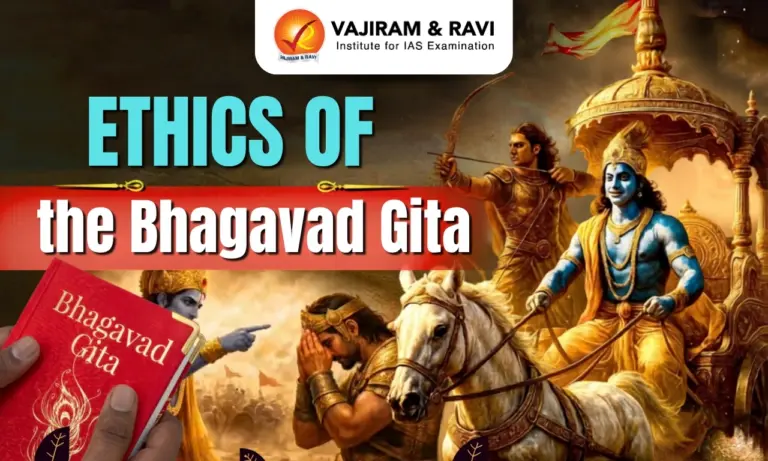
The Bhagavad Gita presents a practical and timeless ethical framework based on Dharma (duty) and Karma (right action). It emphasises righteous conduct, self-control, emotional balance, and public welfare. For civil services, it provides a strong foundation for ethical governance, integrity in decision-making, and value-based administration.
Core Ethical Principles of the Bhagavad Gita
- Dharma (Duty-based Ethics): Dharma refers to performing one’s moral and professional duty according to one’s role and responsibility, even in difficult circumstances.
- For example: When Arjuna saw his relatives on the battlefield, he dropped his bow and refused to fight — letting personal emotions override his duty as a warrior. Krishna immediately corrected him — abandoning one’s Dharma out of emotional weakness or personal conflict is not compassion, it is cowardice
- Nishkama Karma (Selfless Action without Attachment): One should perform duties without attachment to outcomes, focusing on sincerity and ethical intention rather than personal gain or recognition.
- For example: Krishna says “You have the right to work only, but never to its fruits”
- Karma Yoga (Ethics of Action): Ethics is defined through disciplined, responsible, and righteous action rather than inaction or result-based motivation.
- For example: Arjuna sat down in the middle of the battlefield, overwhelmed by fear of consequences — what if his side loses, what if his relatives die, what if he is blamed? Krishna rejected this result-driven paralysis entirely — ethics demands action based on duty, not calculated on outcomes. A civil servant who delays a decision fearing transfers or political backlash reflects the same ethical failure.
- Swadharma (One’s Own Duty): Each individual must perform their assigned duty based on their role, competence, and responsibility rather than imitating others.
- Lokasangraha (Public Welfare Orientation): Actions must aim at the welfare of society and collective good rather than personal or sectional interests.
- For example: Krishna tells Arjuna in Chapter 3 — “I have nothing left to gain in all three worlds, yet I keep acting.” If God himself continues to work for the world’s welfare without personal need, a public servant has no justification to act for private gain over public good.
- Samatva (Equanimity and Emotional Balance): Maintaining balance in success and failure ensures fairness, objectivity, and rational decision-making.
- For example: Arjuna was swinging between extreme emotions — grief, anger, confusion, despair. Krishna taught him to treat victory and defeat, praise and blame equally — a stable mind is the foundation of just and fair decision-making.
- Self-Control (Indriya Nigraha): Control over desires, anger, greed, and ego is essential for ethical conduct and preventing misuse of authority.
- For example: Krishna compares an uncontrolled mind to a boat swept away by strong winds. Just as a sailor must control the boat against powerful currents, a person must control desires and anger to stay on the ethical path.
- Detachment from Ego (Ahankara Tyaga): Leadership should be based on humility and service rather than personal pride or authority.
- For example: Despite being the Supreme Being, Krishna chose to become Arjuna’s charioteer — one of the most humble, serving roles on the battlefield. He drove the chariot, held the reins, and served without any display of authority or pride. True leadership lies in selfless service, not in the assertion of power or position.
- Ethical Decision-Making in Dilemmas: The Gita guides decision-making based on Dharma when faced with conflicting moral choices.
- For example: Arjuna’s situation itself is the greatest example — he faced the hardest dilemma of his life: fight his own family or abandon his duty. Krishna guided him step by step through reason, ethics, and Dharma to make the right decision despite the emotional cost.
Ethics of Bhagavad Gita Application in Public Administration
The ethical principles of the Bhagavad Gita provide a practical framework for civil services by guiding decision-making, conduct, and leadership in complex governance situations.
- Promotes integrity and impartiality in decision-making through Nishkama Karma, where officers focus on duty without expectation of personal gain or political reward.
- For example : Arjuna is reminded to act according to his Kshatriya duty in the battlefield
- Strengthens rule-based governance through Dharma and Swadharma, where civil servants adhere to constitutional duty above personal or external pressure.
- Example: An election officer strictly enforcing Model Code of Conduct despite pressure from ruling or opposition parties demonstrates commitment to institutional duty.
- Encourages citizen-centric administration through Lokasangraha (public welfare), where governance is oriented towards collective well-being.
- Example: Implementation of schemes like Jal Jeevan Mission ensuring last-mile drinking water access in rural villages reflects welfare-oriented governance.
- Supports emotional intelligence and neutrality in crisis management through Samatva (equanimity), enabling balanced decisions under stress.
- Example: During COVID-19 pandemic management, officers coordinating oxygen supply and hospital beds without panic or bias showed emotional stability in governance.
- Reduces corruption by promoting self-discipline and control over greed and ego, strengthening ethical conduct in public offices.
- Example: A procurement officer rejecting bribes in public tender allocation ensures transparency in government contracts.
- Enhances accountability and responsibility in public service delivery by emphasizing duty over personal comfort or convenience
- Example: A municipal officer ensuring timely waste management and sanitation despite logistical challenges reflects accountable governance.
- Guides civil servants in resolving ethical dilemmas under political and administrative pressure by prioritizing righteousness over expediency.
- Example: A collector taking action against illegal encroachment despite pressure from influential groups demonstrates courage in ethical decision-making.
These applications show how the Bhagavad Gita’s ethical framework remains highly relevant for modern public administration by strengthening integrity, neutrality, accountability, and citizen-centric governance.


 Last updated on Oct, 2026
→ UPSC 2027 Notification will be released on 13 January 2027 at upsconline.nic.in.
→ Asian Games 2026 are being held in Aichi-Nagoya, Japan, from 19 September to 4 October.
→ Check Nobel Prize 2026 Winners List here.
→ Download PIB PRiSM Monthly Magazine 2026 here.
→ Check UPSC Monthly Current Affairs Magazine The Recitals here.
→ Check out the latest UPSC Syllabus here.
→ Download UPSC Model Answers for Mains 2026
→ UPSC Mains Question Paper 2026 is out now for Essay & GS Paper 1, 2, 3 & 4.
→ UPSC Calendar 2027 has been released.
→ Enroll in Vajiram & Ravi’s UPSC Mains Test Series 2027 for structured answer writing practice, expert evaluation, and exam-oriented feedback.
→ Join Vajiram & Ravi’s UPSC Mentorship Program 2027 for personalized guidance, strategy planning, and one-to-one support from experienced mentors.
→ Go through the UPSC Mains Previous Year Papers to enhance your preparation.
→ UPSC has released UPSC Toppers List 2025 with the Civil Services final result on its official website.
→ Also check Best UPSC Coaching in India
Ethics of the Bhagavad Gita FAQs
Q1. What is the core ethical message of the Bhagavad Gita?+
Q2. How is Nishkama Karma relevant for civil services?+
Q3. What does Dharma mean in public administration?+
Q4. How does the Gita help in ethical decision-making?+
Q5. What is Lokasangraha and why is it important in governance?+
Q6. How does the Bhagavad Gita promote integrity in administration?+
Tags: ethics of bhagavad gita