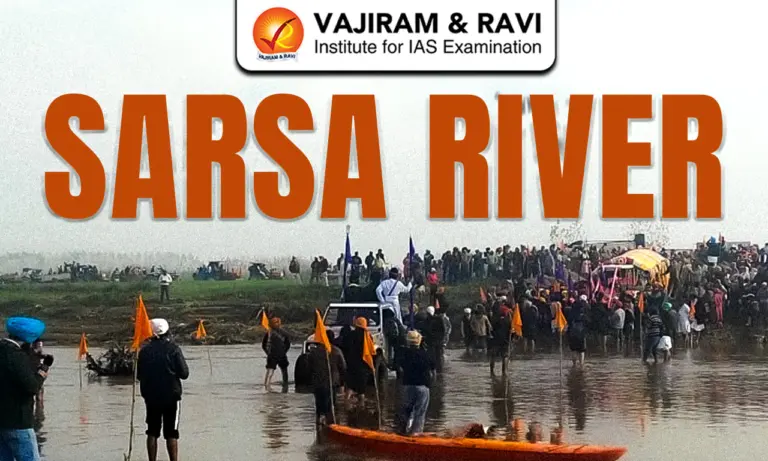
The Sarsa River is a seasonal rivulet of northern India that flows through the Shivalik hills and holds both geographical and deep historical significance. Though relatively small in size and seasonal in nature, the river is closely linked with the ecological system of the Shivalik region and the cultural memory of Sikh history.
About Sarsa River Origin and Course
The Sarsa River is a seasonal, rain-fed tributary of the Sutlej River that originates in the Shivalik foothills of Himachal Pradesh and forms part of the larger Indus River system.
- Origin: It originates in the Shivalik hills of Solan district in Himachal Pradesh.
- Course: It flows through the Baddi-Barotiwala-Nalagarh (BBN) industrial region, enters Punjab near Diwari village, and joins the Sutlej River near Taraf village in Rupnagar district.
- Nature of Flow: Being a seasonal river, its water flow depends mainly on the southwest monsoon and declines significantly during the dry season.
- Tributaries: It is joined by tributaries such as the Balad Nadi, Chikni Khad, Chotta Kafta, Pula, Jattawala, and Sandholi nallahs, most of which are also seasonal streams.
- Geographical Importance: The river helps drain monsoon runoff from the Shivalik hills, supports groundwater recharge, and contributes to the ecology of the Sutlej basin.
Sarsa River Historical Significance
The Sarsa River holds immense religious and historical significance in Sikhism as it was the site of one of the most tragic and defining episodes in the life of Guru Gobind Singh and the Khalsa during the Mughal-Sikh conflict.
- In December 1704, Guru Gobind Singh left Anandpur Sahib after a prolonged siege by the Mughal forces and allied hill chiefs, who had assured him of safe passage if he evacuated the fort.
- As the Guru, his family, and the Khalsa reached the banks of the Sarsa River on the stormy night of 21 December 1704, the river was in full spate due to heavy rainfall, making the crossing extremely difficult.
- Breaking their promise, the Mughal forces led by the Governor of Sirhind, Wazir Khan, launched a surprise attack while the Sikhs were crossing the flooded river, resulting in the historic Battle of Sarsa.
- The fierce battle and the strong currents created chaos, causing Guru Gobind Singh’s family and followers to become separated while attempting to cross the river.
- Guru Gobind Singh, accompanied by his two elder sons – Sahibzada Ajit Singh and Sahibzada Jujhar Singh – reached Chamkaur, where they later fought the famous Battle of Chamkaur against overwhelming Mughal forces.
- His mother, Mata Gujri, and his younger sons – Sahibzada Zorawar Singh and Sahibzada Fateh Singh – were separated from the main group, later captured at Sirhind, where the two young Sahibzadas were bricked alive on the orders of Wazir Khan for refusing to renounce their faith, while Mata Gujri passed away in captivity.
- This tragic separation at the Sarsa River marked the last time Guru Gobind Singh’s family was together, making the river a deeply revered site in Sikh history.
Today, the Sarsa River is remembered as a symbol of the courage, sacrifice, resilience, and unwavering faith of Guru Gobind Singh, his family, and the Khalsa, and continues to hold a special place in Sikh collective memory and heritage.


Sarsa River Ecological Importance
The Sarsa River plays an important ecological role in sustaining the environment and supporting communities in the Shivalik foothill region.
- It helps recharge groundwater, ensuring water availability for agriculture, drinking, and other local needs.
- It provides habitat for fish, aquatic organisms, birds, and riparian vegetation, thereby supporting local biodiversity.
- It carries monsoon runoff and drains excess rainwater, helping reduce the risk of floods and waterlogging.
- It replenishes soil moisture and deposits fertile sediments, making the surrounding floodplains suitable for agriculture.
- As a tributary of the Sutlej River, it contributes to the ecological health and hydrological balance of the larger Indus river basin.
Current Environmental Concerns
Despite its historical and ecological importance, the Sarsa River has become one of the most polluted river stretches in northern India due to rapid industrialisation.
- The river passes through the Baddi-Barotiwala-Nalagarh (BBN) industrial area, one of India’s largest pharmaceutical manufacturing hubs.
- Untreated and inadequately treated industrial effluents, particularly from pharmaceutical and chemical units, have severely degraded the river’s water quality.
- Scientific studies have reported contamination by heavy metals such as cadmium, lead, cobalt, copper, manganese, zinc, and iron, especially downstream of industrial discharge points.
- The Central Pollution Control Board (CPCB) has identified stretches of the Sarsa and its adjoining tributaries among the country’s polluted river stretches, highlighting the need for urgent restoration.

 Last updated on Oct, 2026
→ UPSC 2027 Notification will be released on 13 January 2027 at upsconline.nic.in.
→ Check Nobel Prize 2026 Winners List here.
→ Download PIB PRiSM Monthly Magazine 2026 here.
→ Check UPSC Monthly Current Affairs Magazine The Recitals here.
→ Check out the latest UPSC Syllabus here.
→ Download UPSC Model Answers for Mains 2026
→ UPSC Mains Question Paper 2026 is out now for Essay & GS Paper 1, 2, 3 & 4.
→ UPSC Calendar 2027 has been released.
→ Enroll in Vajiram & Ravi’s UPSC Mains Test Series 2027 for structured answer writing practice, expert evaluation, and exam-oriented feedback.
→ Join Vajiram & Ravi’s UPSC Mentorship Program 2027 for personalized guidance, strategy planning, and one-to-one support from experienced mentors.
→ Go through the UPSC Mains Previous Year Papers to enhance your preparation.
→ UPSC has released UPSC Toppers List 2025 with the Civil Services final result on its official website.
→ Also check Best UPSC Coaching in India
Sarsa River FAQs
Q1. Where does the Sarsa River originate and where does it drain?+
Q2. What type of river is the Sarsa River?+
Q3. Name the major tributaries of the Sarsa River.+
Q4. Which major industrial region is located along the Sarsa River?+
Q5. Why is the Sarsa River considered one of the most sacred rivers in Sikh history?+
Tags: sarsa river