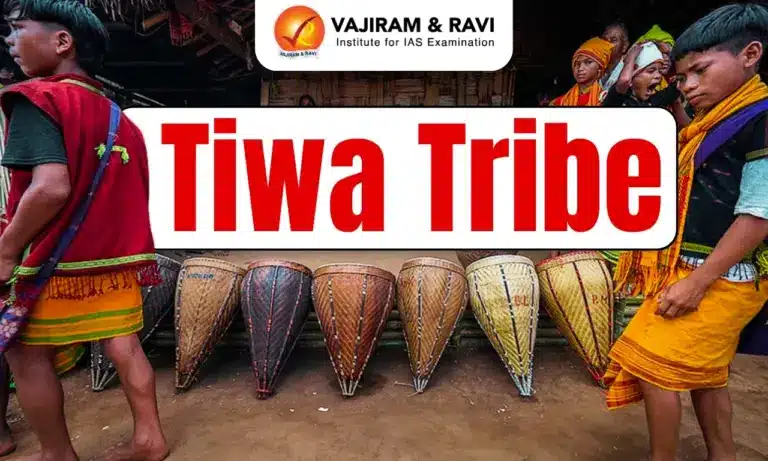
The Tiwa tribe, also known as Lalung, is one of the indigenous tribal communities of Northeast India. They are officially recognised as a Scheduled Tribe (ST). They are known for their rich cultural traditions, agrarian economy, and a unique dual social structure shaped by both hill and plains environments.
Tiwa tribe Geographical Distribution
The Tiwa tribe is mainly concentrated in Assam and Meghalaya.
- In Assam, they inhabit Morigaon, Nagaon, Kamrup, Karbi Anglong, and parts of Lakhimpur and Dhemaji districts.
- In Meghalaya, they are primarily found in the Ri-Bhoi district.
Based on geography, Tiwas are broadly divided into Hill Tiwas and Plains Tiwas, and this division has significantly shaped their culture, language, and social organization.
Tiwa Tribe Origin and Historical Background
The Tiwas are believed to have migrated from the hills of present-day Meghalaya to the plains of Assam many centuries ago in search of fertile land and better livelihood opportunities. They are also historically associated with the Gobha Kingdom, which was an important trade centre between the Ahom and Jaintia kingdoms. Even today, the Gobha Raja is respected as an important cultural and religious figure by the Tiwa community.


Tiwa Tribe Social Structure and Governance
Tiwa society is organised into different clans (khel), and each clan has its own social responsibilities. Every village is traditionally headed by a chief called the Loro, who settles disputes and looks after community affairs.
One of the most unique features of the Tiwa tribe is that Hill Tiwas and Plains Tiwas follow different systems of inheritance.
- Hill Tiwas follow a matrilineal system, where descent is traced through the mother, children take the mother’s clan name, and property is often inherited through the female line. The system also includes matrilocal residence, where the husband resides in the wife’s household after marriage.
- Plains Tiwas follow a patrilineal system, influenced by Assamese society, where descent and inheritance are traced through the father.
Another important institution is the Shamadi (Dekasang), a traditional bachelor dormitory in Hill Tiwa villages. It plays a crucial role in youth training, cultural education, music, dance, and community discipline.
Alongside traditional systems, the modern Panchayati Raj system also operates in Tiwa areas, creating a dual governance structure.
Tiwa Autonomous Council
The Tiwa Autonomous Council (TAC) was established in 1995 under the Tiwa Accord to promote the social, economic, educational, and cultural development of the Tiwa community. It also works to preserve the tribe’s unique identity and improve infrastructure and public services in Tiwa-inhabited areas.
Tiwa Tribe Religious Beliefs and Practices
- The Tiwa tribe follow a syncretic religious system combining animism, ancestor worship, and Hindu influences.
- They believe that natural elements such as rivers, trees, mountains, and animals possess spiritual power.
- Hill Tiwas largely follow traditional tribal religious practices, while Plains Tiwas are more influenced by Hinduism. In recent decades, some Tiwas have also adopted Christianity.
Religious life is closely associated with community institutions like Namghar, Thaan Ghar, and Borghar, which serve both spiritual and social functions.
Tiwa Tribe Festivals and Cultural Life
Tiwa festivals reflect their agrarian lifestyle and cultural diversity. One of the most important festivals is the Junbeel Mela, which involves barter trade between Tiwas and neighbouring communities and promotes cultural exchange. Other major festivals include:
- Pisu (Bihu): Agricultural festival with distinct Tiwa dance forms and rituals.
- Wansuwa: Harvest festival celebrated with traditional rituals, including rice-processing activities in sacred spaces and thanksgiving ceremonies.
- Sagra Misawa: Spring festival marking the sowing season with songs and dances.
- Borot Utsav: Ritual festival aimed at protecting society from diseases and calamities.
- Langkhan Phuja: Seasonal festival celebrated twice a year with traditional songs and rituals.
Tiwa Tribe Language
The Tiwa language belongs to the Tibeto-Burman language family. However, many Tiwas, especially those living in the plains, also speak Assamese, while those living near Meghalaya often speak Khasi. Since younger generations are increasingly using dominant regional languages, the Tiwa language is gradually becoming endangered. To preserve it, efforts are being made through education, cultural programmes, and documentation.
Tiwa Tribe Economy and Livelihood
- The Tiwa economy is primarily agrarian, with wet rice cultivation dominating the plains. In hill regions, shifting cultivation (jhum) is practiced.
- Other livelihoods include fishing, livestock rearing, herbal medicine, and small-scale trade.
- However, agriculture remains vulnerable due to limited modern inputs and frequent flooding in regions like Morigaon, Nagaon, and Karbi Anglong.
Tiwa Tribe Arts, Crafts and Cultural Expression
Tiwa women are highly skilled in weaving, producing traditional garments such as Kasong (wrap skirt) and Phaskai (breast cloth) with distinctive motifs.
The community is also known for bamboo and cane crafts, including baskets, mats, fishing traps, and winnowing tools. These crafts reflect both utility and artistic heritage.
Music and dance are integral to Tiwa culture, supported by instruments like drums, bamboo flutes, and string instruments.
Tiwa Tribe Contemporary Issues
The Tiwa community faces challenges such as cultural assimilation, language erosion, land alienation, economic marginalisation, and environmental vulnerability due to floods. Migration and modernization are further weakening traditional institutions.
Despite this, efforts are being made to preserve their identity through education, documentation of language, and institutional support.

 Last updated on Oct, 2026
→ UPSC 2027 Notification will be released on 13 January 2027 at upsconline.nic.in.
→ Check Nobel Prize 2026 Winners List here.
→ Download PIB PRiSM Monthly Magazine 2026 here.
→ Check UPSC Monthly Current Affairs Magazine The Recitals here.
→ Check out the latest UPSC Syllabus here.
→ Download UPSC Model Answers for Mains 2026
→ UPSC Mains Question Paper 2026 is out now for Essay & GS Paper 1, 2, 3 & 4.
→ UPSC Calendar 2027 has been released.
→ Enroll in Vajiram & Ravi’s UPSC Mains Test Series 2027 for structured answer writing practice, expert evaluation, and exam-oriented feedback.
→ Join Vajiram & Ravi’s UPSC Mentorship Program 2027 for personalized guidance, strategy planning, and one-to-one support from experienced mentors.
→ Go through the UPSC Mains Previous Year Papers to enhance your preparation.
→ UPSC has released UPSC Toppers List 2025 with the Civil Services final result on its official website.
→ Also check Best UPSC Coaching in India
Tiwa Tribe FAQs
Q1. Who are the Tiwa tribe?+
Q2. Where do the Tiwa people live?+
Q3. What is the main occupation of the Tiwa tribe?+
Q4. What is the Tiwa Autonomous Council?+
Q5. What are the main cultural features of the Tiwa tribe?+
Tags: tiwa tribe