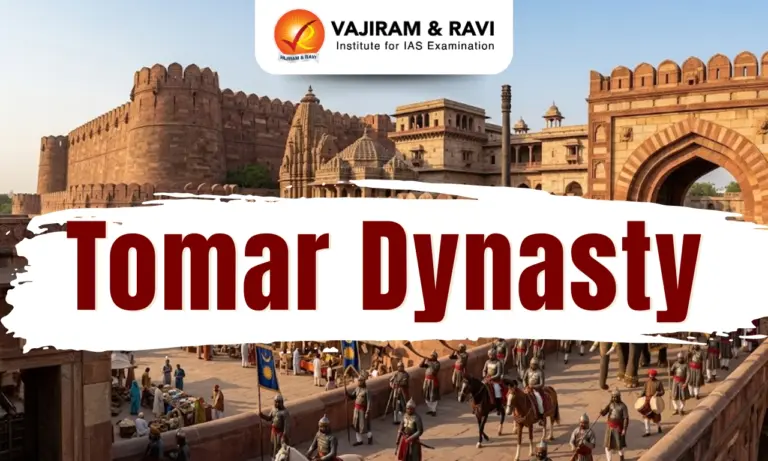
The Tomar Dynasty was an important medieval ruling dynasty in northern India. They are mainly known for ruling parts of present-day Delhi and surrounding regions. The dynasty played a significant role in the early development of Delhi as a political center. Over time, the Tomars contributed to the region’s culture, architecture, and administration, before being replaced by other rising powers.
About the Tomar Dynasty
- The Tomar Dynasty was a small but important ruling family in early medieval northern India. Their history is not very detailed because information comes from limited and scattered sources.
- Most of what we know about them comes from inscriptions, coins, and later literary sources, which provide partial but useful information.
- According to Puranic texts, their early origin is believed to be in the Himalayan region, from where they later moved towards the plains.
- As per bardic traditions, the Tomars were considered one of the 36 Rajput clans, which gave them a place among the well-known warrior groups of that time.
- One of their most important rulers, Anangapala, is credited with founding the early city of Delhi in the 11th century CE, making the dynasty historically significant.
- The rule of the Tomars mainly continued from the time of Anangapala until the mid-12th century, when Delhi came under the control of the Chauhan Dynasty around 1164 CE.
- Even after losing direct control, some Tomar rulers like Madanapala likely continued to govern as feudatories (subordinate rulers) under the Chauhans.
- Their presence in Delhi possibly continued until the late 12th century, when the region was finally conquered during the Muslim invasions around 1192-93 CE.
Administration of Tomar Dynasty
- The Tomar dynasty followed a monarchical system, where the king held supreme authority over administration and governance.
- The position of the king was hereditary, meaning it was passed down within the ruling family.
- The king was assisted by a group of ministers, who were usually chosen from powerful and influential families, and these posts were often hereditary as well.
- The commonly used language during their rule was Apabhraṃśa, a form of early Indo-Aryan language.
- Their main religion was Hinduism, which influenced their culture, administration, and architecture.


Territory of Tomar Dynasty
- The Tomars ruled over regions that include modern-day Delhi, Haryana, and parts of Western Uttar Pradesh.
- Historical inscriptions refer to their rule over the Hariyanaka region (Haryana).
- They are credited with establishing Dhillika (early Delhi) and strengthening it as a fortified settlement.
- One of their major constructions was Lal Kot, a fortified wall around Delhi built by Anangpal Tomar, which is considered one of the earliest forts of Delhi.
- Their kingdom possibly extended from areas like Asigarh to Thanesar, indicating a significant regional presence.
Tomar Dynasty as Feudatories
- In the early phase of their rule, the Tomars were vassals of the Gurjara-Pratiharas, serving under their authority from the 8th-10th century.
- During this time, they gradually gained strength and resources, which later helped them establish independence.
- Some Tomar rulers and nobles contributed to religious activities, such as building temples, including Vishnu temples at Pehowa.
- This phase was important in shaping their political and economic foundation.
Tomar Dynasty as Independent Rulers
- With the decline of the Pratihara power, the Tomars became independent rulers around the 10th-12th century CE.
- They started expanding their control and were involved in conflicts with neighboring dynasties like the Chauhans of Ajmer and the Gahadavalas.
- Bardic sources mention that the dynasty was founded by Anangpal I in 736 CE, though this claim is debated.
- Over time, several rulers succeeded one another, including Tejapala, Madanapala, Kritapala, Mahipala, Lakhanapala, and Prithvipala.
- These rulers played a role in maintaining and expanding the kingdom despite constant regional conflicts.
About Anangpal II (Anangpal Tomar)
- Anangpal II is considered the most important ruler of the Tomar dynasty and is widely credited with founding Delhi (Dhillika Puri) around 1052 CE.
- He is believed to have rebuilt the city from earlier ruins and made it a strong political and military center.
- He constructed important structures like Lal Kot, Anang Tal Baoli, and the Anangpur Dam, which show his contribution to infrastructure and water management.
- His rule is supported by inscriptions and coins, making him one of the better-documented Tomar rulers.
- According to tradition, Prithviraj Chauhan, the famous Rajput king, was his descendant.
Other Important Contributions
- The Tomars contributed to the development of early Delhi as an urban center, which later became a major capital in Indian history.
- They built important water structures like Suraj Kund, believed to be constructed by Surajpala, a Tomar ruler.
- Their architectural works, especially fortifications and reservoirs, show their understanding of defense and water management systems.
- Their rule helped lay the foundation for later dynasties, especially the Chauhans and the Delhi Sultanate.
Tomar Dynasty Decline
- In the 12th century, the Tomars were defeated and replaced by the Chahamanas (Chauhans) of Ajmer.
- After losing power, they once again became feudatories, this time under the Chauhans.
- There are different views about how Delhi passed to the Chauhans:
- Bardic traditions say that the last Tomar ruler Anangpal handed over the throne to Prithviraj Chauhan.
- However, inscriptions suggest that Chauhan rulers captured Delhi through conquest.
- Eventually, after the defeat of Prithviraj Chauhan in 1192, Delhi came under Muslim rule, marking the end of Tomar influence.

 Last updated on Oct, 2026
→ UPSC 2027 Notification will be released on 13 January 2027 at upsconline.nic.in.
→ Check Nobel Prize 2026 Winners List here.
→ Download PIB PRiSM Monthly Magazine 2026 here.
→ Check UPSC Monthly Current Affairs Magazine The Recitals here.
→ Check out the latest UPSC Syllabus here.
→ Download UPSC Model Answers for Mains 2026
→ UPSC Mains Question Paper 2026 is out now for Essay & GS Paper 1, 2, 3 & 4.
→ UPSC Calendar 2027 has been released.
→ Enroll in Vajiram & Ravi’s UPSC Mains Test Series 2027 for structured answer writing practice, expert evaluation, and exam-oriented feedback.
→ Join Vajiram & Ravi’s UPSC Mentorship Program 2027 for personalized guidance, strategy planning, and one-to-one support from experienced mentors.
→ Go through the UPSC Mains Previous Year Papers to enhance your preparation.
→ UPSC has released UPSC Toppers List 2025 with the Civil Services final result on its official website.
→ Also check Best UPSC Coaching in India
Tomar Dynasty FAQs
Q1. What was the Tomar Dynasty known for?+
Q2. Who founded Delhi in the Tomar period?+
Q3. Where did the Tomar Dynasty rule?+
Q4. What were the major contributions of the Tomar Dynasty?+
Q5. Were the Tomars always independent rulers?+
Tags: history history notes tomar dynasty