Rupee Depreciation and India’s External Sector Challenges

Rupee Depreciation

Rupee Depreciation Latest News

  • The Indian rupee has witnessed a sharp depreciation against the U.S. dollar, with the exchange rate crossing ₹96 per dollar in May 2026 compared to around ₹85 a year earlier. 
  • The decline has revived debates over the strength of India’s economy, the sustainability of external balances, and the appropriate role of the Reserve Bank of India (RBI) in managing exchange rate volatility.

Understanding Exchange Rate Dynamics

  • Exchange rate: It refers to the value of one currency relative to another. In a market-driven system, the rupee’s value depends on the demand and supply of rupees vis-à-vis foreign currencies, especially the U.S. dollar.
  • Factors increasing demand for Rupee:
    • Exports of goods and services: Foreign buyers exchange dollars for rupees to pay Indian exporters. 
    • Remittances: From Indians working abroad. 
    • Foreign investments: Into Indian markets and businesses.
  • Factors reducing demand for Rupee: Imports, especially crude oil. Foreign travel and education expenses. Capital outflows, where investors convert rupees into dollars and move funds abroad.

Trade Deficit and Current Account Pressure

  • India consistently runs a merchandise trade deficit because imports exceed exports, particularly due to dependence on crude oil, electronics, gold, and industrial inputs.
  • Although India earns substantial foreign exchange through IT and software services, remittances from migrant workers, and other invisibles, these inflows only partially offset the merchandise trade deficit. 
  • Consequently, India often faces a Current Account Deficit (CAD). A persistent CAD means more rupees are exchanged for dollars than vice versa, and as a result demand for dollars rises, and rupee depreciates.

Role of Capital Flows

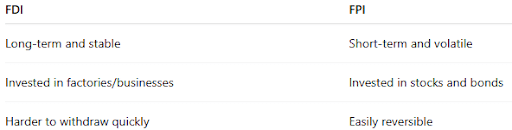
  • India finances its CAD through the Capital Account, mainly via: Foreign Direct Investment (FDI), Foreign Portfolio Investment (FPI), and external borrowings.
  • Difference between FDI and FPI:
  • Why do capital outflows hurt the Rupee?
    • When foreign investors withdraw investments, they sell rupee assets, convert rupees into dollars, increase dollar demand, and trigger rupee depreciation.
    • Recent rupee weakness has been linked to rising U.S. interest rates, global geopolitical tensions, and flight of capital toward safer assets.

Historical Episodes of Sharp Rupee Depreciation

  • Major periods of rupee decline include: 2013 “Taper Tantrum”, 2018 emerging market stress, COVID-19 shock in 2020, 2022 global monetary tightening, and 2024-26 geopolitical and oil price shocks.
  • A common feature across these episodes has been trade account deterioration, FPI outflows, and global uncertainty.

Economic Impact of Rupee Depreciation

  • Negative effects:
    • Costlier imports: As India imports most of its crude oil, a weaker rupee increases fuel prices, inflationary pressures, and input costs for industries.
    • Example: A $100 barrel of oil costs: ₹8,500 at ₹85/$, ₹9,600 at ₹96/$.
    • Imported inflation: Higher import costs raise prices of fertilisers, electronics, industrial machinery, and edible oils.
    • Investment concerns: Depreciation reduces returns for foreign investors in dollar terms, discouraging future capital inflows.
  • Can a weak rupee boost exports?
    • Economic theory suggests depreciation improves export competitiveness because Indian goods become cheaper abroad.
    • However, India faces structural limitations.
      • High import content in exports: Many exports depend on imported inputs. Costlier imports offset export gains.
      • Price-taking nature of exports: India competes with countries like Bangladesh and Vietnam. Foreign buyers may force Indian exporters to lower dollar prices.
      • Supply-side bottlenecks: Logistics costs, infrastructure gaps, and limited manufacturing depth.
    • Hence, depreciation alone may not significantly improve export earnings.

RBI’s Role in Managing the Rupee

  • The RBI intervenes in forex markets to prevent excessive volatility, not to defend any fixed exchange rate.
  • Mechanism of intervention: When the rupee falls sharply RBI sells dollars from forex reserves, purchases rupees, raises rupee demand, and moderates depreciation.
  • Forex reserves as strategic buffer:
    • India’s forex reserves stood at about $691 billion in March 2026, providing around 10.8 months of import cover.
    • These reserves ensure payment for essential imports, provide confidence to markets, and help resist speculative attacks.
  • Limits of RBI intervention:
    • Finite forex reserves: Continuous intervention can deplete reserves below safe import-cover levels.
    • Nature of India’s forex: Unlike China’s export-driven reserves, much of India’s forex comes from volatile capital inflows rather than trade surpluses.
    • Delayed adjustment risk: Artificially stabilising the rupee for long periods may postpone necessary corrections, leading to sharper future depreciation.

Debate: Defend the Rupee or Let It Adjust?

  • Arguments for allowing depreciation: Conserves forex reserves, improves export competitiveness, discourages excessive imports, and allows market-based adjustment.
  • Arguments for RBI defence: Prevents panic and speculation, ensures orderly currency movement, protects financial stability, and reduces inflationary shocks.
  • Risks of free fall: Unchecked depreciation may trigger further speculation, encourage importers to hoard dollars, reduce foreign investment confidence, create a vicious cycle of depreciation, etc.

Source: TH | IE

Rupee Depreciation FAQs

Q1: How does a persistent CAD contribute to rupee depreciation?

Ans: A persistent CAD increases demand for foreign currency over rupees, thereby weakening the rupee’s exchange rate.

Q2: Why are FPI considered more destabilising than FDI?

Ans: FPIs are highly volatile and can exit rapidly during uncertainty, causing capital outflows and currency depreciation.

Q3: What is the primary objective of the RBI’s intervention in the forex market?

Ans: It intervenes to ensure orderly exchange rate movements and maintain financial stability rather than targeting a fixed rupee value.

Q4: Why may rupee depreciation not substantially boost India’s exports?

Ans: High import dependence in exports, global competition, and supply-side constraints reduce the gains from currency depreciation.

Q5: How do large forex reserves strengthen India’s external sector resilience?

Ans: Forex reserves help finance essential imports, manage external shocks, and enable RBI intervention against speculative currency volatility.

Kerala’s Ageing Population Crisis: A Growing Social and Economic Challenge

Kerala’s Ageing Population Crisis

Kerala’s Ageing Population Crisis Latest News

  • The newly elected government in Kerala has announced the formation of a dedicated department for elderly people — the first such initiative in India
  • Currently, welfare of the aged falls under the state's Social Welfare Department. 
  • The move is driven by Kerala's rapidly ageing demographic profile — the most advanced case of population ageing among all Indian states — and signals the urgent need for geriatric governance as a distinct policy domain.

Kerala - India's Most Rapidly Ageing State

  • Kerala is going through a critical phase of demographic transition with a demographic profile resembling East Asian and European countries far more than the rest of India.
  • The Old Age Dependency Ratio — the number of aged persons per 100 working-age persons — has risen sharply from 19.6% (2011) to 26.1% (2021) and is projected to reach 34.3% by 2031.
  • This means one in three working-age Keralites will be supporting an elderly dependent within a decade.

Why is Kerala Ageing So Rapidly? - Three Key Reasons

  • Sharply Falling Fertility Rate - Kerala's TFR has fallen to just 1.35 — significantly below the national replacement level of 2.1 and even below India's national TFR of 1.9. Fewer births mean fewer young people entering the population — accelerating the share of the elderly.
  • Rising Life Expectancy - Better healthcare infrastructure has increased life expectancy significantly — 78.4 years for women and 71.9 years for men — meaning people are living longer, swelling the elderly population.
  • Large-Scale Out-Migration of Working-Age Population - A significant portion of Kerala's working-age population has migrated abroad — particularly to West Asian countries and beyond. 
    • Those who migrate to non-West Asian countries often settle there permanently, leaving aged parents behind — creating households with only elderly members. 
    • Simultaneously, return migrants from West Asia who come back after their working years add to the state's elderly population — creating a double burden.

Geographic and Gender Dimensions

  • The India Ageing Report 2023 noted that 17.5% of Kerala's rural population comprises individuals aged 60 and above — compared to 15.4% in urban areas. 
  • This is because working-age people migrate from rural areas to cities or abroad, leaving a higher density of elderly in villages.

A Feminisation of Ageing

  • There are significantly more elderly women than men in Kerala — particularly at advanced ages. 
  • The sex ratio among those 80 years and above is a striking 1,651 women per 1,000 men. 
  • This has created a large population of widows living alone without adequate social or financial support.

What Kerala Has Already Done — Existing Initiatives

  • State Elderly Commission (2025) — A first-of-its-kind quasi-judicial forum for protecting the rights and welfare of senior citizens.
  • Vayomithram — A mobile medical care programme providing healthcare at the doorstep of elderly citizens.
  • Samayaprabha — A daycare initiative for senior citizens.
  • Kerala Care Palliative Grid — Formed in collaboration with Digital University Kerala to coordinate palliative care. Includes 1,387 government institutions and 1,227 NGOs — currently serving approximately 1.5 lakh bedridden and 4 lakh ailing individuals.
  • Welfare Pension Coverage — Around 75% of the aged population is covered under welfare pension schemes.

Broader Significance - India's Shifting Demographics

  • The Sample Registration System (SRS) Statistical Report, 2024 has highlighted that India's Total Fertility Rate (TFR) has dropped to 1.9 — below the replacement level of 2.1.
    • TFR is the average number of children a woman is expected to have during her lifetime. 
    • A TFR of 2.1 is the replacement level — the rate at which a population exactly replaces itself from one generation to the next. 

Causes of Falling Fertility Rate

  • India's declining TFR is driven by several interconnected factors:
    • rapid urbanisation reducing the economic utility of large families, 
    • better education (especially of women) leading to delayed marriages and fewer children, 
    • improved access to contraception enabling family planning choices, 
    • desire for smaller families as living costs rise and aspirations change, and 
    • better healthcare reducing infant mortality — reducing the need to have more children as insurance against child deaths.

India's Demographic Dividend — Still Available, But for How Long?

  • Despite the falling TFR, India still possesses a significant demographic dividend — a window of economic opportunity created when a large working-age population supports a relatively smaller dependent population (children and elderly). 
  • Key indicators of this window include a median age of just 29.2 years — compared to China's 40.2 and several ageing European nations.
  • Approximately 370-380 million youth aged 15-29 representing ~27% of the population, and over 65% of India's population below 35 years — making India one of the world's youngest cohorts. 
  • However, demographic experts predict that at least three decades of population growth remain — but the window for reaping the demographic dividend will not stay open indefinitely. 
  • India must act with urgency to skill, educate, and employ this young population before it ages.

The Coming Challenge — An Ageing India

  • India is transitioning from a country worried about population explosion to one that must plan for an ageing population and a shrinking workforce expansion. 
  • This transition — well-managed by countries like Japan, South Korea, and several European nations with varying degrees of success — requires proactive policy interventions in healthcare for the elderly, pension systems, labour market flexibility, and immigration policy. 
  • India must reassess the path ahead and pivot to prepare for the needs of a future greying nation — before the demographic dividend disappears.

Source: IE | TH

Kerala’s Ageing Population Crisis FAQs

Q1: What is Kerala’s Ageing Population Crisis?

Ans: Kerala’s Ageing Population Crisis refers to the rapidly rising elderly population creating pressures on healthcare systems, pensions, caregiving structures, and workforce availability.

Q2: Why is Kerala’s Ageing Population Crisis worsening?

Ans: Kerala’s Ageing Population Crisis is worsening due to lower fertility rates, higher life expectancy, migration of younger workers, and changing family support systems.

Q3: How does Kerala’s Ageing Population Crisis affect the economy?

Ans: Kerala’s Ageing Population Crisis can reduce labour force participation, increase healthcare expenditure, strain pensions, and slow long-term economic productivity.

Q4: What policy measures can address Kerala’s Ageing Population Crisis?

Ans: Addressing Kerala’s Ageing Population Crisis requires stronger elderly healthcare, pension reforms, social care infrastructure, workforce planning, and community-based support systems.

Q5: Why is Kerala’s Ageing Population Crisis significant for other Indian states?

Ans: Kerala’s Ageing Population Crisis serves as an early warning for other states likely to face similar demographic transitions and socio-economic pressures in coming decades.

India’s Economic Challenges Amid West Asia Crisis: Risks and Policy Concerns

India’s Economic Challenges

India’s Economic Challenges Latest News

  • Finance Minister Nirmala Sitharaman pushed back against critics of the Indian economy at a SIDBI event in Mumbai, saying that naysayers were creating a "cynical narrative" about India's economic situation. 
  • She emphasised that the challenges India faces are "more external driven" and that India's domestic economic situation remains positive and resilient. 
  • Her remarks come amid mounting pressure on the rupee, falling forex reserves, and growing expert warnings about a potential Balance of Payments crisis.

India’s Three Fs Challenges

  • The Finance Minister outlined India's key external vulnerabilities through the framework of "three Fs":
    • Fuel — High and volatile international crude oil prices are inflating India's import bill and creating inflationary pressure domestically.
    • Fertiliser — An "unimaginable" increase in global fertiliser prices is adding to input costs across agriculture — with direct implications for food inflation and farm incomes.
    • Foreign Exchange — The FM clarified that PM Modi's appeal to conserve foreign exchange was specifically in the context of reducing gold purchases — not a general alarm about the economy's health.
  • Earlier, PM Modi urged the public to change consumption behaviour by reviving Covid-era measures such as work-from-home and virtual meetings, avoiding non-essential foreign travel and gold purchases for a year, and prioritising local goods. 

The Rupee Under Siege — Key Data

  • The Indian rupee has been under severe and sustained pressure since the West Asia war began. 
  • Key indicators of the stress include:
    • Rupee has slumped nearly 5% since February 27 and nearly breached the 97-per-dollar mark.
    • Foreign Portfolio Investors (FPIs) have dumped Indian bonds and stocks worth $24.4 billion since the war began in late February.
    • Net FDI inflows remain weak — further reducing the supply of dollars entering India.
    • Forex reserves are down approximately $40 billion compared to pre-war levels, as of May 15.
    • RBI's gross forex sales of $29.6 billion in March — the highest in 13 months — reflect the scale of intervention needed to defend the rupee.

Government Measures to Stem the Rupee's Fall

  • Sharp hike in import duty on gold, silver, and platinum — from 6% to 15% — to discourage non-essential precious metal imports.
  • Restrictions on duty-free gold imports under a key export scheme to prevent misuse.
  • Four petrol and diesel price hikes at retail pumps within two weeks — to reduce the government's subsidy burden and align domestic prices with elevated global oil prices.
  • Silver imports for domestic consumption placed under the restricted category requiring prior government approval.

India's Growing Fertiliser Crisis

  • India's total fertiliser import bill — including finished products and raw material inputs — reached a whopping $27.2 billion in 2025-26, second only to the record $33.4 billion in 2022-23 (triggered by the Russia-Ukraine war). 
  • Finished fertiliser imports alone stood at $14.5 billion — covering urea, DAP, and MOP.
  • India imports more than half its natural gas, and has virtually no commercially mineable rock phosphate, potash, or sulphur reserves — making it critically dependent on imports for both finished fertilisers and their raw material inputs.
  • The US-Iran conflict and Strait of Hormuz closure have already driven global fertiliser prices to near Russia-Ukraine war highs. 
  • Combined with rupee depreciation, India's 2026-27 fertiliser bill could breach the $33.4 billion record.

Growing Economic Concerns — What Experts Are Warning

  • Despite the FM's reassurances, economists and financial experts have been raising serious concerns about India's near-term economic trajectory.
  • Balance of Payments Risk - With the rupee repeatedly hitting all-time lows and forex reserves depleting, economists have warned that India faces a BoP deficit for the third straight year in 2026-27 — a sustained and serious external sector vulnerability.
  • Growth Slowdown - The RBI's April forecast pegs India's GDP growth in 2026-27 at 6.9%. However, economists have been warning that actual growth could be closer to 6-6.5% — reflecting the drag from high energy prices, weak consumption, and financial market volatility.
  • Inflation Upside Risk - With elevated global crude oil prices and a rapidly weakening rupee both feeding into domestic inflation, experts have flagged significant upside risks to inflation in coming months. A weaker rupee makes all imports more expensive — directly feeding into both fuel and food inflation.

Interest Rate Hike on the Horizon?

  • The RBI's Monetary Policy Committee (MPC) cut the policy repo rate by 125 basis points to 5.25% in 2025 and has made no changes in 2026. 
  • However, some economists are now seeing the possibility of an interest rate hike as early as the June 3-5 MPC meeting — a sharp reversal of the easing cycle — driven by inflation risks from elevated crude oil prices and the weakening rupee.

Source: IE | IE

India’s Economic Challenges FAQs

Q1: What are India’s Economic Challenges Amid West Asia Crisis?

Ans: India’s Economic Challenges Amid West Asia Crisis include rising crude oil prices, inflationary pressures, trade disruptions, higher import bills, and pressure on fiscal stability.

Q2: How do oil prices worsen India’s Economic Challenges Amid West Asia Crisis?

Ans: India’s Economic Challenges Amid West Asia Crisis intensify because higher crude prices increase import costs, widen the trade deficit, and raise inflation across sectors.

Q3: Why is the rupee affected by India’s Economic Challenges Amid West Asia Crisis?

Ans: India’s Economic Challenges Amid West Asia Crisis weaken the rupee by increasing foreign exchange outflows, worsening trade imbalances, and creating investor uncertainty.

Q4: How can policymakers address India’s Economic Challenges Amid West Asia Crisis?

Ans: To manage India’s Economic Challenges Amid West Asia Crisis, policymakers must diversify energy sources, strengthen exports, control inflation, and improve economic resilience.

Q5: Why are India’s Economic Challenges Amid West Asia Crisis strategically important?

Ans: India’s Economic Challenges Amid West Asia Crisis matter because prolonged instability can affect economic growth, energy security, fiscal planning, and geopolitical decision-making.

Ferrocene Puzzle Solved – Indian Researchers Create a Carbon-Free Molecule

Ferrocene

Ferrocene Latest News

  • Researchers from IIT Madras and IISc Bengaluru have synthesised a stable carbon-free molecule resembling ferrocene, solving a long-standing chemistry puzzle spanning over seven decades.

Understanding Ferrocene and Its Importance

  • The recent scientific breakthrough has renewed interest in ferrocene, a unique molecule that transformed modern chemistry after its discovery in the 1950s.
  • Ferrocene belongs to a class of compounds called organometallic compounds, which contain bonds between a metal and carbon-containing molecules. 
  • It has a distinctive structure where an iron atom is positioned between two flat carbon-ring molecules, resembling a “sandwich”.
  • This unusual arrangement made the ferrocene one of the most important discoveries in chemistry because it challenged conventional theories of chemical bonding and expanded understanding of molecular structures.
  • The molecule contains:
    • An iron atom (Fe) at the centre. 
    • Two cyclopentadienyl carbon rings surround the metal atom. 
    • Strong and stable bonding that gives it exceptional chemical stability. 
  • Its structure is often referred to as a “sandwich complex” because the metal atom is placed between two ring-shaped molecules.

Scientific Importance of Ferrocene

  • Ferrocene is important because of both its scientific significance and practical applications.
  • In chemistry, it helped scientists understand how metals interact with ring-based molecules, leading to advances in organometallic chemistry and molecular design.
  • Its practical applications include:
    • Medicines and pharmaceuticals. 
    • Rechargeable batteries and energy systems. 
    • Electronics and advanced materials. 
    • Catalysts used in industrial chemical reactions. 
  • Because ferrocene is highly stable, scientists became interested in understanding whether this stability came only because of carbon-based rings or whether similar structures could be created using entirely different elements.
  • This question remained unresolved for more than 70 years.

The Long-Standing Chemistry Puzzle

  • For decades, scientists across the world tried to create a molecule similar to ferrocene without using carbon rings.
  • The challenge existed because carbon possesses exceptional bonding properties. It can easily form stable, large, and complex molecular structures, making it central to chemistry. 
  • In fact, an entire branch called organic chemistry focuses on carbon compounds.
  • Researchers attempted various combinations of metals and non-carbon elements. However, creating a stable carbon-free sandwich structure proved extremely difficult.
  • The key scientific question was “could the famous ferrocene structure exist without carbon?”
  • Until now, the answer remained uncertain.

The Indian Breakthrough in Chemistry

  • Researchers at IIT Madras, led by Prof. Sundargopal Ghosh and Stutee Mohapatra, in collaboration with Prof. Eluvathingal Jemmis from IISc Bengaluru, have successfully solved this scientific challenge.
  • The researchers developed a completely carbon-free molecule that closely resembles ferrocene in both structure and stability.
  • Instead of iron and carbon rings, the new molecule contains:
    • Osmium metal at the centre instead of iron. 
    • Boron-based rings instead of carbon rings. 
  • Like ferrocene, the new molecule forms a sandwich-like arrangement, where osmium remains positioned between two ring structures.
  • Most importantly, researchers found the molecule to be highly stable, with strong bonding between osmium and boron rings. 
  • Early investigations suggest that the molecule may even prove more robust than ferrocene under certain conditions.
  • The findings have been published in the prestigious scientific journal Science, highlighting the global importance of the discovery.

Significance of This Discovery

  • Although the research is currently viewed as a fundamental scientific breakthrough, it carries important long-term implications.
  • First, it answers a major theoretical question that scientists had struggled with for decades regarding the uniqueness of carbon in forming stable sandwich structures.
  • Second, the discovery could expand possibilities for designing novel materials with specialised properties
  • Such materials may eventually find applications in:
    • Electronics and semiconductors 
    • Energy storage systems 
    • Catalysis and industrial chemistry
    • Advanced materials science
  • At present, researchers are investigating the molecule’s possible technological uses.

Conclusion

  • The successful synthesis of a carbon-free ferrocene-like molecule marks a significant achievement in modern chemistry. 
  • By demonstrating that stable sandwich structures can exist without carbon, Indian researchers have solved a seven-decade-old scientific puzzle. 
  • While practical applications may take time to emerge, the breakthrough has expanded the boundaries of chemical science and opened new avenues for material innovation.

Source: IE | TH

Ferrocene FAQs

Q1: What is ferrocene?

Ans: Ferrocene is an organometallic compound with an iron atom placed between two carbon rings.

Q2: Why is ferrocene called a sandwich molecule?

Ans: Because the metal atom lies between two ring-shaped molecular structures.

Q3: What breakthrough did Indian researchers achieve?

Ans: They synthesized a stable carbon-free molecule resembling ferrocene.

Q4: Which elements were used in the new molecule?

Ans: The new molecule uses osmium and boron-based rings instead of iron and carbon.

Q5: Why is this discovery important?

Ans: It solves a decades-old chemistry puzzle and may enable new advanced materials in the future.

Enquire Now