
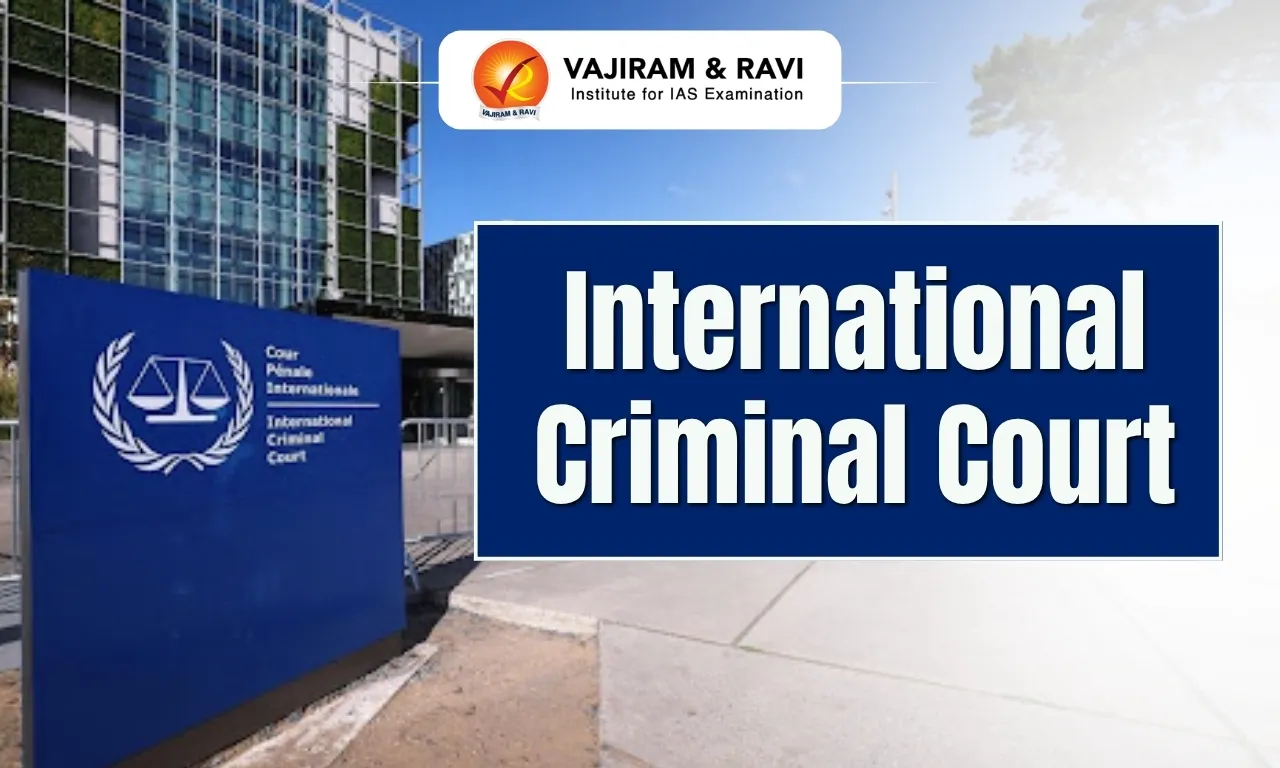
International Criminal Court – Withdrawals & Challenges to Global Justice

International Criminal Court

International Criminal Court Latest News

  • The International Criminal Court (ICC) is facing growing institutional and political pressure as five countries- Venezuela, Chad, Burkina Faso, Mali and Niger- have announced plans to withdraw from the court within the past year. 

International Criminal Court: Background

  • The ICC was established under the Rome Statute, which came into force in 2002
  • Headquartered in The Hague, Netherlands, it is a court of last resort for prosecuting individuals accused of the most serious international crimes.
  • Its jurisdiction covers four core crimes: Genocide, Crimes against humanity, War crimes, & Crime of aggression. 
  • The principle of complementarity is central to the ICC. The court generally intervenes when national authorities are unable or unwilling to genuinely investigate or prosecute serious crimes.
  • Unlike a domestic criminal court, the ICC does not have its own police force. Its ability to investigate, arrest and prosecute suspects therefore depends significantly on cooperation from states.

Current Crisis Facing the ICC

  • Growing U.S. Pressure
    • The United States has significantly increased pressure on the ICC. In July 2026, U.S. Secretary of State Marco Rubio announced what he described as a campaign to dismantle the threat posed by the court to U.S. sovereignty.
    • The U.S. administration has also sanctioned ICC personnel and organisations associated with the court. The measures followed ICC actions involving arrest warrants against senior Israeli officials concerning the Gaza conflict and investigations involving U.S. personnel in Afghanistan. 
    • Washington has also encouraged ICC member states that benefit from U.S. security arrangements to reconsider their membership.
  • Countries Announcing Withdrawal
    • The recent withdrawals have involved countries with different political circumstances.
    • Chad specifically cited U.S. pressure in announcing its decision to withdraw. 
    • According to its Foreign Minister, a U.S. official had expressed concerns regarding the ICC and requested that Chad reconsider its membership shortly before the withdrawal announcement. 
    • Burkina Faso, Mali and Niger, all governed by military juntas, have instead accused the ICC of selective justice and neo-colonialism.
    • Venezuela has similarly criticised what it described as the instrumentalization of the court against national sovereignty and self-determination. 

News Summary

  • The ICC's present challenges are not limited to the United States. Some governments have long criticised the institution for disproportionately focusing on African conflicts.
  • Burundi became the first country to leave the ICC in 2017, after the court opened an investigation into the country. South Africa and Gambia also announced withdrawals that year but subsequently reversed their decisions. 
  • The recent departures, however, raise a broader concern: whether states are prepared to bear political and diplomatic costs to preserve an international system of accountability.
  • The ICC's jurisdiction also does not automatically end when a country withdraws. Withdrawal from the Rome Statute is not retroactive. Consequently, the court can continue investigating crimes committed while a country was a member or otherwise within the court's jurisdiction.
  • This principle is particularly relevant to the Philippines. Although the country withdrew from the ICC in 2019, the court's investigation into alleged crimes associated with former President Rodrigo Duterte's anti-drug campaign continued. 
  • Duterte is currently in ICC detention in the Netherlands and faces charges of crimes against humanity. 
  • Similarly, the ICC's investigation into alleged crimes by Venezuelan security forces under former President Nicolás Maduro will continue despite Venezuela's announced withdrawal. 

New Members and Continuing Relevance

  • Despite the withdrawals, the ICC continues to attract countries seeking international accountability.
  • Ukraine joined the ICC in 2025, having previously accepted the court's jurisdiction over crimes committed on its territory following the outbreak of hostilities with Russia in 2014. 
  • Ukraine has presented ICC membership as part of its effort to ensure accountability for serious international crimes. 
  • This demonstrates the contradictory pressures facing the ICC: while some governments are moving away from the institution, others view it as an important mechanism for addressing grave violations of international law.

Significance and Challenges

  • The ICC represents an important development in international criminal law, particularly the principle that individuals, including political and military leaders, can potentially be held accountable for international crimes.
  • However, its effectiveness is constrained by:
    • Dependence on state cooperation for arrests and evidence
    • Non-universal membership
    • Political opposition from powerful states 
    • Allegations of selective enforcement
    • Limited independent enforcement capacity 
  • The present crisis therefore highlights a fundamental tension between state sovereignty and international accountability.

Way Forward

  • Strengthening the ICC requires greater consistency in the application of international criminal law, stronger cooperation among member states and greater transparency in institutional decision-making.
  • At the same time, concerns regarding selectivity need to be addressed through uniform legal standards and credible, independent investigations, irrespective of the political identity or geographical location of the accused.

Source: PBS

International Criminal Court FAQs

Q1: What is the International Criminal Court?

Ans: The ICC is a permanent international court that prosecutes individuals for genocide, crimes against humanity, war crimes and the crime of aggression.

Q2: What is the Rome Statute?

Ans: The Rome Statute is the treaty that established the International Criminal Court and entered into force in 2002.

Q3: Why are some countries withdrawing from the ICC?

Ans: Some countries have cited U.S. pressure or criticised the ICC for alleged selective justice and interference with national sovereignty.

Q4: Is ICC jurisdiction automatically terminated when a country withdraws?

Ans: No, withdrawal is not retroactive and the court can continue dealing with crimes committed while its jurisdiction applied.

Q5: Which country most recently joined the ICC?

Ans: Ukraine joined the ICC in 2025 after previously accepting its jurisdiction over crimes committed on its territory.

BRICS – From Anti-Western Bloc to Platform for Reforming Global Order

BRICS

BRICS Latest News

  • As India presides over the BRICS Summit in Delhi, its central diplomatic challenge is to project the grouping as a platform for reforming and democratising the international order.
  • As both supporters and critics often interpret BRICS through an anti-Western lens, the perception that BRICS seeks to overthrow the US-led global system must be dispelled.
  • There exists significant differences among BRICS members, and their objectives range from accommodation with the West and strategic autonomy to demands for greater parity and, in some cases, direct confrontation.

BRICS Is Not a Unified Anti-Western Alliance

  • India and Brazil particularly oppose transforming BRICS into an anti-Western bloc.
    Both seek a larger role in an international system that can provide greater trade, technology, investment and diplomatic influence.
  • The political orientation of BRICS members towards the West exists on a spectrum -
    • Iran lies closest to the anti-Western pole, with resistance to US influence deeply embedded in its foreign-policy identity.
    • Russia and China are in strategic competition with the West but continue to seek recognition, influence and a greater role in shaping the international order.
    • India, Brazil and several newer members favour strategic autonomy, institutional reform and greater representation rather than confrontation with the West.
  • Thus, BRICS is better understood as a coalition seeking greater agency for emerging and developing powers than as a coherent anti-Western alliance.

Brazil - Reforming the Order from Within

  • Brazil provides the clearest example of why the “West vs Global South” binary is inadequate.
  • Although Brazil is a leading Global South power and strongly advocates reform of global institutions, its historical, cultural and institutional foundations are deeply connected to the Iberian and Euro-Atlantic world. 
  • Its constitutional democracy, legal traditions and diplomatic emphasis on international law and multilateralism reinforce this connection.
  • Brazil therefore does not seek to overthrow the existing order from outside. Its approach towards the major powers is driven primarily by national interest rather than ideology. 
  • For instance, Brazil supports faster and cheaper bilateral payment mechanisms, including settlements in national currencies where beneficial. 
  • However, it does not support making de-dollarisation or a common BRICS currency the central objective of the grouping.
  • A common currency would require substantial political trust, economic convergence and institutional integration, which BRICS currently lacks.

India - Non-Western Does Not Mean Anti-Western

  • As a post-colonial developing country, India seeks strategic autonomy and does not want to become a geopolitical appendage of the US or Europe. 
  • At the same time, India's partnerships with the US, Europe, Japan and Australia have expanded significantly in trade, technology, defence and other areas.
  • India's simultaneous participation in BRICS and the Quad reflects this multi-alignment.
  • For New Delhi, BRICS derives value from its diversity. However, its utility would decline if it evolved into a China-led alliance against the West. 
  • India therefore has an interest in keeping BRICS focused on reforming global governance rather than constructing geopolitical confrontation.

Russia and China - Competition with the West, Not Complete Separation

  • Russia's conflict with the West has become deep and structural, particularly due to the Ukraine war, NATO's role in European security and Western sanctions. 
    • Yet Moscow continues to seek recognition as a major power and a meaningful role in shaping European and global security arrangements.
  • China presents a different contradiction. Beijing challenges US primacy in Asia, seeks to reduce vulnerabilities arising from Western technology restrictions and supports a more representative international order. 
    • However, China's economic rise itself was closely connected with Western markets, capital and technology.
    • China therefore seeks not necessarily to exit the existing international system, but to obtain a more equal role in shaping it, including greater influence relative to the United States.

New Members Complicating the Anti-Western Narrative

  • The newer BRICS members also weaken the idea of a unified anti-Western bloc -
    • Egypt maintains important security ties with the US.
    • UAE has extensive economic and strategic relations with the US and Europe.
    • Indonesia follows a “free and active” foreign policy, preserving strategic manoeuvring space among competing major powers.
  • These countries seek strategic autonomy, stronger ties with China and a greater Global South voice, but do not necessarily seek membership in an anti-Western alliance.
  • Iran remains the major exception, as resistance to US and Israeli influence is central to the Islamic Republic's political identity. 
    • For Tehran, BRICS provides diplomatic legitimacy and an avenue to counter US-led isolation. 

Way Forward for India

  • India's diplomatic task at the summit is to ensure that autonomy from the United States is not equated with antagonism towards it.
  • New Delhi should position BRICS as -
    • A platform for reforming global governance, rather than dismantling it.
    • A mechanism for enhancing the voice and representation of the Global South.
    • A forum for multipolarity and strategic autonomy, rather than bloc politics.
    • A vehicle for cooperation in areas such as development finance, technology, trade and alternative payment mechanisms, without forcing ideological uniformity.
    • A complement to India's other partnerships, including the Quad, rather than their geopolitical counterweight.

Conclusion

  • BRICS is united less by opposition to the West than by dissatisfaction with the unequal distribution of power in the existing international system. 
  • Its members have divergent strategic interests and varying relationships with the West.
  • India can best advance its interests by promoting BRICS as a reformist, inclusive and multipolar platform—one that seeks a more representative international order without turning strategic autonomy into anti-Western confrontation.

Source: IE

BRICS

Q1: Why cannot BRICS be simply characterised as an anti-Western alliance?

Ans: Because BRICS members have diverse objectives ranging from strategic autonomy and institutional reform.

Q2: How does Brazil challenge the conventional “West vs Global South” binary?

Ans: Brazil combines its Global South identity with deep Euro-Atlantic institutional roots.

Q3: Why does India's “non-Western” identity not imply an “anti-Western” foreign policy?

Ans: India pursues strategic autonomy, simultaneously deepening ties with both the BRICS and the Quad members.

Q4: Why does India oppose the transformation of BRICS into a China-led anti-Western bloc?

Ans: Such a transformation would undermine India’s interests in multipolarity, diversified partnerships, technology access, etc.

Q5: What should be India’s principal diplomatic objective as chair of BRICS?

Ans: India should project BRICS as a platform for democratising global governance, strengthening the Global South’s voice, etc.

Trump’s Threat to the Fed: What It Means for India’s Economy

Trump’s Threat to the Fed

Trump’s Threat to the Fed Latest News

  • After months of using tariffs to pressure allies and rivals into lopsided trade deals, US President Donald Trump has gone a step further. 
  • Recently, he warned the Federal Reserve (Fed) to cut interest rates, failing which the US would stop trading with countries with which it runs a trade deficit. 
  • The threat has raised eyebrows in policy circles worldwide.

A Pattern of Pressure on the Fed

  • This is not the first time Trump has sought to influence the Fed through extreme demands. 
  • During his first term, he routinely pushed for lower rates. 
  • In September 2019, he suggested the Fed bring interest rates down to "zero or less" so that the US could start to "refinance its debt". 
  • The latest warning fits this pattern but is far more aggressive.

The Debt and Deficit Problem Driving the Threat

  • Trump's escalating warnings stem from growing anxiety over US debt and trade deficits. 
  • Key figures:
    • US national debt has crossed a record $40 trillion.
    • The trade deficit has widened despite a slew of tariffs on trading partners.
    • Rising oil prices due to the US-Iran war have made investors nervous, pushing the US 10-year bond yield, a benchmark for global borrowing costs, towards 5 per cent.
    • The US government is estimated to spend just over $1 trillion this fiscal year on interest payments alone, roughly equal to its national defence spending.
    • The US debt-to-GDP ratio has reached 125 per cent. By comparison, borrowing to finance World War II pushed the ratio only to 106 per cent.
  • These uncomfortable numbers explain why Trump is targeting even close trade partners to narrow the trade gap while pushing for cheaper borrowing.

Trade Partners at the Crossroads

  • The US has already narrowed its trade deficit with China to its lowest in two decades. 
  • It is now pressuring other partners to follow suit:
    • Recently, the US banned a broad range of Canadian alcoholic beverages, motorcycles and dairy products after trade ties with Canada escalated.
    • The US has renegotiated its existing deal with Mexico.
    • It has imposed one of two broad Section 301 tariffs on countries globally.

Three Fronts of Pressure on India

  • For India, US pressure is playing out on three fronts:
    • Market access: Steep demands under trade deals for greater access to Indian markets.
    • Investment outflow: Pressure that encourages investment to flow from India to the US.
    • Reducing China dependence: Pressure to cut reliance on input items originating from China. 
      • Washington believes China operates a "shadow transhipment network" that widens the effective US trade deficit, displaces domestic production, lowers GDP growth and reduces federal tax receipts.

The Interim Trade Agreement and Farmers' Concerns

  • India and the US have been negotiating a bilateral trade agreement since February 2025. 
  • In February 2026, the two countries announced a framework for an Interim Agreement. This has created considerable tension, especially among farmers.
  • Trade experts warn that lowering customs duties on US imports would directly threaten the livelihoods of Indian farmers growing apples, cotton, grapes, oranges, soybeans, walnuts and other crops. 
  • These fears are heightened by the fact that the US has for years challenged India's Minimum Support Price (MSP) on rice and wheat at the World Trade Organisation.
  • There is also concern that the Interim Agreement could compel India to set aside its domestic laws and mandatorily allow US imports if consignments carry certificates from US authorities. 
  • Experts warn this could open a backdoor for genetically modified products from the US.

Steps India Has Already Taken

  • To ease US concerns amid tariff worries, India has taken several accommodating measures:
    • Stepped up energy imports from the US.
    • Lowered tariffs on a broad range of products of US interest, from motorcycles to whiskey.
    • Announced tax holidays for data centres and for items needed to boost nuclear power production.
  • The shift in energy sourcing is striking. The US share in India's LPG imports has surged to over 50 per cent in the six months since the West Asia crisis began, up from less than 10 per cent in the preceding six months. 
    • Before the war, India's LPG imports were dominated by Gulf suppliers such as the UAE, Qatar, Kuwait and Saudi Arabia.

Impact on the Textile Sector

  • The US has introduced forced labour-related Section 301 tariffs. In response, the Directorate General of Foreign Trade (DGFT) explicitly prohibited imports of goods produced using forced labour. 
  • Fear of US scrutiny, especially restrictions on cotton from China's Uyghur region, is pushing cotton prices higher.
  • India has advised exporters to maintain detailed employee data such as wage records, age verification and supplier declarations. It warned that strong labour and supply chain documentation is now a "commercial necessity" for accessing the US market.

Conclusion

  • Trump's threat to the Fed reflects deep anxiety over record US debt and persistent trade deficits. 
  • For India, the fallout is real: pressure on farmers through the Interim Agreement, rising input costs for textiles, shifting energy dependence and heavier compliance burdens for exporters. 
  • India must balance accommodation with protection of its core economic interests.

Source: IE

Trump’s threat to the Fed FAQs

Q1: What is behind Trump’s threat to the Fed?

Ans: Trump’s threat to the Fed is driven by concerns over record US debt, persistent trade deficits, rising borrowing costs and pressure for cheaper financing.

Q2: What does Trump want the Federal Reserve to do?

Ans: Trump wants the Federal Reserve to cut interest rates, linking monetary easing with his broader efforts to address US economic and trade pressures.

Q3: How does Trump’s threat to the Fed affect India?

Ans: Trump’s threat to the Fed adds pressure on India through demands for market access, investment shifts, reduced China dependence and tougher export requirements.

Q4: How could US trade pressure affect Indian farmers?

Ans: US trade pressure could expose Indian farmers producing apples, cotton, grapes, oranges, soybeans and walnuts to greater competition from American imports.

Q5: Why are compliance requirements becoming important for Indian exporters?

Ans: US scrutiny requires Indian exporters, particularly textiles, to maintain detailed labour and supply-chain documentation, making compliance increasingly essential for market access.

China-India Ties and BRICS Summit: How Bilateral Tensions Shape BRICS

China-India ties

China-India ties Latest News

  • Chinese President Xi Jinping is arriving in India to attend the 18th BRICS Summit in New Delhi. This is his third visit since becoming President and his first in seven years. 
  • While the stated purpose is the summit, the visit carries deep bilateral significance because of the 2020 border standoff that pushed relations to a low point. 
  • Experts argue that the China-India fault line, combined with a turbulent global environment, will heavily influence the summit's outcome.

The Uneven Journey of BRIC Members

  • The term "BRIC" was coined in 2001 when Goldman Sachs analysts identified Brazil, Russia, India and China as the world's emerging economies. 
  • The grouping took shape in the aftermath of the 9/11 attacks. Twenty-five years later, the members have followed very different paths:
    • China has surged ahead to become the world's second-largest economy after the US.
    • India has grown at a modest pace but has been outpaced by China by a wide margin.
    • Russia has faced challenges due to wars of its own making.
    • Brazil has struggled amid frequent regime changes and scandals.
    • South Africa, a later entrant, has not lived up to expectations.
  • Since the first leaders' summit in 2009, held in the shadow of the global financial crisis, China has emerged stronger, having weathered the crisis better than many Western nations.

China's Rising Assertiveness

  • China's rise is not just economic. It has grown militarily with ambitions to displace the US as the leading global power. This is reflected in its aggressive posture in the South China Sea, the Indo-Pacific and along its border with India. 
  • India has borne the brunt of repeated border confrontations. After the 1962 war and the 1967 clashes in Sikkim, major standoffs include:
    • 2013: Depsang, Ladakh
    • 2014: Chumar, Ladakh
    • 2017: Doklam
    • 2020 onwards: Eastern Ladakh, still ongoing with about 50,000 Indian troops deployed along the Line of Actual Control (LAC)
      • The June 2020 clashes killed 20 Indian defence personnel, including a Colonel-rank officer, and at least four Chinese personnel.

Partial Thaw, Persistent Distrust

  • Years of diplomatic and military talks led to troop disengagement in 2024. Since then, incremental steps have stabilised ties:
    • Resumption of direct flights
    • Easing of visa restrictions
    • Restarting the Kailash Mansarovar Yatra
    • Relaxation of restrictions on Chinese investments
  • Yet structural differences remain. India runs a massive trade deficit with China and has repeatedly flagged the lack of market access for Indian businesses. India is also acting against Chinese firms for tax evasion.
  • Most importantly, strategic and political trust has been badly damaged by the border standoff, now in its seventh year. 
  • China's collusion with Pakistan during Operation Sindoor further deepened the crisis of trust and credibility.

The Global Backdrop to the Summit

  • The summit, attended by leaders of over 30 countries and groupings, takes place amid major global shifts:
    • US tariffs: President Donald Trump's arbitrary tariff moves have cornered countries worldwide, including China and India. The two now find themselves on the same side in trying to counter the effects.
    • War on Iran: Trump's military action against Iran has raised questions about powerful nations violating territorial integrity and sovereignty. However, China and Russia are guilty of the same in their own neighbourhoods.
    • Economic cost of the West Asia war: Energy prices and inflation have risen, and BRICS countries, as part of the Global South, are bearing the brunt.
  • The key question is whether this moment of shared concerns between India and China can become an opportunity to improve ties and unite developing countries on common issues. 
  • Xi's visit is seen as a positive signal, but only to a degree.

The Iran-UAE Polarisation

  • The West Asia war has split the grouping. Iran is attacking US military bases in the region, while the UAE hosts several such bases and personnel. 
  • Here, India needs China's weight to push the two members towards cooperation and present a more unified front. 
  • Whether India and China can reach consensus on such matters, and build on recent gains, will shape not only their bilateral relationship but also the effectiveness of BRICS itself.

Competing Visions of BRICS

  • Beijing has long viewed itself as "first among equals" within BRICS. It backed expansion from the original five members, aiding the 2023 decision that brought the grouping to its current strength of 11.
  • A deeper divergence lies in purpose. China and Russia frame BRICS as an "anti-West" grouping, while India sees it as a "non-Western" grouping. 
  • This is complicated by US actions against fellow members, such as tariffs on Brazil and political disagreements with South Africa.
  • India is decidedly not anti-West. It has built robust ties with the US over 25 years and is pursuing closer partnerships with Europe, Australia, Canada and other Western nations. 
  • India relies on the West for capital, technology and as a destination for its people far more than on China or Russia.

India's Strategic Signalling

  • By hosting the summit, India also signals to the US that it has alternative partners in areas ranging from technology to fuel security:
    • The UAE and Saudi Arabia are investing in the Indian economy.
    • Russia has stepped in as an energy supplier amid the closure of the Strait of Hormuz.
    • Brazil is ready to partner on critical minerals.

Conclusion

  • Xi Jinping's visit offers a cautious opening for India-China ties, driven by shared pressures from US tariffs and the West Asia conflict. 
  • Yet deep distrust over the border, trade imbalances and China-Pakistan collusion persists. The summit's success depends on whether the two Asian giants can set aside rivalry to keep BRICS coherent and functional.

Source: IE

China-India ties FAQ

Q1: How will China-India ties influence the BRICS Summit?

Ans: China-India ties will significantly shape the summit as border distrust, trade imbalances and differing visions of BRICS influence their ability to build consensus.

Q2: What caused the deterioration in China-India ties?

Ans: China-India ties deteriorated sharply after the 2020 Eastern Ladakh border standoff, which damaged strategic trust and created prolonged military and diplomatic tensions.

Q3: Have China-India ties improved since the 2020 border standoff?

Ans: China-India ties have witnessed limited improvement through troop disengagement, resumed flights, eased visa restrictions, renewed Kailash Mansarovar Yatra and relaxed investment restrictions.

Q4: How do India and China differ over BRICS’s purpose?

Ans: China and Russia view BRICS as an anti-West grouping, while India considers BRICS non-Western and maintains strong strategic and economic partnerships with Western countries.

Q5: Why are China-India ties important for BRICS cohesion?

Ans: China-India ties matter because cooperation between the two major Asian members could help BRICS address divisions and maintain effectiveness amid geopolitical conflicts.

Enquire Now

