Climate Equity Latest News
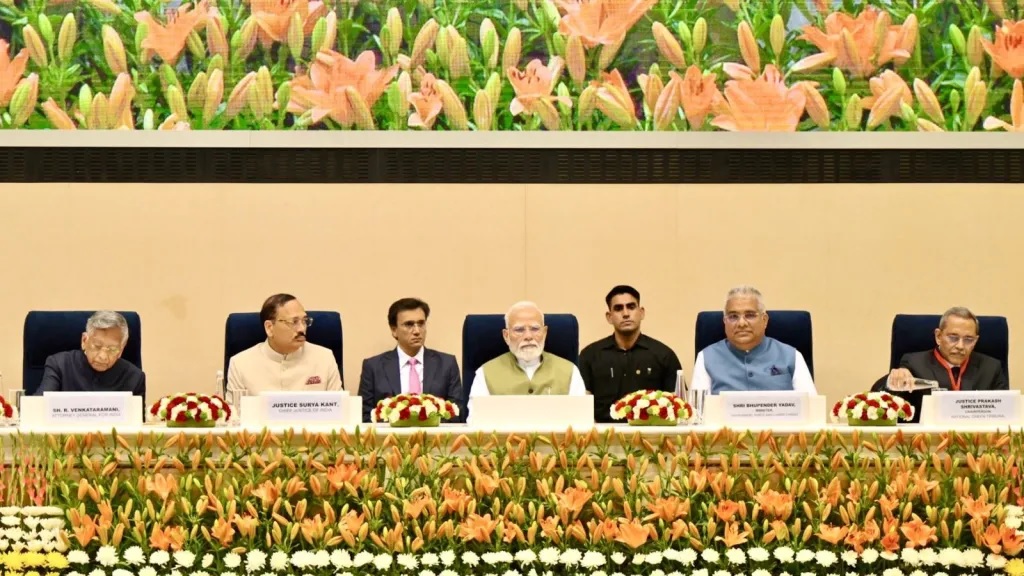
- At an international conference on “The Future of Environment and Climate Dynamics”, organised by the National Green Tribunal (NGT), the Indian PM highlighted the unequal distribution of global carbon emissions.
- Reaffirming India’s commitment to climate action, his remarks come ahead of COP31, scheduled to be held in Antalya, Türkiye.
- India’s position centres on climate equity, historical responsibility and differentiated obligations, while emphasising that development and environmental protection must advance together.
Unequal Carbon Responsibility
- The Indian PM questioned the narrative that places disproportionate responsibility for global emissions on developing countries.
- India’s per capita carbon emissions are about 2.2 tonnes annually, less than half the global average of 4.7 tonnes.
- Developed countries have per capita emissions roughly six times higher than India’s. For example, per capita emissions of the US (14.2 tonnes) and Russia (14 tonnes) are substantially higher than India’s.
- India’s cumulative contribution to global carbon emissions during 1751–2024 is about 3.5%, compared with 23.5% for the US, 15.4% for China, 6.6% for Russia, 5.1% for Germany and 4.3% for the UK.
- India argues that developed countries bear greater historical responsibility, having achieved development through extensive fossil-fuel consumption over the past two centuries.
- At the same time, India maintains that it has not evaded its climate responsibilities and has implemented its commitments under the Paris Agreement.
India’s Climate Action
- India is the only G20 country to have fulfilled all its COP21 Paris commitments ahead of schedule, particularly in areas such as non-fossil-fuel capacity, renewable energy and emissions reduction.
- India’s climate initiatives highlighted at the conference include -
- Solar energy capacity: Increased from around 2 GW in 2012 to 160 GW.
- PM-KUSUM: Around 30 lakh farmers have received solar pumps.
- One Nation One Grid: It has helped prevent an estimated 200 million tonnes of carbon emissions.
- Expansion of wind and hydropower.
- Promotion of rooftop and decentralised solar power.
- Electric vehicles: Annual sales increased from around 3,000 in 2014 to 25 lakh in the previous year.
- Metro rail: Expanded from less than 250 km across five cities before 2014 to over 1,000 km across 20 cities.
- 100% railway electrification.
- Expansion of inland waterways.
- Around 3,000 km of Dedicated Freight Corridors (DFCs), reducing fuel consumption.
- India has also promoted international initiatives such as the International Solar Alliance, Global Biofuel Alliance and International Big Cat Alliance.
Development and Environmental Protection
- The conference emphasised that environmental protection should not be viewed as inherently opposed to economic development.
- CJI Surya Kant observed that the judicial question is increasingly shifting from “conservation versus development” to how both can be harmonised and sustained.
- He also highlighted the transition from conventional environmental rights to climate-related rights, recognising the environment as central to human well-being.
- The Union Environment Minister similarly argued that the real choice is not between development and environment, but between sustainable development and unsustainable development.
- India’s conservation efforts also include protection of wildlife and endangered species, with emphasis on tigers, elephants, lions, the Great Indian Bustard and vultures.
India’s Position Ahead of COP31
- India is expected to continue advocating climate action based on -
- Equity and climate justice
- Historical responsibility
- Implementation of existing commitments
- Greater attention to the needs of vulnerable developing countries
- Balancing developmental needs with climate action
- The issue has acquired greater significance as vulnerable countries seek support through mechanisms such as the Loss and Damage Fund (LDF) for climate-induced disasters.
Conclusion
- India’s climate diplomacy seeks to reconcile developmental aspirations, climate justice and global environmental responsibility.
- Its position stresses that present-day emission obligations must be considered alongside historical emissions, per capita disparities and the developmental needs of poorer countries.
- This position simultaneously demonstrates domestic progress in renewable energy, clean mobility, electrification and biodiversity conservation.
Climate Equity FAQs
Q1: What is India’s position on climate equity?
Ans: India stressed historical emissions and significant per capita emission disparities between developed and developing countries.
Q2: How has India demonstrated its commitment to climate action?
Ans: India has expanded non-fossil energy, solar and wind power, EVs, metro rail, railway electrification, etc.
Q3: Why is the principle of historical responsibility important in climate negotiations?
Ans: It creates a stronger case for greater mitigation and financial responsibilities.
Q4: How can India reconcile development with environmental protection?
Ans: India seeks sustainable development by integrating renewable energy, clean mobility, and energy efficiency.
Q5: What should be India’s priorities at COP31?
Ans: India should emphasise equity, implementation of climate commitments, climate finance, Loss and Damage support, etc.