

Edible Oil Import Duty Cut – Reasons, Impact on Consumers and Farmers

Edible Oil

Edible Oil Latest News

  • The Union Government reduced the Basic Customs Duty (BCD) on major imported edible oils from September 24, 2026, citing rising international prices and the need to moderate domestic food inflation.

Changes in Edible Oil BCD

  • Ahead of the festival season, when demand for edible oils is expected to rise, the government rationalised import duties on several crude and refined edible oils.BCD Comparison for Edible Oil
  • The government has also maintained an import duty differential of 19.25% between crude and refined edible oils, intended to preserve an incentive for domestic refining.

Reasons for Reducing the Import Duty

  • Rising International Edible Oil Prices
    • International prices have been increasing. According to the FAO Food Price Index, the vegetable oil price index averaged 196.9 points in August 2026, increasing 0.6% over July and reaching its highest level since June 2022.
    • The increase was driven particularly by higher global palm and soybean oil prices. International palm oil prices were also affected by strong global import demand and concerns over the potential impact of El Niño-related weather conditions on production in Southeast Asia.
  • Moderating Domestic Prices
    • Import duties form part of the landed cost of imported edible oils. When international prices rise, a high import duty can further increase the cost at which the commodity enters the domestic market.
    • By reducing BCD, the government expects importers to face lower landed costs, with the benefit potentially transmitted through the domestic supply chain to consumers.
    • The stated objective is therefore to provide consumer relief and contain food-price and broader inflationary pressures.
  • Ensuring Adequate Supply During the Festival Season
    • Demand for edible oils generally increases during the festival period. Apart from household consumption, demand also rises from the sweets, snacks, food-service and hospitality sectors.
    • The Indian Vegetable Oil Producers’ Association (IVPA) stated that lower duties could improve the landed cost of imported oils and support availability during the period of higher demand.

Impact on Consumers

  • Lower import duties can reduce the cost of imported edible oils by lowering the tax component of their landed price.
  • Greater flexibility to import sunflower and soybean oil could also increase the availability of alternatives to palm oil. 
  • The industry expects this to be relevant because palm oil prices may remain relatively high due to changes in Indonesia's biofuel policy and constraints on acreage expansion in major producing countries.
  • However, the extent to which lower import duties translate into lower retail prices depends on international prices, exchange rates, transportation costs, domestic margins and the transmission of savings through the supply chain.

Farmers’ Concerns

  • Domestic oilseed farmers have raised concerns that cheaper imports could reduce the competitiveness of domestically produced oilseeds.
  • Farmers growing soybean, sunflower, groundnut and oil palm have also pointed to the government's objective of achieving greater self-sufficiency in edible oil production. Their concern is that increased dependence on imported edible oils could weaken incentives for domestic production.
  • The All India Kisan Sabha has criticised the move on the grounds that it could adversely affect oilseed farmers and potentially conflict with the objective of edible-oil self-sufficiency. 
  • These are the concerns expressed by the farmers' organisation and do not represent the government's stated rationale for the measure.

The Policy Trade-off

  • The duty reduction illustrates a common policy trade-off between short-term consumer price management and long-term domestic production incentives.
  • Lower import duties can help manage inflation and ensure adequate supplies when global prices are high. However, if imported oils become substantially more competitive, domestic oilseed producers may face greater price pressure.
  • Thus, edible oil policy requires balancing:
    • Consumer affordability
    • Food inflation management
    • Adequate market supply
    • Farmer incomes
    • Domestic oilseed production
    • Long-term edible oil self-sufficiency

Conclusion

  • The reduction in edible oil import duties is primarily aimed at reducing landed costs, improving availability and moderating domestic food-price pressures amid rising international edible oil prices. 
  • At the same time, concerns from oilseed farmers highlight the need to balance short-term consumer relief with incentives for domestic production. 
  • The effectiveness of the policy will therefore depend not only on lower import duties but also on how efficiently the resulting cost reduction reaches consumers and how domestic oilseed production is supported.

Source: TH

Edible Oil FAQs

Q1: Why did the Centre reduce import duty on edible oils?

Ans: The Centre reduced import duties to lower landed costs, improve availability and moderate domestic edible oil prices.

Q2: When did the new edible oil import duties take effect?

Ans: The revised BCD rates took effect from September 24, 2026.

Q3: Which edible oil saw its crude import duty reduced to zero?

Ans: The BCD on crude sunflower oil was reduced from 10% to zero.

Q4: How can lower import duties affect consumers?

Ans: Lower duties can reduce the landed cost of imported edible oils and potentially lower retail prices.

Q5: Why are domestic farmers concerned?

Ans: Farmers fear cheaper imports could reduce the competitiveness and prices of domestically produced oilseeds.

AFSPA: Special Powers, Provisions and Areas of Application

AFSPA

AFSPA Latest News

  • The Union Ministry of Home Affairs (MHA) has extended the Armed Forces (Special Powers) Act, 1958 (AFSPA) in parts of Manipur, Nagaland and Arunachal Pradesh for another six months from October 1, 2026.
  • In Manipur, the entire state has been declared a "disturbed area" under AFSPA, barring the jurisdictions of 13 police stations in five Valley districts.
  • In Nagaland, AFSPA continues in nine districts, plus areas under 21 police stations in five other districts.
  • In Arunachal Pradesh, the Act continues in Tirap, Changlang and Longding districts, and in areas under Namsai, Mahadevpur and Chowkham police stations in Namsai district, bordering Assam.
  • This latest extension comes against the backdrop of the ethnic conflict that erupted in Manipur on May 3, 2023.

What Powers Does AFSPA Confer?

  • AFSPA was enacted in 1958 to give the armed forces special powers to operate in areas declared "disturbed" due to insurgency or serious internal security problems.
    • The law first came into effect in 1958 to deal with the uprising in the Naga Hills, followed by the insurgency in Assam.
  • Once an area is notified as disturbed under Section 3, security personnel receive powers that ordinary police do not have:
    • Authority to use force, including lethal force, against persons acting in contravention of prohibitory orders.
    • Power to arrest without a warrant.
    • Power to enter and search premises without a warrant.

Legal Protection

  • The Act also shields personnel: prosecution or any legal proceedings for actions done (or purported to be done) under AFSPA require the prior sanction of the Central government. 
  • It is precisely these extraordinary powers and this protection against prosecution that make AFSPA contentious.

Who Can Declare an Area "Disturbed"?

  • Both the Central and State governments have the power to declare an area disturbed under Section 3. This is why the geographical application of the law has historically not been determined solely by the MHA.
  • For decades, the Manipur government itself issued disturbed-area notifications, even though AFSPA had operated in the state since 1981.
    • This changed after the May 3, 2023 ethnic violence.

Current Status Across States

  • MHA currently issues periodic disturbed-area notifications only for Manipur, Nagaland, and parts of Arunachal Pradesh.
  • For Assam, the notification is issued by the State government.
  • AFSPA was removed entirely from Tripura by then state government in 2015.
  • Meghalaya was under AFSPA for 27 years, until it was revoked by the Ministry from April 1, 2018.
  • Jammu and Kashmir has a separate law — the J&K Armed Forces (Special Powers) Act, 1990.

How AFSPA Shrank in Manipur — and Then Returned

  • AFSPA's footprint in Manipur had been contracting before the current conflict:
    • 2004: Withdrawn from the Imphal municipal area.
    • April 2022 – April 2023: A much larger rollback — AFSPA withdrawn from all police station areas in the Manipur Valley, citing an improved security situation and greater public sense of security.
    • AFSPA, however, continued in the hill regions throughout, where disturbed-area notifications had been renewed periodically for decades.
    • The trend was toward gradual reduction — until the May 2023 violence reversed it.

Reimposition

  • In November 2024, the MHA reimposed AFSPA in Manipur across the jurisdictions of six police stations spread over five districts — areas from which it had earlier been withdrawn. 
  • Notably, this notification came from the MHA, not the Manipur government, marking a shift from the earlier pattern.
  • The then Manipur govt did not agree with this decision to reimpose AFSPA and it sought a reversal almost immediately.

Why AFSPA Continues in Nagaland and Arunachal Pradesh

  • Nagaland: Continuation has historically been linked to the presence and movement of armed insurgent groups and the unresolved Naga political issue. 
    • The Centre has held negotiations with the National Socialist Council of Nagaland (Isak-Muivah), or NSCN-IM, and Naga National Political Groups (NNPGs). 
    • In 2022, security officials indicated that uncertainty over the conclusion of the Naga peace process was a key reason AFSPA persisted in parts of Nagaland and neighbouring states.
  • Arunachal Pradesh: Its application has remained concentrated in districts affected by insurgent movement and areas adjoining Assam.

Conclusion

  • AFSPA's story in India's Northeast is one of contraction and reversal, not a fixed policy. Manipur's own trajectory — years of gradual rollback undone within months of the 2023 violence — shows how tightly the law's reach tracks ground realities. 
  • Even shared political governance, as seen in the Centre-Manipur disagreement, hasn't guaranteed consensus on where the line between security and civil liberty should be drawn.

Source: TH | FL

AFSPA FAQs

Q1: What is AFSPA and why was it enacted?

Ans: AFSPA was enacted in 1958 to provide armed forces special powers for operating in areas declared disturbed because of insurgency or serious security problems.

Q2: What powers does AFSPA provide in disturbed areas?

Ans: AFSPA permits security personnel to use force in specified circumstances, arrest without warrants and enter or search premises without warrants.

Q3: Who can declare an area disturbed under AFSPA?

Ans: Under Section 3, both the Central and State governments can declare an area disturbed, meaning application is not determined solely by the MHA.

Q4: How did AFSPA's application change in Manipur before 2023?

Ans: AFSPA's footprint contracted gradually, including withdrawal from Imphal in 2004 and from Manipur Valley police-station areas between April 2022 and April 2023.

Q5: Why does AFSPA continue in parts of Nagaland and Arunachal Pradesh?

Ans: AFSPA continues in parts of Nagaland because of armed insurgent groups and the unresolved Naga political issue, while Arunachal Pradesh faces insurgent movement in specific areas.

Article 370: From J&K Special Status to Statehood Demand

Article 370

Article 370 Latest News

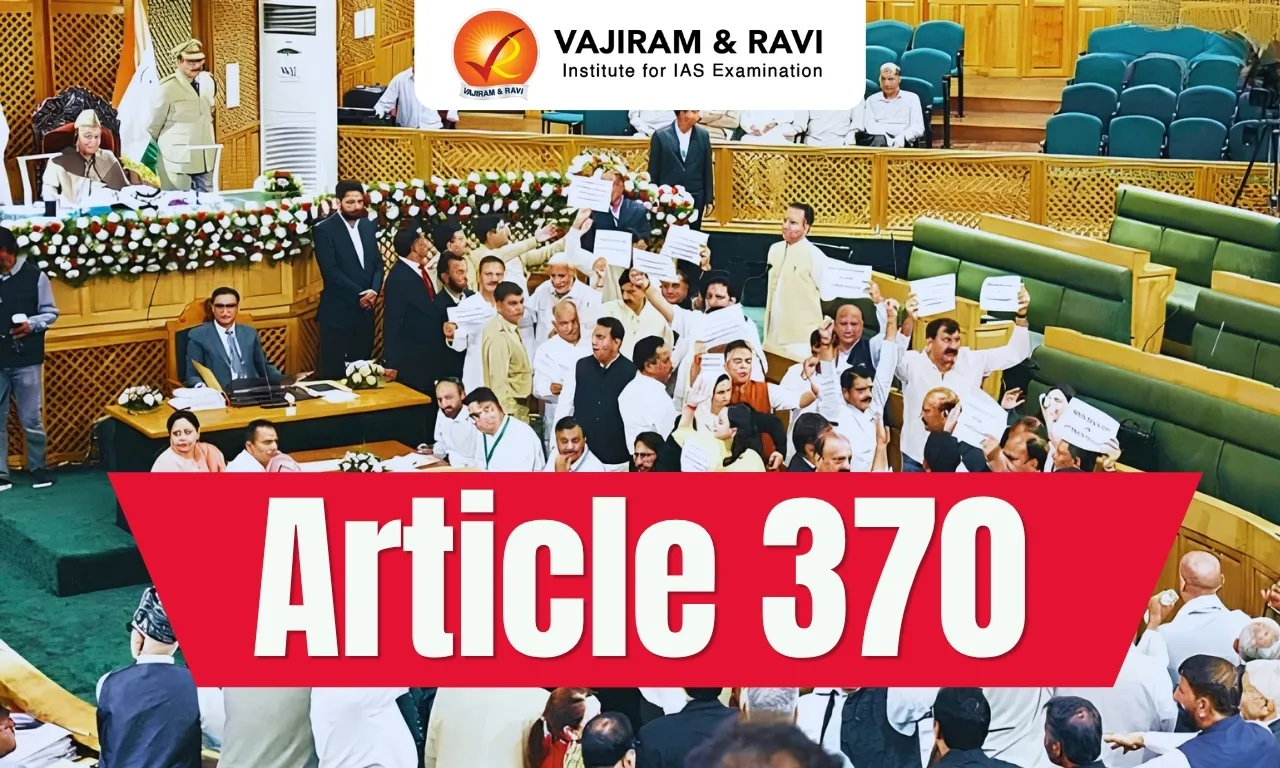
  • As Chief Minister Omar Abdullah brought a resolution seeking immediate restoration of statehood for Jammu and Kashmir in the Assembly recently, several amendments were moved — some seeking the inclusion of Articles 370 and 35A, as they existed before August 5, 2019. 
  • These amendments were later withdrawn, but they brought renewed attention to the constitutional provisions that have shaped J&K's status within India.

What Was Article 370?

  • Article 370 provided special status to Jammu and Kashmir, ensuring Parliament could legislate on only three subjects in relation to the state: Defence; Foreign relations; Communication.
  • These were the exact subjects mentioned in the Instrument of Accession that made the princely state part of India. 
  • J&K was allowed its own constitution, standing apart from other states. 
  • Only Article 1 (defining India's territory) and Article 370 itself applied to the state, beyond the extension of subjects under those three heads.

How Article 370 Came Into Being

  • The Accession Crisis (1947): After Raja Hari Singh, ruler of J&K, tried to remain independent amid Partition, Pakistan — claiming the province due to its Muslim-majority population — sent irregular troops (Kabailis) to capture Kashmir in October 1947. 
    • A worried Hari Singh signed the Instrument of Accession on October 26, 1947, after which Indian soldiers began repelling the invaders.
  • UN Involvement: India took the matter to the UN Security Council in January 1948. The UN Commission for India and Pakistan (UNCIP) mediated a ceasefire. 
    • UNSC Resolution 47 called for both sides to demilitarise so a plebiscite could determine the wishes of J&K's people. 
    • Since demilitarisation never happened, this resolution remained a dead letter.
  • Constitutional Adoption: Article 370 was adopted by the Constituent Assembly on October 17, 1949. 
    • Drafting Committee member N. Gopalaswami Ayyangar explained that the state was "not yet ripe" for full integration, citing ongoing UN entanglement and parts of the state still being "in the hands of rebels and enemies."
  • Restrictions under Article 370: Outsiders required a permit to visit the state and were barred from buying land there.

The Delhi Agreement of 1952

  • Later, the then Nehru government and the J&K government signed the Delhi Agreement in July 1952, under which the state:
    • Accepted the jurisdiction of the Supreme Court.
    • Accepted the supremacy of the Indian flag (though the state flag remained in use too).
    • Accepted the President's power to declare Emergency under Article 352 — but only with the state's concurrence, in case of internal disturbances.

What Was Article 35A?

  • A Presidential Order in 1954, issued under Article 370's authority, added Article 35A to the Constitution as an annexure (Appendix 1) to the official text.
    • Article 35A flowed from Article 370.
    • It empowered the J&K Assembly to define who qualified as a "permanent resident" of the state.
    • It extended special rights to such residents — including the right to own property and access to government jobs and scholarships.

How Article 370 Was Abrogated

  • On August 5, 2019, the government rendered Article 370 inoperative through the Constitution (Application to Jammu and Kashmir) Order, 2019, which superseded the 1954 Order.
  • This nullified J&K's separate constitution and extended all provisions of the Indian Constitution to the state.

The Legal Mechanism Used

  • The government invoked Clause 3 of Article 370, which allows the President to declare the article inoperative — but requires the "recommendation of the Constituent Assembly of the State".
  • Since J&K's constituent assembly no longer existed, the President instead used Clause 1 of Article 370, which empowers the President to modify the Constitution's application to J&K.
  • To achieve this, the phrase "Constituent Assembly of the State" in Article 367 was replaced with "Legislative Assembly of the State."
  • Since the state's Legislative Assembly was suspended at the time (the state was under President's Rule after the BJP-PDP alliance collapsed), the order specified that any reference to the Legislative Assembly would mean a reference to the Governor of Jammu and Kashmir — a central appointee.
  • Judicial Validation: The Supreme Court upheld this abrogation in 2023, holding that Article 370 was meant to enhance integration between the Indian Union and J&K, not cause disintegration.

Conclusion

  • J&K's constitutional journey has never stood still — from a special-status accession meant to be temporary, through decades of gradual integration via agreements like Delhi 1952, to complete abrogation using the very machinery Article 370 itself provided. 
  • The current statehood demand, and the withdrawn push to restore Articles 370 and 35A, shows this evolution is still being contested — now in the Assembly rather than through arms or ordinances.

Source: IE

Article 370 FAQs

Q1: What special status did Article 370 provide to Jammu and Kashmir?

Ans: Article 370 limited Parliament's legislative authority mainly to defence, foreign relations and communications, while allowing J&K to have its own Constitution.

Q2: How did Article 370 emerge in Jammu and Kashmir's constitutional framework?

Ans: Article 370 emerged after J&K's 1947 accession to India, amid the conflict, UN involvement and continuing constitutional negotiations over integration.

Q3: What was the relationship between Article 370 and Article 35A?

Ans: Article 35A was introduced through a 1954 Presidential Order under Article 370 and empowered J&K to define permanent residents and their special rights.

Q4: How was Article 370 made inoperative in 2019?

Ans: In 2019, the government used constitutional orders under Article 370 to modify its application, ultimately making Article 370 inoperative and extending the Constitution fully.

Q5: What does the current statehood demand indicate about J&K's constitutional journey?

Ans: The statehood demand shows that Jammu and Kashmir's constitutional status remains politically contested, with debate now taking place through the elected Assembly.

Enquire Now

