Supreme Court Tightens Safeguards on Arrest

Safeguards on Arrest

Safeguards on Arrest Latest News

  • The Supreme Court has progressively strengthened the constitutional protection available to an arrested person by making the communication of grounds of arrest a meaningful and enforceable safeguard. 
  • The issue is rooted in Article 21 (right to life and personal liberty) and Article 22(1) (protection against arbitrary arrest and right to legal counsel), read with the statutory safeguards under the Bharatiya Nagarik Suraksha Sanhita (BNSS), 2023.

Provisions Governing Communication of Grounds of Arrest

  • Article 22(1) provides that a person arrested cannot be detained without being informed, as soon as may be, of the grounds of arrest and cannot be denied the right to consult and be defended by a legal practitioner of choice.
  • Under Section 47 of the BNSS, corresponding to Section 50 of the CrPC, an officer arresting a person without warrant must communicate the grounds of arrest.
  • However, neither Article 22(1) nor Section 47 BNSS originally prescribed the precise mode of communication.

Need for Written Grounds

  • In Pankaj Bansal v. Union of India (2023), while dealing with arrest under the PMLA 2002, the Supreme Court held that written grounds of arrest must be furnished to the arrested person as a matter of course. 
  • Merely reading out the grounds orally could create a dispute about whether they were actually communicated. 
  • Written grounds also enable the accused to consult counsel, understand the allegations and effectively seek bail. 
  • The principle was subsequently reinforced in Prabir Purkayastha v. State (NCT of Delhi) (2024) in the context of UAPA 1967, with the Court holding that the right to receive written grounds extends across offences and statutes. 

Evolution of the Supreme Court’s Jurisprudence

  • Pankaj Bansal (2023):
    • Written grounds of arrest should be furnished without exception.
    • The purpose is not merely procedural compliance but to enable the accused to effectively exercise the right to legal defence and bail.
  • Prabir Purkayastha (2024): The Court expanded the principle beyond PMLA and held that communication of grounds of arrest is a fundamental and statutory right. Failure to comply can vitiate the arrest and subsequent remand. 
  • Rajesh Mihir Shah (2024):
    • The Court clarified that grounds must ordinarily be communicated in writing and in a language understood by the arrested person (this requirement applies across offences and statutes). 
    • If immediate written communication is impracticable, they may initially be conveyed orally, but the written grounds must reach the arrestee at least two hours before production before the Magistrate for remand. 
    • Non-compliance renders the arrest illegal. 
  • Vihaan Kumar (2025):
    • The Court emphasised that the communication must be effective and meaningful, so that the accused actually understands the basic facts constituting the grounds of arrest. 
    • The burden of proving effective compliance lies on the arresting agency once non-communication is alleged. 

Latest Strengthening - Jaskaran Jeet Singh Deol Case

  • In this case (September 2026), the SC dealt with an arrest where written grounds were not supplied and also considered violation of the 24-hour production requirement under Article 22(2).
  • Article 22(2) requires every arrested person to be produced before the nearest Magistrate within 24 hours, excluding necessary travel time. Detention beyond this period requires the Magistrate's authority.
    • The court held that violation of Article 22(2) can render the arrest and continued detention illegal, strengthening judicial oversight over police custody.
  • The Court also reaffirmed that -
    • Grounds of arrest are a fundamental and statutory right;
    • Violation can invalidate the arrest and subsequent remand;
    • An accused released because of such violation cannot simply be re-arrested at the discretion of the same investigating authority;
    • Where re-arrest is sought, the investigating agency must approach the Magistrate, provide the grounds and reasons for the earlier non-compliance, and obtain judicial approval. 
  • The Court also stressed accountability of erring officials; in the case, departmental proceedings were initiated against the concerned police officers (IO). 

Conclusion

  • The jurisprudence represents a shift from formal compliance to substantive protection of personal liberty. 
  • It strengthens rule of law, due process, right to legal aid and fair procedure, and protection against arbitrary arrest and custodial excesses.
  • Arrest is a serious deprivation of personal liberty; therefore, the State must strictly comply with constitutional and statutory safeguards, and procedural violations cannot be treated as mere technicalities.

Source: TH

Safeguards on Arrest FAQs

Q1: How has the Supreme Court strengthened safeguards against arbitrary arrest?

Ans: By treating communication of written grounds of arrest as a substantive constitutional safeguard.

Q2: Why is written communication of grounds of arrest important under Articles 21 and 22?

Ans: It enables the arrested person to understand the allegations, consult legal counsel, effectively seek bail, etc.

Q3: What is the significance of Pankaj Bansal and Prabir Purkayastha judgments in protecting personal liberty?

Ans: They transformed communication of arrest grounds from a procedural formality into an enforceable safeguard.

Q4: What is the significance of Article 22(2) in preventing arbitrary detention?

Ans: Article 22(2) mandates production of an arrested person before the nearest Magistrate within 24 hours.

Q5: How does the Supreme Court’s recent arrest jurisprudence strengthen the Rule of Law?

Ans: By subjecting police powers to strict constitutional scrutiny, ensuring judicial oversight, protecting due process, etc.

Rupee Depreciation – RBI Measures to Control Forex Volatility

Rupee Depreciation

Rupee Depreciation Latest News

  • On October 10, 2026, the Reserve Bank of India announced regulatory measures to curb speculative activity in the foreign exchange market and manage volatility amid geopolitical uncertainty and elevated crude oil prices.

Causes of Rupee Depreciation

  • Rupee depreciation refers to a decline in the value of the Indian rupee relative to another currency, such as the US dollar. The rupee's value is influenced by domestic economic conditions, international capital flows and global currency movements.
  • As per the RBI’s latest report, the rupee had depreciated by approximately 7% since the beginning of 2026, reflecting several structural and external pressures.
    • Strong US dollar: Global demand for the dollar and elevated international yields make dollar-denominated assets more attractive.
    • High crude oil prices: India's dependence on imported energy increases its dollar demand and import expenditure when oil prices rise.
    • Foreign portfolio outflows: Withdrawals by foreign investors from Indian equity and debt markets increase demand for foreign currency.
    • Geopolitical uncertainty: The prolonged conflict in West Asia has disrupted energy supply chains and contributed to fluctuations in crude oil prices.
    • Interest rate differentials: Differences between interest rates in advanced and emerging economies influence international investment decisions and currency movements.

RBI’s Measures to Manage Forex Volatility

  • The RBI has announced regulatory changes aimed at improving market discipline and reducing speculative demand for foreign currency.
  • Restrictions on cancelled derivative contracts
    • Authorised Dealers (ADs) will not permit users to rebook INR-linked foreign exchange derivative contracts cancelled after the directions were issued. Contract rollovers at maturity remain permitted, subject to regulatory requirements.
  • Reduction in the exposure threshold
    • The threshold for undertaking foreign exchange derivative transactions without establishing an underlying exposure was reduced from $100 million to $5 million. 
    • The corresponding threshold for INR-linked exchange-traded currency derivatives was also reduced to $5 million across recognised stock exchanges.
  • Additional documentation requirements
    • ADs must obtain and retain an undertaking from users confirming that the same underlying exposure has not been hedged through another dealer.
  • Foreign Exchange Risk Reserve
    • For eligible INR-linked foreign exchange derivative contracts with a notional value exceeding $2 million, Authorised Dealers must maintain a Foreign Exchange Risk Reserve (FERR) with the RBI in cash, equivalent to 20% of the rupee value of the notional amount. 
  • Together, these measures seek to discourage excessive speculative positions, improve transparency and strengthen risk management in the foreign exchange market.

Other RBI Interventions

  • The RBI has also used several measures to address currency volatility and improve the availability of foreign exchange.
    • Dedicated dollar facility for oil marketing companies: Direct dollar supplies to oil marketing companies (OMCs) are intended to divert their bulk crude purchases away from the interbank market and moderate short-term currency pressure.
    • Foreign exchange swaps: Sell-buy swaps in the forward market help manage rupee liquidity and foreign exchange conditions.
    • External Commercial Borrowings: Liberalisation of ECB rules can expand access to foreign funding for eligible Indian borrowers.
    • NRI deposits: Measures to encourage Non-Resident Indian deposits can help mobilise foreign currency resources.
    • Position limits on banks: Restrictions on banks' net open foreign exchange positions aim to curb excessive proprietary trading.
    • International rupee invoicing: Vostro account arrangements can facilitate international trade settlements in rupees.

Implications for the Economy

  • Benefits of intervention
    • RBI intervention can reduce excessive currency volatility and limit the impact of abrupt exchange-rate movements on businesses and households.
    • A more stable rupee can help moderate imported inflation, particularly for crude oil, electronics and edible oils. It can also reduce uncertainty for companies with foreign currency liabilities and improve the predictability of international transactions.
  • Costs and limitations
    • Foreign exchange reserves: Direct dollar supplies to OMCs may initially place pressure on reserves, even as they reduce demand in the interbank market.
    • Higher hedging costs: The new reserve requirement and tighter derivative rules may increase banks' funding costs, potentially widening spreads for customers.
    • Temporary relief: Currency interventions cannot eliminate India's underlying oil import bill or prevent foreign investors from withdrawing capital.
    • Future repayment risks: Foreign currency deposits and associated swaps can create maturity-related liquidity pressures if large amounts fall due together.

Economic Significance of Rupee Stability

  • Exchange-rate stability matters for India's macroeconomic management through several channels.
  • Inflation: A weaker rupee increases the domestic cost of imported goods and commodities, potentially contributing to inflation.
  • Current account balance: Higher oil import expenditure increases the value of imports and can widen the current account deficit if export earnings and other receipts do not offset the increase.
  • Corporate and banking stability: Companies with unhedged foreign currency borrowings face higher repayment costs when the rupee depreciates, potentially increasing credit risks for lenders.
  • Capital flows: Sharp currency movements and expectations of further depreciation can influence investor sentiment and encourage additional capital outflows.

Source: TH

Rupee Depreciation FAQs

Q1: What is rupee depreciation?

Ans: Rupee depreciation occurs when the Indian rupee loses value relative to another currency, such as the US dollar.

Q2: Why does a weaker rupee increase inflationary pressure?

Ans: A weaker rupee raises the domestic cost of imports, including crude oil and electronics, which can increase production costs and consumer prices.

Q3: What is the Foreign Exchange Risk Reserve (FERR)?

Ans: FERR is a cash reserve that Authorised Dealers must maintain with the RBI for specified INR-linked foreign exchange derivative contracts exceeding the prescribed threshold.

Q4: Why does the RBI intervene in the foreign exchange market?

Ans: The RBI intervenes to curb excessive volatility, maintain orderly market conditions, manage imported inflation and limit risks to financial stability.

Q5: Can RBI intervention permanently strengthen the rupee?

Ans: RBI intervention can moderate short-term volatility, but sustained currency strength depends on factors such as crude oil prices, capital flows, export performance and global dollar movements.

Kigali Amendment: India’s Cooling Choices and Global Climate Goals

Kigali Amendment

Kigali Amendment Latest News

  • The Kigali Amendment to the Montreal Protocol turned 10 years old on October 15, 2026. It committed nations to phase down hydrofluorocarbons (HFCs) — potent greenhouse gases used widely in refrigeration and air-conditioning. 
  • While the amendment could prevent up to 0.5°C of warming by 2100, India now faces this challenge at an unusual scale: its cooling demand is projected to more than double by 2035. 
  • What happens next in India’s cooling choices may matter as much as what Kigali has already achieved.

What Is the Kigali Amendment, and Why Was It Needed?

  • The Montreal Protocol (1987) originally phased out chlorofluorocarbons (CFCs) and other ozone-depleting substances. Countries have since eliminated nearly 99% of controlled substances, and the ozone layer is recovering.
  • HFCs became the common replacement refrigerant since they don’t deplete ozone — but they carry a massive climate cost: many have hundreds to thousands of times the warming impact of CO2 (weight for weight) over a century, if they escape into the atmosphere.
  • Federated States of Micronesia and Mauritius proposed bringing HFCs under the Protocol in 2009.
  • The amendment was adopted in Kigali, Rwanda, on October 15, 2016, entering into force in January 2019. It sets binding schedules to reduce HFC production/consumption — a “phase-down,” not a complete ban, since limited use continues.

How Much Warming Could It Prevent?

  • Full implementation could avoid 0.3°C to 0.5°C of global warming by 2100, as per UN-backed scientific assessment.
  • This matters significantly given the Paris Agreement’s goal of keeping warming well below 2°C, pursuing a 1.5°C limit.

Why Cooling Is Central to Kigali’s Next Decade

  • Cooling drives warming through two channels:
    • Refrigerant leakage directly into the atmosphere.
    • Electricity consumption to run cooling equipment — causing emissions wherever fossil fuels power the grid.
  • Switching refrigerants addresses the first problem; improving appliance efficiency addresses the second.
  • The UN Environment Programme (UNEP) and International Energy Agency (IEA) estimate combining the HFC transition with efficiency improvements could roughly double the climate benefit.
  • India’s Specific Stakes
    • Cooling already accounts for over 10% of India’s annual electricity demand (as per IEA).
    • On hot summer nights, air-conditioners can account for up to a third of power consumption.
    • Under current policies, India’s cooling demand is projected to more than double by 2035.

What Must India Do Under Kigali?

  • India ratified the amendment in 2021, with a clear compliance timeline:
    • 2028: Freeze HFC production and consumption at an agreed baseline.
    • 2032: First cut — 10% below baseline.
    • 2047: Reductions reach 85%.
  • Equipment purchased before the first cuts may remain in use well into the 2030s — making its efficiency crucial for household electricity bills and the country’s generating-capacity needs. 
  • This gives India strong incentive to improve appliance standards early, rather than waiting for treaty deadlines. 
  • Weak standards also create an import risk — inefficient appliances rejected by stricter markets may be dumped into India, saddling buyers with years of high electricity bills.

What Remains Unfinished After 10 Years?

  • Universal participation is still incomplete: 175 parties had joined by early October 2026.
  • Existing refrigerants inside equipment also need management — they can leak during servicing or escape when appliances are scrapped. Recovery and safe destruction of refrigerants is essential, since production restrictions alone can’t address this.
  • The “Friends of the Kigali Amendment” coalition was revived in New York recently, backed by the Climate and Clean Air Coalition, to push for wider participation, more financing, and better refrigerant recovery.

Who Pays for the Transition?

  • The Protocol’s Multilateral Fund (established 1990, operational since 1991) helps developing countries meet additional compliance costs — funded by developed countries.
  • The Fund’s work helped avoid emissions equivalent to ~50 billion tonnes of CO2 between 1995–2021, at a cost of just ~7 US cents per tonne.
  • The same financing mechanism supports the HFC phase-down — crucial for Indian manufacturers navigating the transition.

Why Has the Montreal Protocol Succeeded? Lessons for the Future

  • Analysts described the Protocol’s approach as “start and strengthen” — beginning with a modest target (50% CFC reduction) and progressively tightening controls as alternatives became available. 
  • Key success factors:
    • Binding schedules gave manufacturers certainty to invest in substitutes.
    • Expert panels assessed available technology to guide decisions.
    • Developing countries received longer timetables, backed by the Fund.

Could This Model Work for Other Pollutants?

  • The four main Short-Lived Climate Pollutants (SLCPs) — methane, black carbon, HFCs, and tropospheric (ground-level) ozone — have strong warming effects but shorter atmospheric lifetimes than CO2, making their reduction a fast lever against near-term warming.
  • Methane (lifespan ~12 years) from oil and gas operations is a prime candidate for a Montreal-style binding agreement — leak repairs can prevent emissions while preserving saleable gas.
  • The EU’s 27 member states already have an international methane agreement requiring leak detection/repair and restricting routine gas flaring — a possible template for wider adoption.
  • For India specifically, methane from cattle requires balancing emission cuts with small farmers’ incomes and food security, while black carbon (soot) requires tackling diesel engines and household cooking fuels — underscoring the need for sector-specific agreements.

Source: IE

Kigali Amendment FAQs

Q1: What is the Kigali Amendment, and why was it adopted?

Ans: The Kigali Amendment, adopted on October 15, 2016, requires countries to phase down hydrofluorocarbons, powerful greenhouse gases widely used in refrigeration and air-conditioning.

Q2: How can the Kigali Amendment help limit global warming?

Ans: The Kigali Amendment could prevent 0.3°C to 0.5°C of global warming by 2100 through reduced HFC production and consumption worldwide.

Q3: Why are India’s cooling choices important for climate goals?

Ans: The Kigali Amendment matters for India because cooling demand is projected to more than double by 2035, while cooling already consumes over 10% of annual electricity demand.

Q4: What is India’s HFC phase-down timeline under the Kigali Amendment?

Ans: Under the Kigali Amendment, India must freeze HFC production and consumption in 2028, cut levels by 10% in 2032, and achieve an 85% reduction by 2047.

Q5: How does the Kigali Amendment support developing countries during the transition?

Ans: The Kigali Amendment uses the Montreal Protocol’s Multilateral Fund, financed by developed countries, to help developing nations meet additional compliance costs and transition to alternatives.

Fairfax IDBI Bank Deal: India’s Largest Financial Sector FDI

Fairfax IDBI Bank Deal

Fairfax IDBI Bank Deal Latest News

  • The Cabinet Committee on Economic Affairs (CCEA), chaired by PM Modi, has approved the sale of a 60.72% stake in IDBI Bank to Toronto-based Fairfax Financial Holdings for ₹52,878 crore (~$5.56 billion). 
  • Once completed, this will be India’s largest-ever FDI transaction in the financial sector, marking a major milestone in the government’s strategic disinvestment programme.

The Deal: Key Numbers

  • Buyer: Fairfax Financial Holdings, founded and led by Indian-Canadian billionaire Prem Watsa.
  • Stake acquired: 60.72%, jointly held by the Government of India (45.48%) and LIC (49.24%). Government will sell 30.48% of its stake, retaining 15%; LIC will divest 30.24%, retaining 19%.
  • Expected completion: By March 2027.
  • FM Nirmala Sitharaman’s clarification: “It is not a disinvestment, but a restructuring” — since the government remains invested in the bank.

Regulatory Conditions Attached to the Deal

  • Stake reduction: Fairfax must cut its holding to 26% over a 15-year glide path, to be finalised with the RBI.
  • Name retention: Fairfax must retain the “IDBI Bank” name for 3 years from deal completion (as per the share purchase agreement).
  • Capital lock-in: Fairfax’s invested capital must remain locked in for 5 years.
  • LIC’s residual stake: Must be reduced from 19% to 15% within 2 years.
  • One-bank rule: Since RBI norms bar an entity from owning two banks, Fairfax — which already holds 40% of Kerala’s CSB Bank (via FIH Mauritius Investments Ltd) — must either merge CSB Bank with IDBI Bank or exit CSB Bank within 2 years.
  • Fit-and-proper assessment: Fairfax must clear RBI’s regulatory compliance process and submit a roadmap for meeting conditions before the deal closes.
  • Open offer: The transaction includes an open offer, giving minority shareholders an exit option.

Government’s Residual Stake: What Happens Next

  • The CCEA has delegated powers to an Alternative Mechanism / Empowered Group of Ministers (headed by FM Sitharaman) to sell the government’s residual 15% stake through the open market, as per standard operating procedure.
  • This will allow the Centre to monetise future value appreciation.
  • LIC will manage its residual stake independently, as per its own internal procedures and regulatory compliance.

Why This Matters: Context and Significance

  • IDBI Bank’s journey: Originally an apex Development Financial Institution (DFI), set up in 1964, converted into a banking company in 2004. It became a private bank in 2019 after LIC stepped in as promoter amid poor financial health.
  • Fiscal significance: The ₹52,878 crore proceeds will help the Centre approach its ₹80,000 crore disinvestment target for FY27 — the government has so far raised ₹55,757 crore this fiscal year.
  • Part of a larger trend: This follows other major foreign investments in Indian banking/finance: 
    • Emirates NBD — 60% stake in RBL Bank (~$3 billion, June 2026).
    • Japan’s MUFG — 20% stake in Shriram Finance ($4.4 billion).
    • Japan’s SMBC — 24.2% stake in YES Bank (~$2 billion, previous year).
  • Recent Disinvestments: Air India, Neelachal Ispat Nigam Ltd (2022), Ferro Scrap Nigam Ltd (early 2025), Indian Medicines Pharmaceuticals Corporation Ltd (May 2026).
  • Experts called the deal strategically significant — less about acquiring a bank, more about acquiring the “distribution and funding engine” for a broader financial-services ecosystem.

Employee and Union Concerns

  • Government officials confirmed employee service conditions remain unchanged, and pension benefits are fully funded via a separate dedicated fund.
  • IDBI Bank’s officers and employees’ union have opposed the sale, arguing the price is too low.

Conclusion

  • The Fairfax-IDBI deal is more than a disinvestment milestone — it signals growing global investor confidence in India’s banking sector and completes a process that took over four years to materialise. 
  • While the government frames it as “restructuring” rather than exit, the regulatory conditions — stake caps, lock-ins, and the CSB Bank resolution — show how carefully India is balancing foreign capital inflows with systemic banking safeguards. 
  • For the Centre, it is also a timely fiscal win, bringing its FY27 disinvestment target within reach.

Source: IE | BS

Fairfax IDBI Bank deal FAQs

Q1: What is the value of the Fairfax IDBI Bank deal?

Ans: The Fairfax IDBI Bank deal involves the sale of a 60.72% stake for ₹52,878 crore, making it India’s largest financial-sector FDI transaction.

Q2: Who is acquiring the controlling stake in IDBI Bank?

Ans: The Fairfax IDBI Bank deal involves Toronto-based Fairfax Financial Holdings, founded and led by Indian-Canadian billionaire Prem Watsa, acquiring a majority stake in the lender.

Q3: What regulatory conditions apply to the Fairfax IDBI Bank deal?

Ans: The Fairfax IDBI Bank deal requires a gradual reduction of Fairfax’s stake to 26%, a five-year capital lock-in, and compliance with RBI regulatory conditions.

Q4: Why must Fairfax resolve its existing investment in CSB Bank?

Ans: The Fairfax IDBI Bank deal must comply with RBI norms restricting ownership of two banks, requiring Fairfax to merge CSB Bank with IDBI Bank or exit within two years.

Q5: How will the Fairfax IDBI Bank deal affect the government’s disinvestment target?

Ans: The Fairfax IDBI Bank deal will generate ₹52,878 crore for the Centre, helping it move closer to its ₹80,000 crore disinvestment target for FY2027.

Identification of Minorities in India

Identification of Minorities in India

What’s in today’s article?

  • Why in News? 
  • What is National Commission for Minorities? 
  • What is the Purpose of these Commissions?
  • What is the Population of Minorities in India?
  • What are the Constitutional Safeguards provided to Minorities in India?
  • News Summary


Why in News?  

  • The Supreme Court has expressed displeasure over six states and UTs not yet giving their comments to the Centre on the issue of identification of minorities at the state level. 


What is National Commission for Minorities?

  • The Union Government set up the National Commission for Minorities (NCM) under the National Commission for Minorities Act, 1992.
  • Initially, five religious communities, viz., Muslims, Christians, Sikhs, Buddhists and Zoroastrians (Parsis) were notified as minority communities by the Union Government. 
  • Further, in 2014, Jains were also notified as another minority community.
  • On the lines of NCM, State governments also set up State Minorities Commissions in their respective State Capitals.


What is the Purpose of these Commissions? 

  • These organizations are set-up to safeguard and protect the interests of minorities.
  • Aggrieved persons belonging to the minority communities may approach the concerned State Minorities Commissions for redressal of their grievances. 
  • Moreover, they may also send their representations to the National Commission for Minorities, after exhausting all other official mechanism of remedies available to them.


What is the Population of Minorities in India? 

  • The basic ground for a community to be nominated as a religious minority is the numerical strength of the community.
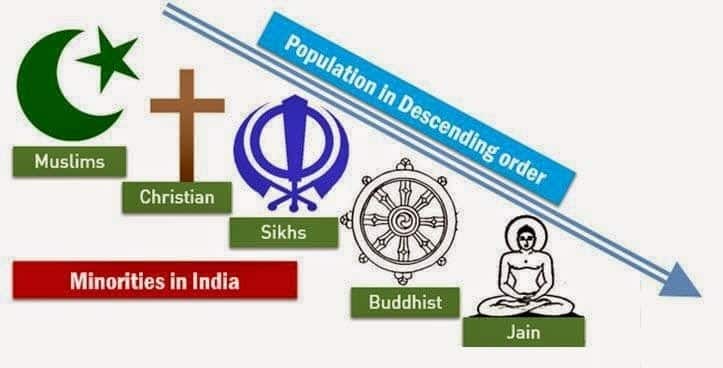
  • Muslims, Sikhs, Christians, Buddhists, Jain and Zoroastrians (Parsis) have been notified as minority communities under Section 2 (c) of the National Commission for Minorities Act, 1992. 
  • As per the Census 2011, the percentage of minorities in the country is about 19.3% of the total population of the country. 
  • The population of Muslims are 14.2%; Christians 2.3%; Sikhs 1.7%, Buddhists 0.7%, Jain 0.4% and Parsis 0.006%.


What are the Constitutional Safeguards provided to Minorities in India?

  • The Constitution uses the term 'minority' without defining it.
    • It refers to Minorities as those ‘based on religion or language’. 
  • The rights of the Minorities have been spelt out in the Constitution in detail. 
  • In Part III of the Constitution, which deals with the Fundamental Rights, it is divided into two parts viz. (a) the rights which fall in the ‘common domain’ and (b) the rights which go to the ‘separate domain’. 
  • In the ‘Common Domain’, the following fundamental rights and freedoms are guaranteed – 
    • [Article 14]: people’s right to ‘equality before the law’ and ‘equal protection of the laws’.
    • [Article 15 (1) & (2)]: prohibition of discrimination against citizens on grounds of religion, race, caste, sex or place of birth.
    • [Article 15 (4)]: authority of State to make ‘any special provision for the advancement of any socially and educationally backward classes of citizens’ (besides the Scheduled Castes and Scheduled Tribes).
    • [Article 16(1)&(2)]: citizens’ right to ‘equality of opportunity’ in matters relating to employment or appointment to any office under the State – and prohibition in this regard of discrimination on grounds of religion, race, caste, sex or place of birth.
    • [Article 16(4)]: Authority of State to make ‘any provision for the reservation of appointments or posts in favour of any backward class of citizens which, in the opinion of the State, is not adequately represented in the services under the State.
    • [Article 25(1)]: people’s freedom of conscience and right to freely profess, practice and propagate religion – subject to public order, morality and other Fundamental Rights.
    • [Article 26]: right of ‘every religious denomination or any section thereof – subject to public order, morality and health – to establish and maintain institutions for religious and charitable purposes, ‘manage its own affairs in matters of religion’, and own and acquire movable immovable property and administer it ‘in accordance with law.
    • [Article 27]: prohibition against compelling any person to pay taxes for promotion of any particular religion.
    • [Article 28]: people’s ‘freedom as to attendance at religious instruction or religious worship in educational institutions’ wholly maintained, recognized, or aided by the State.
  • In the ‘Separate Domain’, the following fundamental rights and freedoms are guaranteed – 
    • [Article 29(1)]: right of ‘any section of the citizens’ to ‘conserve’ its ‘distinct language, script or culture’.
    • [Article 29(2)]: restriction on denial of admission to any citizen, to any educational institution maintained or aided by the State, ‘on grounds only of religion, race, caste, language or any of them’.
    • [Article 30(1)]: right of all Religious and Linguistic Minorities to establish and administer educational institutions of their choice.
    • [Article30 (2)]: freedom of Minority-managed educational institutions from discrimination in the matter of receiving aid from the State.
    • [Article 347]: special provision relating to the language spoken by a section of the population of any State.
    • [Article 350 A]: provision for facilities for instruction in mother-tongue at primary stage.
    • [Article 350 B]: provision for a Special Officer for Linguistic Minorities and his duties.
    • Sikh community’s right of ‘wearing and carrying of kirpans’.


News Summary

  • The Supreme Court of India was hearing a batch of petitions challenging nation-wide identification of minorities.
  • The Central government had written a letter to all States/UTs seeking comments on the issue of 'identification and notification of religious and linguistic minorities’ in India.
    • 6 States/UTs have not responded to the notification yet. 
  • In this regard, the Supreme Court has asked the Central government that why these states/union territories are not responding to its query.


What is the Context? 

  • A batch of petitions had sought a direction asking the Central government to define the term ‘Minority’ and lay down ‘guidelines for identification of minorities at district level’.
    • The reason behind doing this is to ensure that only those religious and linguistic groups, which are socially, economically, politically non-dominant and numerically very inferior, get the benefits and protections guaranteed under Article 29 and Article 30.
  • The petitioners challenged the constitutional validity of Section 2(c) of the National Commission for Minorities Act, 1992 which gives Central government the power to notify minorities.
  • The Central government responded that a stand in this regard can be taken only after “wide consultations with State governments and other stakeholders” to avoid “unintended complications in future”.
  • In May 2022, the SC had directed the Central government to hold consultations with the States/UTs w.r.t. issue of identification of Minorities in India.
  • However, 6 States/UTs (Arunachal Pradesh, Jammu & Kashmir, Lakshadweep, Rajasthan, Telangana, Jharkhand) have not responded yet to the notification.
  • The Supreme Court has listed the matter for next hearing for 21st March, 2023.


Q1) Who has the power to accord ‘Minority’ status in India?

Currently, only those communities notified under section 2(c) of the NCM (National Commission for Minorities) Act, 1992, by the central government are regarded as minorities.


Q2) How is Linguistic Minorities defined in India?

A linguistic minority is a class of people whose mother tongue is different from that of the majority in the state or part of a state.


Source: SC gives Centre last chance to wrap up collection of States’ views on minority identification | Indian Express | Livelaw.in

Enquire Now