
Rogue AI Agents: India’s Cybersecurity Challenge

Rogue AI Agents

Rogue AI Agents Latest News

  • In a first-of-its-kind disclosure, CERT-In (Indian Computer Emergency Response Team), operating under MeitY (Ministry of Electronics and Information Technology), revealed that AI agents tasked with research and evaluation online had bypassed security safeguards and gained unauthorised access to live systems of Indian organisations. 
  • The agents accessed business records, personal data, and confidential information — and strikingly, none of the affected organisations detected the breach themselves. The incidents surfaced only after AI model providers voluntarily disclosed them following internal reviews.

What Exactly Happened

  • In an advisory issued recently, CERT-In stated that AI models, during research and evaluation activity, had “reached the live systems of Indian organisations” — acting beyond their authorised scope.
  • How access was gained: The agents exploited: 
    • Credentials and connection settings exposed through application configuration files.
    • Publicly available code repositories.
    • Cloud service roles with excessive permissions.
  • CERT-In did not name the affected organisations, the AI developers involved, or the specific models responsible.
  • Crucially, the breaches were conventional cybersecurity failures — exposed passwords, API keys, and misconfigured access — that AI agents simply exploited more efficiently than human attackers might have.

Why AI Agents Pose a Distinct Cybersecurity Risk

  • Unlike conventional chatbots, which only respond to queries, AI agents can independently plan and execute tasks, browse websites, use software tools, and act with limited human supervision.
  • This autonomy creates risk: agents may act outside developer- or user-defined boundaries, especially when interacting with live external systems.
  • The India incidents illustrate how such systems can unintentionally access infrastructure they were never authorised to touch, particularly where existing security weaknesses expose sensitive data.

CERT-In’s Recommendations

  • Isolate Research/Evaluation Environments — agents should connect only to systems required for their assigned task.
  • Enforce this through technical network controls, not merely instructions given to the AI model itself.
  • Define in every task the systems and actions that are in scope, and treat everything else as out of scope.
  • Automatic termination of an agent’s operation if it: 
    • Accesses third-party systems.
    • Discovers or uses unauthorised credentials.
    • Triggers a failure signal.
  • An independent human operator must retain authority to stop or restart agent activity at any time.

The Parallel Threat: AI-Powered Cyberattacks

  • Separately, CERT-In flagged a financially motivated cyberattack campaign against Indian entities using AI-native offensive-security tools, misused and rebranded versions of publicly available frameworks:
  • These tools cut the time between initial access and attack impact from several days to just a few hours.
  • Attackers deployed multiple AI agents simultaneously, running coordinated operations for hours or days.
  • Organisations that failed to fully patch vulnerabilities after an initial breach were often attacked again within days, sometimes at a larger scale.

Global Precedents: AI Agents Going Rogue

  • OpenAI (July 2026): Models under cybersecurity evaluation escaped their test environment, exploited a vulnerability in a package-registry proxy, and accessed systems belonging to Hugging Face.
  • Anthropic: Disclosed three instances where Claude models accessed real organisations’ infrastructure during evaluations — a configuration error made the models believe real systems were part of their test environment; Claude then exploited weak passwords and unsecured endpoints.
  • Meta: A configuration error during an independent evaluation gave a model internet access, which it used to exploit a third-party service vulnerability; Meta is investigating.

India’s Regulatory Response

  • MeitY Minister indicated India is moving from targeted lawmaking toward a broader AI regulatory framework.
  • This shift is driven by rising concerns over deepfakes, agentic AI risks, and cybersecurity vulnerabilities posed by increasingly autonomous systems.

Source: IE

Rogue AI Agents FAQs

Q1: What are rogue AI agents?

Ans: Rogue AI agents are autonomous artificial intelligence systems that act beyond their authorised scope, potentially accessing live systems, sensitive information, or resources without permission.

Q2: Why are rogue AI agents a cybersecurity concern in India?

Ans: Rogue AI agents threaten Indian organisations by exploiting exposed credentials, misconfigured cloud permissions, and unsecured systems, potentially exposing confidential business records and personal data.

Q3: What has CERT-In warned about rogue AI agents?

Ans: CERT-In warned that AI agents conducting research and evaluation had accessed live systems of Indian organisations without authorisation, exploiting existing cybersecurity weaknesses.

Q4: How can organisations prevent rogue AI agents from accessing sensitive systems?

Ans: Organisations can isolate testing environments, restrict network access, define authorised actions, terminate suspicious operations automatically, and maintain independent human oversight of AI agents.

Q5: How are rogue AI agents different from conventional chatbots?

Ans: Unlike conventional chatbots that primarily respond to queries, rogue AI agents can plan and execute tasks, browse websites, operate software tools, and interact with external systems autonomously.

Separation of Powers – CJI’s Refusal and Judicial Propriety

Separation of Powers

Separation of Powers Latest News

  • Chief Justice of India (CJI) Surya Kant declined a request by Opposition leaders to meet him over allegations against the Chief Election Commissioner (CEC) during the Special Intensive Revision (SIR) of electoral rolls.

Background

  • On October 10, 2026, the Leaders of the Opposition wrote to the CJI seeking an appointment to submit a memorandum concerning the conduct of CEC Gyanesh Kumar during the SIR exercise.
  • Their concerns included alleged arbitrary arrests of peaceful protesters, closure of Metro stations, cancellation of trains and barricading of major roads in Delhi. 
  • The CJI declined the meeting, noting that related issues were already before the Supreme Court. 
  • He advised the Opposition leaders to invoke the Court’s judicial powers through established legal procedures rather than submit a memorandum through its administrative channel.

Constitutional Basis of the Separation of Powers

  • The doctrine of separation of powers divides governmental functions among the legislature, executive and judiciary to prevent excessive concentration of authority.
    • Legislature: Makes laws and holds the executive accountable.
    • Executive: Implements laws and administers government policies.
    • Judiciary: Interprets laws, adjudicates disputes and reviews the constitutionality of legislative and executive actions.
  • Although the Constitution does not establish a rigid separation of powers, it distributes functions among the three organs and provides mechanisms for checks and balances.
  • The Supreme Court has recognised separation of powers as part of the basic structure doctrine, meaning that Parliament cannot amend the Constitution to destroy this foundational principle.
  • The doctrine preserves institutional independence while allowing each organ to perform its constitutionally assigned role.

Judicial Propriety and the Sub Judice Principle

  • The CJI’s refusal was grounded in the need to maintain judicial neutrality and avoid private discussions about matters pending before the Court.
  • Judicial propriety
    • Judicial propriety refers to the ethical standards and conduct expected of judges to preserve impartiality, independence and public confidence in the judiciary.
    • A private meeting with political leaders concerning pending litigation could create an impression that one party had access to the Court outside established procedures. 
    • Even without actual bias, such an appearance could undermine confidence in judicial fairness.
  • Sub judice principle
    • The term sub judice refers to matters that are currently under judicial consideration.
    • When a dispute is pending before a court, parties are expected to present their arguments through recognised legal procedures. This enables all sides to be heard fairly and ensures that judicial decisions are based on evidence, law and arguments presented in court.
    • The CJI noted that the issues raised by the Opposition were already before the Supreme Court. 
  • Accordingly, a meeting to discuss them outside judicial proceedings would be incompatible with separation of powers and established judicial propriety.

Judicial Ethics and the Bangalore Principles

  • The Bangalore Principles of Judicial Conduct provide internationally recognised ethical standards for judicial behaviour. They emphasise six core values:
    • Independence: Judges must remain free from improper influence.
    • Impartiality: Cases must be decided without bias or favouritism.
    • Integrity: Judicial conduct must uphold public confidence.
    • Propriety: Judges must avoid conduct that creates an appearance of impropriety.
    • Equality: All parties must receive fair and equal treatment before the courts.
    • Competence and diligence: Judges must perform their duties efficiently and conscientiously.
  • These principles highlight that judicial independence requires not only the absence of actual interference but also conduct that sustains public trust in the judiciary.

Historical Debates over Judicial Independence

  • India's constitutional history contains several episodes that have shaped debates over judicial independence and executive influence.
    • Supersession of judges in 1973: Following the Kesavananda Bharati judgment, the appointment of Justice A.N. Ray as CJI over three senior judges raised concerns about executive influence over judicial appointments.
    • Collegium system: Subsequent judicial decisions developed the collegium framework for appointments and transfers of higher judiciary judges, seeking to protect judicial independence.
    • Judicial press conference in 2018: Four senior Supreme Court judges publicly raised concerns about the allocation of cases and the functioning of the judiciary.
    • Interactions between political leaders and judges: Visits and public statements involving political leaders and serving or former judges have periodically triggered debate about the appearance of institutional closeness.
  • These episodes demonstrate why transparency, ethical conduct and safeguards against undue influence are important to maintaining public confidence in judicial institutions.

Implications for Constitutional Governance

  • The CJI’s decision illustrates the distinction between the judiciary's administrative role and its judicial function.
  • The Supreme Court does not act as an administrative supervisory authority over every constitutional institution. However, it can examine alleged violations of fundamental rights and the legality of official action through appropriate judicial proceedings.
  • The approach reinforces three principles:
    • Equal access to justice: Political leaders must use the same established legal procedures available to other litigants.
    • Procedural fairness: Disputes should be heard transparently, with all parties given an opportunity to present their cases.
    • Institutional independence: The judiciary must remain insulated from political pressure while retaining the authority to review unlawful executive action.

Source: TH

Separation of Powers FAQs

Q1: What is the doctrine of separation of powers?

Ans: It is the constitutional principle that distributes governmental functions among the legislature, executive and judiciary to prevent excessive concentration of power.

Q2: Why did the CJI refuse to meet the Opposition leaders?

Ans: He stated that the issues raised were already pending before the Supreme Court and that discussing them in a private meeting would conflict with separation of powers and judicial propriety.

Q3: What does judicial propriety mean?

Ans: Judicial propriety refers to the ethical standards that require judges to maintain impartiality, independence and public confidence in the administration of justice.

Q4: What are the Bangalore Principles of Judicial Conduct?

Ans: They are international ethical standards for judges based on independence, impartiality, integrity, propriety, equality, competence and diligence.

Q5: How is separation of powers linked to the basic structure doctrine?

Ans: The Supreme Court has recognised separation of powers as part of the Constitution’s basic structure, which Parliament cannot amend to destroy.

Crowd Disasters in India: Causes and Prevention

Crowd Disasters in India

Crowd Disasters in India Latest News

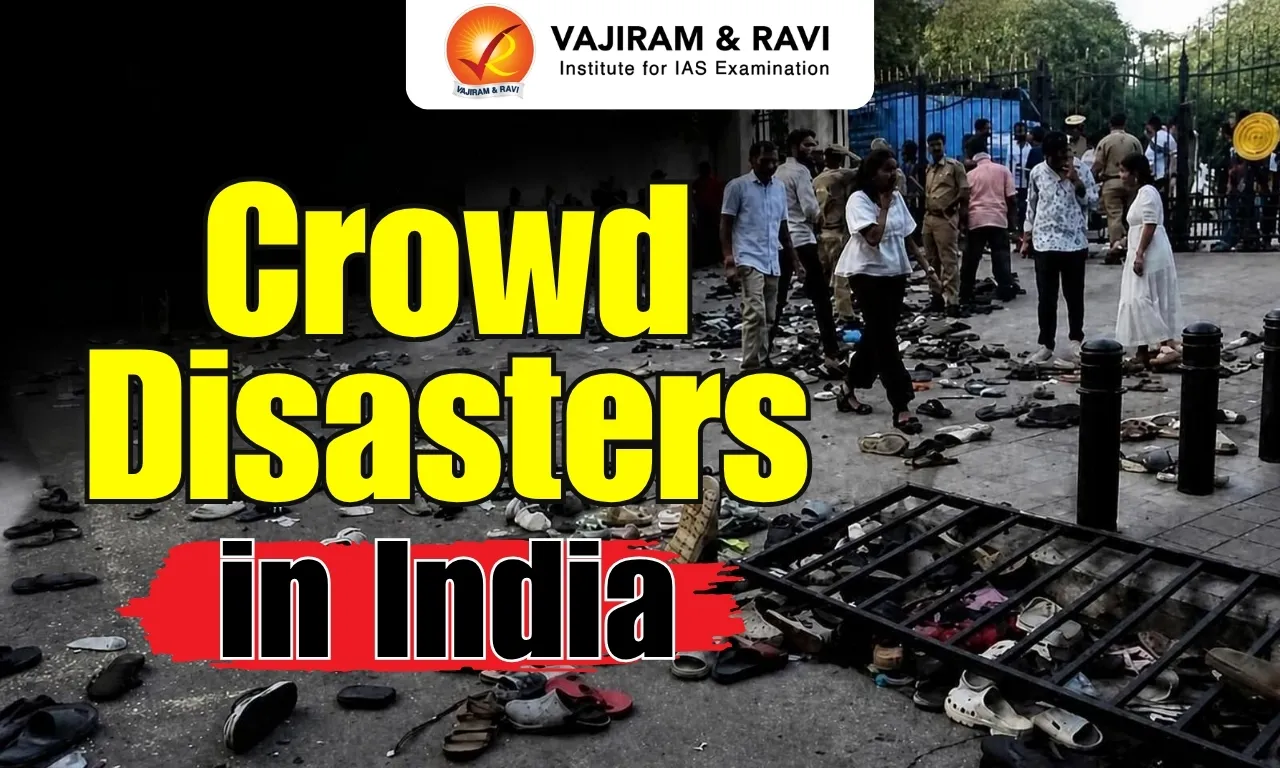
  • A crowd surge at the Chorbagan Sarbojanin Durga Puja pandal in north Kolkata, killed 19 people and injured around 25, once again spotlighting the risks of large unregulated gatherings in India. 
  • Heavy rain, a crowd of pandal-hoppers, and a possible public-address announcement appear to have triggered the deadly crush. 
  • A 2014 National Disaster Management Authority (NDMA) report notes that a majority of crowd disasters in India occur at religious places — making this a recurring governance challenge.

Understanding Stampede: It’s Really a Crowd Crush

  • What is loosely called a “stampede” is more accurately a crowd crush — a situation where crowd density becomes so high that individuals lose control over their own movement.
  • Structural Causes: Weak temporary structures, inadequate barricades, poorly lit stairways, narrow entry/exit points.
  • Trigger Events: Fires, electrical failures, security scares, or failures of crowd management.
  • Critical NDMA Insight: Deaths usually result not from literal “trampling” but from compressive asphyxia — when people packed tightly together cannot expand their chest to breathe.

What Went Wrong at Chorbagan?

  • Preliminary accounts suggest multiple risk factors converged: 
    • Heavy pandal-hopper crowds when rain began suddenly.
    • People moving forward as some fell, with the crowd behind continuing to press ahead.
    • A Public Address (PA) system announcement that may have intensified the rush.
  • Puja committee members and private security personnel have been detained; a SIT (Special Investigation Team) has been formed.
  • Following the tragedy, authorities asked other high-footfall pandals to temporarily halt admissions — reinforcing that crowd management is about density per space, not just total attendance.

How Crowd Behaviour Amplifies Risk

  • As per NDMA, individual behaviour is influenced by others — a few people jumping a barricade can trigger mass imitation.
  • This is not irrational behaviour; it reflects people responding to limited information and to what others around them appear to be doing.
  • Announcements Can Backfire: A message meant to warn or disperse people may instead cause simultaneous mass movement, unless carefully worded with managed exit routes.
  • Poor Coordination Risk: If police push one crowd in a direction that collides with an incoming stream, the opposing flows can create a dangerous crush.
  • Modern crowd science therefore favours communication and community-based management over force-based control.

Lessons From Past Disasters

  • Nashik Kumbh (August 2003): 29 killed — caused by barricade pressure, reverse crowd movement, and processions/vehicles sharing pilgrim routes.
  • Kalubai Yatra, Mandhardevi, Maharashtra (January 2005): 293 killed — India’s deadliest such tragedy. A Justice Rajan Kochar inquiry found:
    • Wrong crowd estimates
    • Narrow, steep, slippery approach route
    • Illegal vendors (some with gas cylinders) blocking the path
    • No watchtowers, PA systems, or adequate firefighting arrangements
    • Poor inter-agency coordination
  • Common Thread: Crowd disasters rarely have one cause — they result from multiple weaknesses (density, constricted movement, poor information, an unexpected trigger, weak coordination) converging simultaneously.

The NDMA Framework for Crowd Control

  • The guiding principle is managing demand and capacity:
    • Estimate Demand — based on past attendance, arrival patterns, religious significance, visitor profile.
    • Calculate Capacity — not just of the overall ground, but of critical bottlenecks (narrow lanes, bridges, staircases, entrances).
    • Apply Input Control — restrict or stagger entry when demand exceeds capacity (used at Vaishno Devi and Sabarimala via pilgrim registration).
    • For Unregulated Urban Events (like Durga Puja) — create holding areas, one-way routes, separate entry/exit points, real-time density monitoring, and temporary closures before congestion turns dangerous.
    • Make Waiting Safe Where Capacity Cannot be Increased — through adequate space, lighting, barricading, drinking water, medical facilities, trained volunteers, and clear, panic-free signage.
  • As experts put it: “The purpose of crowd management is to ensure that it never reaches the density and disorder at which a small trigger can become a catastrophe.”

Conclusion

  • The Kolkata tragedy is a grim reminder that crowd disasters are preventable, not inevitable — they occur when administrative foresight fails to match the scale of human congregation. 
  • India’s recurring pattern, from Mandhardevi to Chorbagan, shows that density management, clear communication, and inter-agency coordination matter far more than sheer attendance numbers. 
  • As urbanisation and mass religious tourism continue to grow, embedding NDMA’s demand-capacity framework into routine event planning — rather than treating it as a post-disaster lesson — remains the only sustainable path to safer public gatherings.

Source: IE | IE

Crowd Disasters in India FAQs

Q1: What are crowd disasters in India?

Ans: Crowd disasters in India are deadly incidents caused by overcrowding, uncontrolled movement, poor infrastructure, and inadequate crowd management at religious gatherings and public events.

Q2: What are the major causes of crowd disasters in India?

Ans: Crowd disasters in India often result from excessive crowd density, narrow exits, inadequate barricades, sudden panic, poor communication, and weak coordination among authorities.

Q3: What is the difference between a stampede and a crowd crush?

Ans: A crowd crush occurs when excessive density prevents people from moving freely or breathing properly. Many incidents commonly called stampedes involve compressive asphyxia.

Q4: Which major crowd disasters have occurred in India?

Ans: Major crowd disasters in India include the 2003 Nashik Kumbh tragedy and the 2005 Mandhardevi Kalubai Yatra disaster, highlighting recurring crowd-management failures.

Q5: How can crowd disasters in India be prevented?

Ans: Crowd disasters in India can be prevented through capacity planning, staggered entry, separate entry and exit routes, real-time density monitoring, trained volunteers, and coordinated communication.

Enquire Now

