
Venezuelan Oil Imports – India’s Energy Security and US Pressure

Venezuelan Oil Imports

Venezuelan Oil Imports Latest News

  • US Secretary of State Marco Rubio’s October 2026 visit to Reliance Industries’ Jamnagar refinery highlighted the US’  push for India to increase Venezuelan oil imports.

India’s Energy Security and Import Dependence

  • India is among the world's largest crude oil importers, making energy security a critical component of its economic and foreign policy. 
  • Crude oil imports support transportation, manufacturing, petrochemicals and other essential sectors, but expose the economy to global price fluctuations and geopolitical disruptions.
  • India has pursued energy-source diversification by sourcing crude from more than 40 countries. However, a relatively small group of suppliers accounts for a substantial share of total imports.
  • Russia emerged as India's largest crude supplier after the Russia-Ukraine war began in February 2022. Western restrictions on Russian oil created opportunities for Indian refiners to purchase discounted crude, reshaping India's import basket.
  • The West Asia crisis has further highlighted the importance of diversifying supplies to reduce vulnerability to disruptions along critical shipping routes and in major oil-producing regions.

Venezuela’s Role in India’s Crude Oil Basket

  • Venezuela possesses vast oil reserves, but its production remains limited relative to its resource base. Its flagship Merey crude is particularly heavy and contains high levels of sulphur, making it suitable mainly for refineries equipped with advanced processing capabilities.
  • India resumed Venezuelan oil imports after the United States eased restrictions. Imports rose from virtually zero before the recent crisis to approximately 350,000 barrels per day (bpd) in August 2026, before declining to around 200,000 bpd in September.
  • During April-August 2026, India imported Venezuelan crude worth approximately US$3.59 billion. Reliance Industries accounted for 74.3% of these imports, reflecting the importance of its Jamnagar refinery complex.

Refining Capacity and Commercial Constraints

  • US efforts to increase Venezuelan oil exports to India face several technical and economic limitations.
  • Refinery compatibility
    • Venezuelan Merey crude is extremely heavy and highly sulphurous. Reliance's Jamnagar complex, with combined crude-processing capacity of approximately 1.4 million bpd, is particularly well equipped to process it.
    • However, only a limited number of Indian refineries can handle substantial volumes of Venezuelan crude. Refining capability therefore places a natural limit on how much India can import without changing its existing crude mix or making additional investments.
  • Freight and landed cost
    • Venezuelan crude may be offered at a discount of approximately US$25 per barrel to Brent, the international benchmark. However, shipping to India's west coast can cost around US$35 per barrel.
    • These transportation costs can eliminate the apparent price advantage and make Venezuelan crude more expensive on a delivered basis. The economics of transporting smaller cargoes can be particularly challenging because very large crude carriers (VLCCs) are generally more cost-efficient for long-distance shipments.
  • Competition from other suppliers
    • Crude supplies from West Asia are gradually returning to the market, including heavier grades from Iraq. These supplies benefit from shorter shipping distances and lower freight costs, making them potentially more competitive than Venezuelan crude.
    • Consequently, Indian refiners must assess crude purchases on the basis of total delivered cost, quality, processing requirements and reliability rather than headline discounts alone.

Venezuelan Crude and Russian Oil: Different Roles

I
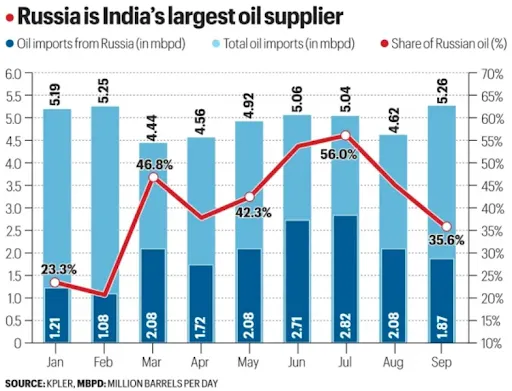
  • Venezuelan oil cannot readily replace India's large volumes of Russian crude because the two supplies differ in quality, refinery compatibility and commercial terms.
  • Russia supplied approximately 1.9 million bpd of crude to India in September 2026, accounting for more than 35% of India's total oil imports that month. Imports had reached a reported high of 2.8 million bpd in July.
  • Russian Urals crude is more compatible with a broader range of Indian refining facilities than Venezuela's particularly heavy Merey grade. Replacing Russian supplies with Venezuelan crude on a large scale would therefore require substantial adjustments to refinery operations and procurement strategies.
  • The United States has encouraged India to buy more Venezuelan crude while also seeking a reduction in Russian oil purchases. However, these objectives need not be treated as inseparable. India can diversify its sources without making an automatic commitment to reduce purchases from Russia.
  • For India, the central consideration is whether each transaction supports energy security and provides acceptable commercial returns.

Geopolitical Dimensions of the US Push

  • The US’ interest in Venezuelan crude reflects both energy-market and geopolitical considerations. Increasing exports to buyers such as India could help establish a larger market for Venezuelan oil under US oversight.
  • India's large refining sector makes it an attractive destination, particularly because relatively few countries can process heavy Venezuelan crude at scale.
  • At the same time, energy trade has become closely linked to broader US-India economic relations, including negotiations over a bilateral trade agreement and discussions about sanctions on Russian energy.
  • This creates a policy challenge for India: it must preserve constructive relations with the US while retaining flexibility in sourcing energy according to domestic economic requirements.
  • Any additional commitments should be assessed against clearly defined terms covering pricing, supply reliability, investment obligations, commercial returns and the duration of demand.

Source: IE

Venezuelan Oil Imports FAQs

Q1: Why does the United States want India to import more Venezuelan oil?

Ans: Washington wants to expand the market for Venezuelan crude and views India's advanced refining capacity as an opportunity to absorb larger volumes.

Q2: Why is Venezuelan crude difficult for many Indian refineries to process?

Ans: Its Merey grade is extremely heavy and highly sulphurous, requiring specialised refining capabilities that only a limited number of Indian facilities possess.

Q3: Why may discounted Venezuelan oil still be expensive for India?

Ans: High freight costs can exceed the crude's price discount, making its delivered cost less competitive than supplies from closer regions.

Q4: Can Venezuelan oil replace Russian crude in India's import basket?

Ans: Not on a comparable scale, because the two crude grades differ in quality, commercial terms and compatibility with India's refining infrastructure.

Q5: What should guide India's crude oil procurement decisions?

Ans: Procurement should be based on total cost, quality, refinery compatibility, supply reliability and national energy-security requirements.

Counter-Drone Missiles in India: Jwala and Defence Costs

Counter-drone missiles in India

Counter-Drone Missiles in India Latest News

  • In modern warfare, the cost of a weapon matters as much as its range or precision. 
  • The ongoing West Asia conflict has starkly exposed this “cost asymmetry”: a drone costing roughly $10,000 can force the launch of an interceptor worth hundreds of thousands, even millions, of dollars — meaning a defender may win the engagement but lose the economics of war. 
  • Against this backdrop, India’s private sector is pushing into cost-effective counter-drone interceptors, exemplified by the test of Jwala.

Why Cheap Interceptors Matter Now

  • The rapid proliferation of inexpensive drones has fundamentally changed defence economics.
  • This creates a new requirement: interceptors that are cheap enough to use repeatedly, yet reliable enough to protect military bases, troops, and critical infrastructure.
  • The key question: can Indian industry build affordable precision weapons that deliver the lowest sustainable cost per successful interception against a clearly defined threat class?

What Is Jwala?

  • Jwala-MK1 is a cost-effective short-range surface-to-air missile, developed by Indian defence technology firm IG Defence, an Odisha-based start-up.
  • Purpose: Primarily designed to destroy hostile unmanned aerial vehicles (UAVs) — unlike conventional air-defence missiles aimed at aircraft or high-value targets.
  • First public showcase: North Tech Symposium, Prayagraj, May 2026.
  • Technical Specifications
    • Uses a solid-fuel dual-pulse rocket motor — enabling rapid acceleration at launch and extra speed during final attack.
    • Engagement range: 2–5 km.
    • Altitude envelope: 50 metres to 5,000 metres.
  • Milestone: Recently, the company successfully test-fired two solid rocket motors — a key step toward full propulsion-system integration.
  • Next steps: Complete-system flight trials, guidance and control validation, testing against representative targets, reliability assessment, and integration with command-and-control architecture.
  • IG Defence plans to integrate Jwala with its GRID battle-management architecture — linking sensors, threat assessment, and defensive systems for a broader solution, not just a standalone interceptor.
  • It remains premature to assess Jwala’s actual cost-per-interception, since commercial viability — interception rates, procurement costs, performance against real threats — is not yet independently validated.

India’s Defence-Industrial Growth Context

  • Defence production hit a record ₹1.78 lakh crore in FY2025-26, with private firms contributing ~₹42,000 crore (24%).
  • Defence exports reached ₹38,424 crore during the same year.
  • In March 2026, the Defence Ministry highlighted the growing role of startups and MSMEs in indigenous defence technology development.
  • Market potential: As per various reports, India’s counter-UAS market — valued at $315 million in 2025 — is projected to reach $1.09 billion by 2030, implying 28.2% annual growth. 

Other Private Players in the Missile/Counter-Drone Space

  • Solar Industries India — rockets, ammunition, loitering munitions.
  • Adani Defence & Aerospace — building missile manufacturing infrastructure.
  • NIBE Group — new manufacturing complex for missile and rocket systems.
  • L&T — precision engineering, launch systems, defence electronics, weapon-platform integration.
  • Paras Defence and Space Technologies — signed a pact with US-based Powerus to manufacture and sell the Guardian-1 counter-drone interceptor in India.

What Determines Success

  • Jwala’s — and by extension India’s private counter-drone industry’s — success hinges on three outcomes:
    • Reliable interception — consistently neutralising threats.
    • Competitive lifecycle cost — staying affordable across production and deployment.
    • Scalable production — ability to manufacture in meaningful numbers.
  • Achieving all three could secure India a valuable position in both its own defence ecosystem and global counter-drone markets.

Conclusion

  • The Jwala test underscores a critical shift in India’s defence strategy — recognising that future conflicts will be won or lost not just on battlefield performance, but on economic sustainability. 
  • As cheap drones proliferate globally, India’s growing ecosystem of private defence startups and established manufacturers signals a serious attempt to close the cost-asymmetry gap. 
  • However, Jwala’s true test lies ahead — in rigorous trials proving it can deliver reliable, affordable, and scalable interception, transforming early promise into a credible indigenous counter-drone capability.

Source: TH

Counter-drone missiles in India FAQ

Q1: Why are counter-drone missiles in India becoming increasingly important?

Ans: Counter-drone missiles in India are gaining importance because inexpensive hostile drones can force defenders to use costly interceptors, creating an unfavourable economic imbalance in warfare.

Q2: What is the Jwala-MK1 counter-drone missile?

Ans: Jwala-MK1 is a short-range surface-to-air missile developed by Odisha-based IG Defence to destroy hostile unmanned aerial vehicles and improve affordable interception capabilities.

Q3: What are the technical specifications of the Jwala-MK1 missile?

Ans: Jwala-MK1 has a reported engagement range of 2–5 kilometres, an altitude envelope of 50–5,000 metres, and a solid-fuel dual-pulse rocket motor.

Q4: How can counter-drone missiles in India reduce defence expenditure?

Ans: Counter-drone missiles in India could reduce defence expenditure by lowering the sustainable cost per successful interception while protecting military bases, troops and critical infrastructure.

Q5: What will determine the success of India’s counter-drone industry?

Ans: India’s counter-drone industry will depend on reliable interception, competitive lifecycle costs and scalable production, supported by rigorous testing and integration with command-and-control systems.

PHP2Shell Vulnerabilities, Risks to Global Cybersecurity

PHP2Shell Vulnerabilities

PHP2Shell Vulnerabilities Latest News

  • Recently, websites worldwide went offline as a precaution, after two critical vulnerabilities in PHP, one of the internet’s most widely used programming languages, were discovered.
    • The websites included services run by Japan’s Finance Ministry, US HR platform BambooHR, the Port of Rotterdam, and the Wikimedia Foundation (operator of Wikipedia).
  • The flaws, collectively dubbed PHP2Shell, triggered emergency security updates and prompted governments and cybersecurity agencies worldwide to urge immediate action.

What Is PHP, and Why Does It Matter So Much?

  • PHP (Hypertext Preprocessor) is a free, open-source, volunteer-maintained programming language that runs behind the scenes of websites — handling logins, form submissions, and online purchases.
  • It powers ~70% of websites whose server-side language is identifiable.
  • WordPress — which runs over 40% of all websites globally (blogs, government portals, news sites, online shops) — is itself built on PHP.
  • This pervasiveness is exactly why a flaw in PHP has such outsized global impact.

What Exactly Is PHP2Shell?

  • PHP2Shell refers to two critical vulnerabilities that could let attackers remotely execute malicious code on web servers — without logging in — or access sensitive information stored in server memory.
  • Flaw 1 — Interrupted Mid-Task: When PHP runs out of memory while processing a request (e.g., a CV upload), it can be cut off midway and later mistakenly treat incomplete data as valid — creating an exploitable gap.
  • Flaw 2 — Leftovers: PHP can sometimes retain leftover information from an earlier user’s request even after that memory should have been cleared. When handling a new request, it may mistakenly reuse this outdated data instead of starting fresh — which an attacker could exploit to interfere with server operations.

Why It’s Dangerous

  • Attackers need no account or physical access — a single malicious request sent over the internet could, under certain conditions, make a server execute attacker-chosen instructions.
  • This could expose personal information, uploaded documents, or login credentials.
  • AI tools could accelerate exploitation, even though the flaws are dangerous on their own.

Why Websites Went Offline

  • Cybersecurity agencies urged immediate patching; where that wasn’t feasible, temporary shutdown was the safer precaution.
  • Key challenge: Updating PHP isn’t always simple. 
    • Many small websites run on shared hosting, where owners don’t control the server or even know who maintains PHP.
    • The immediate challenge is not simply installing a patch, but finding and managing every instance where PHP is running.
    • PHP can be embedded invisibly within content-management systems, hosting platforms, and third-party products.
    • Older appliances/devices are especially hard to patch, often being a black box with limited visibility, dependent on vendors for updates.
  • CERT-EU advised organisations unable to patch immediately to take vulnerable systems offline.
  • India’s CERT-In issued a critical advisory the same day, warning of potential full system takeover and urging immediate updates.

Conclusion

  • The PHP2Shell episode is a stark reminder that the internet’s foundational infrastructure often rests on decades-old, volunteer-maintained code — vulnerable not because of neglect, but because of sheer scale and invisibility across millions of interconnected systems. 
  • While AI tools helped researchers find and understand the flaws faster than ever before, the same technology could equally empower attackers, compressing the window organisations have to respond. 
  • As PHP2Shell shows, cybersecurity resilience today depends as much on visibility into sprawling, often-hidden software dependencies as on the speed of releasing a patch.

Source: IE | ToI

PHP2Shell Vulnerabilities FAQs

Q1: What are PHP2Shell vulnerabilities?

Ans: PHP2Shell vulnerabilities are two critical flaws in PHP that could allow attackers to execute malicious code remotely on web servers or access sensitive information in server memory.

Q2: Why are PHP2Shell vulnerabilities dangerous for websites?

Ans: PHP2Shell vulnerabilities are dangerous because attackers may exploit them through malicious internet requests without an account, potentially exposing personal information, uploaded documents and login credentials.

Q3: Why did websites go offline following the discovery of PHP2Shell vulnerabilities?

Ans: Websites temporarily went offline because cybersecurity agencies urged immediate security updates, while shutdowns offered a precautionary measure when vulnerable systems could not be patched promptly.

Q4: How do PHP2Shell vulnerabilities affect WordPress websites?

Ans: PHP2Shell vulnerabilities matter to WordPress because the platform relies on PHP, which powers a substantial share of websites and supports essential server-side operations.

Q5: How can organisations respond to PHP2Shell vulnerabilities?

Ans: Organisations should identify affected PHP installations, apply security updates promptly, assess third-party dependencies, and temporarily isolate vulnerable systems when immediate patching is not feasible.

Enquire Now

