
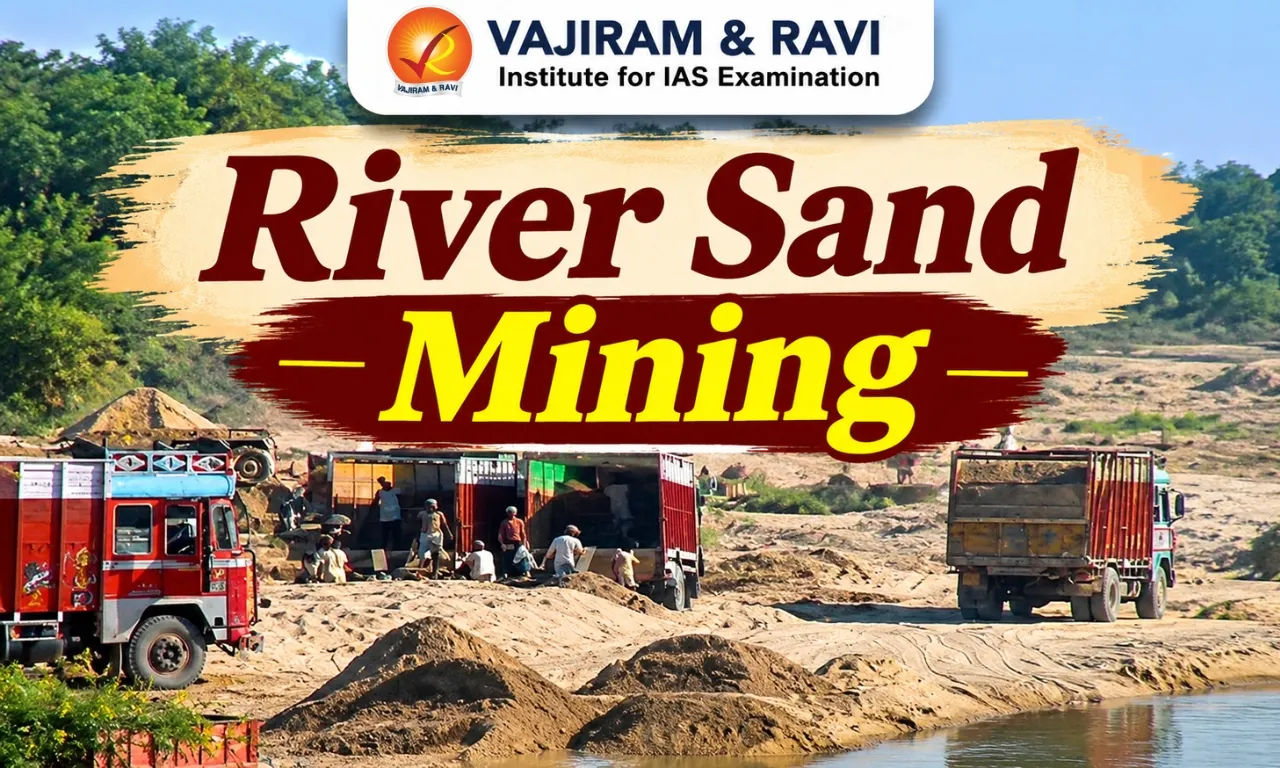
River Sand Mining in India – Supreme Court Panel’s Recommendations

River Sand Mining

River Sand Mining Latest News

  • The Supreme Court-appointed Central Empowered Committee (CEC) has recommended phasing out unsustainable sand extraction from active river channels within three years and developing alternative sources to meet construction demand.

Background and CEC Recommendations

  • The recommendations form part of CEC Report No. 36 of 2026, submitted to the Supreme Court on November 2, in the suo motu proceedings concerning illegal sand mining in the National Chambal Sanctuary.
  • The Supreme Court had expanded the proceedings to cover river sand mining across India, after expressing concern over its damaging impact on river ecosystems.
  • The CEC has proposed a time-bound roadmap to progressively phase out unsustainable extraction from active river channels over three years. 
  • The transition would be supported by alternative sources, including:
    • Reservoir sediment: Sand recovered through planned desilting of dams.
    • Manufactured Sand (M-sand): Produced by crushing and processing suitable rock. It can substitute natural river sand in construction when it meets Bureau of Indian Standards (BIS) specifications.
    • Recycled Construction and Demolition (C&D) Waste: Recovered material that can help meet construction requirements.

Reservoir Desilting as an Alternative

  • The CEC has recommended a time-bound desilting programme, with contracts for eligible works awarded within three years, followed by a structured 10-year cycle for reservoirs identified as suitable.
  • The proposed framework includes:
    • Assessing all storage dams older than 15 years that have not undergone systematic desilting.
    • Desilting approximately one-tenth of suitable reservoirs annually.
    • Selling recovered sand through transparent mechanisms.
    • Ensuring that desilting is based on technical and environmental suitability rather than treating it as mandatory for every dam.
  • The Ministry of Jal Shakti has been recommended as the lead agency for developing a national framework in consultation with relevant institutions, including the Central Water Commission, National Dam Safety Authority, Ministry of Environment, Forest and Climate Change, and State Governments.

Reservoir Sedimentation and Storage Loss

  • The CEC cited Ministry of Jal Shakti data presented to Parliament in December 2025:
    • Of the 439 assessed reservoirs, average gross storage loss due to sedimentation was 19.24%.
    • Twenty-three reservoirs had lost more than half of their storage capacity.
    • Gobind Sagar reservoir, behind the Bhakra Dam, had declined from 9,868 million cubic metres (MCM) to approximately 7,300 MCM, representing a reduction of about 26%.
  • Desilting could therefore serve a dual purpose: restoring reservoir storage capacity and supplying part of the construction sector's demand for sand.
  • However, the CEC cautioned that total accumulated sediment cannot be treated as entirely recoverable or commercially usable sand. Its technical recoverability and environmental acceptability require assessment.

Digital Monitoring and Traceability

  • To improve regulation and curb illegal extraction, the CEC recommended a digital monitoring system covering:
    • Mining permissions and permitted quantities
    • Actual mineral extraction
    • Electronic transit permits
    • End-use of extracted material
  • Secure electronic transit permits should incorporate unique QR codes, barcodes or RFID-based identification to improve traceability of mineral movement.

Challenges in Implementing the Recommendations

  • Limited national data: There is no consolidated and reliable national database quantifying the volume or value of illegally extracted river sand.
  • Uncertain reservoir potential: The usable quantity of construction-grade sand available in reservoirs has not been adequately assessed at the national level.
  • Centre-State coordination: Sand, classified as a minor mineral, and water are State subjects. Implementation will require coordination between the Union Government and State Governments.
  • Construction demand: Alternative sources must be developed without disrupting legitimate construction requirements.
  • The CEC also highlighted an earlier 2020 report on Rajasthan, which found that legal sand collection declined from approximately 57 million tonnes annually to 5 million tonnes after mining restrictions imposed by the Supreme Court. The report identified the resulting supply gap as a major driver of illegal mining.

Conclusion

  • The CEC's recommendations seek to shift India's approach from restricting illegal river sand mining towards developing sustainable alternatives and improving mineral traceability. 
  • Reservoir desilting, M-sand and recycled construction waste could reduce pressure on river ecosystems while supporting construction demand. 
  • Their implementation will depend on scientific assessments, environmental safeguards and effective Centre-State coordination.

Source: IE

River Sand Mining FAQs

Q1: What is the Central Empowered Committee (CEC)?

Ans: The CEC is a committee appointed by the Supreme Court to assist it in matters concerning environmental protection and related issues.

Q2: What has the CEC recommended regarding river sand mining?

Ans: It has recommended a time-bound roadmap to phase out unsustainable extraction from active river channels within three years.

Q3: What is Manufactured Sand (M-sand)?

Ans: M-sand is produced by crushing and processing suitable rocks. It can replace natural river sand in construction when it meets BIS specifications.

Q4: Why is reservoir desilting being proposed?

Ans: Desilting can help restore reservoir storage capacity and recover sediment that may be suitable for construction use.

Q5: What is the proposed desilting cycle?

Ans: The CEC has recommended assessing storage dams over 15 years old that have not been systematically desilted, followed by desilting around one-tenth of suitable reservoirs annually as part of a structured 10-year cycle.
Apple’s India Manufacturing Challenges: Worker Deaths at Tata’s Hosur Plant

Apple’s India Manufacturing Challenges

Apple’s India Manufacturing Challenges Latest News

  • Recently, three contract workers died at a Tata Electronics factory in Hosur, Tamil Nadu, while performing maintenance at an effluent treatment plant. 
  • The incident has renewed scrutiny of safety and operational standards in Apple’s rapidly expanding Indian manufacturing ecosystem, which now produces roughly 25% of global iPhones. 
  • This is not an isolated event — it is the latest in a long pattern of fires, protests, environmental violations, and security breaches plaguing Apple’s Indian supply chain.

What Happened at Hosur

  • Three workers inhaled suspected toxic gases while inspecting a nano-filtration tank at an effluent treatment plant operated by Nalco Water (a subsidiary of US-based Ecolab) within Tata’s facility.
  • The Tamil Nadu government has ordered an investigation; Apple and Tata are conducting their own inquiries.
  • The incident raises questions about industrial safety standards at facilities increasingly critical to Apple’s global supply chain — especially as India moves from mere assembly to manufacturing sophisticated components.

How India Became Central to Apple’s Supply Chain

  • Apple began iPhone assembly in India in 2017, initially with older models.
  • Expansion accelerated due to: 
  • India now contributes ~25% of global iPhone production.
  • Two key manufacturing partners: 
    • Tata Group: ~40% of domestic iPhone assembly.
    • Foxconn (Taiwan): remainder of assembly operations.
  • Tata’s rise was driven by acquiring Wistron’s Indian operations (2023) and later taking over Pegatron’s Indian iPhone business.
  • Tata’s Hosur facility is strategically significant — it manufactures precision-engineered metal casings and back panels, reflecting India’s shift toward deeper local value addition, not just assembly of imported components.

A Pattern of Recurring Problems

  • Cybersecurity Breach (June 2026)
    • A ransomware attack on Tata’s Hosur iPhone assembly facility leaked over 200,000 files on the dark web, including confidential supplier details, component specs, and images of the then-unreleased iPhone 18 Pro.
    • This was particularly damaging given Apple’s strict confidentiality protocols around unreleased products.
    • Tata responded by restricting internal system access and hiring a global forensic consultant.
  • Environmental Allegations (2026)
    • The Tamil Nadu Pollution Control Board (TNPCB) warned of possible factory closure over alleged groundwater contamination from wastewater discharge affecting nearby farmland and wells.
    • Tata disputed the findings, claiming freshwater sample analyses showed no contamination; the regulator eventually accepted Tata’s explanation and dropped action.
  • Employment Discrimination (2024-25)
    • Foxconn faced allegations of systematically excluding married women from assembly-line jobs at its Sriperumbudur (Tamil Nadu) plant, exposed via a Reuters investigation.
    • This triggered scrutiny from the Union Labour Ministry and the National Human Rights Commission (NHRC).
    • NHRC criticised labour officials in January 2025 for inadequate investigation, but a subsequent government probe cleared Foxconn of wrongdoing.
    • Foxconn later removed age, gender, and marital-status criteria from job advertisements.
  • Fires and Production Disruptions
    • September 2024: A major fire at Tata’s Hosur facility (chemical storage area) temporarily halted iPhone back-panel component manufacturing — then a crucial domestic supply source.
    • September 2023: Pegatron suspended iPhone assembly at its Chennai facility after a fire.
    • Earlier 2023: Foxlink (iPhone charger manufacturer) halted production in Andhra Pradesh after a fire caused partial building collapse.
  • Worker Unrest
    • December 2021: Foxconn’s Chennai-area factory shut for over three weeks after ~250 workers fell ill, triggering protests over living conditions and food safety; Apple later found the facility did not meet its standards.
    • December 2020: Workers at Wistron’s Narsapura (Karnataka) plant vandalised property protesting alleged non-payment of wages, forcing a three-month shutdown.

Conclusion

  • As India cements its position as a critical node in Apple’s global supply chain, the recurring pattern of fires, worker unrest, environmental concerns, and now fatal industrial accidents signals that manufacturing scale has outpaced safety and governance systems. 
  • For India’s electronics manufacturing ambitions to be sustainable, stronger enforcement of industrial safety, labour rights, and environmental compliance must keep pace with its growing share of global production.

Source: IE | IT

Apple’s India Manufacturing Challenges FAQs

Q1: What happened at Tata Electronics’ Hosur plant?

Ans: Three contract workers died after inhaling suspected toxic gases while inspecting a nano-filtration tank at an effluent treatment plant inside Tata’s facility.

Q2: Why has India become important to Apple’s global manufacturing operations?

Ans: Apple’s India manufacturing challenges accompany its growing production footprint, driven by efforts to diversify beyond China and India’s smartphone Production Linked Incentive scheme.

Q3: What role does Tata Group play in Apple’s Indian supply chain?

Ans: Tata accounts for approximately 40% of domestic iPhone assembly and manufactures precision-engineered metal casings and back panels at its Hosur facility.

Q4: What recurring problems have affected Apple’s Indian manufacturing ecosystem?

Ans: Apple’s India manufacturing challenges include industrial fires, worker protests, cybersecurity breaches, environmental allegations and concerns over employment discrimination at supplier facilities.

Q5: What measures are needed to make India’s electronics manufacturing ecosystem sustainable?

Ans: Addressing Apple’s India manufacturing challenges requires stronger enforcement of industrial safety standards, labour rights and environmental regulations alongside expanding manufacturing capacity.

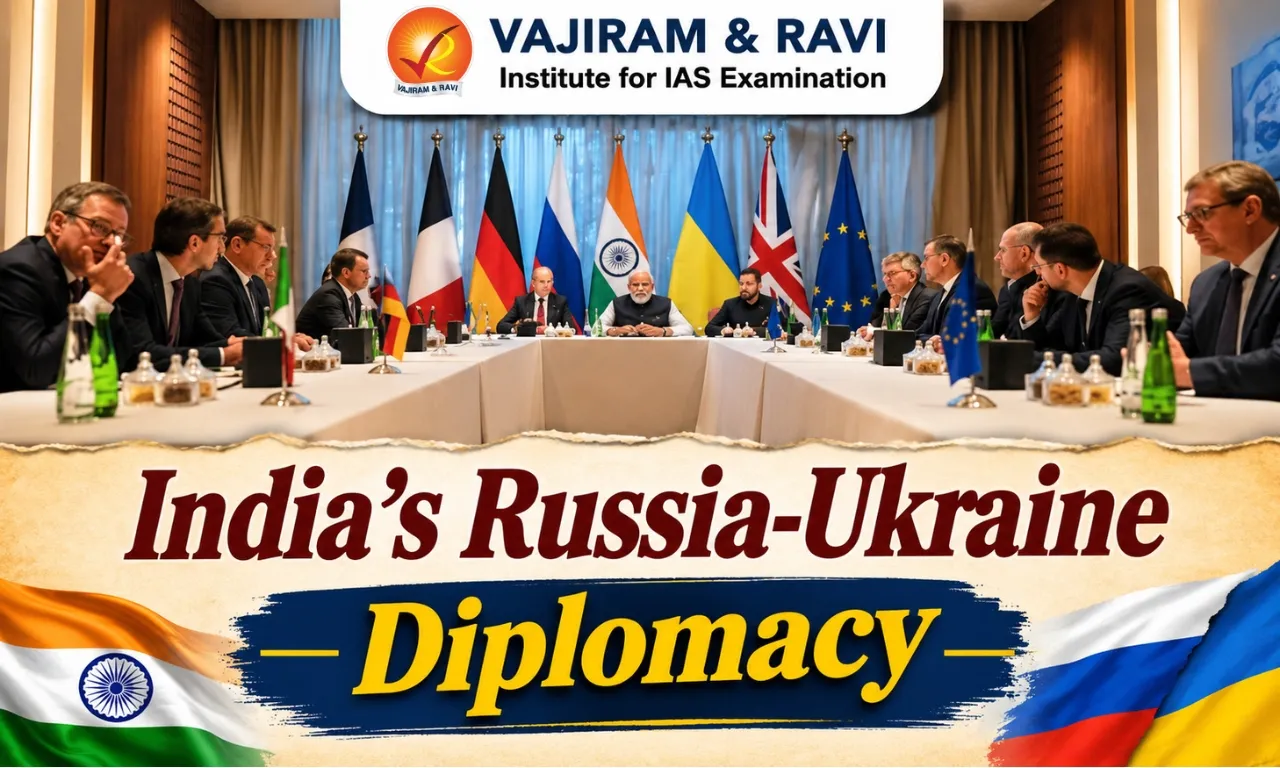
India’s Russia-Ukraine Diplomacy: 2026 Peace Talks and India’s Expanding Role

India’s Russia-Ukraine Diplomacy

India’s Russia-Ukraine Diplomacy Latest News

  • On November 10-11, 2026, delegations from the US, Russia, and Ukraine met in Abu Dhabi for the third round of US-mediated peace talks, aiming to end the nearly five-year war — Europe’s deadliest conflict since World War II. 
  • Alongside, India has emerged as an active diplomatic player, engaging both Moscow and Kyiv at the highest levels, with concrete proposals on maritime security and humanitarian concerns.

The Road to Abu Dhabi: Earlier Rounds of Talks

  • May-June 2025 (Istanbul): First direct talks since the 2022 invasion. A 28-point US-Russia peace plan demanded Ukraine renounce NATO membership and give up its long-range arsenal — rejected by Zelenskyy. 
    • Europe countered with demands for an Article 5-style security guarantee (collective defence principle). No consensus reached.
  • February 2026 (Geneva): Russia insisted Ukraine cede the entire Donbas region before any ceasefire; Kyiv rejected this and demanded an unconditional ceasefire. 
    • Talks collapsed, further disrupted by the US-Israel conflict with Iran, which diverted US diplomatic bandwidth.

What’s on the Table Now

  • Territory: Russia controls Crimea (annexed 2014) and parts of eastern/southern Ukraine, claiming Donetsk, Luhansk, Zaporizhzhia, and Kherson. It wants Ukraine to withdraw from Donbas; Ukraine rejects this, though US negotiators see room for limited mutual concessions.
  • Security Guarantees: Ukraine demands credible guarantees against future Russian aggression, having earlier sought NATO membership — a key trigger cited for Russia’s 2022 invasion.
  • European Security Architecture: Russia wants this framework discussed before resolving the immediate conflict; EU’s Ursula von der Leyen insists it should follow a ceasefire. 
    • Notably, Russia has blocked European participation in talks, even as France, Germany, UK, Italy, EU, and NATO hold parallel discussions with US/Ukrainian officials in Abu Dhabi.

Impact of US Midterm Elections

  • Democrats’ “blue wave” win in the US Congress could push for greater military aid to Ukraine and tougher sanctions on Russia once new members take office in January.
  • However, Trump’s administration retains control over the immediate negotiations; a shift in Congress doesn’t automatically alter foreign policy, depending instead on bipartisan legislative support.

India’s Diplomatic Role

  • A day before the talks, PM Modi spoke with Zelenskyy; hours later, EAM Jaishankar spoke with Lavrov — reflecting India’s engagement with both sides at the highest level.
  • Zelenskyy urged India to leverage its diplomatic ties with world leaders to help end the war, highlighting food security as a cooperation area.
  • Ukraine’s FM Andrii Sybiha called India’s proposal the “most comprehensive” among those received from India, Egypt, Turkey, and the US; Putin praised Modi’s “very good ideas.”

India’s Three-Part Truce Proposal

  • Reduce attacks around the Black Sea to enable Ukrainian agricultural exports.
  • Halt Russian attacks on Ukraine’s energy infrastructure.
  • Ukraine refrains from attacking Russian positions along the line of contact.

Why the Black Sea Matters

  • The Black Sea is critical for both nations: 
    • Ukraine’s three key ports (Odesa, Chornomorsk, Pivdennyi) handle ~90% of its agricultural exports; 
    • Russia transports 77-81% of its grain exports (42-44 million tonnes) via the Azov-Black Sea region.
  • Continued fighting threatens 400 million people across Africa, West Asia, and Asia with food shortages and malnutrition.
  • India’s direct stakes: 5 Indian seafarers killed, 2 missing in Black Sea attacks; India imports ~1.97 million barrels/day of Russian crude (~35% of total oil imports) — making safe shipping a vital national interest.

India’s Broader Regional Concerns

  • India has also called for free and safe navigation through the Strait of Hormuz, amid the West Asia conflict, engaging Iran, Israel, and the US.
  • Foreign Secretary Vikram Misri visited the UAE as part of these sustained diplomatic efforts.

What If Talks Fail?

  • Diplomacy would likely continue through separate channels (prisoner exchanges, shipping safety), even without a comprehensive deal.
  • Unresolved territorial and security disputes would mean continued Western support for Ukraine and continued Russian military operations — with spillover effects on global trade, energy prices, and food security.

Conclusion

  • India’s shift from advocating peace to proposing concrete, actionable measures marks a significant evolution in its Russia-Ukraine diplomacy — driven as much by humanitarian concern as by its own economic and strategic stakes in energy security and global trade. 
  • While India remains outside the formal Abu Dhabi talks, its channels with both Moscow and Kyiv position it as a credible facilitator in an otherwise deadlocked peace process.

Source: IE | IT | IE

India’s Russia-Ukraine Diplomacy FAQ

Q1: What is the significance of the 2026 US-mediated Russia-Ukraine peace talks?

Ans: The talks seek to end the prolonged Russia-Ukraine war, addressing territorial disputes, security guarantees and European security architecture through renewed diplomacy.

Q2: What are the major issues under discussion in the Abu Dhabi peace talks?

Ans: The key issues include territorial control, Ukraine’s security guarantees and the sequencing of discussions on the future European security architecture.

Q3: How is India’s Russia-Ukraine diplomacy evolving?

Ans: India’s Russia-Ukraine diplomacy has moved beyond advocating peace to proposing concrete measures on maritime security, energy infrastructure and humanitarian concerns.

Q4: What are the three components of India’s proposed Russia-Ukraine truce?

Ans: India’s Russia-Ukraine diplomacy proposes reducing Black Sea attacks, halting Russian strikes on Ukrainian energy infrastructure and preventing Ukrainian attacks along the line of contact.

Q5: Why is the Black Sea strategically important for India?

Ans: The Black Sea matters to India’s Russia-Ukraine diplomacy because attacks threaten Indian seafarers, Russian crude shipments, agricultural exports and wider global food security.

Enquire Now

