
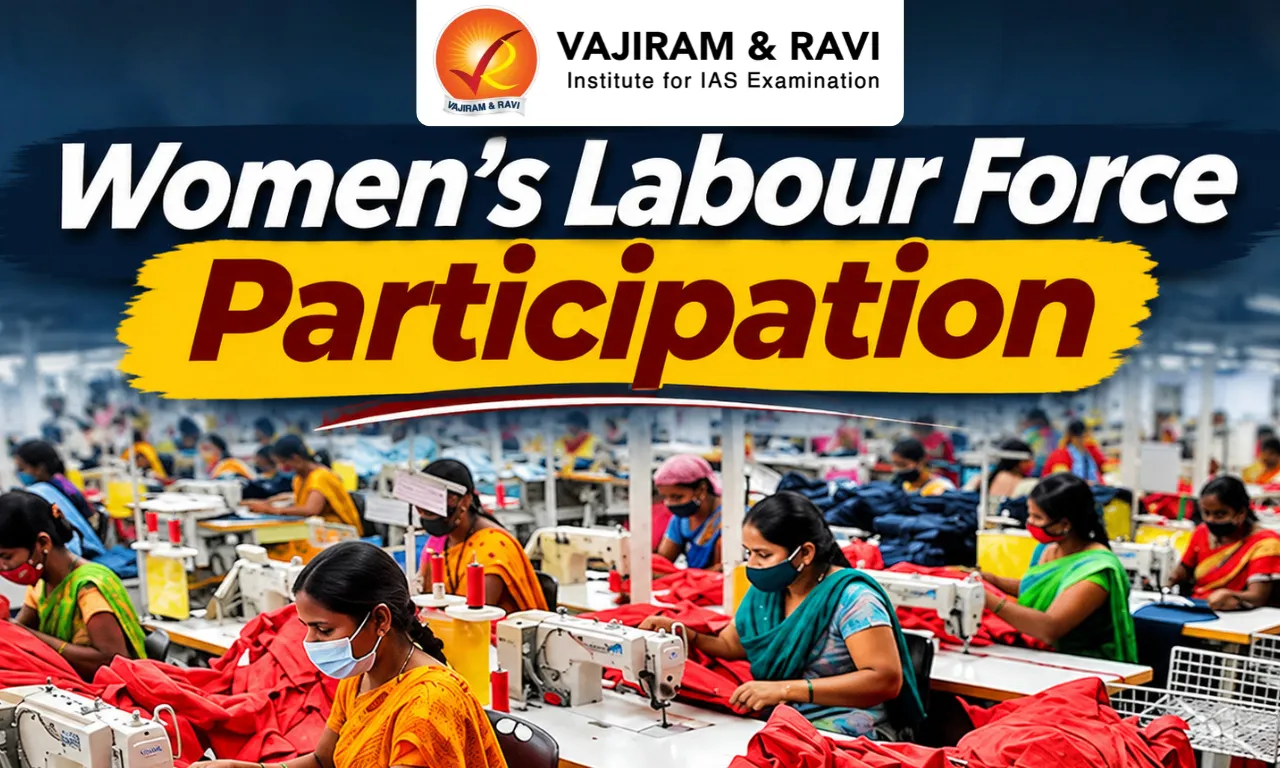
Women’s Labour Force Participation – Addressing the Unpaid Care Work Barrier

Women’s Labour Force Participation

Women’s Labour Force Participation Latest News

  • Achieving the goal of Viksit Bharat by 2047 requires India to raise its economic growth rate closer to 8% and expand women’s participation in the workforce.
  • According to the World Bank, increasing the Female Labour Force Participation Rate (FLFPR) to 50% (from  34.6% in Sept 2026) could significantly accelerate India’s progress towards becoming a high-income economy.
  • However, inadequate data on unpaid domestic and caregiving responsibilities makes it difficult to understand why women remain outside paid employment.

Understanding the Gender Gap in Workforce Participation

  • Women’s participation in paid employment is influenced by several factors, including unpaid domestic work, childcare, eldercare, mobility restrictions and workplace accessibility.
  • However, experts caution against assuming a direct relationship between care responsibilities and women's withdrawal from the workforce without adequate empirical evidence.
  • The government is therefore attempting to improve its statistical framework to understand the relationship between unpaid care work and women's employment decisions.
  • The Ministry of Statistics and Programme Implementation (MoSPI) has proposed changes to two major surveys following suggestions from academics, government ministries and economic advisers.

Periodic Labour Force Survey (PLFS)

  • The proposed changes aim to capture the nature and extent of unpaid household work.
  • Key additions include:
    • Identifying whether household-produced goods and services, such as cooking, feeding children and caring for elderly people, are meant for self-consumption or commercial purposes.
    • Asking whether individuals actively sought paid employment during the previous 30 days.
    • Identifying whether they currently wish to undertake paid work.
    • Recording the principal reasons for not seeking employment, including family and household responsibilities.
  • Existing data gap:
    • The PLFS already asks individuals outside the workforce why they are not seeking employment. 
    • However, its existing categories, such as childcare and personal commitments in homemaking, are considered too generic.
    • In 2025, 44.4% of women cited childcare or personal commitments in homemaking as their primary reason for not seeking employment.
    • The existing framework does not distinguish between women who undertake unpaid work by choice and those who do so because of social expectations or a perceived sense of duty.

Annual Survey of Unincorporated Sector Enterprises (ASUSE)

  • MoSPI also proposes collecting information from female business owners on barriers affecting women's entrepreneurial participation, particularly:
    • Limited time available for entrepreneurial activities.
    • Restrictions on women's mobility outside their homes.
    • Household responsibilities and caregiving obligations.
  • These additions could help identify gender-specific barriers to women's participation in the informal and entrepreneurial sectors.

Unpaid Care Work - The Gendered Burden

  • The government's Time Use Surveys (2019 and 2024) highlight the unequal distribution of unpaid domestic and caregiving responsibilities.
  • For example, working-age men (aged 15-59 years) spent 62 minutes a day on various unpaid activities in 2024, down from 74 minutes in 2019.
  • In comparison, women in the same age bracket saw their time spent on unpaid activities go up slightly from 364 minutes per day in 2019 to 366 minutes in 2024. 
  • Key observations:
    • Women spend nearly six times as much time as men on unpaid activities.
    • While men's unpaid work declined between 2019 and 2024, women's contribution remained almost unchanged.
    • Despite this persistent disparity, female LFPR increased from approximately 26.5% to 43.6% during the same period.
  • Significance: These contrasting trends demonstrate the need to examine how women balance paid employment with unpaid responsibilities rather than assuming that unpaid care work automatically prevents labour market participation.

Importance of Improved Data Collection

  • The proposed survey changes could strengthen evidence-based policymaking in several ways:
    • Better measurement: Establish the magnitude and distribution of unpaid domestic and care work.
    • Regional analysis: Identify differences between rural and urban areas and across States.
    • Demographic insights: Examine variations among younger and older women.
    • Employment preferences: Understand whether women outside the workforce actually wish to undertake paid employment.
    • Policy targeting: Distinguish between lack of employment opportunities, social restrictions and caregiving responsibilities.
  • However, the reliability of findings will depend on respondents providing accurate information. 
  • MoSPI officials believe that people generally report their work accurately, although expectations of government benefits may sometimes influence responses.

Addressing Structural Barriers - Lessons from Tamil Nadu

  • Unpaid care responsibilities are only one part of the problem. Women's employment also depends on suitable wages, workplace proximity, safe transportation and appropriate living arrangements.
  • Tamil Nadu employs four out of every ten directly employed female factory workers in India.
  • The State has adopted elements of the Chinese manufacturing model by providing dormitories for women workers near factories or within industrial campuses.
  • Significance of the model:
    • Reduces commuting distances and mobility-related constraints.
    • Provides safer and more accessible accommodation.
    • Facilitates the employment of migrant women workers.
    • Supports manufacturing growth amid demographic ageing in several southern States.
  • However, re-entering the workforce requires multiple conditions to come together, including adequate remuneration, accessible workplaces, safe transportation and childcare and eldercare support.

Way Forward

  • Strengthen care infrastructure: Expand affordable crèches, childcare centres and accessible eldercare facilities.
  • Recognise unpaid work: Improve measurement and recognition of women's unpaid domestic and caregiving contributions.
  • Promote shared responsibilities: Encourage equitable distribution of household and caregiving duties between men and women.
  • Improve workplace accessibility: Provide safe transport, affordable accommodation and gender-sensitive workplace facilities.
  • Support women entrepreneurs: Improve access to credit, skills, markets and flexible working arrangements.
  • Adopt evidence-based policymaking: Use disaggregated PLFS and ASUSE data to develop region-specific interventions.
  • Generate decent employment: Expand formal, secure and adequately remunerated employment opportunities for women.

Conclusion

  • Achieving Viksit Bharat by 2047 requires moving beyond merely increasing women's labour force participation figures towards addressing the structural barriers that restrict their economic choices. 
  • Better data on unpaid care work can transform women's economic participation into a major driver of India's inclusive and sustainable growth.

Source: IE

Women’s Labour Force Participation FAQs

Q1: How can higher Female Labour Force Participation Rate (FLFPR) contribute to Viksit Bharat 2047?

Ans: Raising FLFPR to 50% can expand India's productive workforce, boost GDP growth, improve household incomes, etc.

Q2: How does unpaid care work act as a barrier to women's workforce participation?

Ans: Disproportionate responsibility for childcare, eldercare and household activities restricts women's time, mobility, etc.

Q3: What is the significance of MoSPI's proposed changes in PLFS and ASUSE?

Ans: They will generate disaggregated data on unpaid care work, employment preferences and entrepreneurial barriers.

Q4: What lessons can India learn from Tamil Nadu's women-friendly industrial employment model?

Ans: Factory-linked dormitories and accessible accommodation can reduce mobility and safety constraints.

Q5: What measures will address the gender gap in India's labour market?

Ans: Affordable childcare, eldercare facilities, safe transport, equal household responsibilities, flexible workplaces, etc.
Physical AI – Applications, Industrial Transformation and Challenges

Physical AI

Physical AI Latest News

  • The deployment of Physical AI is gaining momentum as companies increasingly integrate AI-powered autonomous systems into industrial operations, with applications ranging from robotics and predictive maintenance to energy exploration and automated manufacturing.

About Physical AI

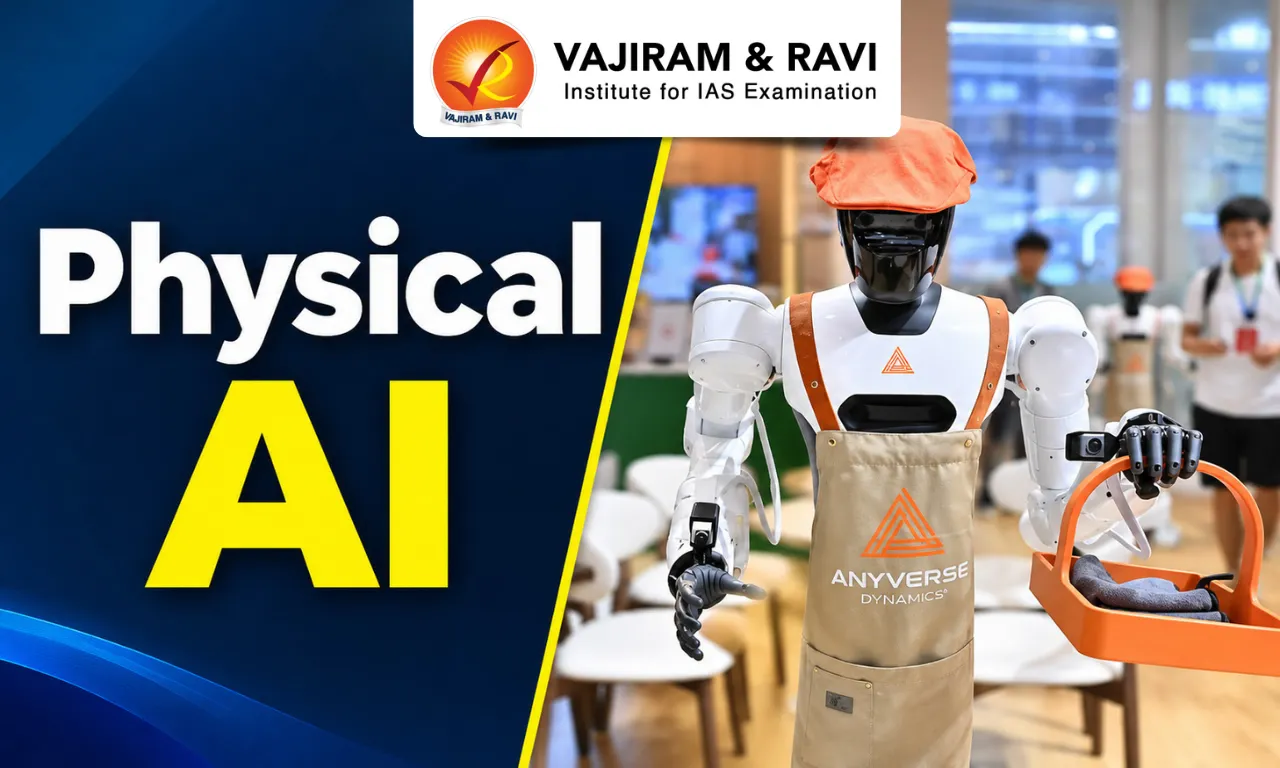
  • Physical AI refers to the application of artificial intelligence to autonomous systems that can perceive, understand and perform complex actions in the physical world. 
  • It combines AI models with sensors, actuators and control systems, enabling machines to interact with and respond to real-world environments.
  • Unlike conventional AI applications that operate primarily in digital environments, Physical AI enables systems to move beyond software-based tasks and perform physical actions.
  • For instance, traditional industrial robots are generally programmed to perform predefined tasks in controlled environments, such as repeatedly welding the same section of an automobile. In contrast, AI-enabled robots can use broader contextual understanding to adapt to different situations and perform more complex tasks.
  • Physical AI can be applied to individual robots as well as larger systems, including AI-powered factories, smart energy grids and fleets of autonomous vehicles.

Evolution from Generative AI to Physical AI

  • Generative AI models such as ChatGPT and Meta's Llama are primarily trained on large volumes of text and image data. 
  • They can generate language, visuals and abstract concepts but have limitations in understanding physical environments and real-world interactions.
  • Physical AI seeks to overcome these limitations by integrating AI models with multimodal inputs, including:
    • Images and videos
    • Text and speech
    • Real-world sensor data
    • Spatial and environmental information
  • These inputs enable autonomous machines to understand their surroundings, interpret physical conditions and execute appropriate actions.
  • Physical AI also combines large language models (LLMs) with reinforcement learning and specialised training. 
  • This allows robots to develop general contextual understanding alongside task-specific capabilities.
  • Real-world data is particularly important because synthetic data alone is insufficient to train machines for complex physical environments. 
  • Robots need exposure to actual operating conditions and multiple sensory inputs to improve their performance over time.

Real-World Industrial Applications

  • Physical AI is increasingly being deployed across energy, manufacturing and logistics sectors.
  • Energy and Oil Industry
    • Several major energy companies are integrating AI into their operations:
    • ADNOC: The Abu Dhabi state-owned oil company has partnered with G42 and OpenAI to deploy advanced AI capabilities across its operations, focusing on operational efficiency and complex engineering challenges.
    • Shell: It has implemented a predictive maintenance system with C3.ai to monitor more than 13,000 pieces of equipment, helping prevent failures and reduce emergency repair costs.
    • BP: It uses AI to analyse real-time drilling data and optimise drilling parameters. The company has reported a 7% reduction in exploration and drilling costs and an approximately 8% reduction in non-productive time.
    • Chevron: Its AI-powered seismic interpretation system, ApEX, uses multiple search agents to improve subsurface imaging and assess potential drilling sites.
  • Manufacturing and Robotics
    • Taiwanese electronics manufacturer Foxconn has begun deploying AI-powered robotic systems to address rising labour costs and changing manufacturing requirements.
    • By combining AI with digital twin technology, the company simulates and automates complex tasks such as screw tightening and cable insertion.
    • The reported outcomes include:
      • Nearly 50% reduction in deployment time for new systems.
      • 20-30% improvement in robotic cycle times.
      • 25% reduction in error rates.
  • These applications demonstrate how Physical AI can improve manufacturing precision, operational efficiency and production flexibility.

Physical AI and the Monetisation Challenge

  • One of the major reasons behind the growing interest in Physical AI is the AI industry's challenge of converting technological capabilities into sustainable revenue.
  • Although generative AI has attracted significant investment, monetisation remains a concern for technology companies. 
  • Physical AI offers an opportunity to deploy AI in industrial environments where measurable improvements in productivity, maintenance, operational efficiency and cost reduction can generate commercial value.
  • Partnerships between AI companies and industrial organisations, such as the OpenAI-G42-ADNOC agreement, reflect this shift towards enterprise applications.
  • According to McKinsey estimates, robotics and Physical AI could generate at least US$1 trillion in economic value between 2026 and 2040, primarily across manufacturing and logistics.
  • The economic impact may extend beyond replacing workers or improving productivity. It could transform how products are designed and manufactured and how responsibilities are distributed between humans and automated systems.

Challenges in Deploying Physical AI

  • Dependence on real-world data: Physical AI systems require extensive data from actual operating environments. Capturing and integrating multiple sensory inputs remains a significant challenge.
  • Complexity of physical environments: Unlike digital systems, real-world environments are dynamic and unpredictable. Machines must respond safely and accurately to changing conditions.
  • Integration with industrial infrastructure: Deploying AI-powered robots requires integration with existing machinery, sensors, control systems and operational processes.
  • Commercial viability: Companies must demonstrate measurable returns on investment through reduced costs, improved productivity and better operational outcomes.

Source: IE

Physical AI FAQs

Q1: What is Physical AI?

Ans: Physical AI refers to AI-enabled autonomous systems that can perceive, understand and perform actions in the physical world using models, sensors, actuators and control systems.

Q2: How is Physical AI different from Generative AI?

Ans: Generative AI primarily creates digital outputs such as text and images, whereas Physical AI enables machines to interpret real-world environments and perform physical actions.

Q3: What are the major applications of Physical AI?

Ans: Its applications include industrial robotics, predictive maintenance, automated manufacturing, energy exploration, smart grids and autonomous vehicles.

Q4: How are companies such as Shell, BP and Foxconn using Physical AI?

Ans: Shell uses AI for predictive maintenance, BP for drilling optimisation, and Foxconn for automating complex manufacturing tasks through AI-powered robots and digital twin technology.

Q5: Why is Physical AI important for the technology industry?

Ans: It offers opportunities to convert AI capabilities into measurable commercial value through industrial automation, operational efficiency and improved manufacturing processes.

Rebalancing India’s Rice Economy – Water, Exports and Sustainability

Rice Economy

Rice Economy Latest News

  • India's position as the world's largest rice exporter has renewed the focus on the water, energy and environmental costs of rice production, highlighting the need to shift agricultural policy from export volumes towards sustainable value creation.

India's Position in the Global Rice Market

  • India has remained the world's largest rice exporter since 2012, accounting for approximately 30-35% of global rice exports in recent years. The country produced an estimated 154.02 million tonnes of rice in 2025-26.
  • Rice exports increased from 17.73 million tonnes in 2020-21 to 21.57 million tonnes in 2025-26, while export earnings rose from $8.82 billion to $11.54 billion.
  • The major rice-producing States include Uttar Pradesh, Telangana, West Bengal, Punjab, Chhattisgarh, Odisha, Madhya Pradesh, Bihar, Andhra Pradesh and Tamil Nadu.
  • India's rice exports comprise two major categories:
    • Basmati rice: In 2025-26, India exported 6.52 million tonnes, valued at Rs. 50,138 crore ($5.67 billion).
    • Non-Basmati rice: Exports reached 15.04 million tonnes, valued at Rs. 51,892 crore ($5.86 billion).
  • Although non-Basmati rice accounted for more than twice the export volume of Basmati rice, its aggregate export value was only marginally higher. 
  • This highlights the potential for improving export earnings through quality, branding and value addition rather than relying primarily on higher volumes.

The Hidden Resource Cost of Rice Exports

  • A major concern surrounding India's rice economy is the water embedded in agricultural production and exports. This is referred to as virtual water trade, which represents the water used to produce goods that are subsequently traded internationally.
  • Two categories of water are particularly important:
    • Green water: Rainwater stored in soil and used by crops. Rice cultivation dependent on rainfall generally places relatively little pressure on local freshwater resources.
    • Blue water: Water drawn from rivers, reservoirs and groundwater aquifers for irrigation. Excessive dependence on these sources can deplete already scarce water resources.
  • The pressure is particularly acute in Punjab, Haryana and western Uttar Pradesh. Groundwater-fed rice cultivation in parts of West Bengal, Bihar, Odisha, Chhattisgarh, Telangana, Andhra Pradesh, Tamil Nadu and Karnataka also contributes to water stress.
  • Therefore, the sustainability of rice exports cannot be measured only through export earnings and volumes. The amount of scarce blue water used to produce every tonne of exported rice is equally important.

Rice Cultivation and Climate Change

  • Rice production also contributes to greenhouse gas emissions, particularly through two major sources:
    • Methane emissions: Flooded paddy fields create anaerobic conditions that encourage methane-producing microorganisms, making rice cultivation a significant source of agricultural methane emissions.
    • Nitrous oxide emissions: Excessive or inappropriate application of nitrogen-based fertilisers can increase nitrous oxide emissions. Other intensive conventional farming practices also contribute to greenhouse gas emissions.
  • Several agricultural practices can improve resource efficiency and reduce emissions:
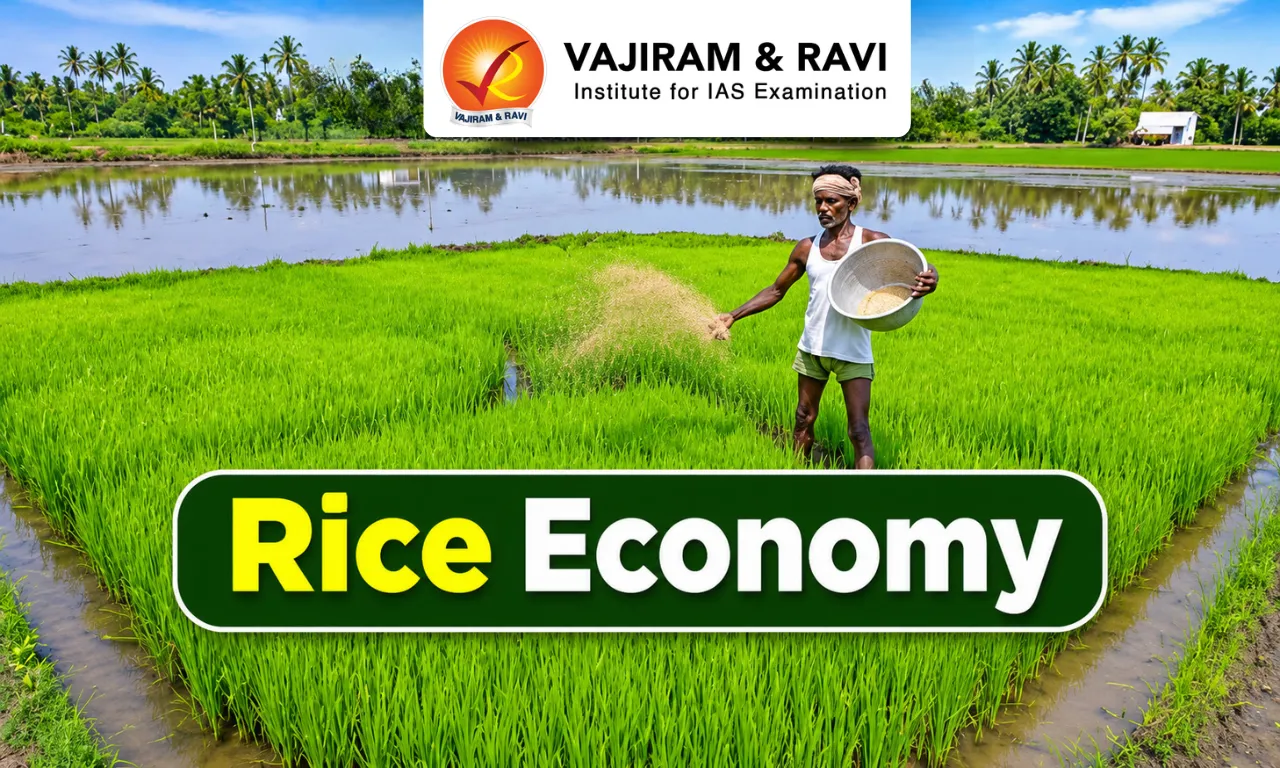
    • Alternate Wetting and Drying (AWD): A water-management technique that periodically allows paddy fields to dry rather than keeping them continuously flooded.
    • Direct-Seeded Rice (DSR): Rice seeds are directly sown in fields instead of being raised in nurseries and transplanted.
    • Integrated Nutrient Management: Combines organic and inorganic nutrient sources to improve fertiliser efficiency and soil health.
  • However, the effectiveness of these interventions varies across agro-climatic and soil conditions. Their environmental benefits and possible trade-offs between different greenhouse gases require context-specific assessment.

Moving from Volume to Value

  • India's rice policy needs a differentiated production and export strategy based on regional water availability, agro-climatic conditions and groundwater status.
  • The key priorities include:
    • Crop diversification: In highly water-stressed regions, farmers should be encouraged to shift towards less water-intensive crops, supported by appropriate incentives.
    • Improved irrigation efficiency: Better water-management practices and efficient irrigation systems can reduce pressure on groundwater and other freshwater resources.
    • Quality and branding: Export competitiveness should increasingly depend on product quality, branding, processing, traceability and geographical indications (GIs), rather than simply increasing physical export volumes.
    • Sustainable agricultural practices: Wider adoption of AWD, DSR and integrated nutrient management can improve water-use efficiency and reduce the environmental footprint of rice cultivation.
  • The objective is not necessarily to export less rice, but to produce and export higher-value rice with lower water and environmental costs.

Measuring Sustainability Through a Water-Carbon-Value Framework

  • A more comprehensive assessment of rice exports requires indicators that capture their economic and environmental performance.
  • The proposed water-carbon-value framework includes:
    • Export value per tonne of rice.
    • Export value per cubic metre of blue water consumed.
    • Groundwater used per tonne of rice produced.
    • Irrigation water productivity.
    • Greenhouse gas emissions per kilogramme of rice.
    • Farmer income generated per unit of water.
    • Groundwater trends across major rice-producing districts.
  • These indicators can help policymakers assess whether improvements in export earnings are being achieved alongside better resource efficiency and environmental sustainability.

Source: TH

Rice Economy FAQs

Q1: What is virtual water trade?

Ans: Virtual water trade refers to the water used in producing goods that are subsequently traded internationally. Rice exports therefore also represent the export of the water used during cultivation.

Q2: What is the difference between green water and blue water?

Ans: Green water refers to rainwater stored in soil and used by crops, whereas blue water refers to freshwater drawn from rivers, reservoirs and groundwater sources.

Q3: Why is rice cultivation associated with methane emissions?

Ans: Flooded paddy fields create oxygen-deficient conditions that encourage methane-producing microorganisms, resulting in methane emissions.

Q4: What is Alternate Wetting and Drying (AWD)?

Ans: AWD is an irrigation technique in which paddy fields are periodically allowed to dry instead of remaining continuously flooded, potentially reducing water consumption and methane emissions.

Q5: What is Direct-Seeded Rice (DSR)?

Ans: DSR is a cultivation method in which rice seeds are directly sown in the field rather than being raised in nurseries and transplanted.

Enquire Now

