
India-Nepal Relations – Resetting the Himalayan Partnership

India-Nepal Relations

India-Nepal Relations Latest News

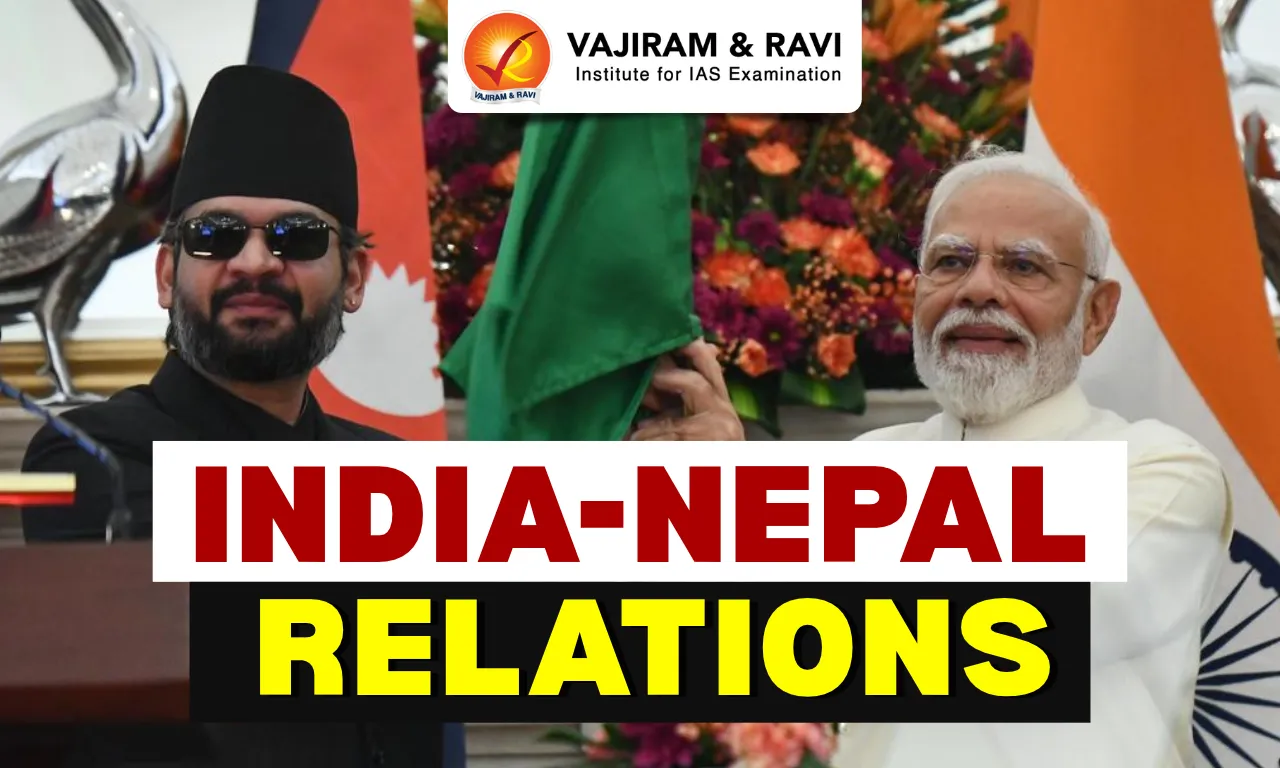
  • India and Nepal have sought to revitalise bilateral relations after a period of diplomatic strain, particularly over the boundary dispute involving Kalapani, Lipulekh and Limpiyadhura.
  • During Nepal PM Balendra Shah's first bilateral visit to India, the Indian PM announced a 24,000 crore Nepalese rupee (approximately $1.63 billion or Rs 15,000 crore) development cooperation package. 
  • The two countries also signed eight MoUs and adopted a 10-pillar Joint Vision Document titled Viksit Bharat and Samunnat Nepal: Re-imagining the Partnership.
  • The initiative aims to transform traditional cultural and geographical ties into a modern, mutually beneficial development partnership.

Economic Partnership - From Aid to Shared Growth

  • Development package: Includes grant assistance and a line of credit, focusing on reconstruction, infrastructure and energy-sector development.
  • Cross-border economic zones: Cooperation to establish Special Economic Zones (SEZs), export-oriented manufacturing facilities and IT parks near the border.
  • Trade and transit: India will facilitate Nepal's access to its Kandla and Paradip ports, strengthening Nepal's connectivity with international markets.
  • Air connectivity: Agreement to operationalise the Kathmandu–Bhairahawa–Lucknow route as a two-way air corridor.
  • Significance: Promotes Nepal's economic diversification, trade competitiveness and regional economic integration.

Phygital (Physical+Digital) Connectivity - Backbone of Cooperation

  • Initiatives:
    • Saryu-Kamala Express: Connects Ayodhya with Janakpur, promoting religious tourism.
    • Dharchula–Darchula bridge: Strengthens cross-border road connectivity.
    • Banbasa Integrated Check Post: Facilitates smoother movement of goods and people. Both sides also agreed to expedite Integrated Check Posts at Bhairahawa, Sunauli, and Dodhara Chandani.
    • Jayanagar–Bardibas and Jogbani–Biratnagar rail links: Strengthen cross-border railway connectivity.
    • Siliguri–Jhapa pipeline: Expands petroleum infrastructure.
    • UPI linkage: Facilitates cross-border digital payments.
  • Significance: Reduces trade costs, improves logistical efficiency and strengthens people-to-people connectivity.

Energy Partnership - Turning Rivers into Economic Assets

  • Nepal's enormous hydropower potential complements India's growing energy demand.
  • Major initiatives include:
    • Lower Arun Hydroelectric Project: Foundation stone laid for the 669-MW project.
    • Arun-3 Project: Commitment to its timely completion.
    • Petroleum security: Inauguration of Phase II of the Motihari–Amlekhgunj petroleum pipeline and advancement of the Jhapa petroleum terminal.
    • New pipeline: Proposed Siliguri–Jhapa petroleum pipeline. 
    • Other supplies: India also reiterated its commitment to maintaining supplies of fuel, fertilisers and essential commodities to Nepal.
  • Significance: Creates an interdependent energy ecosystem through hydropower development, electricity trade and energy security.

Beyond Traditional Diplomacy - Emerging Areas of Cooperation

  • The 10-pillar vision document expands bilateral cooperation into newer domains.
  • For example,
    • Technology and AI: Startup partnerships, digital parks, data centres and AI cooperation.
    • Space: Satellite development, remote sensing and disaster management.
    • Education: Exploring an IIT campus in Nepal, scholarships and academic exchanges.
    • Healthcare: Jan Aushadhi Kendras, medical institutional linkages and laboratory upgradation.
    • Agriculture: Agro-Industrial Park in Chitwan and ICAR Centre of Excellence.
    • Sports: Cricket academy and sports infrastructure development.
    • Governance: Training of Nepali civil servants and exchange of administrative practices.
  • Additionally, cooperation between Nalanda University and Lumbini Buddhist University will be strengthened through a Nalanda Centre at Lumbini.

Culture and Tourism - Leveraging Civilisational Bonds

  • India and Nepal share deep religious and cultural connections associated with Ram, Sita and Buddha.
  • Both countries will develop three major religious tourism circuits, for instance, Ramayana Circuit (Ayodhya–Janakpur), Buddhist Circuit (Lumbini–Bodh Gaya–Sarnath–Kushinagar), and Shiv-Shakti Circuit [Kathmandu (Pashupatinath)–Varanasi].
  • These initiatives can strengthen cultural diplomacy, tourism revenues and cross-border social ties.

Unresolved Issues - Managing Differences through Dialogue

  • Despite renewed cooperation, certain structural challenges remain, for instance,
    • Boundary dispute: Kalapani, Lipulekh and Limpiyadhura remain contentious.
    • 1950 Treaty of Peace and Friendship: Both sides recognise the need to review the existing bilateral legal framework in accordance with contemporary realities.
    • Water-sharing issues: Differences concerning water resources and hydropower projects require sustained negotiations.
    • Trust deficit: Nepal's concerns regarding sovereignty, unequal economic dependence and India's perceived interference need sensitivity.
    • Trade asymmetry: Nepal's dependence on Indian transit infrastructure and trade (India accounts for ~62% of Nepal's total merchandise trade) highlights the need for greater economic diversification.
  • Institutional mechanism: A High-Level Monitoring Group, led by Nepal's Foreign Secretary and India's Ambassador to Nepal, will meet at least once every six months to monitor implementation.

Way Forward - From Neighbourhood to Interdependence

  • Respect sovereignty: Address Nepal's concerns through equality, mutual trust and non-interference.
  • Resolve disputes: Institutionalise dialogue on boundary and water-sharing issues.
  • Deliver projects: Ensure timely completion of cross-border infrastructure and energy projects.
  • Promote economic integration: Encourage private investment, manufacturing and regional value chains.
  • Strengthen people-to-people ties: Expand educational, cultural and youth exchanges.

Conclusion

  • India–Nepal relations are rooted in geography, history and civilisational bonds but must evolve through economic interdependence and mutual respect. 
  • The success of the new vision will depend not merely on announcements and agreements but on their timely implementation.
  • A prosperous Nepal and a developed India can emerge as complementary partners in building a peaceful, connected and economically integrated South Asia.

Source: ToI | IE | IE

India-Nepal Relations FAQs

Q1: How does the India-Nepal Joint Vision Document seek to transform bilateral relations?

Ans: It seeks to move beyond traditional ties towards a comprehensive partnership encompassing trade, technology, healthcare, etc.

Q2: Why is hydropower cooperation strategically important for India and Nepal?

Ans: It combines Nepal's vast hydropower potential with India's growing energy demand.

Q3: What is the significance of cross-border connectivity in India-Nepal relations?

Ans: Railways, roads, Integrated Check Posts, petroleum pipelines and digital payment linkages can reduce trade costs.

Q4: What are the major challenges in India–Nepal bilateral relations?

Ans: Boundary disputes, concerns over the 1950 Treaty, water-sharing issues, trade asymmetry, etc.

Q5: How can cultural diplomacy strengthen India–Nepal relations?

Ans: Developing Ramayana, Buddhist and Shiv-Shakti tourism circuits can leverage shared civilisational heritage.
Memorandum of Procedure for Judicial Appointments: SC Notice Explained

Memorandum of Procedure for judicial appointments

Memorandum of Procedure for judicial appointments Latest News

  • The Supreme Court has issued notice to the Union government and the Chief Justice of India (CJI) in a public interest litigation (PIL) filed by the NGO Lok Prahari, seeking directions to finalise the revised Memorandum of Procedure (MoP) for appointing judges to the Supreme Court and High Courts. 
  • The plea highlights that this revision has remained pending since December 2015, when the Supreme Court struck down the National Judicial Appointments Commission (NJAC) and left the task to the Centre.

What Is the Case About?

  • A bench of Justices M M Sundresh and P B Varale issued notice to the Centre and, notably, to the Supreme Court itself (in its administrative capacity).
  • The Court must respond on two fronts: 
    • Finalising the pending MoP.
    • Bringing Collegium decisions under the Right to Information (RTI) Act.

What Is the Memorandum of Procedure (MoP)?

  • The MoP is a document of mutually agreed conventions laying out the steps for appointment, elevation, and transfer of judges to the High Courts and Supreme Court.
  • It was first drawn up on June 30, 1999, following the: 
    • Second Judges Case (1993)
    • Third Judges Case (1998)
      • — both of which established the Collegium system's primacy in judicial appointments.
  • Process: The CJI initiates proposals for Supreme Court appointments; a High Court Chief Justice, in consultation with the two senior-most puisne judges, initiates proposals for that High Court.
  • As per the Law Ministry, appointments continue to be governed by the original 1999 MoP — the "revised" version has never been finalised.

The 2015 NJAC Judgment: Where It All Began

  • In October 2015, a five-judge Constitution Bench declared the 99th Constitutional Amendment (which created the NJAC) unconstitutional, restoring the Collegium system.
  • The proposed NJAC would have comprised: the CJI, two senior judges, the Law Minister, and two eminent persons.
  • The Court then invited suggestions to improve Collegium functioning, receiving around 11,500 pages of input, grouped under four heads: transparency, a Collegium secretariat, eligibility criteria, and complaints.
  • In its December 2015 order, the Court accepted the government's position (as per then-AG Mukul Rohatgi) that drafting the MoP is an executive function, directing the government to finalise it "in consultation with the CJI" — but set no time limit.

What Has Happened Since 2015? A Decade of Delay

  • 2016–2017: Consultations continued; a draft MoP was reportedly sent to the judiciary in March 2016. Two sticking points remained unresolved: 
    • The Centre's demand for power to reject a judicial nominee on "national security" grounds.
    • A proposal for a permanent Collegium secretariat.
  • December 2016: A parliamentary standing committee flagged that the lack of Centre-judiciary consensus on the MoP was delaying appointments.
  • 2023: Then Law Minister wrote to then-CJI D Y Chandrachud, suggesting Centre/State nominees be included in search-cum-evaluation committees — seen by some as an attempt to revisit the Collegium system. The government later clarified in the Rajya Sabha that this was merely a "facilitator" role, with the Collegium retaining final say.
  • February 2026: Law Minister Arjun Ram Meghwal told the Rajya Sabha the MoP revision was "under consideration."

Where Things Stand Informally

  • Secretariat Issue: Effectively resolved — successive CJIs have established internal systems tracking judges' performance data.
  • National Security Veto: Never formally accepted, but exercised in practice — e.g., the Centre delayed/blocked the Collegium's recommendation for Senior Advocate Saurabh Kirpal's appointment to the Delhi High Court, citing concerns raised via the Research & Analysis Wing (RAW) about his sexual orientation and his partner's nationality.

Judicial Attempts to Push for Resolution

  • October 2017: Justices A K Goel and U U Lalit sought the Centre's response on the delay, noting the issue couldn't remain pending indefinitely — but this order was later recalled by a bench headed by then-CJI Dipak Misra.
  • RTI responses revealed the finalised MoP (as per the Collegium) was sent to the government in March 2017, remaining "under consideration" ever since.
  • What Happens Next - The Centre and the Secretary General of the Supreme Court must now file their responses before the matter is heard again — reopening a question that has lingered for over a decade.

Conclusion

  • A decade after the NJAC's demise, the absence of a finalised MoP reflects an unresolved tug-of-war between executive oversight and judicial independence. 
  • The Supreme Court's latest notice signals renewed urgency — but with "national security" and secretariat disputes still simmering beneath the surface, a lasting resolution remains uncertain.

Source: IE

Memorandum of Procedure for judicial appointments FAQs

Q1: What is the Memorandum of Procedure for judicial appointments?

Ans: The Memorandum of Procedure for judicial appointments outlines conventions governing the appointment, elevation and transfer of judges to High Courts and the Supreme Court.

Q2: Why has the revised Memorandum of Procedure remained pending?

Ans: The Memorandum of Procedure for judicial appointments remains unresolved due to disagreements over national security veto powers and a permanent Collegium secretariat.

Q3: How did the NJAC judgment affect the Memorandum of Procedure?

Ans: After striking down the NJAC in 2015, the Supreme Court directed the government to finalise the Memorandum of Procedure for judicial appointments in consultation with the CJI.

Q4: What are the major disagreements over the revised MoP?

Ans: The Memorandum of Procedure for judicial appointments faces disagreements regarding executive involvement, national security-based rejection of nominees and institutional transparency.

Q5: Why is finalising the Memorandum of Procedure important?

Ans: Finalising the Memorandum of Procedure for judicial appointments could clarify selection procedures, improve transparency and address longstanding tensions between judicial independence and executive oversight.

FSSAI vs Maharashtra FDA: Centre-State Food Safety Jurisdiction Dispute

FSSAI vs Maharashtra FDA

FSSAI vs Maharashtra FDA Latest News

  • Maharashtra's Food and Drug Administration (FDA) Commissioner Tukaram Mundhe had filed a petition in the Bombay High Court in September 2026, accusing the Centre and the Food Safety and Standards Authority of India (FSSAI) of creating a parallel enforcement system that usurped State powers. 
  • The petition has now been withdrawn, raising questions about the Centre-State jurisdictional dynamics in food safety regulation.

What Was the Petition About?

  • The core dispute centred on jurisdiction — whether the FSSAI had overstepped its authority under the Food Safety and Standards (FSS) Act, 2006.
  • Maharashtra argued that: 
    • The FSS Act envisaged a decentralised framework, delegating executive implementation powers to State authorities.
    • FSSAI's actions amounted to centralisation of enforcement, contradicting this original design.
    • The Act's Statement of Objects and Reasons explicitly intended decentralised licensing, empowering States to issue registrations and State licences.
  • The FDA claimed this centralisation hindered its ability to protect public health and consumer interests, including stopping FDA officials from independently raiding centrally-licensed establishments.

Provisions Challenged in the Petition

  • The petition contested the constitutional validity of multiple regulations:
    • Regulations 1.2.1(1), 1.2.1(3), 1.2.1(6), and 2.1.5(2) of the Food Safety and Standards (Licensing and Registration of Food Businesses) Regulations, 2011.
    • Creation of Food Analysts and Central Food Safety Officers posts under the FSSAI (Recruitment and Appointment) Regulation, 2018.
    • Rule 2.1.2(1)(i) of the Food Safety and Standards Rules, 2011.
    • The 2026 Amendment to the Licensing and Registration Regulations.

Timeline of Centralisation (As Alleged by Maharashtra)

  • August 2011: FSSAI framed regulations creating the "Central Licensing Authority" and "State Licensing Authority" — going beyond Section 36(1) of the 2006 Act, which recognised only State-appointed Designated Officers.
  • November 2018: FSSAI created Central Food Safety Officers (FSOs) and Food Analysts (FAs), building independent field machinery for the central regulator.
  • October 2020: FSSAI launched the Food Safety Compliance System (FoSCoS) portal — replacing the earlier Food Licensing and Registration System (FLRS) — for issuing licences and registrations.
  • March 2026: FSSAI revised turnover thresholds for licensing: 
    • Up to ₹1.5 crore → Registration only.
    • ₹1.5 crore to ₹50 crore → State Licence.
    • Above ₹50 crore → Central Licence.

The 'Clandestine' Allegation

  • The FDA alleged that FSSAI framed the 2011 Regulations without prior Central Government approval.
  • It claimed stakeholder objections were finalised internally by FSSAI, never placed before the Central Government — allegedly violating Section 92(1) of the FSS Act and Section 23 of the General Clauses Act, 1897.

Impact on Businesses and Consumers

  • For consumers: Certain establishments fall under Central jurisdiction, others under State jurisdiction — but the core mandate (ensuring food safety) remains unchanged for both.
  • For businesses: Experts argue uniform regulation benefits businesses operating across States, since inconsistent State-wise interpretation of the same law often causes confusion and harassment.
  • Experts’ view: The petition reflected a "narrow way of looking at food safety." Better Centre-State coordination, not confrontation, serves consumers best. Notably, newer legislation has raised the threshold for Central licensing, meaning fewer businesses now fall under central purview.

Conclusion

  • The withdrawal leaves the underlying jurisdictional ambiguity between the FSSAI and State food authorities unresolved, even as the political controversy fades. 
  • The episode underscores a recurring federal governance challenge: balancing uniform national standards with meaningful State-level enforcement powers — a tension likely to resurface unless the Centre and States build genuine institutional coordination.

Source: TH | BS

FSSAI vs Maharashtra FDA FAQs

Q1: What was the dispute between FSSAI and Maharashtra FDA about?

Ans: The FSSAI vs Maharashtra FDA dispute concerned whether the central regulator had centralised enforcement powers that Maharashtra claimed belonged primarily to State authorities.

Q2: Why did Maharashtra challenge FSSAI's regulatory framework?

Ans: Maharashtra argued that the FSSAI vs Maharashtra FDA dispute arose from regulations allegedly undermining decentralised enforcement envisaged under the Food Safety Act.

Q3: Which regulations were challenged in the FSSAI vs Maharashtra FDA case?

Ans: The FSSAI vs Maharashtra FDA petition challenged licensing regulations, central food safety officer appointments, relevant rules and the 2026 licensing amendments.

Q4: Why is centralisation of food safety regulation controversial?

Ans: The FSSAI vs Maharashtra FDA controversy highlights concerns that centralised enforcement could weaken State authority, although uniform regulation may benefit businesses operating nationwide.

Q5: What does the FSSAI vs Maharashtra FDA dispute reveal about Indian federalism?

Ans: The FSSAI vs Maharashtra FDA dispute illustrates the challenge of balancing uniform national standards with State enforcement autonomy and effective Centre-State coordination.

Enquire Now

