Asian Palm Civet

Asian Palm Civet

Asian Palm Civet Latest News

In a bizarre incident, Kerala High Court’s Chamber 1 proceedings got disrupted recently due to a foul stench caused by Asian Palm Civet.

About Asian Palm Civet

  • The Asian Palm Civet, also known as the Toddy Cat or Common Palm Civet, is a small, nocturnal mammal that is found throughout South and Southeast Asia, including India, Sri Lanka, Indonesia, and the Philippines. 
  • It is a member of the Viverridae family, which also includes other civet and mongoose species.
  • Scientific Name: Paradoxurus hermaphroditus

Asian Palm Civet Features

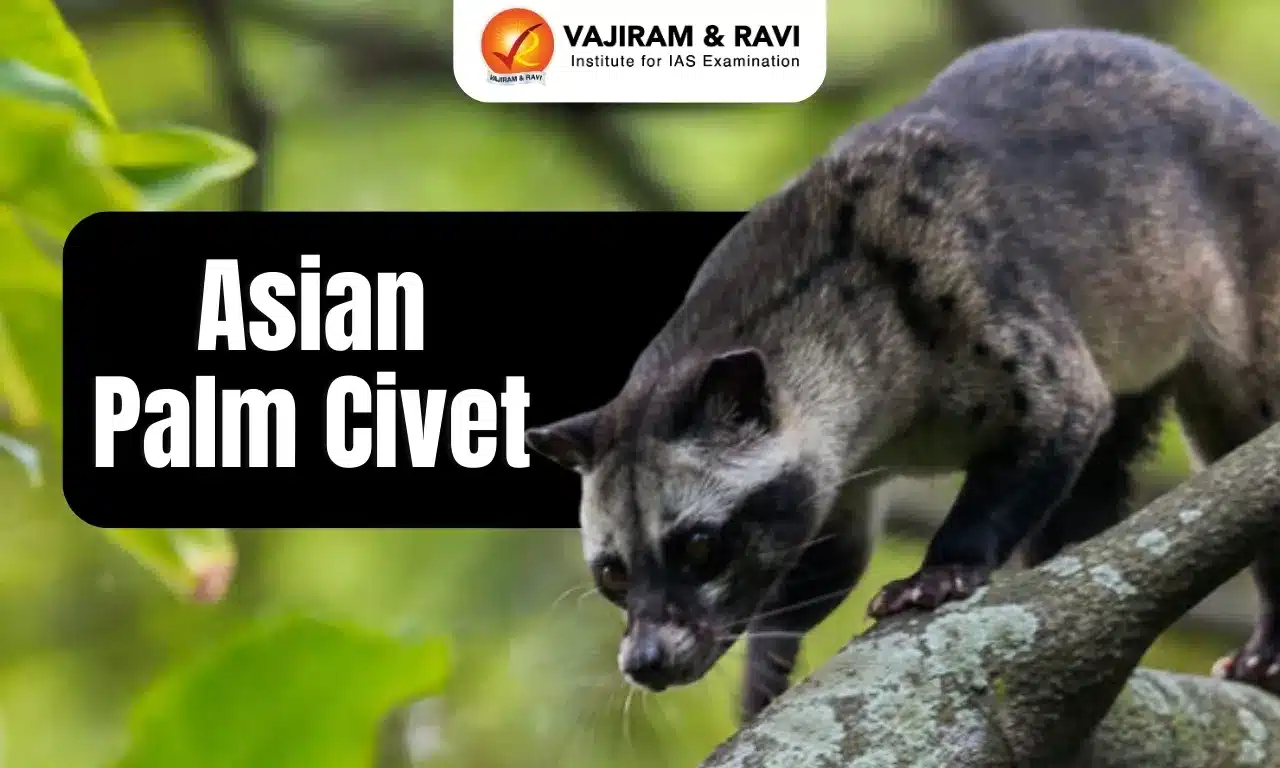
  • It has a long, slender body, short legs, and a pointed snout. 
  • It weighs between 2 to 5 kg (4.4 to 11 lbs) and measures around 53 to 71 cm (21 to 28 inches) in length, including the tail.
  • Its fur is brownish-gray with black spots, and it has a white mask-like marking around its eyes. 
  • It is a nocturnal animal and feeds on a variety of prey, including insects, small mammals, and fruits.
  • One of the most distinctive features of Asian palm civets is their ability to digest coffee beans, which makes them an important part of the coffee production process in some countries.
  • They are also known for their strong sense of smell and excellent climbing skills, allowing them to easily climb trees and forage for food. 

Asian Palm Civet Conservation Status

It is classified as 'Least Concern' under the IUCN Red List

Source: N18

Asian Palm Civet FAQs

Q1: What is the scientific name of the Asian Palm Civet?

Ans: Paradoxurus hermaphroditus

Q2: What is the IUCN conservation status of the Asian Palm Civet?

Ans: Least Concern

Q3: In which regions is the Asian Palm Civet naturally found?

Ans: It is found throughout South and Southeast Asia, including India, Sri Lanka, Indonesia, and the Philippines.

Q4: What is the fur color and markings of the Asian Palm Civet?

Ans: Its fur is brownish-gray with black spots, and it has a white mask-like marking around its eyes.

Mines and Minerals (Development and Regulation) Amendment Bill, 2025

Mines and Minerals (Development and Regulation) Amendment Bill

Mines and Minerals (Development and Regulation) Amendment Bill, 2025 Latest News

The Rajya Sabha cleared the Mines and Minerals (Development and Regulation) Amendment Bill recently, even as the Opposition members walked out.

About Mines and Minerals (Development and Regulation) Amendment Bill, 2025

  • The bill will amend the Mines and Minerals (Development and Regulation) Act, 1957. 
  • The Bill provides that leaseholders may apply to the state government for adding other minerals to an existing lease. 
    • For inclusion of critical and strategic minerals and other specified minerals, no additional amount needs to be paid.  
    • These include minerals such as lithium, graphite, nickel, cobalt, gold, and silver. 
  • The Act establishes the National Mineral Exploration Trust to fund mineral exploration in the country. The Bill widens the scope of the Trust to also fund the development of mines and minerals. 
  • Under the Act, captive mines are allowed to sell up to 50 percent of minerals produced in a year, after meeting end-use requirements. The Bill removes the limit on the sale of minerals. 
  • The Bill allows for a one-time extension of the area under a mining or composite lease.  
    • This will be applicable for deep-seated minerals. Deep-seated minerals are minerals which occur at a depth of more than 200 metres from the surface of land. 
  • The Bill provides for establishing an authority to register and regulate mineral exchanges.
    • The Bill defines mineral exchange as a registered electronic trading platform or marketplace for trading minerals and metals. 
    • The central government will frame rules regarding mineral exchanges on matters including: 
      • manner of registration
      • levy of fees and other charges
      • prevention of insider trading and market manipulation
      •  grievance redressal.

Source: TH

Mines and Minerals (Development and Regulation) Amendment Bill, 2025 FAQs

Q1: The Mines and Minerals (Development and Regulation) Amendment Bill, 2025 amends which existing Act?

Ans: Mines and Minerals (Development and Regulation) Act, 1957

Q2: What does the National Mineral Exploration Trust fund under the original Act?

Ans: Mineral exploration

Q3: What new function has been added to the National Mineral Exploration Trust under the Bill?

Ans: Fund the development of mines and minerals.

Thattekad Bird Sanctuary

Thattekad Bird Sanctuary

Thattekad Bird Sanctuary Latest News

A comprehensive faunal survey at the Thettekad Bird Sanctuary, Ernakulam, Kerala, has added nine species records to its official biodiversity checklist. 

About Thattekad Bird Sanctuary

  • It is the first bird sanctuary in Kerala, located on the banks of Periyar River.
  • Thattekad bird sanctuary is also known as Dr. Salim Ali bird sanctuary, named after Dr Salim Ali, the best known ornithologist in India.
  • The sanctuary, which spreads across the foot of western Ghats , was notified in 1983 based on previous recommendation by Dr. Salim Ali.
  • Vegetation: It consists of Tropical Evergreen Forests, Tropical Semi-evergreen forests, Moist Decidious forests.
  • It consists of natural habitats which includes Periyar river, lagoons and marshes formed by Bhootattankettu dam reservoir, tropical semi & evergreen forests of the western Ghats.
  • Major peaks in the sanctuary are Thoppimudi and Nyayapillimudi.
  • Flora: Myristica dactyloides, Hopea parviflora, Tetrameles mudiflora, eak, Rosewood, Mahagony
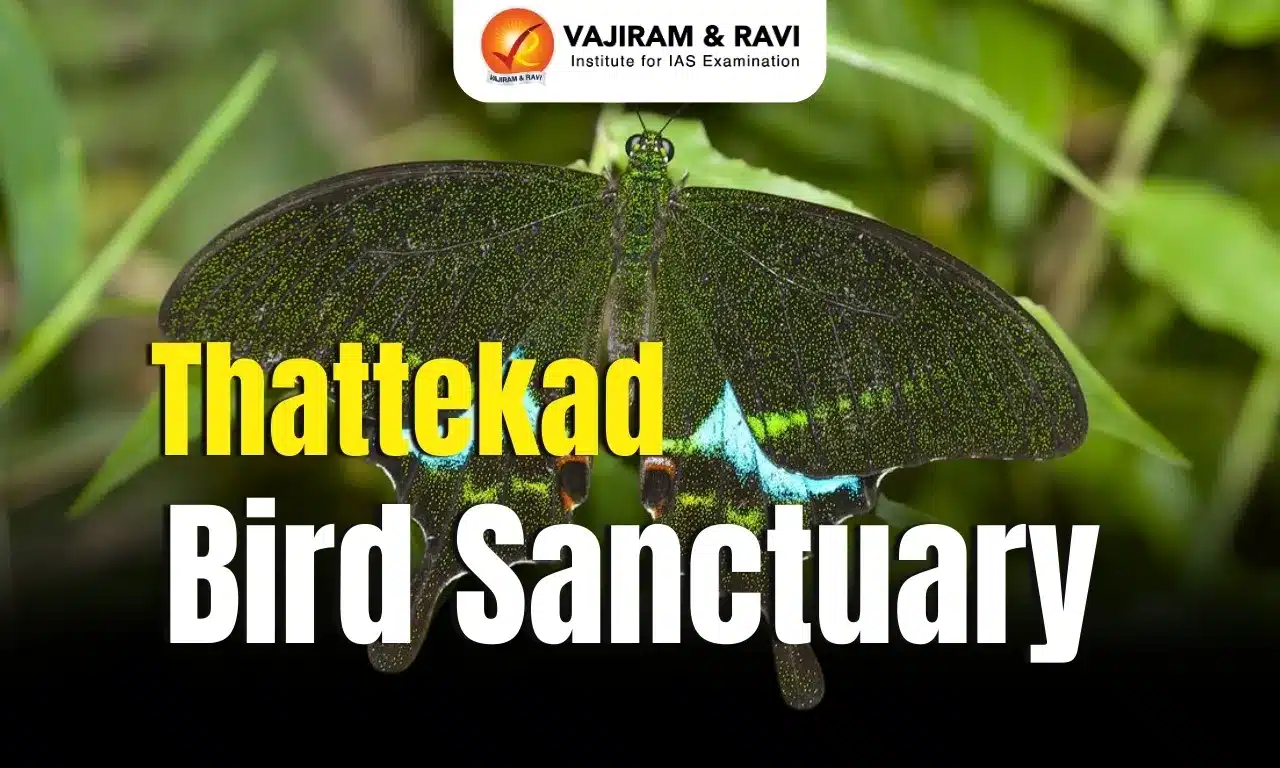
  • Fauna: It is famous for many endemic and rare birds like Ceylon Frogmouth, Black Bazza, Oriental dwarf kingfisher, Bay owl etc. 

Source:  TH

Thattekad Bird Sanctuary FAQs

Q1: Which is the largest bird sanctuary in Kerala?

Ans: Thattekad Bird Sanctuary

Q2: Which river flows through Thattekad Bird Sanctuary?

Ans: Periyar River

United Nations High Commissioner for Refugees

United Nations High Commissioner for Refugees

United Nations High Commissioner for Refugees Latest News

The United Nations High Commissioner for Refugees (UNHCR) has temporarily suspended the process of facilitating the repatriation of Sri Lankan Tamil refugees. 

About United Nations High Commissioner for Refugees

  • It is a UN Refugee Agency which protects refugees worldwide and facilitates their return home or resettlement.
  • History: It was established by the General Assembly of the United Nations in 1950 in the aftermath of the Second World War to help the millions of people who had lost their homes.
  • It is a global organization dedicated to saving lives, protecting rights and building a better future for people forced to flee their homes because of conflict and persecution.
  • Funding:  It is funded voluntarily, contributed by governments, private donors, and organisations.
  • It was awarded Nobel Peace Prizes in 1954 and 1981.
  • It started the Nansen Refugee Award in 1954 for recognition of outstanding service to the cause of refugees, displaced or stateless people.
  • Governance structure
    • It is governed by the UN General Assembly and the Economic and Social Council (ECOSOC).
    • The UNHCR Executive Committee approves the agency's biennial programmes and the corresponding budget.
    • These are presented by the High Commissioner, who is appointed by the UN General Assembly.
  • Headquarters: Geneva, Switzerland

Source: TH

United Nations High Commissioner for Refugees FAQs

Q1: Where is UNHCR headquarters in India?

Ans: New Delhi

Q2: Who is the largest donor to the UNHCR?

Ans: United States

Enquire Now