UNESCO’s Creative Cities Network

UNESCO Creative Cities Network

UNESCO's Creative Cities Network Latest News

Recently, Lucknow has officially joined the UNESCO Creative Cities Network (UCCN) under the Gastronomy category during the 43rd Session of the UNESCO General Conference.

About UNESCO Creative Cities Network

  • It was created in 2004 to promote cooperation among cities that have identified creativity as a strategic factor for sustainable urban development.
  • It was launched to promote UNESCO’s goals of cultural diversity and strengthen resilience to threats such as climate change, rising inequality, and rapid urbanisation.
  • The network covers seven creative fields: crafts and folk arts, media arts, film, design, gastronomy, literature and music.
  • Aim of UCCN: The network is aimed at leveraging the creative, social, and economic potential of cultural industries.
  • Indian Cities in the UCCN: Kozhikode (Literature) and Gwalior (Music) Jaipur (Crafts and Folk Arts), Varanasi (Music), Chennai (Music), Mumbai (Film), Hyderabad (Gastronomy), Lucknow (Gastronomy), and Srinagar (Crafts and Folk Arts).

Objectives of the UCCN

  • It allows member cities to recognise creativity as an essential component of urban development, notably through partnerships involving the public and private sectors and civil society.
  • It envisages developing hubs of creativity, innovation and broadening opportunities for creators and professionals in the cultural sector.
  • These cities have to achieve the UN agenda of sustainable development.

Source: TH

UNESCO Creative Cities Network FAQs

Q1: When was the UNESCO Creative Cities Network (UCCN) established?

Ans: 2004

Q2: What is the primary objective of the UNESCO Creative Cities Network (UCCN)?

Ans: To foster cooperation among cities that prioritize creativity in their urban development.

Chaolung Sukapha

Chaolung Sukapha

Chaolung Sukapha Latest News

Recently, the union Minister of Ports, Shipping & Waterways led a vibrant celebration of Assam Day and paid rich tributes to Chaolung Sukapha.

About Chaolung Sukapha

  • He was a visionary 13th-century ruler who founded the Ahom kingdom that ruled Assam for six centuries.
  •  He is widely referred to as the architect of “Bor Asom” or “greater Assam”.
  • It was in Charaideo that Sukapha established his first small principality, sowing the seeds of further expansion of the Ahom kingdom.

Administration of Chaolung Sukapha

  • He divided the kingdom into territorial units called khels or phoids, each under an officer responsible for supplying a fixed number of paiks. 
    • Paiks are the able-bodied male population who owed labour and military service to the state.
    • Every adult male between sixteen and fifty was registered as a paik and served the king for part of the year in agriculture, construction, or war. In return, he was allotted land for personal cultivation.
  • He emphasized guerrilla tactics suited to the terrain of rivers, jungles, and hills. 

Why is Chaolung Sukapha Important?

  • Sukapha’s significance — especially in today’s Assam — lies in his successful efforts towards assimilation of different communities and tribes.
  • He adopted a policy of conciliation and assimilation rather than annihilation.
  • Sukapha developed very amiable relationships with the tribal communities living in Assam — especially the Sutias, the Morans and the Kacharis.

Source: PIB

Chaolung Sukapha FAQs

Q1: Who was Chaolung Sukapha?

Ans: A Ahom king

Q2: What is Chaolung Sukapha's significance in Indian history?

Ans: He unified Assam under one rule.

New Geographical Indication Products

New Geographical Indication Products

New Geographical Indication Products Latest News

Recently, five products from Tamil Nadu have secured the Geographical Indications (GI) tag.

About New Geographical Indication Products

Woraiyur Cotton Sari

  • It is native to Tiruchi district, and is woven in Manamedu on the banks of the Cauvery.
  • They are known for their distinctive Korvai border (a continuous running pattern) — block colour palettes, and geometric motifs.
  • The border has different motifs, including many geometrical shapes.
  • The Devanga community has been the driving force behind the Woraiyur cotton sarees for generations.

Thooyamalli Rice

  • Thooyamalli, meaning ‘pure jasmine’, is a traditional sambha-season rice variety grown over 135 - 140 days.
  • It is often referred to as ‘pearl rice’ due to its shiny nature and is regarded highly for its nutritional benefits.

Kavindapadi ‘Naatu Sakkarai’

  • Kavindapadi in Erode district is a major supplier of jaggery powder in Tamil Nadu, with vast stretches of sugarcane fields nourished by the Lower Bhavani Project canal.
  • It is made locally by mechanically crushing the cane and slowly evaporating the extracted juice.

Namakkal ‘Kalchatti’

  • Namakkal’s famed cookware is made using soapstone (makkal pathirangal).
  • It is popularly known as kalchatti, and has been a staple in South Indian kitchens for generations.

Ambasamudram ‘Choppu Saman’

  • Origin: The art of making choppu saman (wooden toys) has been practiced for over two centuries, with origins tracing back to the 18th century.
  • This craft involves the careful handcrafting of miniature wooden toys — from tiny kitchen utensils to small tables, chairs, and other play objects.
  • Material used:Traditionally, these toys were carved from indigenous trees like the Manjal Kadamba tree (Neolamarckia cadamba), teak, and rosewood.

Source: TH

New Geographical Indication Products FAQs

Q1: What is a Geographical Indication (GI)?

Ans: A sign that identifies a product as originating from a specific geographical location.

Q2: Which community is known for weaving Woraiyur Cotton Sari?

Ans: Devanga community

Rock Eagle Owl

Rock Eagle Owl

Rock Eagle Owl Latest News

Recently, a Rock Eagle Owl nest prompted the Telangana forest department to halt quarrying operations for over a month.

About Rock Eagle Owl

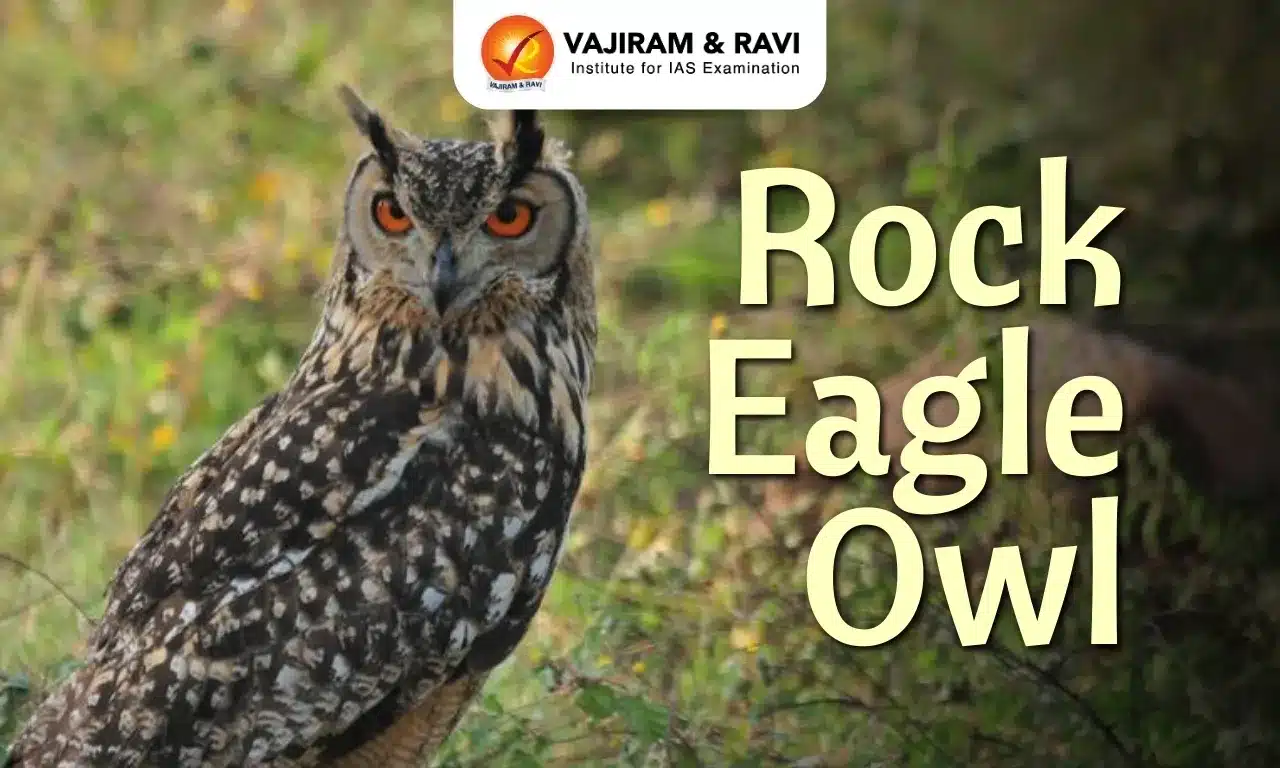
  • It is also called Indian eagle-owl (Bubo bengalensis) or Bengal eagle-owl.
  • It is a large-horned owl species native to hilly scrub forests in India.
  • Appearance
    • It is usually brown and grey in colour, with a white throat patch that has black stripes.
      It was earlier treated as a subspecies of the Eurasian eagle-owl.
    • Its chicks are born with white fluff which is gradually replaced by speckled feathers during the pre-juvenile moult after about two weeks.
    • It is usually seen in pairs. It has a deep resonant booming call that may be heard at dawn and dusk.
  • Habitat: They are especially seen near rocky places within the mainland of the Indian Subcontinent south of the Himalayas. They avoid humid evergreen forests and extremely arid areas.
  • Distribution: It is mainly found in South Asian countries like India, Nepal, Pakistan

Conservation Status of Rock Eagle Owl

  • IUCN: Least Concern
  • CITES: Appendix II

Source: IE

Rock Eagle Owl FAQs

Q1: What is the scientific name of the Rock Eagle Owl?

Ans: Bubo bengalensis

Q2: What is a distinctive feature of the Rock Eagle Owl?

Ans: Large ear tufts

Colombo Security Conclave (CSC)

Colombo Security Conclave

Colombo Security Conclave Latest News

The 7th National Security Adviser level meeting of the Colombo Security Conclave  was held in New Delhi recently.

About Colombo Security Conclave 

  • It is a regional security grouping comprising India, Bangladesh, Sri Lanka, Maldives, Mauritius, and Seychelles.
  • The CSC’s core objective is to promote regional security by addressing transnational threats and challenges of common concern to the member states.
  • CSC brings together National Security Advisors (NSAs) and Deputy NSAs of the member countries.
  • Origin:
    • The CSC, initially known as the Trilateral for Maritime Security Cooperation, evolved out of trilateral meetings between NSAs and Deputy NSAs from India, Maldives, and Sri Lanka, starting in 2011.
    • It came to a standstill after 2014 due to rising tensions between India and the Maldives. 
    • After its revival and rebranding as the CSC in 2020, Mauritius joined the CSC in 2022, while Bangladesh joined in 2024.
    • More recently, Seychelles has become the sixth member of the CSC.
  • Cooperation under the conclave focuses on five pillars:
    • Maritime safety and security.
    • Countering terrorism and radicalisation.
    • Combating trafficking and transnational organised crime.
    • Cyber-security and protection of critical infrastructure.
    • Humanitarian assistance and disaster relief.
  • Permanent secretariat: Colombo.

Source: NOA

Colombo Security Conclave FAQs

Q1: Which countries are members of the Colombo Security Conclave?

Ans: India, Bangladesh, Sri Lanka, Maldives, Mauritius, and Seychelles.

Q2: What is the primary objective of the Colombo Security Conclave?

Ans: Promote regional security by addressing transnational threats and challenges of common concern to the member states.

Q3: Where is the permanent secretariat of the Colombo Security Conclave (CSC) located?

Ans: Colombo

Cold Wave

Cold Wave

Cold Wave Latest News

Higher than normal cold wave days are expected to impact parts of central India as well as some regions in northwest and northeast India, according to the India Meteorological Department (IMD).

About Cold Wave

  • Cold waves are unusual weather occurrences caused by extremely low temperatures in the near-surface atmosphere.
  • Their duration can range from several days to a few weeks, contingent upon the geography and climatic conditions of the region.
  • The India Meteorological Department (IMD) defines a cold wave as a rapid fall in temperature within 24 hours. 
  • This is distinguished by a marked cooling of the air, or with the invasion of very cold air, over a large area.
  • As per IMD, a cold wave is considered when the minimum temperature of a station is 10°C or less for plains and 0°C or less for hilly regions. 
    • A cold wave and severe cold wave is considered a negative departure from normal i.e., 4.5°C to 6.4°C and more than 6.4°C in hill stations, respectively. 
    • Similarly, the departure in minimum temperature of ≤ 04°C and ≤ 02°C for plains is considered a cold wave and severe cold wave, respectively.
  • Cold waves are predominantly experienced during the period December-February, when minimum temperatures drop to very low levels, especially over the northern parts of India. 
  • Health Risks:
    • Exposure to extreme cold can lead to frostbite, hypothermia, and other cold-related illnesses.
    • Non-freezing cold injuries, such as Immersion Foot—caused by prolonged exposure to cold, wet conditions—are also a risk.
    • In extreme cases, cold exposure may result in fatalities if adequate precautions are not taken.

Source: HT

Cold Wave FAQs

Q1: What is a cold wave according to the India Meteorological Department (IMD)?

Ans: A rapid fall in temperature within 24 hours over a large area.

Q2: As per IMD, what minimum temperature qualifies as a cold wave in the plains?

Ans: 10°C or less

Q3: Cold waves are most commonly experienced in India during which months?

Ans: December–February

Q4: What indicates a severe cold wave in hilly regions?

Ans: Departure of minimum temperature ≥ 6.4°C from normal.

Bitra Island

Bitra Island

Bitra Island Latest News

The Chief of Staff of the Southern Naval Command recently said the Navy is setting up a detachment in Bitra Island, which "is more or less completed".

About Bitra Island

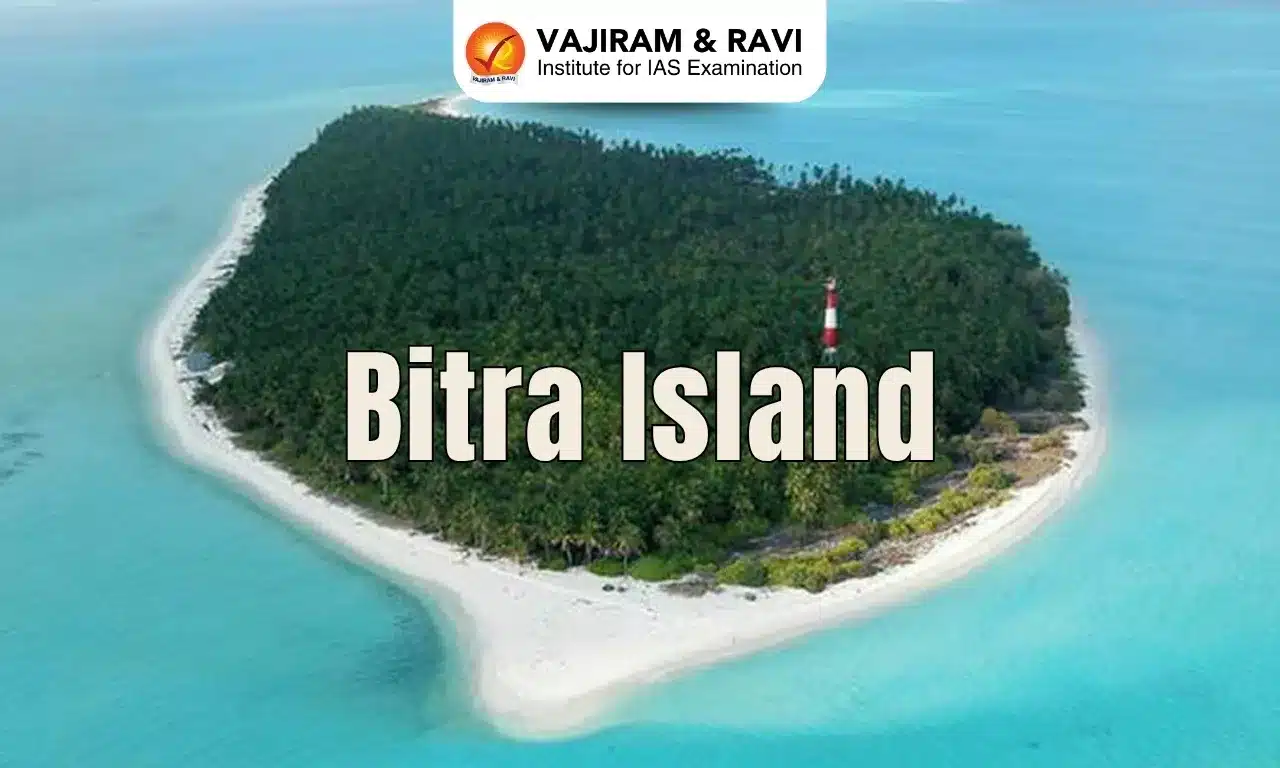
  • It is located in the northern region of Lakshadweep in the Arabian Sea.
  • It is the smallest inhabited island in the territory. 
  • It has a land area of 0.105 sq.km. 
  • It has a length of 0.57 km and a width of 0.28 km at the broadest point. 
  • Though the land area is small, its lagoon area is 45.61 sq.km.
  • There is a small shrine of Malik Mulla, an old Arab saint who is said to have been buried here. The shrine is a place of pilgrimage for the people of other islands.
  • As per the 2011 census, the population of Bitra Island is 271.
  • Climate:
    • The climate of Bitra is similar to the climatic conditions of Kerala. March to May is the hottest period of the year.
    • The temperature ranges from 25°C to 35°C, and humidity ranges from 70 to 76 percent for most of the year.
  • It used to be covered by thick shrubs and was the breeding ground for seabirds. In the early 19th century the birds left the place due to human interference.
  • It is strategically important to India, as it lies in a key position in the Arabian Sea.
  • Bitra would become the third island in the archipelago with a defence establishment – two Indian naval bases in the archipelago are INS Dweeprakshak in Kavaratti, the capital of the UT, and INS Jatayu in Minicoy.

Source: NIE

Bitra Island FAQs

Q1: Where is Bitra Island located?

Ans: It is located in the northern region of Lakshadweep in the Arabian Sea.

Q2: What is the land area of Bitra Island?

Ans: It has a land area of 0.105 sq.km.

Q3: Which saint’s shrine is located on Bitra Island?

Ans: Malik Mulla, an old Arab saint.

Q4: As per the 2011 Census, what is the population of Bitra Island?

Ans: 271

Bonda Tribe

Bonda Tribe

Bonda Tribe Latest News

Members of the Bonda community in Odisha’s Malkangiri district are set to transition from fragile thatched huts to permanent pucca houses under the Union government’s PM-Janman scheme.

About Bonda Tribe

  • The Bondas are exclusively found in the Malkangiri district of Odisha and are mostly concentrated in the Khairaput block of the district.
  • It is a particularly vulnerable tribal group (PVTG) and one of the oldest tribes of India.
  • They are also known as Bondo, Bondas, Bonda Paraja, and Bhonda.
  • With a population of approximately 7,000 people, they live in a mountainous and forest ecosystem
  • They are considered one of the first settlers in India, with their lineage tracing back to the Austroasiatic race. 
  • Language
    • The Bonda people speak Remo, a language belonging to the Austroasiatic linguistic family.  
    • This is distinct from mainstream Indian languages, making it difficult for outsiders to communicate with them. 
  • The Bondas are divided into two groups because of their distinct cultural practices:
    • The Lower Bondas, who live in the Malkangiri district in south Odisha and border Andhra Pradesh and Chhattisgarh, and
    • The Upper Bondas, who live in the remote villages of the district’s hilly terrain.
  • The social organization is hierarchical, with a council of elders that makes important decisions for the community.
  • The Bonda people live in small villages organized around communal spaces where ceremonies and meetings take place.
  • Bonda architecture is characterized by mud and thatched-roof houses, designed to adapt to the mountainous environment and climatic conditions. 
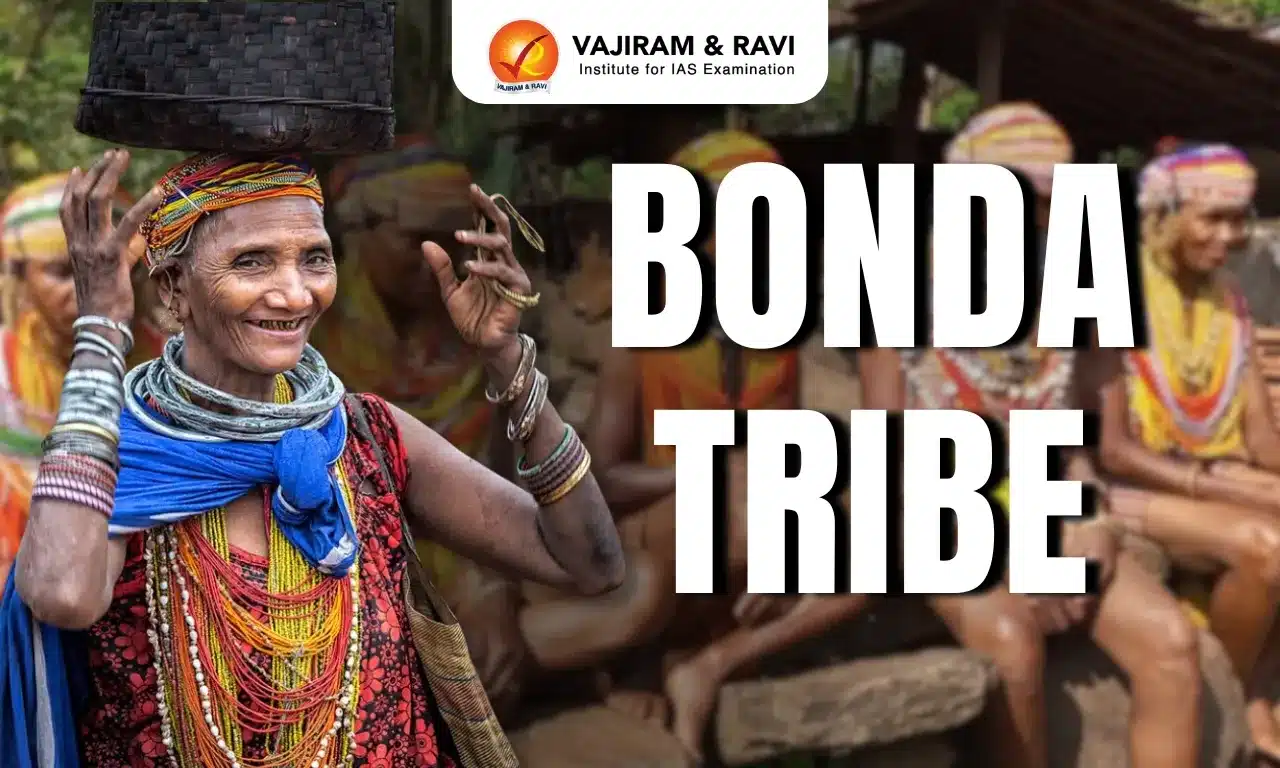
  • The art of the Bonda is expressed mainly through the creation of decorative tools and utensils, in addition to their colorful fabrics and jewelry.
  • They have an interesting dressing style – ladies are semiclad and wear different sorts of rings and pieces of jewelry around their bodies, while the men wear deadly attires.
  • Religion: The religion of the Bonda people is animistic, focused on the worship of nature and ancestral spirits. 
  • Occupation
    • Their economy is based mainly on subsistence agriculture, hunting, and gathering.
    • They are known for their unique practice of shifting cultivation called dangar chas. 
    • They grow crops like paddy, millet, pulses, and vegetables.
  • Only 6% of Bondas are literate. The life expectancy of the tribe is so low they are nearly extinct.

Source: DC

Bonda Tribe FAQs

Q1: The Bonda Tribe is primarily found in which Indian state?

Ans: Odisha

Q2: The Bonda Tribe is classified under which category?

Ans: Particularly Vulnerable Tribal Group (PVTG)

Q3: The language spoken by the Bonda people, Remo, belongs to which linguistic family?

Ans: Austroasiatic linguistic family.

Q4: What is the estimated population of the Bonda Tribe?

Ans: About 7,000

Q5: What type of agriculture is traditionally practiced by the Bonda people?

Ans: Shifting cultivation (dangar chas)

Enquire Now