Nevado Ojos del Salado

Nevado Ojos del Salado

Nevado Ojos del Salado Latest News

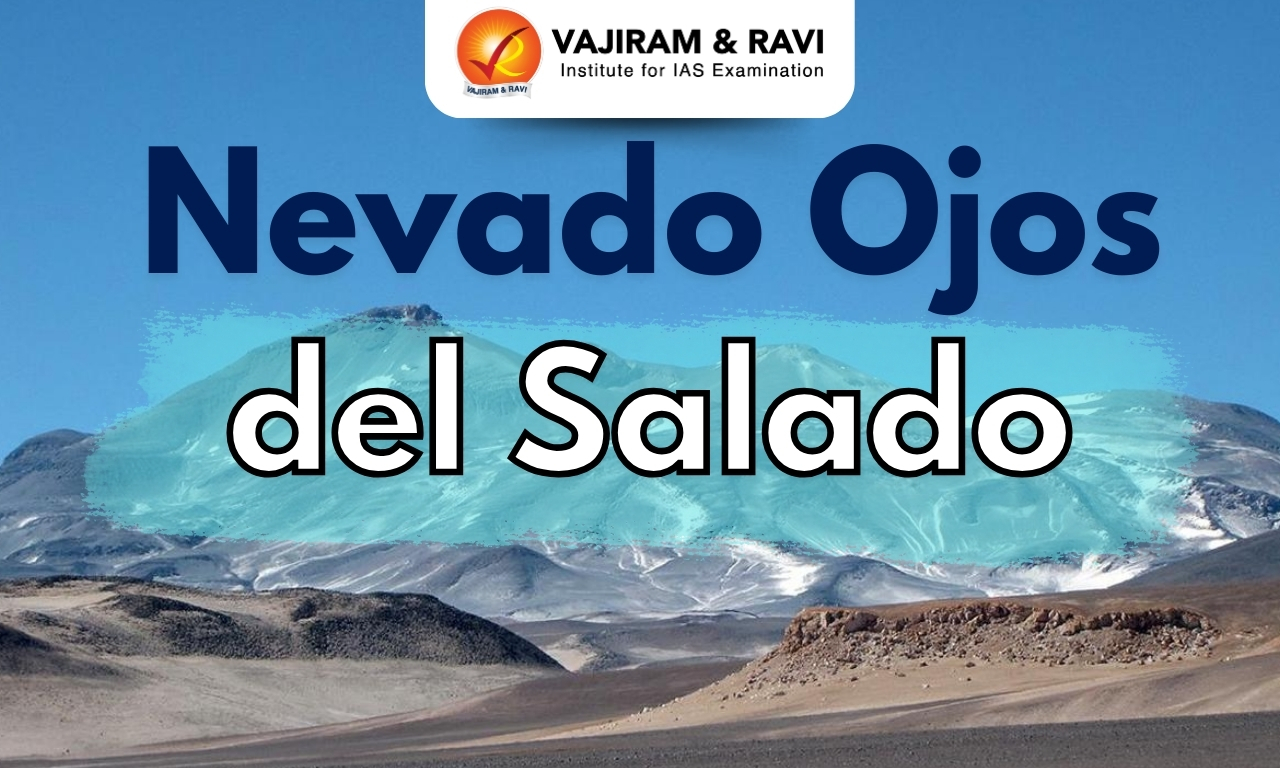
Recently, a professor at the Indian Institute of Science (IISc) has summited the Nevado Ojos del Salado peak.

About Nevado Ojos del Salado

  • Location: It is located in the Andes Mountain Range on the boundary between Chile and Argentina. 
  • It is also the highest mountain (6,893 meters) in Chile.

Features OF Nevado Ojos del Salado

  • It is the world’s highest active stratovolcano.
  • It was largely formed from the accumulation of lava flows and explosive volcanic material.
  • Climate: The Mountain’s climate is high desert. Day and night temperatures vary widely, with an average maximum of 18°C and an average minimum of -10°C.
  • The upper part of the mountain features a set of craters and elongated volcanic peaks. 
  • Due to its location near the Atacama Desert, the mountain has very dry conditions with snow usually only remaining on the peak during winter.
  • There is a permanent crater lake about 100 m (330 ft) in diameter at an elevation of 6,390 m (20,960 ft) on the eastern side of the mountain.

Source: TH

Nevado Ojos del Salado FAQs

Q1: What type of volcano is Nevado Ojos del Salado?

Ans: Stratovolcano

Q2: Where is Nevado Ojos del Salado located?

Ans: Argentina-Chile border

Van Allen Probe A

Van Allen Probe A

Van Allen Probe A Latest News

NASA's 600 kg Van Allen Probe A satellite is falling back to Earth, raising questions about whether people on the ground should be concerned.

About Van Allen Probe A

  • NASA’s Van Allen Probes mission was the first mission to use two spacecraft in tandem to study Earth’s radiation belts. 
  • Originally designed for a two-year mission, the Van Allen Probes A and B launched on Aug. 30, 2012, and gathered unprecedented data on Earth’s two permanent radiation beltsnamed for scientist James Van Allen — for almost seven years.
  • From 2012 to 2019, the spacecraft and its twin, Van Allen Probe B, flew through the Van Allen belts, rings of charged particles trapped by Earth’s magnetic field, to understand how particles were gained and lost. 
  • The belts shield Earth from cosmic radiation, solar storms, and the constantly streaming solar wind that are harmful to humans and can damage technology, so understanding them is important. 
  • By having two spacecraft with identical instruments, with one followed by the other along nearly the same path, researchers could measure changes that occur in Earth’s radiation belts over time and through space, providing insights into the physical dynamics of the radiation belts and changes that occur in this critical region of space.
  • NASA ended the mission after the two spacecraft ran out of fuel and were no longer able to orient themselves toward the Sun. 

Source: NDTV

Van Allen Probe A FAQs

Q1: What was the primary objective of the Van Allen Probes mission?

Ans: To study Earth’s radiation belts.

Q2: Which space agency launched the Van Allen Probes mission?

Ans: NASA.

Q3: When were the Van Allen Probes launched?

Ans: August 30, 2012.

Q4: For how long did the Van Allen Probes collect scientific data?

Ans: For almost seven years (2012–2019).

Cobalt

Cobalt

Cobalt Latest News

According to a new report, the world’s largest cobalt producing company has caused serious environmental and public health damage in the Democratic Republic of Congo (DRC).

About Cobalt

  • It is a hard, lustrous, silver-grey metal.
  • Properties
    • It is a ferromagnetic strategic alloying metal.
    • It is a chemical element with the symbol Co and atomic no.27. 
    • It is associated mostly with copper, nickel and arsenic ores.
    • Cobalt is extracted as a by-product of copper, nickel, zinc or precious metals.
  • Major World reserves of cobalt: Democratic Republic of Congo, Russia, Canada, Philippines and Cuba.
  • Occurrences of cobalt in India: Jharkhand, Odisha, Rajasthan, Nagaland and Madhya Pradesh.

Applications of Cobalt

  • Major use of cobalt is in metallurgical applications, in the Special alloy/Superalloy Industry, in magnets and cutting tools industries.
  • Cobalt is used as precursors (cobalt compounds) for cathodes in rechargeable batteries.
  • It is also used in powerful magnets, cutting tools and high-strength alloys in the aerospace, energy and defence sectors.
  • Cobalt compounds have been used since antiquity as a pigment (cobalt-blue) for pottery, glass, paints and other media. 

Source: DTE

Cobalt FAQs

Q1: Which industry uses Cobalt extensively?

Ans: Electronics and batteries

Q2: What is Cobalt's symbol?

Ans: Co

Spotted Hyena

Spotted Hyena

Spotted Hyena Latest News

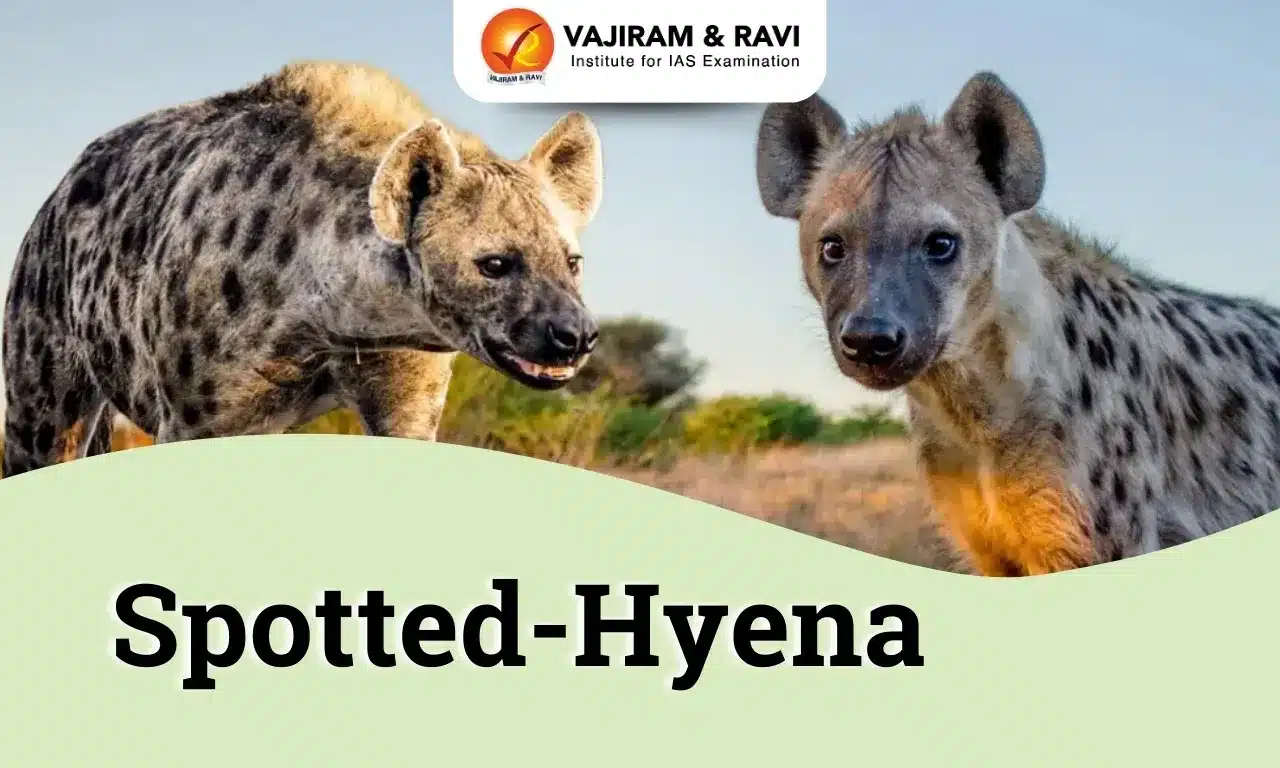
According to a new study the spotted hyena (Crocuta crocuta) has emerged as an unlikely ‘eco-warrior’ in Ethiopia’s second-largest city Mekelle.

About Spotted Hyena

  • It is also called the laughing hyena.
  • It is a strong and capable hunter and the largest member of the hyena family. 
  • Appearance: It looks like a dog but is closer related to cats, civets, and genes.
    • It is physically distinguished from other species by its vaguely bear-like build, rounded ears, less prominent mane, spotted pelt, more dual-purposed dentition, fewer nipples, and pseudo-penis.
  • Habitat: It inhabits savannas, open and dense dry woodland, grasslands, mountains, tropical rainforests, semi-deserts, and coastal areas. 
  • Distribution: It is mainly found throughout sub-Saharan Africa (Chad, Central African Republic, South Sudan, Ethiopia, Kenya, Tanzania, Botswana, Angola, Namibia, and parts of South Africa),

Characteristics of Spotted Hyena

  • They have excellent night vision, being mostly nocturnal, hunting at night, and sleeping or staying near their den in the daytime.
  • They have a matriarchal social order of related individuals that are called clans. One alpha female leads the clan.
  • These animals mark their territory by scratching the ground and with an oily substance that they secrete from their anal glands.
  • Diet:  These are carnivorous animals that hunt and scavenge.
  • It is the only placental mammalian species where females have a pseudo-penis and lack an external vaginal opening. 
  • Conservation status: IUCN: Least Concern.

Source: DTE

Spotted Hyena FAQs

Q1: What is the scientific name of the Spotted Hyena?

Ans: Crocuta crocuta

Q2: Spotted Hyenas are primarily found in?

Ans: Savannas and grasslands

Kurumba Painting

Kurumba Painting

Kurumba Painting Latest News

Recently, it was observed that the Kurumba art form is facing the threat of extinction.

About Kurumba Painting

  • It is a prehistoric art form, estimated to be over 3000 years old.
  • It originates from the Kurumba tribe in Tamil Nadu, Kerala, and Karnataka.
  • The art was traditionally drawn on rocks and in caves across the high hills of the Nilgiris.
  • Raw Materials and Tools Used
    • Kurumba paintings use natural pigments sourced from the forest.
    • Yellow-brown and black pigments come from Vengai tree resin, while green pigments are derived from crushed leaves.
    • Artists use fine twigs, bamboo sticks, and natural fiber brushes for application.
    • The paintings are traditionally done on walls, fabric, and handmade paper.
  • Design and Color
    • Kurumba tribal paintings use natural colors—green from leaves, red and white from soil, and black from tree bark—applied with cloth on cow dung-coated walls.
    • The art features simple, linear motifs with dots, lines, and geometric shapes, depicting huts, animals, and community life.
    • Themes center around spiritual beliefs, rituals, festivals, and daily activities.
    • This minimalist yet expressive style preserves the tribe’s cultural heritage and reflects their deep spiritual bond with nature.
  • Product Range: Wall murals, decorative panels, ritual paintings, cloth artworks.

Source: IE

Kurumba Painting FAQs

Q1: Kurumba Painting is associated with which community?

Ans: Kurumba tribe

Q2: What is Kurumba Painting known for?

Ans: Depictions of nature and mythology

Beas River

Beas River

Beas River Latest News

Four people drowned in the Beas River in the Kangra district, Himachal Pradesh, recently.

About Beas River

  • It is a river passing through the northern Indian states of Himachal Pradesh and Punjab.
  • It is one of the five rivers that give Punjab (“Five Rivers”) its name.
  • It was known as Vipas in the past, meaning the “Unfettered” river.
  • The Beas River was the approximate eastern limit of Alexander the Great’s invasion of India in 326 BCE.
  • Course
    • The river originates in the Rohtang Pass of the Himalayas in central Himachal Pradesh at a height of 13,050 feet.
    • From there it flows south through the Kullu Valley, receiving tributaries from the flanking mountains, and then turns west to flow past Mandi into the Kangra Valley. 
    • After crossing the valley, the Beas enters Punjab state and veers south and then southwest to its confluence with the Sutlej River at Harike.
  • The total length of the river is 470 km.
  • The Beas catchment is under the influence of western disturbances that bring snowfall to the upper sub-catchment during winter, and the monsoon provides around 70% of the annual rainfall during June – September.
  • Major Tributaries: Bain, Banganga, Luni, and Uhal, along with Banner, Chakki, Gaj, Harla, Mamuni, Parvati, Patlikuhlal, Sainj, Suketi, and Tirthan.
  • Dams: The Pong Dam, also known as the Beas Dam, is an earth-fill embankment dam constructed on the river Beas in the Kangra district of Himachal Pradesh.

Source: NEWSM

Beas River FAQs

Q1: Through which Indian states does the Beas River flow

Ans: Himachal Pradesh and Punjab.

Q2: Where does the Beas River originate?

Ans: Rohtang Pass in the Himalayas.

Q3: With which river does the Beas River meet at Harike?

Ans: Sutlej River.

Q4: What is the total length of the Beas River?

Ans: Approximately 470 km.

Chelonus (Carinichelonus) mahadeb

Chelonus (Carinichelonus) mahadeb

Chelonus (Carinichelonus) mahadeb Latest News

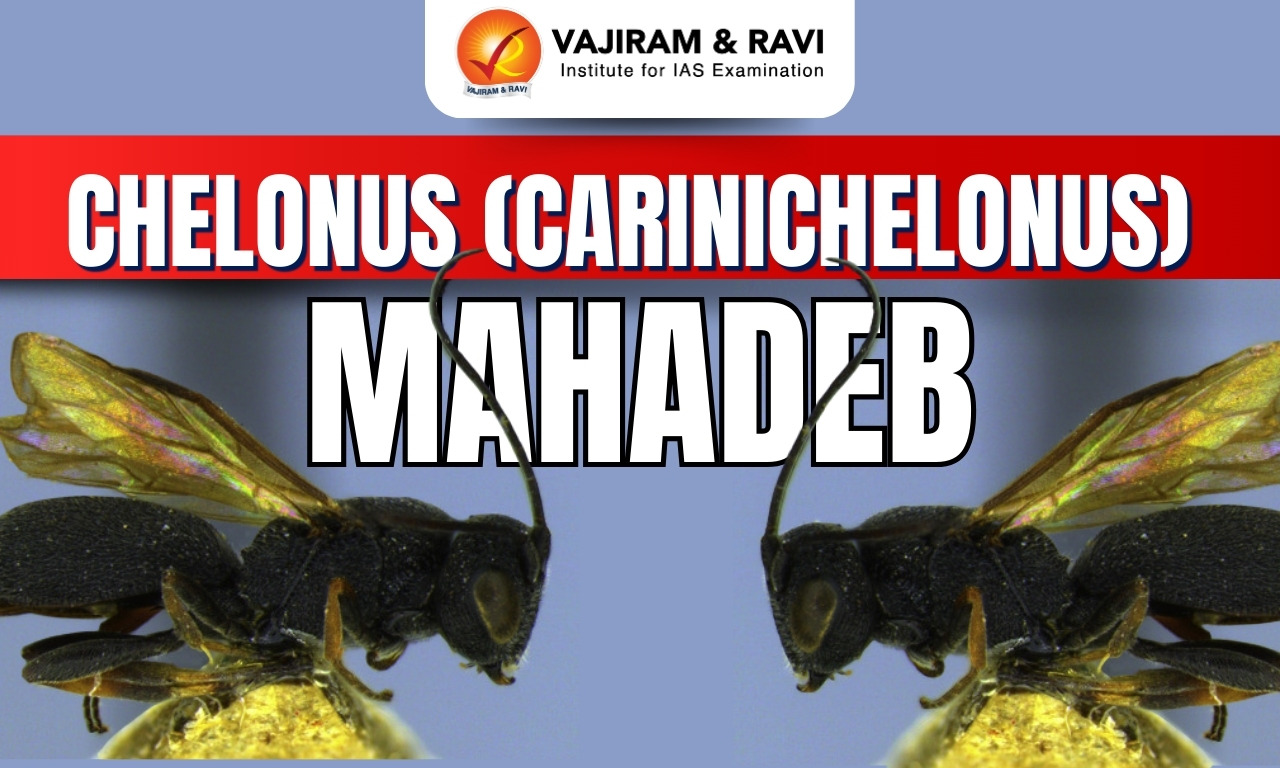
A rare parasitic wasp Chelonus (Carinichelonus) mahadeb named has been recently recorded from a tea estate in Assam.

About Chelonus (Carinichelonus) mahadeb

  • It is a new species of parasitic wasp.
  • It was discovered from Nahortoli Tea Estate in Assam.
  • Parasitic wasps of the genus Chelonus are tiny insects but play an important ecological role. 
    • They are known as egg–larval parasitoids, meaning they lay their eggs inside the eggs of other insects, usually moths and butterflies. 
    • The developing wasp larva eventually consumes the host, helping regulate insect populations naturally.
    • Because many moth larvae are major agricultural pests, species of Chelonus are often considered beneficial insects that contribute to natural pest control in crop ecosystems, including plantations.
  • The discovery is notable because the subgenus Carinichelonus is extremely rare and poorly documented worldwide. 
  • It is only the second new species of this subgenus described from India in recent times.

Source: EM

Chelonus (Carinichelonus) mahadeb FAQs

Q1: What is Chelonus (Carinichelonus) mahadeb?

Ans: A newly discovered species of parasitic wasp.

Q2: Where was Chelonus (Carinichelonus) mahadeb discovered?

Ans: Nahortoli Tea Estate in Assam, India.

Q3: What is the ecological role of parasitic wasps of the genus Chelonus?

Ans: They help regulate insect populations naturally.

Q4: Where do Chelonus wasps lay their eggs?

Ans: Inside the eggs of other insects, usually moths and butterflies.

Enquire Now