Exercise Sea Dragon Latest News
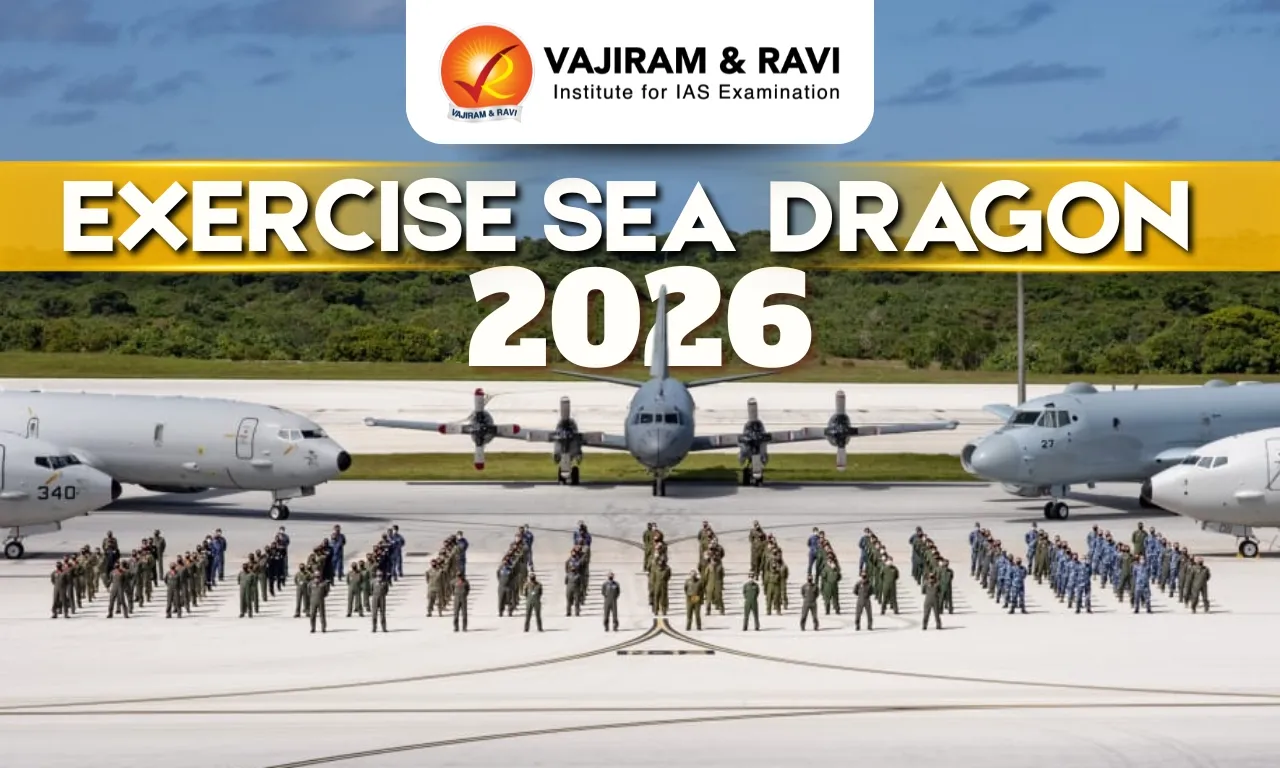
The Indian Navy along with multiple partner nations is participating in Exercise Sea Dragon 2026, a United States Navy-led multinational anti-submarine warfare drill.
About Exercise Sea Dragon
- It is a United States Navy-led multinational anti-submarine warfare (ASW) drill conducted annually to strengthen maritime security and cooperation among allied nations in the Indo-Pacific region.
- It has been held annually since 2019 at Andersen Air Force Base in Guam in the Western Pacific.
- Participating countries deploy long-range maritime patrol aircraft, such as the P-8 Poseidon.
- It provides a structured environment to test interoperability between near-identical platforms operated by different nations, standardizing data links, communication protocols, and tactical procedures that would be essential in any real-world combined ASW operation.
- Sea Dragon 2026:
- The exercise includes forces from the United States Navy, the Indian Navy, the Royal Australian Air Force, the Japan Maritime Self-Defence Force, and the Royal New Zealand Air Force.
- Participants will be challenged on speed, accuracy, and coordinated mission execution, strengthening ASW proficiency and enhancing interoperability among partner forces.
- It advances aircrew proficiency in ASW by progressing from track-simulated targets to detecting and tracking a live submarine.
- During the exercise, each event is graded, and the nation scoring the highest total points will receive the coveted Dragon Belt award.
Source: HBL
Exercise Sea Dragon FAQs
Q1: What is Exercise Sea Dragon?
Ans: It is a United States Navy-led multinational anti-submarine warfare (ASW) exercise conducted annually in the Indo-Pacific region.
Q2: Which organization leads Exercise Sea Dragon?
Ans: The United States Navy.
Q3: Where is Exercise Sea Dragon usually conducted?
Ans: Andersen Air Force Base in Guam in the Western Pacific.
Q4: What is the main objective of Exercise Sea Dragon?
Ans: To strengthen maritime security, improve ASW capabilities, and enhance interoperability among participating nations.