Raja Ravi Varma

Raja Ravi Varma

Raja Ravi Varma Latest News

Recently, Raja Ravi Varma’s Yashoda and Krishna painting was sold for ₹167.2 crore at Saffronart.

About Raja Ravi Varma

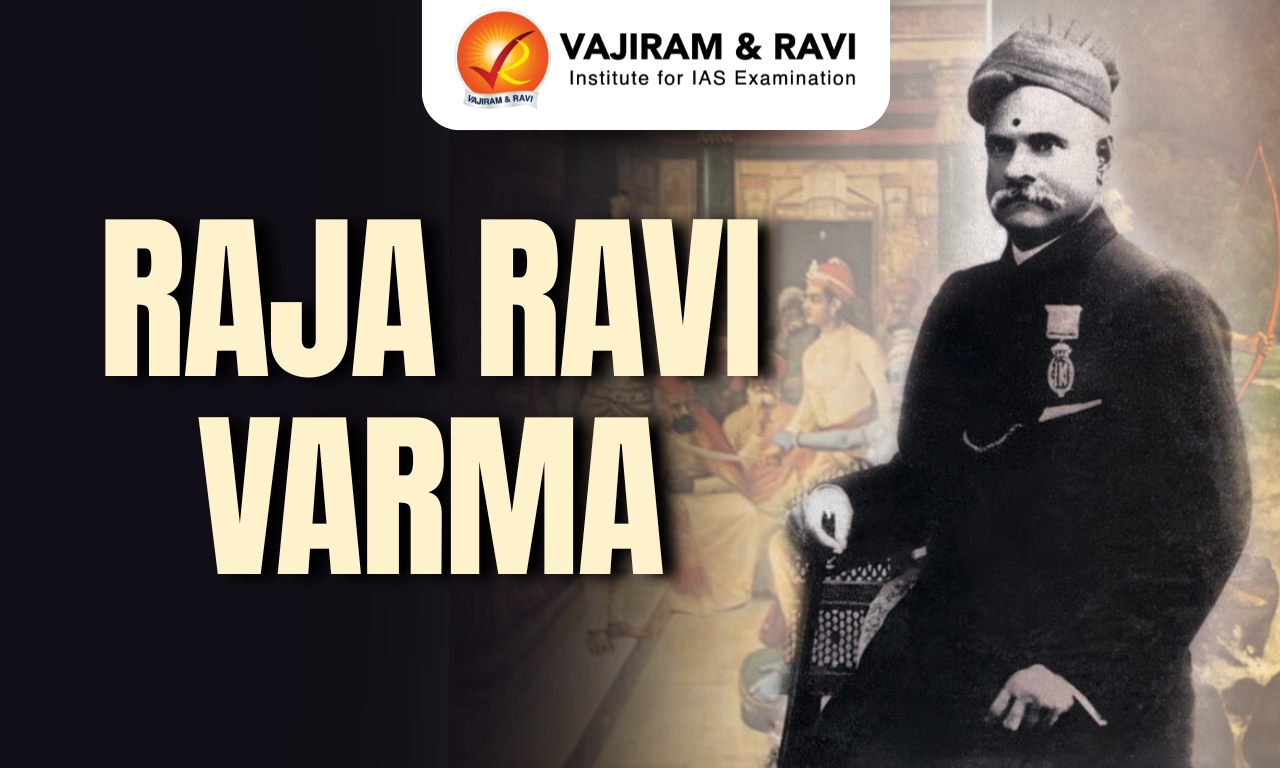
  • He was born on 29 April 1848, in the village of Kilimanoor in Kerala to a family of chieftains known as the Koil Thampurans. 
  • Ravi Varma was an Indian painter celebrated for blending Hindu mythological themes with European realism and naturalism.
  • He was among the first Indian artists to use oil paints and master lithographic reproduction.
  • Themes: Varma painted scenes from Hindu mythology and portraits of Indian and British figures in India.
  • Notable Works: His notable works include Shakuntala Writing a Love Letter to Dushyanta and Shri Rama Vanquishing the Sea.
  • He is also known for having mastered the reproduction of his work on the lithographic press– through which his paintings spread far and wide.
  • He set up his own printing press in Maharashtra — first in Ghatkopar and eventually in Lonavala in 1894.
  • Awards
    • In 1904, he received the Kaiser-i-Hind medal and was popularly known as Raja Ravi Varma.
    • His 1873 painting, Nair Lady Adorning Her Hair, won Varma prestigious awards including Governor’s Gold Medal when it was presented in the Madras Presidency, and Certificate of Merit at an exhibition in Vienna.

Source: TH

Raja Ravi Varma FAQs

Q1: Who is Raja Ravi Varma?

Ans: A renowned Indian painter

Q2: What style of painting is Raja Ravi Varma known for?

Ans: Fusion of European and Indian styles

Kar Saathi

Kar Saathi

Kar Saathi Latest News

Recently, the Income Tax Department on Thursday launched a new website called ‘Kar Saathi’.

About Kar Saathi

  • It is the Income Tax Department's AI chatbot, designed to serve as a virtual tax assistant available round-the-clock through the department's official website.
  • It is aimed at simplifying compliance under the Income Tax Act, 2025.
  • It functions as a digital assistant integrated within the new income tax website.
  •  Its primary purpose is to address user inquiries, provide step-by-step guidance, and streamline procedures such as filing returns.
  • It is integrated into the site to provide automated, real-time responses to taxpayer queries.

Features of Kar Saathi

  • The tool is available 24x7 and can explain processes such as filing returns, understanding updated provisions, and navigating forms.
  • It's positioned as a "one-stop solution" for taxpayers — covering everything from understanding tax rules to walking you through return filing and resolving queries about direct tax compliance.

Source: DD News

Kar Saathi FAQs

Q1: What is the primary objective of Kar Saathi Portal?

Ans: To simplify tax compliance and return filing

Q2: Which section of the Income Tax Act deals with deductions for charitable contributions?

Ans: Section 80G

Sukhna Wildlife Sanctuary

Sukhna Wildlife Sanctuary

Sukhna Wildlife Sanctuary Latest News

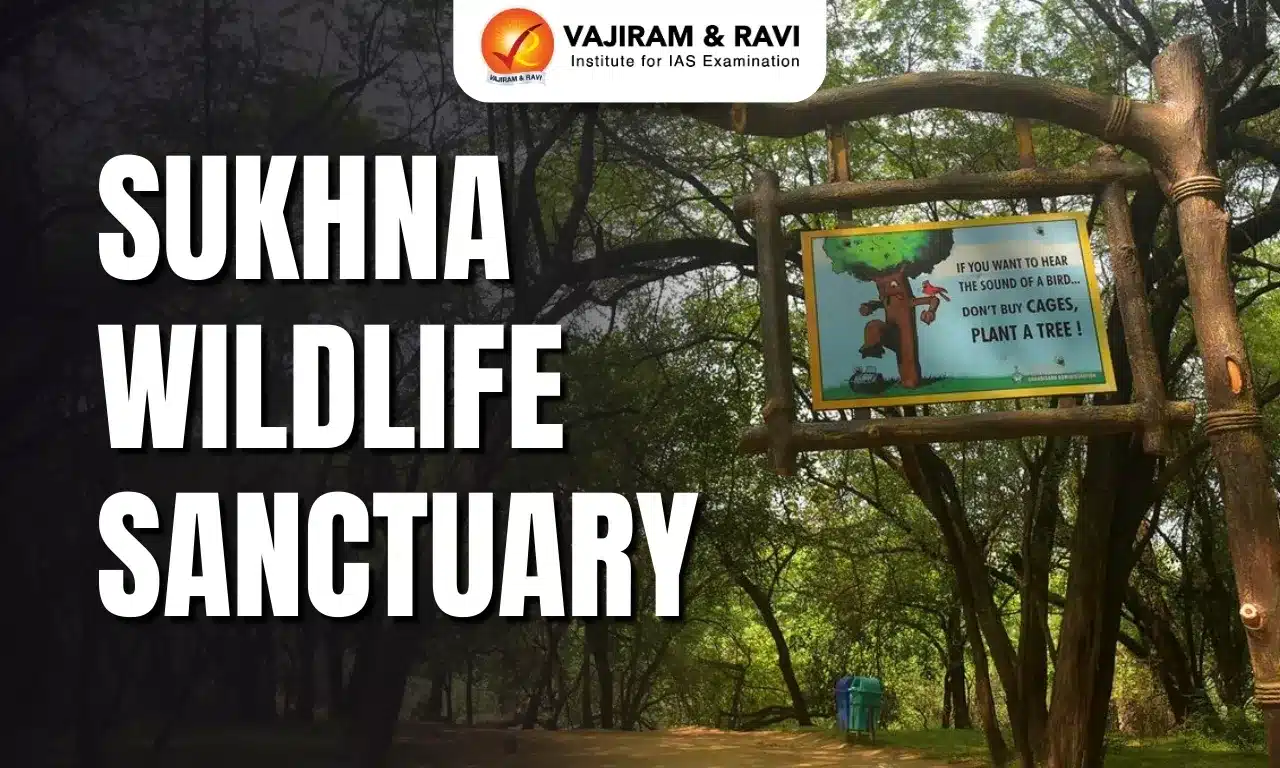
Sukhna Wildlife Sanctuary has emerged as a remarkable success story of ecological revival which is nestled in the fragile Shivalik Hills.  

About Sukhna Wildlife Sanctuary

  • Location: It is a protected area located in Chandigarh, near the famous Sukhna Lake at the foothills of the Shivalik range.
    • The lake was created by the architect Le Corbusier in 1958 by diverting the Sukhna Choe, a seasonal stream that flows down from the Shivalik hills. 
  • The sanctuary was developed as a result of afforestation done for soil conservation around Sukhna Lake. 
  • The Sanctuary was established in 1998.
  • The place is quite unstable geographically and becomes prone to soil erosion by surface runoff during rains.
  • It has sandy soil of Shivalik with pockets of clay embedded at places. 
  • Apart from the Sukhna Lake, there are around 150 small and large water bodies in the sanctuary that form its catchment area.
  • Vegetation: It is characterized by a mix of forests, grasslands, and wetlands, with the Sukhna Lake forming an important part of the ecosystem.
  • Flora: The common flora of the sanctuary includes Khair, Phulai, Kikar, Shisham, Moonj, Amaltas, Jhingan, Amla, Rati, Vasaka, and many more.
  • Fauna: Squirrel, Common-Mongoose, Indian Hare, Porcupine, Jungle Cat, Jackal, Wild boar, etc, are the mammals found in the sanctuary.

Source: TOI

Sukhna Wildlife Sanctuary FAQs

Q1: Sukhna Lake is part of which project?

Ans: Sukhna Lake Project

Q2: Where is Sukhna Wildlife Sanctuary located?

Ans: Chandigarh

Azerbaijan

Azerbaijan

Azerbaijan Latest News

Recently, India and Azerbaijan comprehensively reviewed the current state of bilateral relations, covering areas of mutual interest in Baku.

About Azerbaijan

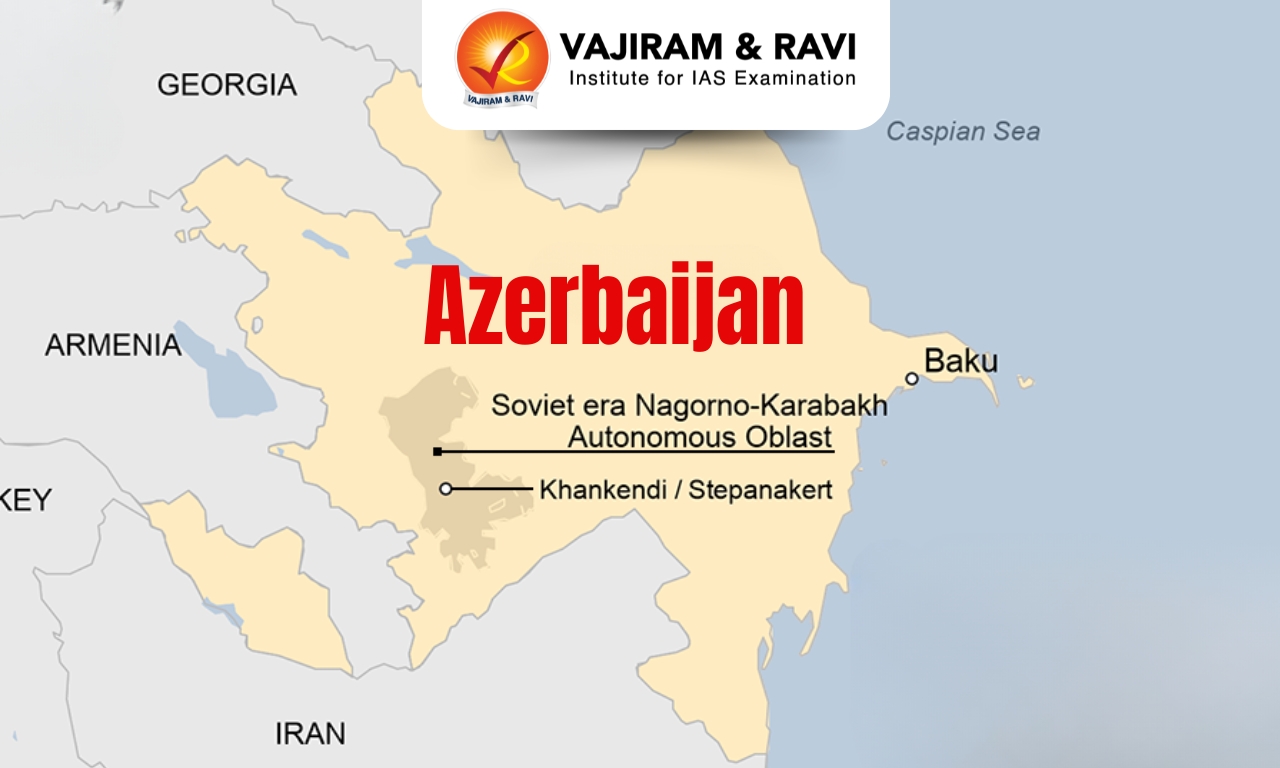
  • Location: It is located at the junction of Eastern Europe and Western Asia along the southern flanks of the Caucasus Mountains.
  • Bordering Countries:  It is bordered by Russia in the north, Georgia in the northwest, Armenia in the west, and Iran in the south.
  • Water Bodies: It is bounded in the east by the Caspian Sea.
  • Capital City:  Baku

Geographical Features of Azerbaijan

  • Climate: Its climate is highly varied and contains examples of nine out of the world's eleven climate zones.
  • Major Rivers: Alazani, Aras, and Kura Rivers 
  • Highest Point: Mount Bazardüzü is the highest peak in the Greater Caucasus Range and the highest mountain in Azerbaijan. 
  • Natural Resources: It mainly consists of gold, silver, iron, titanium, copper, manganese, cobalt, molybdenum, and chromium.

Source: TH

Azerbaijan FAQs

Q1: Where is Azerbaijan located?

Ans: South Caucasus region

Q2: What is the capital of Azerbaijan?

Ans: Baku

Commission for Air Quality Management

Commission for Air Quality Management

Commission for Air Quality Management Latest News

Recently, the 128th meeting of the Enforcement Task Force (ETF) of the Commission for Air Quality Management in NCR and Adjoining Areas (CAQM) was held.

About Commission for Air Quality Management

  • It is a statutory body established under the Commission for Air Quality Management in National Capital Region (NCR) and Adjoining Areas, Act 2021.
  • Mandate: Better coordination, research, identification, and resolution of problems surrounding the air quality index and for matters connected therewith or incidental thereto.
  • It undertakes action for the prevention and control of Air pollution in Delhi-NCR & Adjoining Areas.
  • It is required to coordinate its actions on monitoring of air quality with the government of Delhi and the adjoining states, which includes Punjab, Haryana, Rajasthan, and Uttar Pradesh. 
  • Powers
    • Restricting activities influencing air quality
    • Investigating and conducting research related to environmental pollution impacting air quality, preparing codes and guidelines to prevent and control air pollution,
    • Issuing directions on matters including inspections, which will be binding on the concerned person or authority?
    • All the directions and orders by the Commission are of binding nature, and any person, officer, or authority shall be bound to comply with the same.
    • The commission is directly accountable to the parliament.
  • Composition
    • Chairperson: To be chaired by a government official of the rank of Secretary or Chief Secretary. He will hold the post for three years or until s/he attains the age of 70 years.
    • It will also have five ex officio members who are either Chief Secretaries or Secretaries in charge of the department dealing with environment protection in the States of Delhi, Punjab, Haryana, Rajasthan, and Uttar Pradesh.
    • Three full time technical members.
    • Three members from non-government organisations.
    • Technical members from Central Pollution Control Board (CPCB), Indian Space Research Organisation, and NITI Aayog.

 Source: PIB

Commission for Air Quality Management FAQs

Q1: What is the primary objective of CAQM?

Ans: To prevent and control air pollution in NCR and adjoining areas

Q2: Who is the chairperson of CAQM?

Ans: A government official of Secretary or Chief Secretary rank

Rongali Bihu

Rongali Bihu

Rongali Bihu Latest News

Recently, the festive fervour of Rongali Bihu has gripped different parts of Assam.

About Rongali Bihu

  • It is one of the major festivals of Assam which is commonly known as Bohag bihu.
  • It is the most popular Bihu that celebrates the onset of the Assamese New Year and the coming of spring. 
  • The word ‘Rongali’ is derived from ‘Rong’ which means Happiness and celebrations.
  • This festival reflects the rich culture of Assamese society.
  • During the celebration, traditional pat or muga silk or cotton mekhela chadors are worn by ladies (the two-piece attire). 
  • As a sign of affection and respect, gamocha, the traditional Assamese towel, also known as Bihuwaan, is exchanged.

Key Facts about Bihu

  • Bihu is celebrated by people from all parts of Assam irrespective of caste, creed or religious background.
    • The first Bihu is known as the Rongali Bihu or Bohag Bihu, which is celebrated in the month of April.
    • The second Bihu is known as Kati Bihu or Kongali Bihu, which is celebrated during the month of October
    • Finally there is Magh Bihu, which is observed during the month of January.

Source: DD News

Rongali Bihu FAQs

Q1: Which season does Rongali Bihu mark the beginning of?

Ans: Spring

Q2: Rongali Bihu is a festival celebrated in which state?

Ans: Assam

Namo Drone Didi Yojana

Namo Drone Didi Yojana

Namo Drone Didi Yojana Latest News

Karnataka has the most number of women self-help groups (SHGs) to have undergone training as drone pilots under the ‘Namo Drone Didi Yojana’ (NDDY).

About Namo Drone Didi Yojana

  • It is a central sector initiative to empower women-led Self-Help Groups (SHGs) promoted under Deendayal Antyodaya Yojana – National Rural Livelihoods Mission (DAY-NRLM) by providing them with drone technology for agricultural services.
  • It aims to provide drones to selected SHGs for rental services to farmers for agriculture purposes (application of liquid fertilizers and pesticides for the present).
  • Target: A total of 15,000 drones will be provided to selected women SHGs between 2024-25 and 2025-26.
  • Financial Assistance: Central Financial Assistance @ 80% of the cost of drone package up to a maximum of Rs. 8.00 lakhs will be provided to the women SHGs.
  • For the remaining 20% cost, SHGs can seek loans from the National Agriculture Infrastructure Financing Facility (AIF) with a 3% interest subvention.
  • Training: One of the members of the women SHGs will be selected for 15 day training consisting of mandatory drone pilot training and additional training for agriculture purpose for nutrient and pesticide application.
  • It is implemented by converging the resources of
    • Department  of Agriculture & Farmer’s Welfare (DA&FW), Department of Rural Development (DoRD) and Department of Fertilizers (DoF) and Lead Fertilizer Companies (LFCs).

Source: TH

Namo Drone Didi Yojana FAQs

Q1: Which ministry is the nodal ministry for Namo Drone Didi Yojana?

Ans: Ministry of Agriculture and Farmers Welfare

Q2: What is the main objective of Namo Drone Didi Yojana?

Ans: To provide drones to farmers

Juang Tribe

Juang Tribe

Juang Tribe Latest News

A 16-year-old Juang tribal girl in Odisha changed the entire mindset of a village related to child health and child marriage.

About Juang Tribe

  • Juang is one of the 13 particularly vulnerable tribal groups (PVTGs) of the total 62 tribes found in Odisha.
  • They are primarily concentrated in the current districts of Keonjhar and Dhenkanal in Odisha.
  • Language: Linguistically, they converse in the Juang language, a member of the Munda family within the Austroasiatic languages.
  • The Juangs are known for their clan structure and kinship organisations.
  • Occupation: Initially reliant on hunting, gathering, and limited cultivation, the declaration of their forests as reserves during the British colonial era prompted a shift in traditional customs. 
    • Adapting to these changes, the Juang people showcased expertise in basket-weaving, exchanging their products with neighboring caste villages for essentials like salt, oil, and food.
  • Clothing: Historically known as Patuas or “leaf-wearers,” Juang women adorned leaf girdles, while men wore small loincloths. 
  • Beliefs: Although they have some Hindu beliefs, Juangs practice mostly ancient animistic rituals.
  • Their supreme god is the sun god. However, they have also adopted the Hindu deities in addition to tribal gods and goddesses.

Source: TOI

Juang Tribe FAQs

Q1: Where is the Juang Tribe primarily located?

Ans: Odisha

Q2: Juang Tribe is a part of which larger group?

Ans: Austroasiatic tribes

Purchasing Managers’ Index

Purchasing Managers’ Index

Purchasing Managers’ Index Latest News

According to recent data, India’s manufacturing activity slowed to a 45-month low in March, with the HSBC India Manufacturing Purchasing Managers’ Index falling to 53.9 from 56.9 in February.

About Purchasing Managers’ Index

  • It is an indicator of business activity — both in the manufacturing and services sectors.
  • It is a survey-based measure that asks the respondents about changes in their perception of some key business variables from the month before.
  • It is calculated separately for the manufacturing and services sectors and then a composite index is constructed.
  • The index helps in determining whether the market conditions, as seen by purchasing managers, is expanding, contracting or staying the same. 
  • There are two types of PMI — Manufacturing PMI and Services PMI.

How is the Manufacturing PMI Derived?

  • It is derived by sending fact-based questions to a large number of companies in the concerned sector.
  • The questions are related to 5 key variables— new orders, output employment, suppliers’ delivery times and stock of items purchased
  • The surveys are conducted on a monthly basis.
  • The Purchasing Managers' Index can range between 0 and 100, with a number over 50 citing expansion and under 50 noting contraction.

Source: TH

Purchasing Managers’ Index FAQs

Q1: What does a PMI reading above 50 indicate?

Ans: Expansion in business activity

Q2: What does PMI measure?

Ans: Business activity and sentiment

INS Aridhaman

INS Aridhaman

INS Aridhaman Latest News

Recently, India inducted its third nuclear-powered ballistic missile submarine (SSBN), INS Aridhaman into the Indian Navy.

About INS Aridhaman

  • It is India’s third indigenously built nuclear-powered ballistic missile submarine.
  • It is the second submarine in the Arihant class of SSBNs (Submersible Ship Ballistic Nuclear).
  • It is built under the Advanced Technology Vessel (ATV) project to build nuclear submarines at the Ship Building Centre in Visakhapatnam.

Features of INS Aridhaman

  • Displacement Capacity: It can displace 6,000 tonnes on the surface and 7,000 tonnes submerged.
  • It consists of an 83 MW pressurized water reactor supplied by the Bhabha Atomic Research Centre.
  • Armaments
    • Equipped with eight vertical launch tubes, it is designed to carry more long-range nuclear-tipped missiles than INS Arihant and INS Arighaat.
    • It has four launch tubes capable of deploying up to 24 K-15 Sagarika submarines each with a 750 km range  or Longer-range K-4 missiles extending to 3,500 km for intercontinental strikes.
    • It also has anechoic tiles for acoustic damping and advanced sonar suites enhancing its survivability against detection.

Source: IE

INS Aridhaman FAQs

Q1: What is INS Aridhaman?

Ans: A ballistic missile submarine

Q2: What is the displacement capacity of INS Aridhaman?

Ans: 7,000 tonnes

Enquire Now