Tasgaon Lift Irrigation Scheme

Tasgaon Lift Irrigation Scheme

Tasgaon Lift Irrigation Scheme Latest News

Maharashtra Krishna Valley Development Corporation recently issued the Letter of Award (LoA) to a joint venture involving Mumbai-based infrastructure company Patel Engineering Ltd (PEL) for an irrigation project under the Tasgaon Lift Irrigation Scheme in Maharashtra.

About Tasgaon Lift Irrigation Scheme

  • It is an important irrigation infrastructure initiative in Maharashtra.  
  • It encompasses the construction of a comprehensive water distribution system for a command area of 2,277 hectares across six villages in Satara Taluka in Satara district. 
  • The villages included in the project scope are Tasgaon, Varne, Karandwadi, Devkarwadi, Degaon, and Nigadi.  
  • The project is expected to improve water availability and irrigation access across the region, supporting long-term agricultural and rural development.
  • Lift irrigation schemes, unlike gravity-fed canal systems, rely on electrically powered pumping infrastructure to raise water from a source body and push it through a pressurized distribution network to farmland at higher elevations.
  • The scheme includes multiple work fronts: head works, pump houses, switch yards, rising mains, delivery chambers, and a closed-pipe distribution network.  
  • The scheme falls under the Maharashtra Krishna Valley Development Corporation, Pune.  

News: HBL

Tasgaon Lift Irrigation Scheme FAQs

Q1: What is the Tasgaon Lift Irrigation Scheme?

Ans: It is an important irrigation infrastructure initiative in Maharashtra.

Q2: In which state is the Tasgaon Lift Irrigation Scheme located?

Ans: Maharashtra.

Q3: Which villages are included in the Tasgaon Lift Irrigation Scheme?

Ans: Tasgaon, Varne, Karandwadi, Devkarwadi, Degaon, and Nigadi.

Q4: What is a lift irrigation scheme?

Ans: A system that uses electrically powered pumps to lift water from a source and distribute it to higher-elevation farmland.

Q5: Which organization is responsible for the Tasgaon Lift Irrigation Scheme?

Ans: The Maharashtra Krishna Valley Development Corporation (MKVDC), Pune.

Knob-Billed Duck

Knob-Billed Duck

Knob-Billed Duck Latest News

A rare knob-billed duck — a species usually associated with the wetlands of Central India, particularly Rajasthan and Gujarat — has been recently recorded for the first time at Pong Lake Wildlife Sanctuary.

About Knob-Billed Duck

  • The knob-billed duck, or African comb duck, is a species of duck named for the prominent, leaf-shaped comb on top of the male's bill. 
  • Scientific Name: Sarkidiornis melanotos 

Knob-Billed Duck Habitat and Distribution 

  • It is found in tropical wetlands in Sub-Saharan Africa, Madagascar, and the Indian subcontinent from northern India to Laos and extreme southern China. 
  • It still breeds in freshwater swamps and lakes in the tropics. It is largely resident, apart from dispersion in the wet season. 

Knob-Billed Duck Features

  • It is one of the largest species of duck. Length can range from 56 to 76 cm, wingspan ranges from 116 to 145 cm and weight from 1.03 to 2.9 kg.
  • Adults have a white head freckled with dark spots and a pure white neck and underparts.  
  • The upperparts are glossy blue-black upperparts, with bluish and greenish iridescence especially prominent on the secondaries (lower arm feathers). 
  • The male is much larger than the female.
  • Young birds are dull buff below and on the face and neck, with dull brown upperparts, top of the head, and eyestripe. 

Knob-Billed Duck Conservation Status

It is classified as 'Least Concern' under the IUCN Red List.

News: TI

Knob-Billed Duck FAQs

Q1: Where is the Knob-billed Duck found?

Ans: It is found in tropical wetlands of Sub-Saharan Africa, Madagascar, and the Indian subcontinent from northern India to Laos and extreme southern China.

Q2: What is the color of the adult Knob-billed Duck's head?

Ans: The head is white with dark spots.

Q3: What is the IUCN Red List status of the Knob-billed Duck?

Ans: Least Concern (LC).

Q4: What distinctive feature of male Knob-billed Duck?

Ans: Prominent, leaf-shaped comb on top of the male's bill.

GRAPES-3 Telescope

GRAPES-3 Telescope

GRAPES-3 Telescope Latest News

Recently, researchers from Mumbai, Kochi, and Japan used the GRAPES-3 telescope to track how the earth’s upper atmosphere temperature and the sun’s magnetic field affect muons — subatomic particles from space.  

About GRAPES-3 Telescope

  • Gamma Ray Astronomy PeV EnergieS phase-3 (GRAPES-3) is designed to study the origin, acceleration and propagation of cosmic rays through measurement of extensive air showers.
  • It is induced by primary cosmic rays or gamma rays entering the Earth’s atmosphere in tera to peta electronvolt energies.
  • It also studies solar and thunderstorm phenomena using cosmic ray muons.
  • GRAPES-3 employs an array of plastic scintillator detectors and a large area muon detector based on proportional counters.
  • Location: It is located in Ooty, India.
  • It is operated by the Tata Institute of Fundamental Research.

Key Facts about Cosmic rays

  • These rays were discovered more than a century ago.
  • They are considered to be the most energetic particles in the universe.
  • Our planet is constantly bombarded by them from outer space almost uniformly from all directions at a constant rate.
  • They enter into Earth’s atmosphere and induce a shower of particles that travel to the ground almost at the speed of light.
  • The shower particles constitute electrons, photons, muons, protons, neutrons etc.
  • They have been observed over a remarkably wide energy range (108 to 1020 eV).

Source: TH

GRAPES-3 Telescope FAQs

Q1: What is the unique feature of GRAPES-3 that makes it the world’s most sensitive in its class?

Ans: World’s largest muon telescope covering 560 m² area with 16 modules – detects muons from cosmic rays

Q2: Which fundamental physics question does GRAPES-3 help address through PeV energy cosmic-ray studies?

Ans: Origin and acceleration mechanism of galactic cosmic rays

Wind Turbine Supply Chain Management Portal

Wind Turbine Supply Chain Management Portal

Wind Turbine Supply Chain Management Portal Latest News

Recently, the Union Minister for New and Renewable Energy launched India’s first dedicated Wind Turbine Supply Chain Management Portal. 

About Wind Turbine Supply Chain Management Portal

  • It is India's first dedicated digital platform for streamlining the wind energy supply chain.
  • It is aimed at strengthening the country's domestic wind manufacturing ecosystem and accelerating its clean energy ambitions.
  • It has been developed under the aegis of the Ministry for New and Renewable Energy (MNRE) with support from Indian Wind Turbine Manufacturers Association (IWTMA).
  • Key Features
    • Visibility: It is designed to improve visibility across the wind energy supply chain.
    • Approved List of Models and Manufacturers Linkage:  It facilitates compliance with domestic sourcing requirements under the Approved List of Models and Manufacturers (ALMM) framework,
    • Collaboration: It supports supplier discovery and qualification, strengthens collaboration among stakeholders and enhances export readiness.

What is Wind Energy?

  • Wind energy is a renewable energy source that uses the wind's kinetic energy to generate electricity.
  • Wind turbines capture the wind's power and use it to spin a generator, which creates electricity.
  • Wind Energy Top States in India: Tamil Nadu, Gujarat (Has highest potential), Rajasthan, Karnataka, Maharashtra, Telangana, Madhya Pradesh etc.

Source: DD News

Wind Turbine Supply Chain Management Portal FAQs

Q1: Which industry association partnered with MNRE to develop India’s first Wind Turbine Supply Chain Management Portal?

Ans: Indian Wind Turbine Manufacturers Association (IWTMA)

Q2: Wind Turbine Supply Chain Management Portal aims to ensure compliance with which framework?

Ans: Approved List of Models and Manufacturers (ALMM) framework

Joint Crediting Mechanism

Joint Crediting Mechanism

Joint Crediting Mechanism Latest News

Recently, India and Japan have adopted the Rules of Implementation for the Joint Crediting Mechanism (JCM) under Article 6.2 of the Paris Agreement.

About Joint Crediting Mechanism

  • It was first proposed by the Government of Japan and was officially launched in 2013.
  • Aim: It is a Japanese initiative that aims to facilitate diffusion of leading decarbonizing technologies and infrastructure through investment by Japanese entities and contributes to sustainable development of partner countries.
  • It is a bilateral mechanism which is being implemented in accordance with Article 6 of the Paris Agreement.
  • The JCM contributes to the achievement of both countries’ NDC (Nationally Determined Contribution) by evaluating Japan’s contributions in a quantitative manner and acquiring the part of credit.
  • It operates under the United Nations Framework Convention on Climate Change (UNFCCC).
  • It complements other existing mechanisms, such as the Clean Development Mechanism (CDM) and Joint Implementation (JI).
  • India is one of the 31 partner countries of the Joint Crediting Mechanism.
  • Focus Area of Joint Crediting Mechanism
    • This mechanism focuses on priority sectors which includes renewable energy with storage, sustainable aviation fuel, compressed biogas, green hydrogen and green ammonia, and in hard-to-abate sectors.

Source: PIB

Joint Crediting Mechanism FAQs

Q1: The Joint Crediting Mechanism is a bilateral carbon credit system initiated by which country?

Ans: Japan

Q2: Which Indian ministry is the nodal body for implementing JCM projects in India?

Ans: Ministry of Environment, Forest and Climate Change

Powai Lake

Powai Lake

Powai Lake Latest News

The BMC recently proposed appointing infrastructure consultancy firm AECOM Asia Company Limited to prepare a comprehensive redevelopment plan for a stretch of Powai Lake along Adi Shankaracharya Marg at a consultancy cost of Rs 1.85 crore.

About Powai Lake

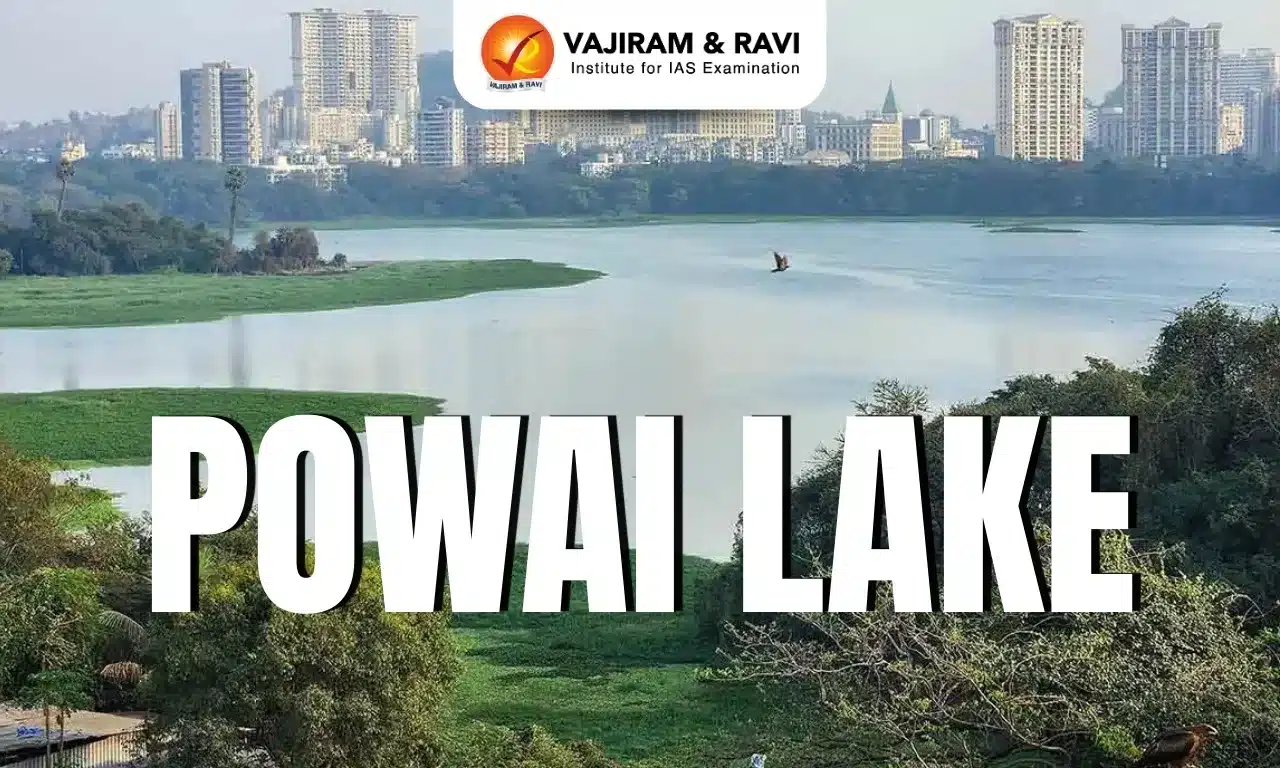
  • It is an artificial lake situated in the northern suburb of Mumbai, Maharashtra.
  • The lake was built by the British in 1890, after constructing two dams between two hillocks across Mithi River, to augment the water supply to Bombay.
  • The hillocks seen on the south end of the lake are the lowest slopes of the Western Ghats.
  • The catchment area of the lake is 6.6 sq.km., with the depth varying from 3 to 12 metres.
  • Around Powai Lake are two famed institutions-Indian Institute of Technology-Bombay (IIT-B) and the National Institute of Industrial Engineering (NITIE).
  • The Padmavati Devi Temple, situated on the bank of the lake inside IIT Bombay campus dates back to the 10th century AD.
  • The lake is surrounded by the Powai Bird Sanctuary.
  • It is an important resting, feeding, and breeding site of several bird species, resident and migratory. 
  • Among some of the lake’s rare and distinguished residents and visitors are the Watercock, Pheasant-tailed Jacana, Slaty-legged Crake, Ruddy-breasted Crake, Woolly-necked Stork, Caspian Tern, and Peregrine Falcon.
  • It is also home to a small population of the marsh crocodile.
  • It has been extensively used for fishing over the years. Currently, it is being used for the conservation of the Indian mahaseer. 
  • In recent times, 40% of the lake has disappeared. The lake has deteriorated due to accelerated growth of residential, commercial, and industrial areas around the lake.

News: TOI

Powai Lake FAQs

Q1: Where is Powai Lake situated?

Ans: In the northern suburb of Mumbai, Maharashtra.

Q2: Is Powai Lake a natural or artificial lake?

Ans: It is an artificial lake.

Q3: When was Powai Lake constructed?

Ans: The lake was built by the British in 1890.

Q4: Why was Powai Lake built?

Ans: To augment the water supply to Bombay (Mumbai).

Q5: Which premier educational institution is located near Powai Lake?

Ans: The Indian Institute of Technology Bombay (IIT Bombay).

Amangarh Tiger Reserve

Amangarh Tiger Reserve

Amangarh Tiger Reserve Latest News

The fourth eco-tourism season at Amangarh Tiger Reserve in Uttar Pradesh was recently extended by 15 days.

About Amangarh Tiger Reserve

  • It is situated in the Bijnor district of Uttar Pradesh.
  • It encompasses an area of approximately 95 sq.km.
  • It forms a part of the Terai-Bhabar ecosystem, a unique stretch of forests at the foothills of the Himalayas. 
  • It was originally part of the Jim Corbett National Park, and after the state of Uttarakhand was carved out of Uttar Pradesh, Jim Corbett went to Uttarakhand, and Amangarh remained in Uttar Pradesh. 
  • The landscape here is a mesmerising blend of dense forests, rolling hills, grassy meadows, and pristine water bodies. 
  • Flora: 
    • The most dominant tree in Amangarh’s landscape is Sal (Shorea robusta), which forms large, continuous forests across the reserve.  
    • Alongside sal, species like Khair (Acacia catechu), Sheesham (Dalbergia sissoo), and Haldu (Adina cordifolia) thrive abundantly.
  • Fauna:
    • Mammals: Tiger, Elephant, Swamp Deer, Sambar, Cheetal, Hog Deer, Kakar, Langur, Sloth Bear, Porcupine, Otter.
    • Birds: Hornbill, Red Jungle Fowl, Pea Fowl, Bengal Florican, Fishing Eagle, Serpent Eagle, Osprey, Woodpeckers, Shama, Indian Pitta, Paradise Flycatcher, Orioles, Emerald Dove.
    • Reptiles: Monitor Lizard, Turtles, Python, Gangetic Dolphin, Mugger, Gharia, etc.

News: ET

Amangarh Tiger Reserve FAQs

Q1: Where is the Amangarh Tiger Reserve located?

Ans: It is located in the Bijnor district of Uttar Pradesh.

Q2: Which famous national park was Amangarh originally a part of?

Ans: Jim Corbett National Park.

Q3: Which is the dominant tree species in the Amangarh Tiger Reserve?

Ans: Sal (Shorea robusta).

Q4: What are the major landscape features of the Amangarh Tiger Reserve?

Ans: Dense forests, rolling hills, grassy meadows, and pristine water bodies.

INS Tarkash

INS Tarkash

INS Tarkash Latest News

Indian Naval Ship Tarkash, a stealth frigate of the Indian Navy, recently arrived in Port Victoria, Seychelles, during its ongoing deployment in the South West Indian Ocean Region.

About INS Tarkash

  • It is a state-of-the-art stealth frigate of the Indian Navy.
  • It is the second of three Talwar-class guided missile frigates. 
  • Designed and built in Russia, the Talwar-class guided missile frigates are modified version of the Krivak III-class frigate 
  • It was built by the Yantar shipyard in Kaliningrad, Russia.
  • It was commissioned into Indian Navy service on 9 November 2012 at Kaliningrad and joined the Western Naval Command on 27 December 2012.

INS Tarkash Features

  • Displacing 3,850 tonnes, it has a length of 124.8 m, a beam of 15.2 m, and a draught of 4.2 m.
  • With maximum speeds in excess of 30 knots, a range of 4,500 miles or 30 days and a complement of 253 personnel, the ship is powered by four gas turbines. 
  • It has been equipped with a weapon sensor that enables it to address threats in all dimensions. 
  • It uses stealth technologies and a special hull design to ensure a reduced radar cross-section.
  • It can board one Ka-28 Helix-A antisubmarine helicopter or one Ka-31 Helix-B airborne early warning helicopter.
  • It carries cutting-edge weaponry, which includes advanced surface-to-air missiles, 100 mm calibre guns (artillery), close-range guns, torpedoes, rocket launchers, and associated fire control systems. 
  • It is also equipped with BrahMos missiles instead of the Klub-N missiles, which makes it different from the earlier flight of Talwar-class ships.

News: DEF

INS Tarkash FAQs

Q1: What is INS Tarkash?

Ans: INS Tarkash is a state-of-the-art stealth frigate of the Indian Navy.

Q2: To which class of warships does INS Tarkash belong?

Ans: Talwar-class guided missile frigates.

Q3: In which country was INS Tarkash designed and built?

Ans: Russia.

Q4: When was INS Tarkash commissioned into the Indian Navy?

Ans: 9 November 2012.

Q5: What is the operational range of INS Tarkash?

Ans: 4,500 miles or 30 days at sea.

Manas National Park

Manas National Park

Manas National Park Latest News

Recently, Assam Chief Minister announced that Manas National Park has recorded zero rhino and tiger poaching cases for three consecutive years. 

About Manas National Park

  • Location: It is located in the foothills of Himalayas in Assam. 
  • It shares a border with Bhutan’s Royal Manas National Park.
  • River: The Manas River (A major tributary of the Brahmaputra River), from which its name has been derived, flows through the west of the park and is the main river within it. 
  • The park’s elevation ranges from 60 to 1,500 meters (200 to 4,900 feet) above sea level, contributing to its rich biodiversity.
  • The area has the unique distinction of being a UNESCO World Heritage Site, a Tiger Reserve, an Elephant Reserve, a Biosphere Reserve, and an Important Bird Area.
    • It is one of the first reserves included in the tiger reserve network under Project Tiger in 1973.
  • It forms part of a large tiger conservation landscape which includes Buxa-Nameri-Pakke-Namdapha tiger reserves and protected areas of Bhutan and Myanmar.
  • The park is inhabited by several indigenous communities, including the Bodo.
  • Vegetation: It consists of semi-evergreen and mixed deciduous forests, interspersed with grasslands and riparian vegetation (in core area).
  • Flora: The most presiding plant species found here are hoolong trees. Some other prominent species available here are Amari, Dewa Sam, Himolu, Garjan, etc.
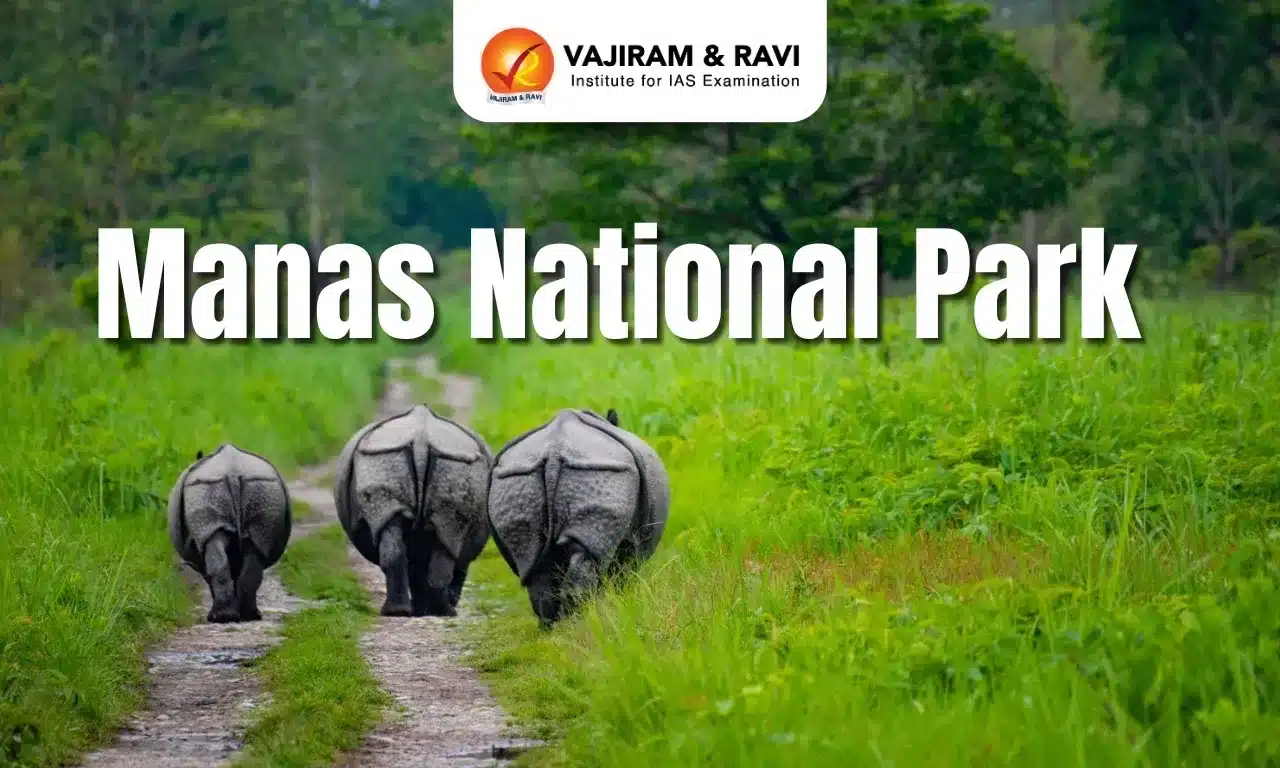
  • Fauna: It is home to Hispid Hare, Pygmy Hog, Golden Langur, Indian Rhinoceros, Asiatic Buffalo, etc.

Source: DD News

Manas National Park FAQs

Q1: Manas National Park is located in which state?

Ans: Assam, India

Q2: Which endangered species, once thought extinct, was reintroduced in Manas NP under species recovery program?

Ans: Pygmy Hog

Thailand

Thailand

Thailand Latest News

Recently, India & Thailand agreed to deepen collaboration in manufacturing, research, innovation & capability development during 10th Defence Dialogue in Bangkok. 

About Thailand

  • Location: It is located in the center of mainland Southeast Asia.
  • Bordering Countries:  It shares boundaries with Myanmar (North West), Laos (North Easst), Cambodia (East), and Malaysia (South).
  • Maritime boundary: It is bordered by Andaman Sea (SW) and Gulf of Thailand (S)
  • Capital City: Bangkok.

Geographical Features of Thailand

  • Terrain: The Fold Mountains dominate the country's landscape to the north and west.
  • Climate: It is influenced by Southwest and Northeast Monsoon.
  • Highest Peak: Doi Inthanon (Approx. 2,565 m)
  • Plateau: Khorat Plateau in the northeast region which is a vast tableland bounded by the Mekong River on the north and east.
  • Major Rivers: Chao Phraya River and Mekong River (Forms a natural border with Laos)
  • Natural Resources: It consists of Rubber, Rice, Tin, Natural Gas, Timber, Tungsten, Tantalum

Source: PIB

Thailand FAQs

Q1: Thailand shares land borders with which countries?

Ans: Myanmar, Laos, Cambodia, Malaysia

Q2: India and Thailand conduct which annual bilateral army exercise focused on counter-insurgency?

Ans: Exercise Maitree

Enquire Now