New Naval Platforms

New Naval Platforms

New Naval Platforms Latest News

The Indian Navy is scheduled to commission three indigenously built frontline platforms – Dunagiri, Sanshodhak, and Agray – in Kolkata. 

About New Naval Platforms

  • INS Dunagiri
    • It is the fifth Project 17A stealth frigate.
    • It was designed by Warship Design Bureau (WDB).
    • It was built at Garden Reach Shipbuilding and Engineers Ltd (GRSE).
    • It is equipped with advanced weapons and sensors, including BrahMos surface-to-surface missiles and the Medium Range Surface-to-Air Missile system, significantly enhancing the Navy’s combat capability.
  • Sanshodhak
    • It is the fourth Survey Vessel (Large).
    • Function: It is designed for coastal and deep-water hydrographic surveys and collection of oceanographic and geophysical data for defence and civil applications.
    • It is equipped with advanced survey systems including Autonomous Underwater Vehicles and Remotely Operated Vehicles.
  • Agray
    • It is the fourth of the Arnala-class Anti-Submarine Warfare Shallow Water Craft.
    • It is equipped with lightweight torpedoes, indigenous rocket launchers, and shallow-water sonar systems to detect and engage underwater threats in littoral waters.

Source: PIB

New Naval Platforms FAQs

Q1: INS Dunagiri, launched in Kolkata in July 2022, belongs to which class of warships?

Ans: Project-17A Nilgiri-class stealth frigate

Q2: INS Sanshodhak, launched by GRSE Kolkata in June 2023, is what type of naval vessel?

Ans: 4th Survey Vessel Large (SVL)

Turquoise Nexus Initiative

Turquoise Nexus Initiative

Turquoise Nexus Initiative Latest News

Turkey’s Presidency of 2026 UNFCCC COP31 and Food and Agriculture Organization (FAO) have introduced the Turquoise Nexus Initiative (TNI).  

About Turquoise Nexus Initiative

  • It is aimed at integrating food security, water management and climate adaptation into national climate plans.
  • It is unveiled by Turkey’s upcoming COP31 Presidency and Food and Agriculture Organization.
  • It will help developing countries align NDCs and Paris Agreement efforts with farmer-inclusive strategies and improved climate finance.
  • It is a proposed programme under FAO’s multistakeholder Food and Agriculture for Sustainable Transformation (FAST) Partnership which was launched by the COP27 Presidency in 2022 in Sharm el-Sheikh, Egypt.  

Key Facts about FAST Partnership

  • The FAST Partnership is a multi-stakeholder partnership that aims to catalyze and accelerate the transformation of agriculture and food systems by 2030 for people, climate, and nature.
  • FAST is the most consistent COP-to-COP mechanism for agrifood systems.
  • The three pillars of FAST are
    • Access to finance: enhance country capacities to identify and access climate finance and investment.
    • Knowledge and capacity: develop analyses and voluntary guidelines, support capacity development across stakeholders.
    • Policy support and dialogue: ensure agrifood systems are fully embedded and prioritized in climate change policies.

Source: DTE

Turquoise Nexus Initiative FAQs

Q1: Which country is leading the Turquoise Nexus Initiative ahead of its COP31 Presidency?

Ans: Turkey

Q2: What is the core objective of the Turquoise Nexus Initiative?

Ans: To integrate food security, water management, and climate adaptation into national climate plans/NDCs

Fast X-Ray Transient

Fast X-Ray Transient

Fast X-Ray Transient Latest News

Recently, astronomers have uncovered new clues about the origin of a rare and powerful cosmic X-ray flash known as a Fast X-ray Transient (FXT).

About Fast X-Ray Transient

  • FXTs are energetic, non-repeating bursts of low-energy X-rays associated with violent cosmic events.
  • It was first identified about a decade ago.
  • They typically last from a few minutes to several hours before fading rapidly, making them difficult to study and leaving their origins largely uncertain.
  • Many FXTs are associated with high-redshift long period gamma-ray bursts (lGRBs).
  • Known X-ray transient types with these timescales include stellar flares, X-ray binary outbursts, supernova shock breakouts (SN SBOs) and gamma-ray bursts (GRBs).

What is Gamma-Ray Burst?

  • It is a powerful astronomical cosmic burst of high-energy gamma-ray.
  • It emits more energy in a few seconds than our Sun will emit in its lifetime.
  • It has two distinct emission phases: the short-lived prompt emission (the initial burst phase that emits gamma-rays), followed by a long-lived multi-wavelength afterglow phase. 
  • Sources of Gamma Ray
    • They are produced by the hottest and most energetic objects in the universe, such as neutron stars and pulsars, supernova explosions, and regions around black holes.
    • On Earth, gamma waves are generated by nuclear explosions, lightning, and the less dramatic activity of radioactive decay.

Source: PIB

Fast X-ray Transient FAQs

Q1: What are Fast X-ray Transients (FXTs)?

Ans: Brief, intense flashes of X-rays lasting seconds to minutes – from explosive cosmic events

Q2: Which Indian space observatory detected a rare FXT named ‘XT-190630’?

Ans: AstroSat – using Cadmium Zinc Telluride Imager (CZTI) instrument

Bharat Climate Observation Network

Bharat Climate Observation Network

Bharat Climate Observation Network Latest News

Recently, the Indian Institute of Tropical Meteorology and the Aryabhatta Research Institute of Observational Science Nainital have signed a long-term Memorandum of Understanding (MoU) to establish a climate observation station in the Himalayan region under the Bharat Climate Observation Network (BCON).

About Bharat Climate Observation Network

  • It is a national observational initiative conceptualized and implemented by Indian Institute of Tropical Meteorology (IITM) under the Ministry of Earth Sciences (MoES), Government of India,
  • Objective: It is to develop a long-term, high-precision climate monitoring framework across the country.
  • Functions
    • Monitor Meteorological Parameters: BCON will monitor meteorological parameters, climate-active trace gases (greenhouse gases and short-lived climate forcers), atmospheric chemistry and soil moisture observations.
    • National Database: BCON will develop a robust national database that supports the detection of long term trends, advances climate change research, and strengthens India’s capacity for climate assessment and evidence based policy development.
  • Significance of Bharat Climate Observation Network Data
    • The high accuracy datasets produced through BCON will also provide the critical validation and benchmarking required for Earth System Models, including India’s first ESM, the IITM ESM.
    • It enables more accurate simulations of the Indian climate change and enhances future climate projections.

Source: PIB

Bharat Climate Observation Network FAQs

Q1: Why is Devasthal campus ideal for BCON observations?

Ans: High-altitude, relatively pristine environment

Q2: What is the main objective of BCON datasets?

Ans: Generate long-term, high-quality climate datasets to detect trends + support evidence-based policymaking

Drunix

Drunix

Drunix Latest News

Recently, the National Payments Corporation of India (NPCI) rolled out the Drunix platform.

About Drunix

  • It is an enterprise-grade distributed ledger technology designed to help organizations build and scale tokenization platforms, digital asset ecosystems, and multi-organization networks. 
  • Drunix is a custom-built private blockchain framework designed to deliver high scalability and optimized performance.
  • It enables blockchain deployment at scale and is engineered for enterprise and public infrastructure adoption.
  • It is a high-performance distributed ledger platform built as an enhanced fork of Hyperledger Fabric.
    • Hyperledger Fabric is an open-source enterprise blockchain framework developed under the umbrella of the Linux Foundation.

What is Blockchain Technology?

  • Blockchain, also known as Distributed Ledger Technology (DLT), is an emerging technology that facilitates the conversion of currency and various assets into digital formats for storage and management.
  • Blockchain Technology Features
    • Distributed Ledger: The blockchain is a distributed ledger that exists on multiple computers simultaneously in a peer-to-peer network.
    • Immutability: Once data is written to the blockchain, it is extremely difficult to alter it retroactively. Cryptographic hashes help achieve this which improves security and trust.
    • Secured: Cryptography through hashing and digital signatures secures the blockchain network. It also provides participant identity protection through private/public keys.
    • Consensus-Based: For a transaction to be valid and added to the blockchain, all nodes must agree to its validity based on the existing rules of the network through a consensus mechanism.
    • Decentralised: No single entity or computer controls the network. Full copies of the blockchain reside on multiple computers in a decentralised manner.

Source: BS

Drunix FAQs

Q1: Which organization released the open-source blockchain platform ‘Drunix’?

Ans: National Payments Corporation of India (NPCI)

Q2: Drunix is built as an enhanced fork of which open-source enterprise blockchain framework?

Ans: Hyperledger Fabric

Pradhan Mantri Viksit Bharat Rozgar Yojana

Pradhan Mantri Viksit Bharat Rozgar Yojana

Pradhan Mantri Viksit Bharat Rozgar Yojana Latest News

Recently, the Prime Minister of India disbursed incentives amounting to approximately ₹2,400 crore under the Pradhan Mantri Viksit Bharat Rozgar Yojana (PM-VBRY). 

About Pradhan Mantri Viksit Bharat Rozgar Yojana

  • It is a flagship employment generation scheme launched by the Government of India to encourage job creation in the formal sector.
  • The scheme provides financial incentives to employers and first-time employees, promoting increased enrollment in the Employees’ Provident Fund Organisation (EPFO).
  • It aims to boost employment opportunities, strengthen social security coverage, and support the vision of a developed India by 2047.

Key Features of Pradhan Mantri Viksit Bharat Rozgar Yojana

  • Part A – Support to First-Time Employees
    • Targeting first-time employees registered with EPFO, this Part will offer one-month EPF wage up to Rs 15,000 in two installments.
    • Employees with salaries up to Rs 1 lakh will be eligible for the incentives.
    • All payments to the First Time Employees under Part A of the Scheme will be made through DBT (Direct Benefit Transfer) mode using Aadhar Bridge Payment System (ABPS).
  • Part B – Incentives for Employers
    • This part will encourage generation of additional employment in all sectors, with a special focus on the manufacturing sector.
    • The employers will get incentives in respect of  new employees with salaries up to Rs 1 lakh.
    • The Government will incentivize employers, up to Rs 3000 per month, for two years, for each additional employment, sustained  for at least six months.
    • For the manufacturing sector, incentives will be extended to the 3rd and 4th  years as well.
    • Payments to the Employers under Part B will be made directly into their PAN-linked Accounts.

Source: PIB

Pradhan Mantri Viksit Bharat Rozgar Yojana FAQs

Q1: PM-VBRY has two parts. What is Part A for?

Ans: First-time employees – up to ₹15,000 in 2 instalments; salary ceiling ₹1 lakh/month

Q2: What incentive does Part B provide to employers?

Ans: Up to ₹3,000/month per new employee – 2 years for all sectors, 4 years for manufacturing

Lebanon

Lebanon

Lebanon Latest News

Recently, talks between the U.S. and Iran were called off due to intense fighting between Israel and Hezbollah in southern Lebanon.

About Lebanon

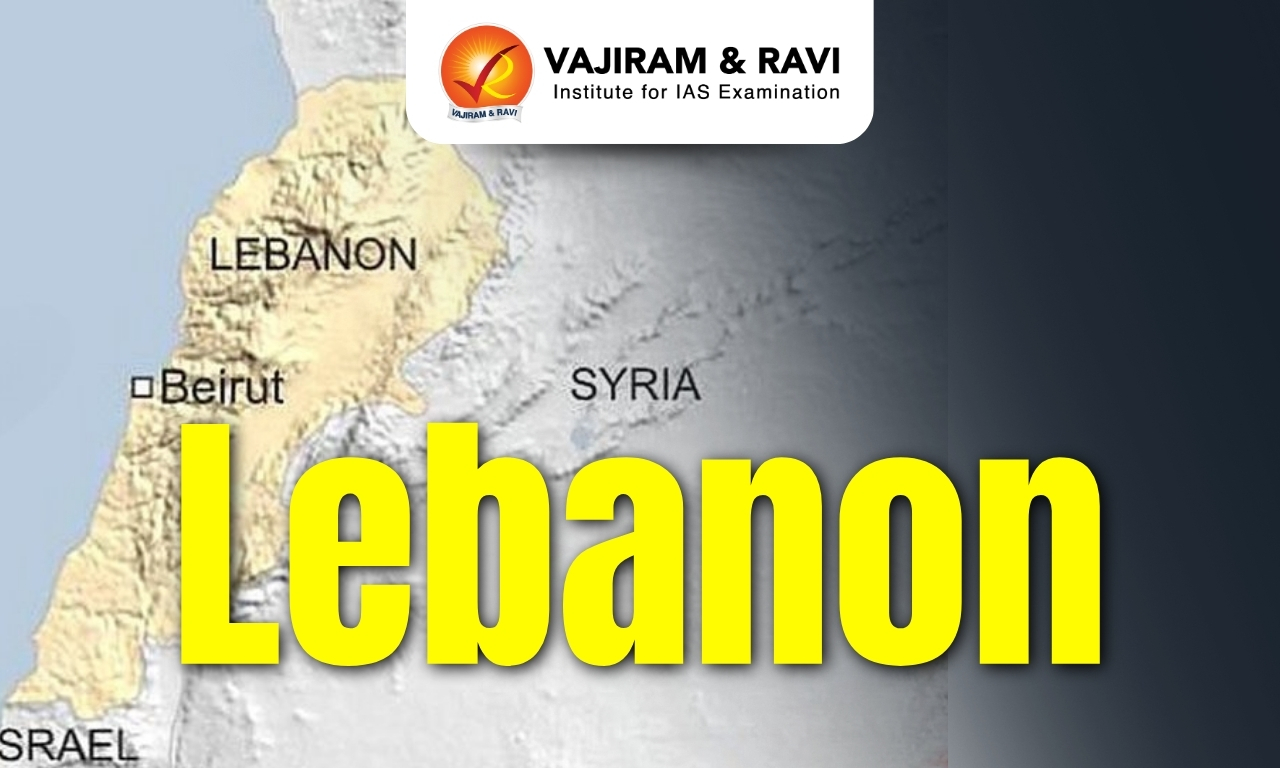
  • Location: It is situated on the eastern coast of the Mediterranean Sea in Western Asia.
  • Borders: It is bounded in the northern and eastern parts by Syria; in the southern part by Israel; in the western part by the Mediterranean Sea.
  • Capital City: Beirut

Geographical Features of Lebanon

  • Climate: Its Mediterranean climate brings mild, wet winters and hot, dry summers.
  • Mountains: Its major mountains are Lebanon Mountains (Jabal Lubnan), Hermon Ranges.
  • Highest Peak: The highest point of Lebanon is Qurnat as Sawda’ which peaks at 10,128 ft. (3,087 m) in the Lebanon Mountains.
  • Major Valley: Bekaa (Al-Biqa)
  • River: The Litani the most significant river which irrigates the heart of the fertile Bekaa Valley.
  • Natural Resources: It mainly consists of mineral products which include limestone, gypsum, oil, natural gas, and salt.

Source: TH

Lebanon FAQs

Q1: What is the capital of Lebanon?

Ans: Beirut

Q2: Which two countries share land borders with Lebanon?

Ans: Syria and Israel

Energy Transition Index

Energy Transition Index

Energy Transition Index Latest News

India moved up two places to rank 70th in the Energy Transition Index (ETI) 2026.

About Energy Transition Index

  • It is released by the World Economic Forum.
  • It evaluates countries on energy security, sustainability and equity, along with the readiness of their policy, financial and infrastructure environments to support the transition.
  • A country’s final ETI score is a weighted composite of two sub-indices: system performance (60%) and transition readiness (40%).
    • System performance is evenly distributed across equity, security and sustainability dimensions, while transition readiness is divided into two categories: core enablers and enabling factors.
      • Core enablers include regulation and political commitment as well as finance and investment, while enabling factors encompass innovation, infrastructure and education and human capital.
  • ETI scores use a 0-100 scale, with 100 representing the highest global performance for each indicator and index component. 

Key Findings of Energy Transition Index

  • Sweden, Finland and Denmark retained their top three positions globally
  • Singapore posted one of the largest improvements, climbing 10 places to 42nd due to stronger regulations and political commitment.
  • Six G20 members featured in the top 20: Germany (9th), France (10th), the United Kingdom (11th), China (14th), Brazil (17th) and the United States (19th).

Source: TI

Energy Transition Index FAQ's

Q1: Which organisation releases the annual Energy Transition Index?

Ans: World Economic Forum

Q2: What is India’s rank in the Energy Transition Index 2026?

Ans: 70th

Financial Action Task Force

Financial Action Task Force (FATF)

Financial Action Task Force Latest News

Recently, India has been elected to the Vice-Presidency of the Financial Action Task Force (FATF) for the first time.

About Financial Action Task Force

  • It is an independent intergovernmental body that develops and promotes policies to protect the global financial system against money laundering and terrorist financing.
  • Origin
    • It was established in 1989 during the G7 Summit in Paris in response to a growing concern about money laundering.
    • In 2001, its mandate expanded to include terrorism financing.
  • Headquarters: Paris, France.
  • Members:FATF members include 40 countries, including the United States, India, China, Saudi Arabia, Britain, Germany, France, and the EU as such.
    • India became a member of FATF in 2010. 
    • In addition, over 200 jurisdictions around the world have committed to the FATF Recommendations through the global network of FSRBs and FATF memberships.
  • FATF regularly publishes reports that raise awareness about the latest money laundering, terrorist financing, and proliferation financing techniques.
  • Once a member, a country or organization must endorse and support the most recent FATF recommendations and commit to being evaluated by (and evaluating) other members.
  • The FATF holds countries to account that do not comply with the FATF Standards.
  • If a country repeatedly fails to implement FATF Standards, then it can be placed under the grey and black lists.
  • The FATF recommendations are recognised as the global anti-money laundering (AML) and counter-terrorist financing (CFT) standard.

Source: PIB

Financial Action Task Force FAQ's

Q1: Which are the only 3 countries currently on the FATF Black List in 2026?

Ans: North Korea, Iran, and Myanmar

Q2: When and where was the Financial Action Task Force established?

Ans: 1989 by G7 Summit in Paris

Dongria Kondh Community

Dongria Kondh Community

Dongria Kondh Tribe Latest News

The Dongria Kondh tribes who inhabit the Niyamgiri hills across Rayagada and Kalahandi districts in southwestern Odisha for whom forests, food and faith shape their daily life.  

About Dongria Kondh Tribe

  • It is a Particularly Vulnerable Tribal Group (PVTG) Community.
  • Dongria Kondhs are ancient occupants of Niyamgiri hills spread across Kalahandi and Rayagada districts of Odisha.
  • They derive their name from dongar, meaning ‘hill’ and the name for themselves is Jharnia: protector of streams.
  • Belief: They trace their ancestry to Niyam Raja, a mythical god-king, who they believe is a creator of the Niyamgiri hills and whose stewardship has been left to them. 
  • Culture and Society
    • The Dongria have distinctive jewellery, tattoos and hairstyles. Women wear many rings through their ears and three through their noses, while boys wear two nose rings. 
    • They have no overarching political or religious leader
    • Clans and villages have their own leaders and individuals with specific ceremonial functions, including the beju and bejuni, male and female priests. 
    • Language: They speak two languages namely “kuyi” and “kuvi”, vocabulary which is completely unrelated to odiya, the state’s official language.
    • Members of the Dongria Kondh tribe perform a traditional dance at Phakeri.
  • Economy: The economy and livelihood of Dongria kondh is dependent on collection of Non-timber forest products (NTFPs) and podu cultivation. They are traditionally horticulturists.

Source: TH

Dongria Kondh Tribe FAQs

Q1: What is the traditional shifting cultivation practice of Dongria Kondh called?

Ans: Podu cultivation

Q2: In which state and district is the Dongria Kondh tribe primarily located?

Ans: Odisha

Enquire Now