Ceratocaudia antigua

Ceratocaudia antigua

Ceratocaudia antigua Latest News

Scientists recently discovered a new species of long-necked dinosaur named Ceratocaudia antiqua in western India that possessed a unique, horn-like tail crest.

About Ceratocaudia antigua

  • It is a new species of long-necked dinosaur.
  • It was discovered following excavations in the Kaladongar Formation of the Kachchh Basin in the Kutch district of Gujarat. 
  • Living roughly 170 to 180 million years ago during the Jurassic period, this diminutive giant reaches only about seven meters in length, significantly smaller than its more famous 20-meter-long relatives like Brachiosaurus. 
  • Ceratocaudia is distinguished by several physical traits that set it apart from its closest relatives. 
    • The most striking feature is a curved, horn-like crest atop its front tailbones. 
    • It also possessed a unique notch on its neck vertebrae and specific shapes in its lower leg bones, the tibia and fibula, which have not been seen in other sauropods.
    • Furthermore, its tail vertebrae show a rare transition from flat-ended joints to "ball-and-socket" joints near the tip, a feature usually reserved for much later dinosaur species. 
  • The name Ceratocaudia antiqua reflects these physical and historical traits. 
    • The genus name is derived from the Greek words ‘cerato’ (meaning horn) and ‘caud’ (meaning tail), referring to the unique spike on its vertebrae. 
    • The species name, ‘antiqua’, is Latin for "old" or "ancient," highlighting that this is one of the earliest known macronarian dinosaurs, a group of long-necked giants characterised by their large, boxy skulls and wide nostrils.
  • Ceratocaudia now stands as the earliest diagnosable member of its lineage in India and one of the oldest in the world .

News: RM

Ceratocaudia antigua FAQ's

Q1: What is Ceratocaudia antiqua?

Ans: It is a new species of long-necked dinosaur.

Q2: Where was Ceratocaudia antiqua discovered?

Ans: It was discovered in the Kaladongar Formation of the Kachchh Basin in the Kutch district of Gujarat.

Q3: During which geological period did Ceratocaudia antiqua live?

Ans: The Jurassic Period, about 170–180 million years ago.

Q4: What is the most distinctive feature of Ceratocaudia antiqua?

Ans: A curved, horn-like crest on its front tail vertebrae.

Q5: To which group of dinosaurs does Ceratocaudia antiqua belong?

Ans: It belongs to the macronarian group of long-necked dinosaurs.

Lake Mansarovar

Lake Mansarovar

Lake Mansarovar Latest News

The wish of pilgrims undertaking the Kailash Mansarovar Yatra to take a holy dip in Lake Mansarovar remained unfulfilled yet again this year, as Chinese authorities continued to prohibit bathing in the lake. 

About Lake Mansarovar

  • It is a large freshwater lake situated in China's Tibet Autonomous Region.
  • It is regarded as one of the holiest lakes in Hinduism, Buddhism, Jainism, and Bon. 
  • The lake covers an area of 410 sq.km. and lies at an altitude of 4,590 meters/15,060 feet. 
  • It is one of the highest freshwater lakes in the world.
  • It is located adjacent to Lake Rakshastal, which is a saltwater lake. The two lakes are connected by the Ganga Chhu channel. 
  • The highest peak in the surrounding range is Gurla Mandata (7694 meters). To the north of the lake is magnificent Mount Kailash.
  • The waters of the lake are so clear with transparency up to 14 meters.
  • The Kailash Manasarovar region is a source of 4 great rivers flowing across Asia, including the Ganges (also known as the Karnali, the longest river in Nepal), flows on the south side, whereas the Indus, the Sutlej, and the Brahmaputra (the Yarlung Tsangpo) in the east, west, and north, respectively. 
  • At present, along with the shores of Mansarovar, there are 5 Buddhist monasteries, and out of those five, Chiu Monastery is the most popular and is located on the northwest shore of the lake. 

News: ETVB

Lake Mansarovar FAQs

Q1: Where is Lake Mansarovar located?

Ans: It is located in the Tibet Autonomous Region of China.

Q2: At what altitude is Lake Mansarovar situated?

Ans: 4,590 metres (15,060 feet) above sea level.

Q3: Which saltwater lake lies adjacent to Lake Mansarovar?

Ans: Lake Rakshastal.

Q4: Which mountain lies to the north of Lake Mansarovar?

Ans: Mount Kailash.

Kuldiha Wildlife Sanctuary

Kuldiha Wildlife Sanctuary

Kuldiha Wildlife Sanctuary Latest News

A 26-year-old farmer was critically injured in a suspected leopard attack in the Kuldiha Wildlife Sanctuary in the Balasore district recently.

About Kuldiha Wildlife Sanctuary

  • It is situated in the Balasore District of Odisha.
  • It is spread across the Chota Nagpur Plateau region.
  • It covers an area about 300 sq.km., connected to Simlipal National Park through hills called Sukhupada and Nato.  
  • It is characterized by its complex topography, which includes rolling hills, valleys, and plateaus that contribute to its microclimates.  
  • The local tribal communities, including the Santhal and Munda, maintain a deep-rooted spiritual connection to Kuldiha. 
  • The sanctuary is also home to unique geological formations, such as the ancient rock shelters adorned with petroglyphs that date back thousands of years.
  • Vegetation: It contains mixed deciduous forest.
  • Flora: It  is dominated by species such as Sal (Shorea robusta) and various bamboo species.
  • Fauna: 
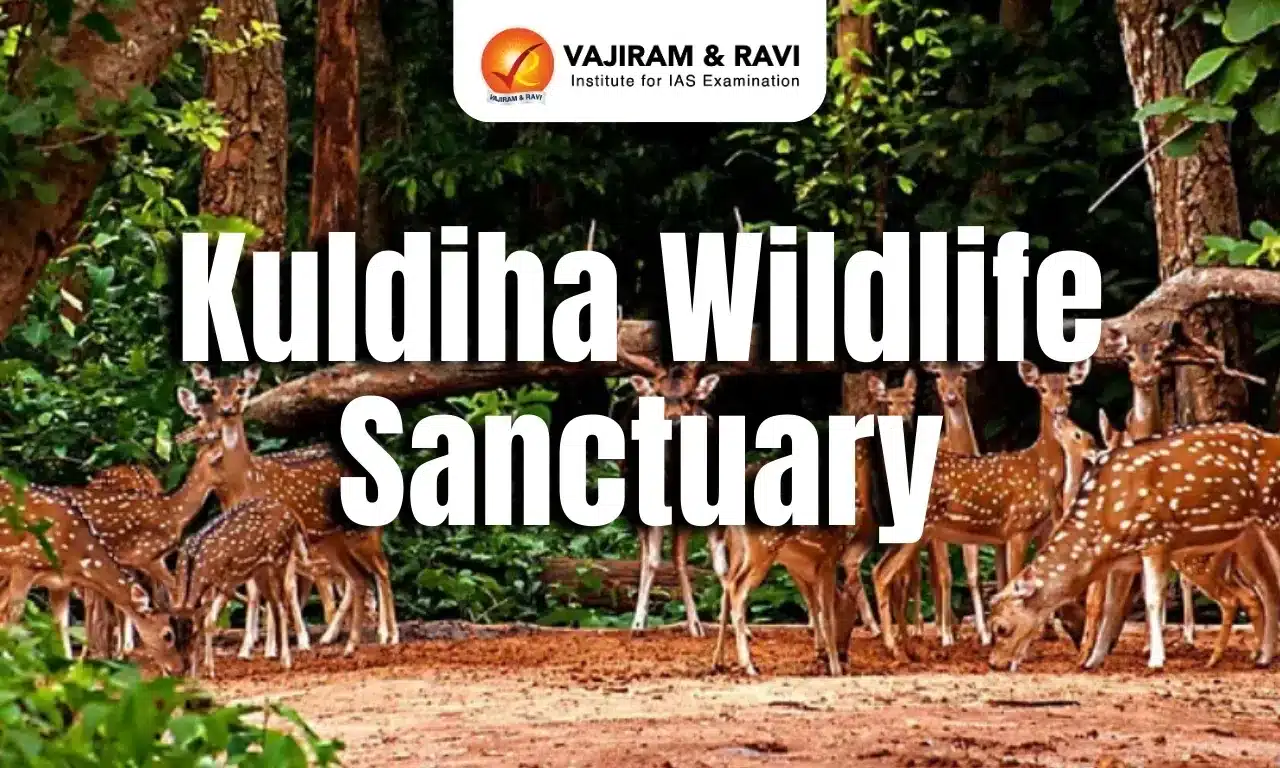
    • The dense forests of the region are home to wild animals like the elephants, leopards, deer, bison and Malabar giant squirrels. 
    • The forest also houses a variety of birds. Some of them are like white-rumped shama, parrot, hornbills, and peafowl. 

News: NIE

Kuldiha Wildlife Sanctuary FAQs

Q1: Where is Kuldiha Wildlife Sanctuary located?

Ans: It is located in the Balasore district of Odisha.

Q2: In which physiographic region is Kuldiha Wildlife Sanctuary situated?

Ans: The Chota Nagpur Plateau region.

Q3: Which national park is connected to Kuldiha Wildlife Sanctuary?

Ans: Simlipal National Park.

Q4: Which tribal communities have a deep-rooted spiritual connection with Kuldiha Wildlife Sanctuary?

Ans: The Santhal and Munda communities.

Q5: What type of vegetation is found in Kuldiha Wildlife Sanctuary?

Ans: Mixed deciduous forest.

Enquire Now