HYDERACENE

HYDERACENE

HYDERACENE Latest News

The University of Hyderabad (UoH) recently secured an Indian patent for HYDERACENE, a dual-action material designed specifically for rocket propellants and high-performance defence applications.

About HYDERACENE

  • It is a novel polymer-based material developed for use in solid rocket propellants for defence and space applications. 
  • The innovation was developed by Mutyalanaidu Ganivada, Sourav Jana, and Tushar Jana of the School of Chemistry, with the University of Hyderabad as the patentee. 
  • The patented material, formally described as Ferrocene Polyethylene Glycidyl Grafted Hydroxyl-Terminated Polybutadiene, was synthesised using ring-opening polymerisation.
  • Why is this Innovation Significant?
    • In conventional solid rocket propellants, two critical components are required:
      • The Binder: A glue-like polymer that holds all active fuel components together while providing structural integrity.
      • The Catalyst: A specialized chemical additive that speeds up and controls the burning rate of the propellant.
    • Traditionally, these are two separate materials. HYDERACENE acts as both at the same time—a polymer binder-cum-catalyst. 
    • This improves long-term stability by preventing the catalyst from separating from the binder over time and enables more controlled and efficient combustion in solid rocket motors. 
    • Hyderacene has also been developed as an indigenous alternative to Butacene, a commercially used material in aerospace and defence applications.
      • BUTACENE is largely imported from European countries. 
  • Named after the city of Hyderabad, the patented material is designed for use in high-performance rocket propellants and other advanced defence applications requiring controlled burn rates and improved propulsion efficiency.

News: NIE

HYDERACENE FAQs

Q1: What is HYDERACENE?

Ans: HYDERACENE is a novel polymer-based material developed for use in solid rocket propellants for defence and space applications.

Q2: Which institution developed HYDERACENE?

Ans: The University of Hyderabad.

Q3: What makes HYDERACENE unique compared to conventional rocket propellant materials?

Ans: It functions as both a binder and a catalyst.

Q4: How does HYDERACENE improve the stability of solid rocket propellants?

Ans: It enables more controlled and efficient combustion in solid rocket motors.

Q5: HYDERACENE has been developed as an indigenous alternative to which imported material?

Ans: BUTACENE.

Hexavalent Vaccine

Hexavalent Vaccine

Hexavalent Vaccine Latest News

Introducing the hexavalent (six-in-one) vaccine into India’s Universal Immunisation Programme (UIP) could improve the efficiency of the country’s childhood immunisation programme, according to a recent study conducted by the Union Health Ministry.

About Hexavalent Vaccine

  • It is a combination vaccine that protects infants against six different diseases with a single injection. 
  • It combines six different antigens through special manufacturing processes. 
  • The hexavalent vaccine protects against: 
    • Diphtheria
    • Tetanus
    • Pertussis (Whooping Cough)
    • Hepatitis B
    • Polio
    • Haemophilus influenzae type b (Hib) infections
  • Hexavalent vaccine could deliver several benefits, including:
    • Fewer injections for infants, making vaccination more convenient for children and caregivers.
    • Lower cold-chain storage requirements.
    • Reduced use of syringes and other vaccination supplies.
    • Less time spent by Auxiliary Nurse Midwives (ANMs) administering vaccines and maintaining records.
    • Lower workload for cold-chain handlers and vaccine managers.
    • Time savings for parents and caregivers during immunisation visits.

News: TH

Hexavalent Vaccine FAQs

Q1: What is a Hexavalent Vaccine?

Ans: A combination vaccine that protects infants against six different diseases with a single injection.

Q2: Which six diseases are prevented by the Hexavalent Vaccine?

Ans: Diphtheria, Tetanus, Pertussis (Whooping Cough), Hepatitis B, Polio, and Haemophilus influenzae type b (Hib) infections.

Q3: What is the major advantage of the Hexavalent Vaccine for infants?

Ans: It provides protection against six diseases with fewer injections.

Q4: How does the Hexavalent Vaccine benefit parents and caregivers?

Ans: It reduces the number of immunisation visits and saves time.

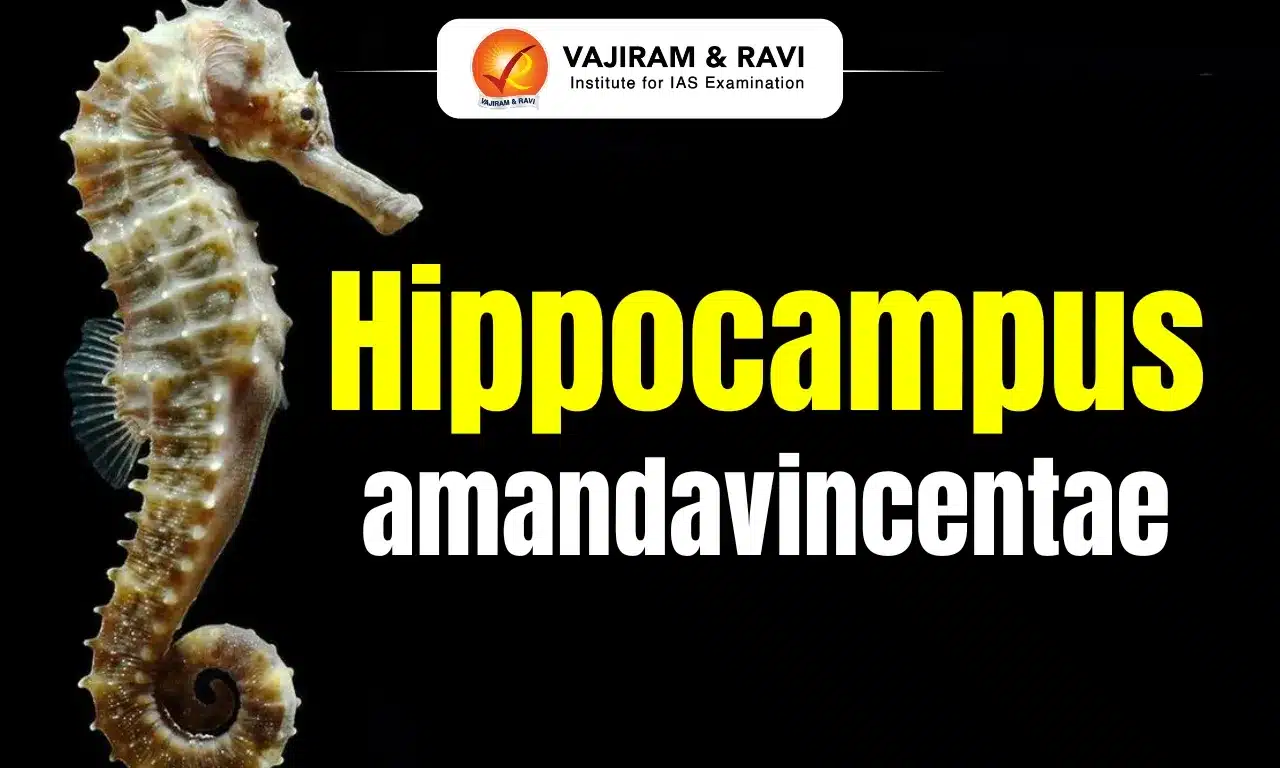
Hippocampus amandavincentae

Hippocampus amandavincentae

Hippocampus amandavincentae Latest News

Scientific studies recently identified a new species of seahorse named Hippocampus amandavincentae, which was previously misidentified as Hippocampus histrix.

About Hippocampus amandavincentae

  • It is a new species of seahorse.
  • It was recorded off the southwest coast of Kerala. 
  • This discovery has made a total of 5 seahorse species discovered from the Kerala coast.

What is a Seahorse?

  • A seahorse is a marine fish belonging to the genus Hippocampus and related to pipefishes.  
  • There are at least 50 species of seahorses. 
  • Distribution: They are found in temperate and tropical waters around the world. 
  • Habitat: 
    • Typically found in shallow waters with abundant vegetation such as coral reefs, mangroves, seagrass beds, and estuaries. 
    • They are usually found clinging to plants or corals with their tails.  
  • They are unique in appearance, with their horselike head, prehensile tail, independently moving eyes, and brood pouch.  
  • They have long, tubular snouts and small, toothless mouths. 
  • Their bodies are covered with consecutive rings of bony plates. 
  • Seahorses vary in size, ranging in length from about 2 to 35 cm.
  • Seahorses are rather immobile, swimming more slowly than other fishes.
  • When swimming they maintain a vertical position and propel themselves forward using a soft-rayed dorsal fin. They use pectoral fins located on the side of the head to maneuver. 
  • To move up and down, they adjust the volume of air in a tiny pocket inside their body, called a ‘swim bladder’. 
  • Experts in camouflage, they can change color to blend into their surroundings and avoid danger. 
  • They are carnivores. They eat small crustaceans and invertebrates.

News: TH

Hippocampus amandavincentae FAQs

Q1: What is Hippocampus amandavincentae?

Ans: It is a new species of seahorse.

Q2: Where was Hippocampus amandavincentae discovered?

Ans: Off the southwest coast of Kerala.

Q3: What is a seahorse?

Ans: A seahorse is a marine fish belonging to the genus Hippocampus.

Q4: Which fishes are closely related to seahorses?

Ans: Pipefishes.

Q5: What are the preferred habitats of seahorses?

Ans: Coral reefs, mangroves, seagrass beds, and estuaries.

Enquire Now