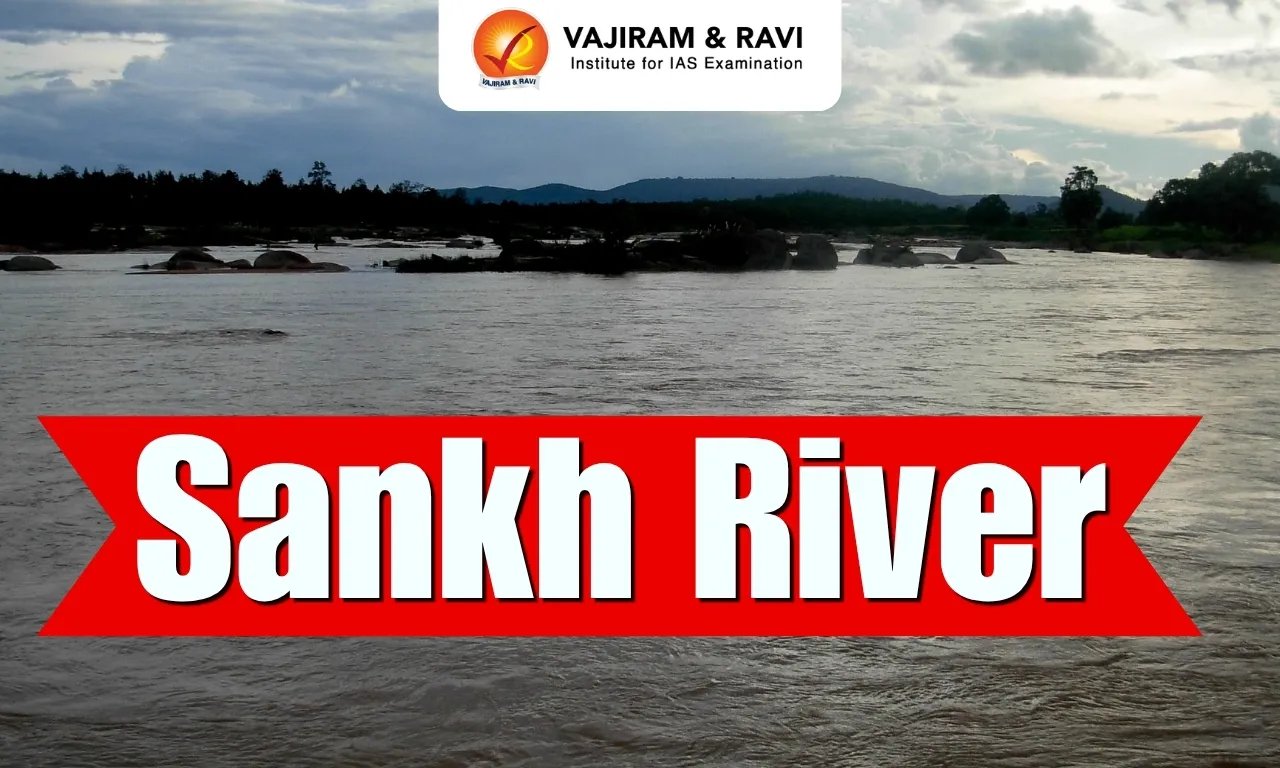
Sankh River

Sankh River

Sankh River Latest News

Tragedy struck Salangabahal village in Odisha when three minor girls drowned in the Sankh river while preparing for the Karma Puja festival recently.

About Sankh River

  • It flows across Jharkhand, Chhattisgarh, and Odisha states in India. 
  • The river is also known locally as the Shankh River and is a key tributary in the Brahmani River system. 
  • Course:
    • The river starts 1,000 metres above sea level in the Lupungpat village in Gumla district in Jharkhand and flows 67.5 kilometres in the state before entering Chhattisgarh. 
    • It runs a distance of about 50 kilometres in Chhattisgarh and enters Jharkhand again to flow for another 78 kilometres. 
    • The river finally enters Odisha and travels another 45 kilometres before merging with the Koel. 
    • The South Koel enters Odisha and joins the Sankh River at Vedavyas near Rourkela, from where it is called the Brahmani. 
  • Total Length: 240 km
  • A major feature along its course is the 60-metre-high Sadni Falls located at the edge of the Ranchi plateau, known as a scarp or knick-line waterfall.

News: NIE

Sankh River FAQs

Q1: Which states does the Sankh River flow through?

Ans: Jharkhand, Chhattisgarh and Odisha.

Q2: Which major river system does the Sankh River form a part of?

Ans: The Brahmani River system.

Q3: Where does the Sankh River originate?

Ans: At Lupungpat village in Gumla district, Jharkhand.

Q4: What is the total length of the Sankh River?

Ans: About 240 kilometres.
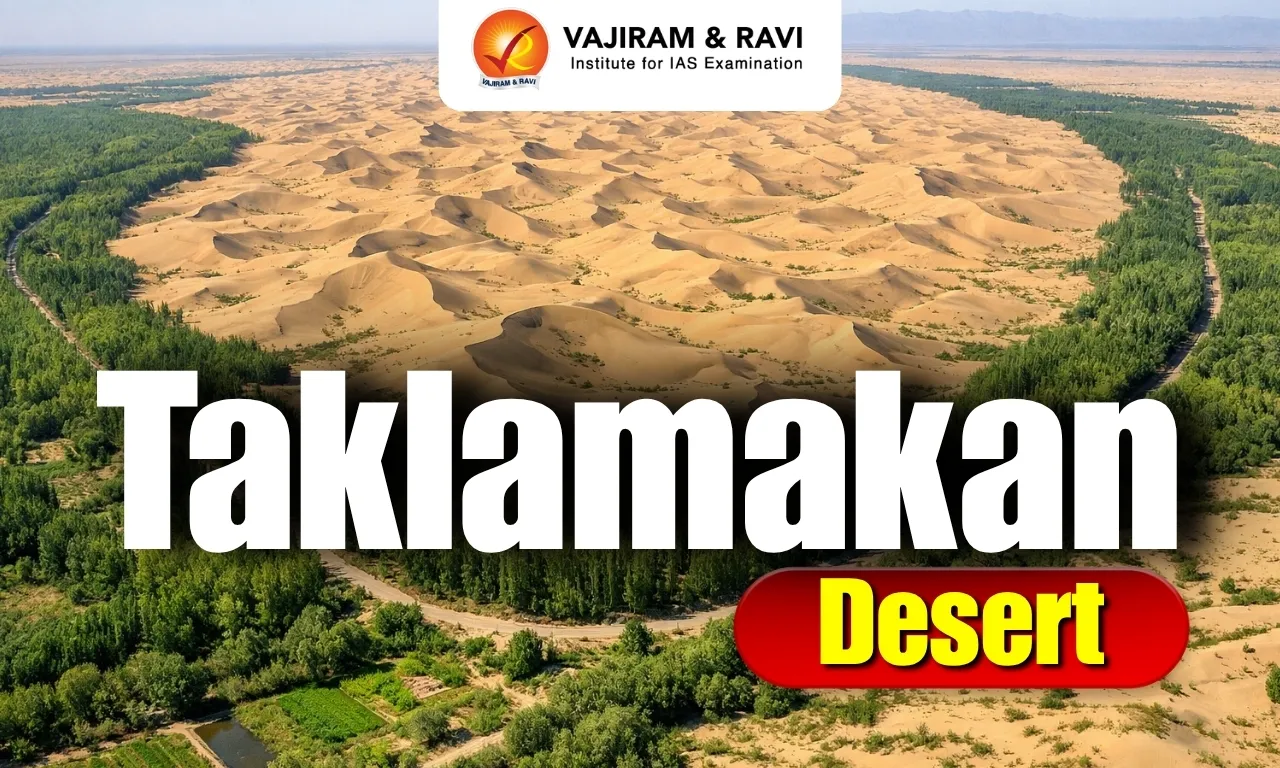
Taklamakan Desert

Taklamakan Desert

Taklamakan Desert Latest News

For decades, China has been planting trees and other vegetation around the edges of the Taklamakan Desert, one of the world's largest and driest deserts, in an effort to stop desertification and hold back shifting sand.

About Taklamakan Desert

  • The Taklamakan Desert, located in southwest Xinjiang in northwest China, is one of the world’s largest sandy deserts. 
  • It sits right in the middle of the largest inland basin in China—the Tarim Basin. 
  • The desert area extends about 960 km from west to east, and it has a maximum width of some 420 km and a total area of approximately 320,000 sq.km.  
  • It is the world’s second-largest shifting-sand desert, and 85% of its total area is composed of crescent-shaped dunes.
  • It is flanked by two towering mountain ranges-Tien Shan to the north and Kunlun mountain ranges to the south.
  • It also has the Pamir Mountains and Tian Shan (ancient Mount Imeon) to the west and the famed Gobi Desert to the east.
  • There is a gradual transition to the Lop Nur basin in the east; in the south and west, between the sandy desert and the mountains, lies a band of sloping desert lowland composed of pebble-detritus deposits. 
  • The place has a typical continental climate with strong gusts of wind, very little precipitation, and a significant shift in temperature from daytime to nighttime and vice versa.
  • The continuously shifting nature of the sand in the desert has extended Taklamakan to about 100 km southward during the last thousand years. 
  • There are also small mountain ranges in the desert as well as the Tarim River that flows through its Northern edge. 

News: MC

Taklamakan Desert FAQ's

Q1: Where is the Taklamakan Desert located?

Ans: It is located in southwest Xinjiang in northwest China.

Q2: In which basin is the Taklamakan Desert located?

Ans: It sits right in the middle of the largest inland basin in China—the Tarim Basin.

Q3: What type of desert is the Taklamakan Desert?

Ans: It is a sandy desert.

Q4: Which mountain range lies to the north of the Taklamakan Desert?

Ans: The Tien Shan Mountains.

Q5: What are the major climatic characteristics of the Taklamakan Desert?

Ans: Strong winds, very little precipitation, and large day-night temperature variations.

Ariosoma cmfriense

Ariosoma cmfriense

Ariosoma cmfriense Latest News

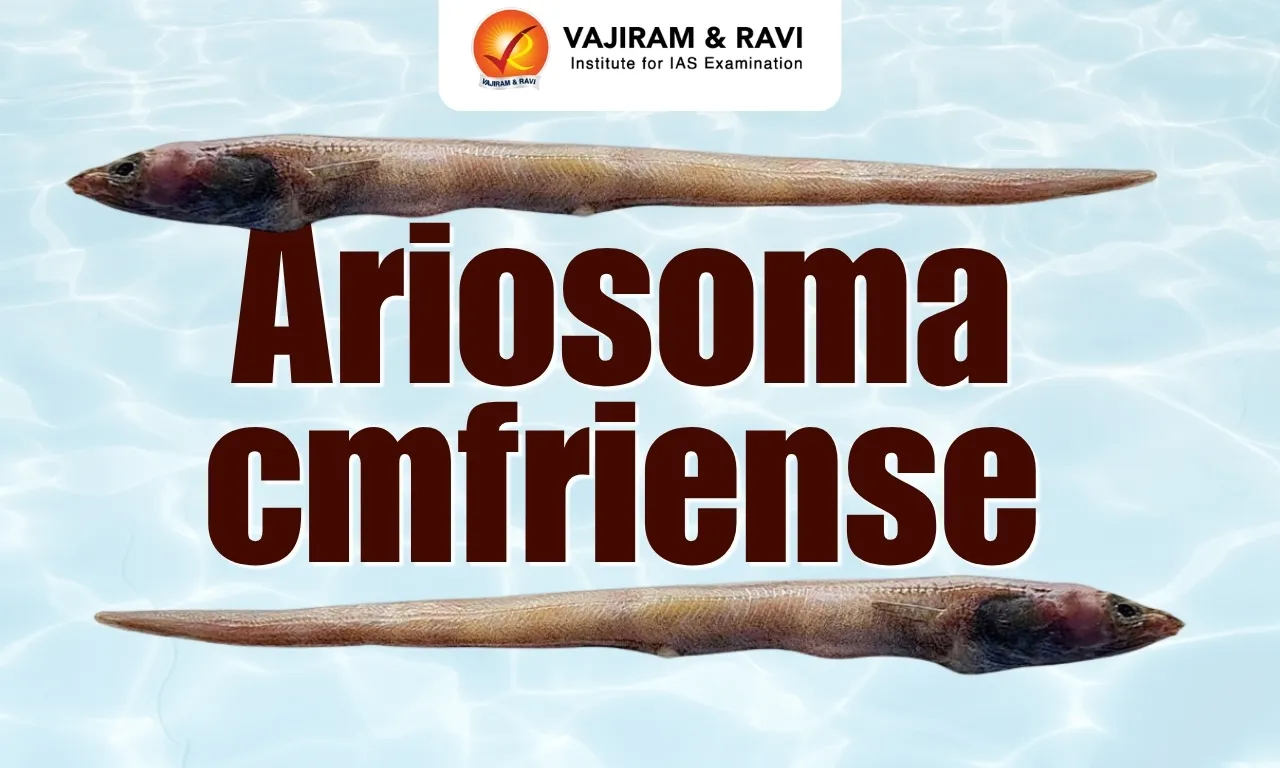
Scientists recently discovered a new species of conger eel named Ariosoma cmfriense from the deep waters of the Arabian Sea. 

About Ariosoma cmfriense

  • It is a new species of conger eel.
    • Conger eels are powerful fish with an elongated, snake-like body which is smooth and scaleless. 
  • It was found in the waters off Kollam, Kerala, at a depth of about 300 metres.
  • The discovery was made by scientists from the ICAR-Central Marine Fisheries Research Institute, Kochi, as part of the research component under the Deep Ocean Mission (DOM), a national programme of the Ministry of Earth Sciences (MoES).
  • Ariosoma cmfriense has several distinct features. 
    • These include a relatively low total vertebral count of 135 and 127-130 lateral-line pores.
    • Its preanal length is nearly half its total length.
    • It also has two supraorbital pores and a dorsal fin that begins just ahead of the pectoral fin base.
    • The fish has a plain pectoral fin, a dark patch over the operculum, and fine black speckling below the lateral line, a feature not observed in the other related species.

News: ETVB

Ariosoma cmfriense FAQs

Q1: What is Ariosoma cmfriense?

Ans: A newly discovered species of conger eel.

Q2: Where was Ariosoma cmfriense discovered?

Ans: In the waters off Kollam, Kerala.

Q3: What type of fish are conger eels?

Ans: Powerful, elongated, snake-like fish with smooth and scaleless bodies.

Q4: What distinctive marking is present over the operculum of Ariosoma cmfriense?

Ans: A dark patch is present over the operculum.

Gallium Nitride Monolithic Microwave Integrated Circuit Technology

Gallium Nitride Monolithic Microwave Integrated Circuit Technology

Gallium Nitride Monolithic Microwave Integrated Circuit Technology Latest News

Recently, the Defence Research and Development Organisation (DRDO) has successfully demonstrated and implemented indigenous Gallium Nitride Monolithic Microwave Integrated Circuit (GaN MMIC) Technology.

About Gallium Nitride Monolithic Microwave Integrated Circuit (GaN MMIC) Technology

  • It is a tiny, super-powerful computer chip built on a special chemical material that handles extremely high-frequency wireless signals without melting.
  • It’s an all-in-one chip that combines tiny parts—like transistors, resistors, and capacitors—onto a single piece of material to manage invisible wireless waves (microwaves).
  • It is designed for applications up to the X-band frequency range.
  • Origin: DRDO developed the GaN MMIC technology in 2024 and helped India quietly entered an elite club of seven countries — US, Russia, France, Germany, South Korea, China

Why is GaN Important?

  • It is a material with exceptional thermal and electrical properties, making it critical for advanced defence applications such as sensors, radars, satellites, and missiles.
  • A single indigenous GaN chip, measuring 3.5 x 3 mm can deliver up to 30 watts of power and operate at speeds 300 times faster than silicon.
  • Gallium Nitride (GaN) is considered one of the most important semiconductor technologies for modern defence systems.
  • It offers: Higher power output, Better energy efficiency, Faster signal processing, Reduced size and weight, Improved thermal performance, Greater reliability in harsh environments

Source: TOI

Gallium Nitride Monolithic Microwave Integrated Circuit Technology FAQs

Q1: Who developed Gallium Nitride Monolithic Microwave Integrated Circuit Technology?

Ans: DRDO developed the GaN MMIC technology

Q2: What is Gallium Nitride Monolithic Microwave Integrated Circuit Technology?

Ans: It is a tiny, super-powerful computer chip built on a special chemical material.

Indian Council of World Affairs

Indian Council of World Affairs

Indian Council of World Affairs Latest News

Recently, the Vice-President of India addressed the 25th Anniversary celebrations of Indian Council of World Affairs (ICWA) at Sapru House, New Delhi. 

About Indian Council of World Affairs

  • Origin: It was established in 1943 by a group of Indian intellectuals as a think tank.
    • It was established by a group of eminent intellectuals led by Sir T.B. Sapru and Dr. H.N. Kunzru to create an Indian perspective on international relations and foreign policy issues. 
    • It was registered as a non-official, non-political and non-profit organisation under the Registration of Societies Act 1860.
    • By an Act of Parliament in 2001, the Indian Council of World Affairs has been declared an institution of national importance.
    • The Vice President of India is the ex-officio President of ICWA.
  • It is funded by the Ministry of External Affairs and enjoys full autonomy.
  • Functions: It is devoted exclusively for the study of international relations and foreign affairs.

Source: PIB

Indian Council of World Affairs FAQs

Q1: What is Indian Council of World Affairs?

Ans: It was established in 1943 by a group of Indian intellectuals as a think tank.

Q2: Whos is the president Indian Council of World Affairs?

Ans: The Vice President of India is the ex-officio President of ICWA.

Changthang Wildlife Sanctuary

Changthang Wildlife Sanctuary

Changthang Wildlife Sanctuary Latest News

Authorities will undertake spatial mapping and field verification of military installations within the Changthang Cold Desert Wildlife Sanctuary in Ladakh in coordination with police and the defence establishment, officials said recently.

About Changthang Wildlife Sanctuary

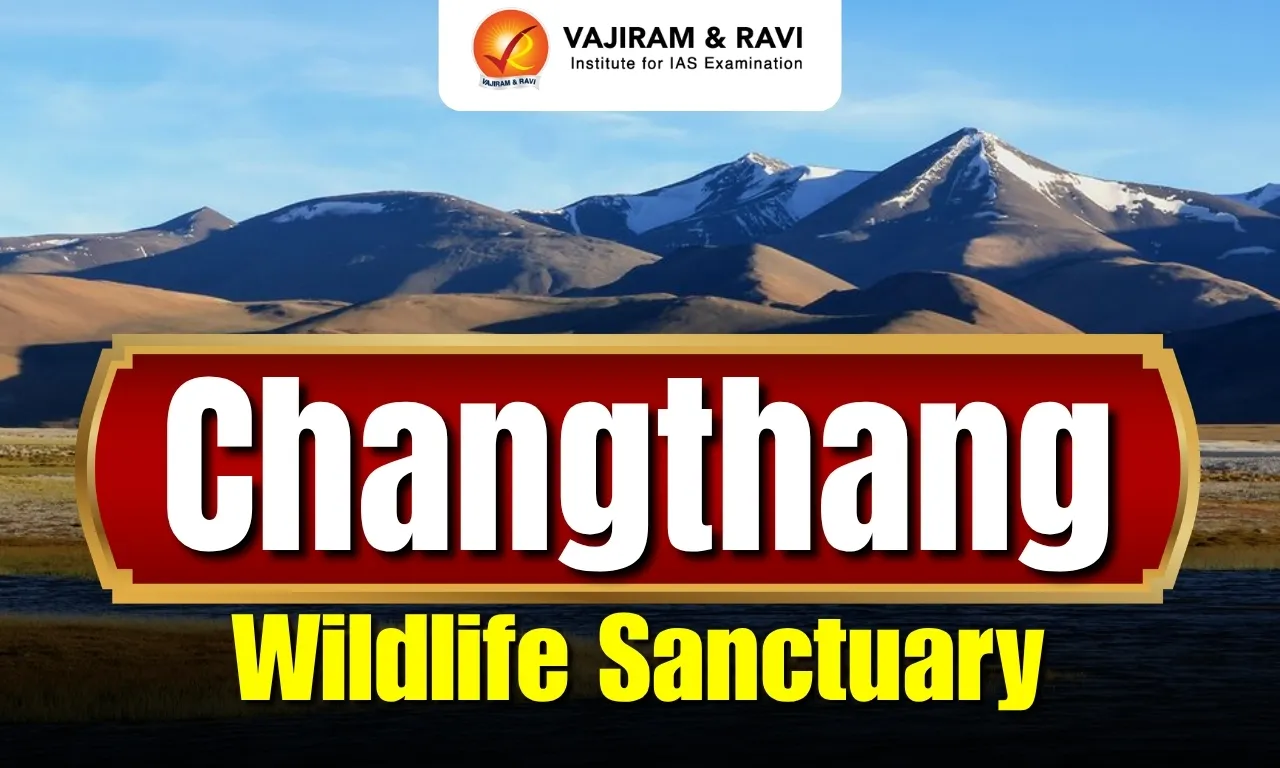
  • It is located in the Ladakhi Changthang plateau in the Leh district of Jammu and Kashmir.
  • It covers an area of almost 4,000 sq.km.
  • The altitude of the sanctuary varies from 14000 to 19000 feet, and the topography is formed of deep gorges and vast plateaus. 
  • It is home to the highest altitude water lakes, namely, Tso Moriri, Pangong Tso, and Tso Kar.
  • The Changthang region is inhabited by nomadic pastoral communities, primarily the Changpa tribe, who lead a traditional way of life herding yaks, goats, and sheep across the vast grasslands.
  • This region is steeped in Tibetan Buddhist culture and heritage.
  • It includes one of the world’s highest villages, Korzok Village, which attracts tourists to the Korzok Monastery.
  • Flora: It is home to almost 200 species of wild plants that grow in the higher pastures and are food for the animals inside the sanctuary.
  • Fauna
    • The major attraction of this place is the Snow Leopard. 
    • Along with that, it is one of the few places in India which is the abode of the Kiang, or Tibetan wild ass, along with the dark-necked crane. 
    • It also houses a huge variety of animal species, which include the Tibetan Wolf, Wild Yak, Bharal, Brown Bear, Tibetan Argali, Tibetan Gazelle, and the Mormot.  
    • It also serves as the habitat for numerous species of avifauna, including Brahminy Ducks and Brown Headed Gulls, etc.

News:TP

Changthang Wildlife Sanctuary FAQ's

Q1: Where is the Changthang Wildlife Sanctuary located?

Ans: It is located in the Ladakhi Changthang Plateau in the Leh district of Jammu and Kashmir.

Q2: Which high-altitude lakes are located in the Changthang Wildlife Sanctuary?

Ans: Tso Moriri, Pangong Tso and Tso Kar.

Q3: Which nomadic pastoral community primarily inhabits the Changthang region?

Ans: The Changpa tribe.

Q4: Which animal is the major attraction of the Changthang Wildlife Sanctuary

Ans: The Snow Leopard.

Dadasaheb Phalke Award

Dadasaheb Phalke Award

Dadasaheb Phalke Award Latest News 

Legendary actor Anant Nag, known for his impressive work in Hindi and Kannada cinema will be honoured with the Dadasaheb Phalke Award for 2024.

About Dadasaheb Phalke Award

  • It is given by the Indian government for lifetime contribution to Indian cinema.
  • It was instituted in 1969 the birth centenary year of Dadasaheb Phalke.
  • It is the highest award in the field of cinema in India.
  • It was introduced by the Government of India to commemorate Dadasaheb Phalke’s contribution to Indian cinema.
  • The award’s inaugural recipient was Devika Rani, aptly titled “the first lady of Indian cinema”.
  • The recipients are recognized for their ‘outstanding contribution to the growth and development of Indian cinema’.
  • Award includes: The award comprises a Swarna Kamal (Golden Lotus) medallion, a shawl, and a cash prize of ₹10 lakh.
  • It is presented by the President of India. 

Key Facts about Dhundiraj Govind Phalke

  • He was born on April 30, 1870, in Trimbak, Maharashtra.
  • He was a film director who is considered the father of Indian cinema. 
  • He directed India’s first full-length feature film, Raja Harishchandra in 1913.

Source: TH

Dadasaheb Phalke Award FAQs

Q1: What is Dadasaheb Phalke Award?

Ans: It is the highest award in the field of cinema in India.

Q2: When was the Dadasaheb Phalke Award instituted?

Ans: It was instituted in 1969 the birth centenary year of Dadasaheb Phalke.

India Electric Mobility Index

India Electric Mobility Index

India Electric Mobility Index Latest News

According to the index released by NITI Aayog, Delhi topped India’s states and Union territories in the India Electric Mobility Index (IEMI) 2025, scoring 84. 

About India Electric Mobility Index

  • It is a composite Index, which assesses the policy framework and implementation outcomes for e-mobility at the state-level.
  • It is developed by the NITI Aayog in collaboration with WRI India.
  • It evaluates and scores all Indian States and UTs out of 100 across 16 indicators under three-core themes: 
    • Transport Electrification Progress to capture demand-side adoption 
    • Charging Infrastructure Readiness to track allied charging infrastructure development
    • EV Research and Innovation Status: Covers supply-side ecosystem R&D efforts.
  • Based on the score, each State or UT was classified into one of the following classes: 
    • Top Performers: score ≥65
    • Frontrunners: score of 50–64
    • Emerging Performers: score of 35–49
    • Aspirants: score <35

Highlights of the India Electric Mobility Index 2025

  • According to the index, the composite scores on performance across all 36 States and Union Territories (UTs) ranges from 10 to 84, and a median score of 40.
  • Delhi bagged the highest score of 84, followed by Maharashtra (78), Karnataka (73), Chandigarh (71), and Goa (65).
  • Madhya Pradesh recorded a substantial improvement, moving from the 23rd to seventh rank.
  • The index further shows that eight large states — Tamil Nadu, Madhya Pradesh, Odisha, Andhra Pradesh, Telangana, Haryana, Rajasthan, and Uttar Pradesh — have qualified as frontrunners.
  • The other seven large states such as Chhattisgarh, West Bengal, Bihar, Kerala, Jharkhand, Punjab, and Gujarat were emerging performers with a score of 35-49.
  • The report also shows that Delhi, Chandigarh, and Maharashtra were the only UTs and states to qualify as top performers in transport electrification progress.
  • In the Charging Infrastructure Readiness (30% weightage), Karnataka recorded the highest score nationwide at 97, Goa (92) and Maharashtra (91).
  • Delhi also achieved the top score of 94 in the EV Research and Innovation Status (20% weightage) category.

Source: IE

India Electric Mobility Index FAQs

Q1: Who publishes India Electric Mobility Index?

Ans: It is developed by the NITI Aayog in collaboration with WRI India.

Q2: What is India Electric Mobility Index?

Ans: It is a composite Index, which assesses the policy framework and implementation outcomes for e-mobility at the state-level.

Black-Headed Ibis

Black-Headed Ibis

Black-headed Ibis Latest News

Recently, the Pallar paddy fields at Tirunavaya in Malappuram , Kerala have turned white with the arrival of a large flock of Black-headed ibis(Threskiornis melanocephalus).

About Black-headed Ibis

  • It is a species of wading bird of the ibis family Threskiornithidae.
  • It is also known as the Oriental white ibis, Indian white ibis, and black-necked ibis.
  • Adaptability: These are called wader birds due to their adaptability to a wide variety of aquatic environments.
  • Habitat: Found primarily around wetlands including agricultural fields and occasionally around coastal areas, but also seen foraging in dry fields and human-modified landscapes.
  • Distribution: It is found in South- and Southeast Asia from India to the west and as far east as Japan.
  • Features of Black-headed Ibis
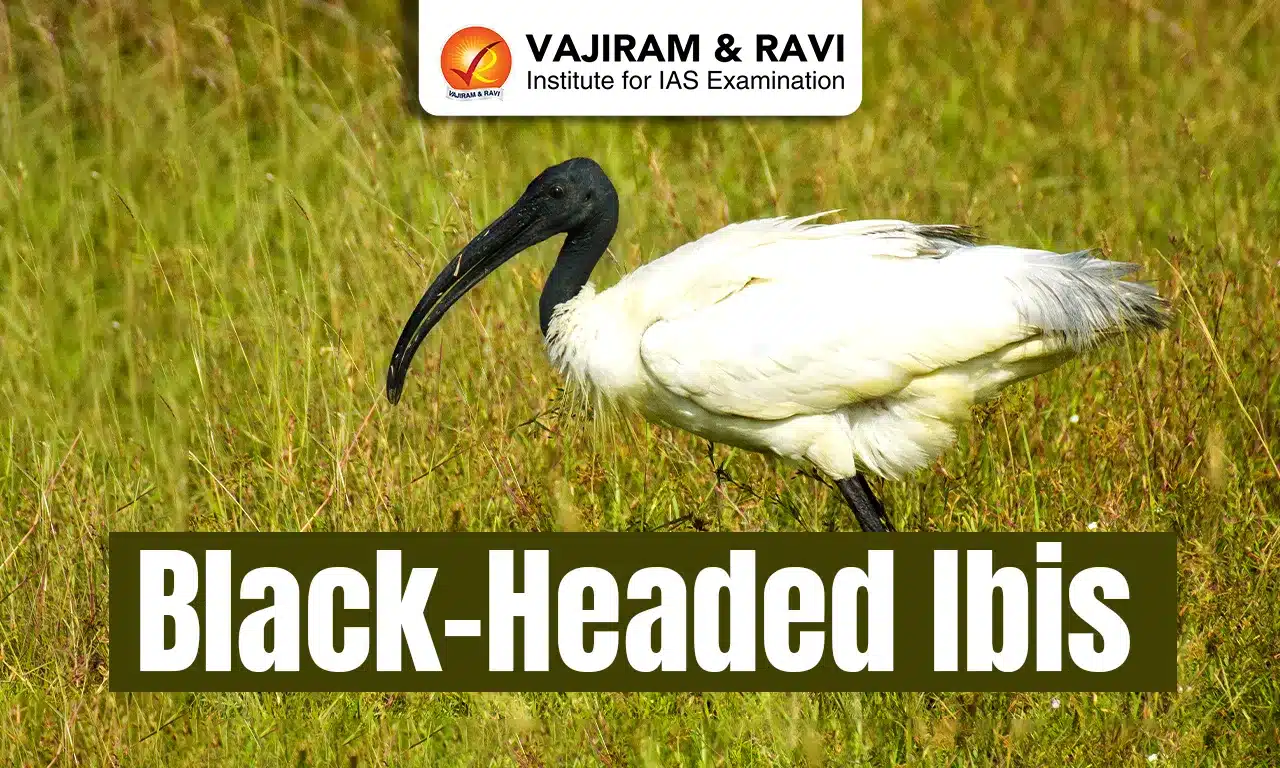
    • It is a large wader bird, with adults measuring 65–76 cm in length. 
    • It is the only native ibis species in its range that has an overall white plumage with a black neck and head. 
    • Males and females look similar and both have greyish tail feathers. 
    • Tails of adults bear light grey ornamental feathers that turn jet black during the breeding season. 
  • Conservation Status: It is classified as ‘Least Concern’ under the IUCN Red List.

Source: TH

Black-headed Ibis FAQs

Q1: What is Black-headed Ibis?

Ans: It is a species of wading bird of the ibis family Threskiornithidae.

Q2: What is the IUCN status of Black-headed Ibis?

Ans: Least Concern

MQ-9 Reaper

MQ-9 Reaper

MQ-9 Reaper Latest News

Iran's Islamic Revolutionary Guard Corps claims it shot down a US MQ-9 Reaper drone over Qeshm Island in southern Iran using an advanced air defence system recently.

About MQ-9 Reaper

  • The MQ-9 Reaper (Reaper MQ-9A) is an armed, multi-mission, medium-altitude, long-endurance unmanned aerial vehicle (UAV).
  • It is developed by the American company General Atomics Aeronautical Systems (a United States-based aerospace and defence company), primarily for the United States Air Force (USAF).
  • It is an upgraded version of the MQ-1 Predator and was first deployed in Afghanistan in October 2007. 
  • It is used for strategic and operational reconnaissance, battlefield surveillance, and can directly engage targets. 

MQ-9 Reaper Features

  • It has a wingspan of 66 feet (20 meters) and endurance of more than 27 hours. 
  • It is equipped with a fault-tolerant flight control system and triple redundant avionics system architecture 
  • It is powered by a turboprop engine, integrated with Digital Electronic Engine Control (DEEC), which significantly improves engine performance and fuel efficiency, particularly at low altitudes. 
  • It cruises at roughly 322 to 370 kilometers per hour and can fly at altitudes up to 50,000 feet (15,240 meters), giving it reach across wide areas of operation. 
  • It  can be armed with air-to-ground Hellfire missiles as well as laser-guided bombs.
  • It is remotely operated by a two-person team consisting of a pilot and an aircrew member who operates sensors and guides weapons.

News: TOI

MQ-9 Reaper FAQs

Q1: What is the MQ-9 Reaper?

Ans: An armed, multi-mission, medium-altitude, long-endurance unmanned aerial vehicle (UAV).

Q2: Which company developed the MQ-9 Reaper?

Ans: General Atomics Aeronautical Systems, a U.S.-based aerospace and defence company.

Q3: What are the major roles of the MQ-9 Reaper?

Ans: Strategic and operational reconnaissance, battlefield surveillance, and direct engagement of targets.

Q4: What is the endurance of the MQ-9 Reaper?

Ans: More than 27 hours.

Q5: Which missiles can the MQ-9 Reaper carry?

Ans: Air-to-ground Hellfire missiles.

Enquire Now