Himalayan Monal

Himalayan Monal

Himalayan Monal Latest News

A study in Uttarakhand found that Himalayan monals exposed to roads, tourists and pilgrimage traffic use higher-frequency calls which are impacting this species' calling behaviour.

About Himalayan Monal

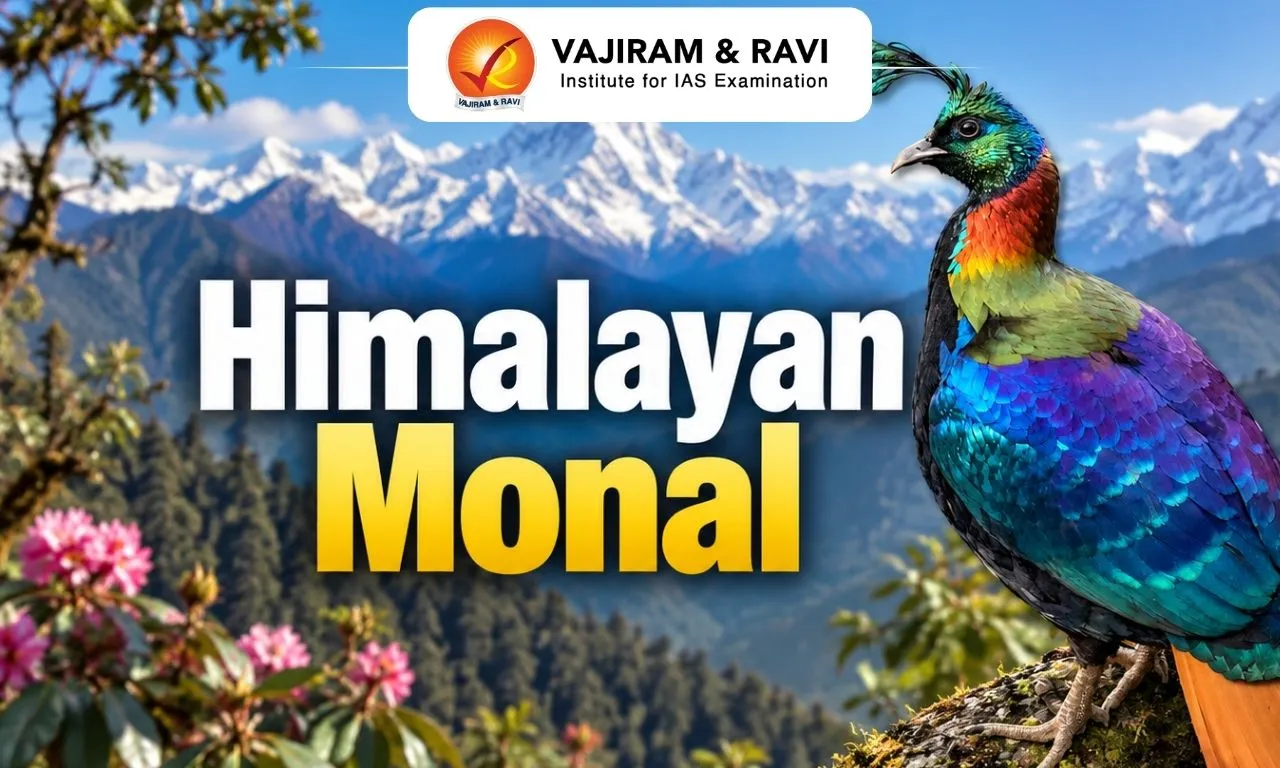
  • The Himalayan Monal (Lophophorus impejanus) is also known as the Impeyan Monal or Danphe.
  • They are among the larger birds in the Phasianidae family.
  • It is the state bird of Uttarakhand.
  • Appearance: It exhibits high sexual dimorphism—the males decked head to toe in multicoloured plumage and exhibiting a long green metallic crest, while the females have a pale blue eye patch, white throat, and a streaky brown body.
  • Habitat
    • It occupies the upper temperate forests of conifer and oak with open grasslands.
    • It typically inhabits altitudes between 2,500 and 4,000 meters in Great Himalayan National Park (GHNP).
    • It is commonly sighted in Tirthan Valley especially during the spring and post-monsoon seasons.
  • Distribution: It is found across the Himalayan mountains, including in Jammu and Kashmir, Himachal Pradesh, Uttarakhand and Sikkim.
  • Behavior
    • It is a ground-dwelling bird, often seen digging through leaf litter or soft soil with its powerful beak in search of roots, tubers, seeds, insects, and grubs.
    • It exhibits a clear altitudinal migration, descending as low as 2,000m in winter.
    • However, it also shows tolerance to snow and has been observed digging through snowfall for roots, tubers and invertebrates.
  • Threats: It faces threats from habitat loss, hunting, and disturbance from tourism.
  • Conservation Status

Source: IE

Himalayan Monal FAQs

Q1: Where do we find Himalayan Monal?

Ans: It is found across the Himalayan mountains, including in Jammu and Kashmir, Himachal Pradesh, Uttarakhand and Sikkim.

Q2: What is the IUCN status of Himalayan Monal?

Ans: Least Concern

Advance Authorization Scheme

Advance Authorization Scheme

Advance Authorization Scheme Latest News

The government has relaxed the existing 15-day stockholding limit for bulk consumers to 30 days, provided the quantity of stock held beyond 15 days limit shall be sourced exclusively from sugar imported under the Advance Authorisation Scheme (AAS). 

About Advance Authorization Scheme

  • It allows duty free import of inputs, which are physically incorporated in an export product.
  • In addition to any inputs, packaging material, fuel, oil and catalysts which are consumed/utilized in the process of production of export products, are also allowed.
  • It is overseen by the Directorate General of Foreign Trade (DGFT).
  • The inputs imported are exempt from duties like,
    • Basic Customs Duty, Additional Customs Duty, Education Cess, Anti-dumping duty, Safeguard Duty and Transition Product-Specific Safeguard duty, Integrated tax, and Compensation Cess, wherever applicable, subject to certain conditions. 
  • An export obligation is usually set as a condition for issuing Advance Authorization.
  • Advanced Authorization Coverage
    • Manufacturer Exporters: Entities engaged in manufacturing goods for export.
    • Merchant Exporters tied to Supporting Manufacturer(s): Traders who do not manufacture themselves but procure goods from a supporting manufacturer for export.
  • The Advanced Authorization shall be issued for
    • Physical exports
    • Intermediate supply
    • Supplies made to specified categories of deemed exports
    • Supply of ‘stores’ on board of a foreign-going vessel/aircraft, provided that there are specific Standard Input Output Norms (SION) in respect of items supplied.
  • Advance Authorization is valid for 12 months from the date of issue of such Authorization.

Source: PIB

Advance Authorization Scheme FAQs

Q1: What is Advance Authorization Scheme?

Ans: It allows duty free import of inputs, which are physically incorporated in an export product.

Q2: Who implements Advance Authorization Scheme?

Ans: It is overseen by the Directorate General of Foreign Trade (DGFT).

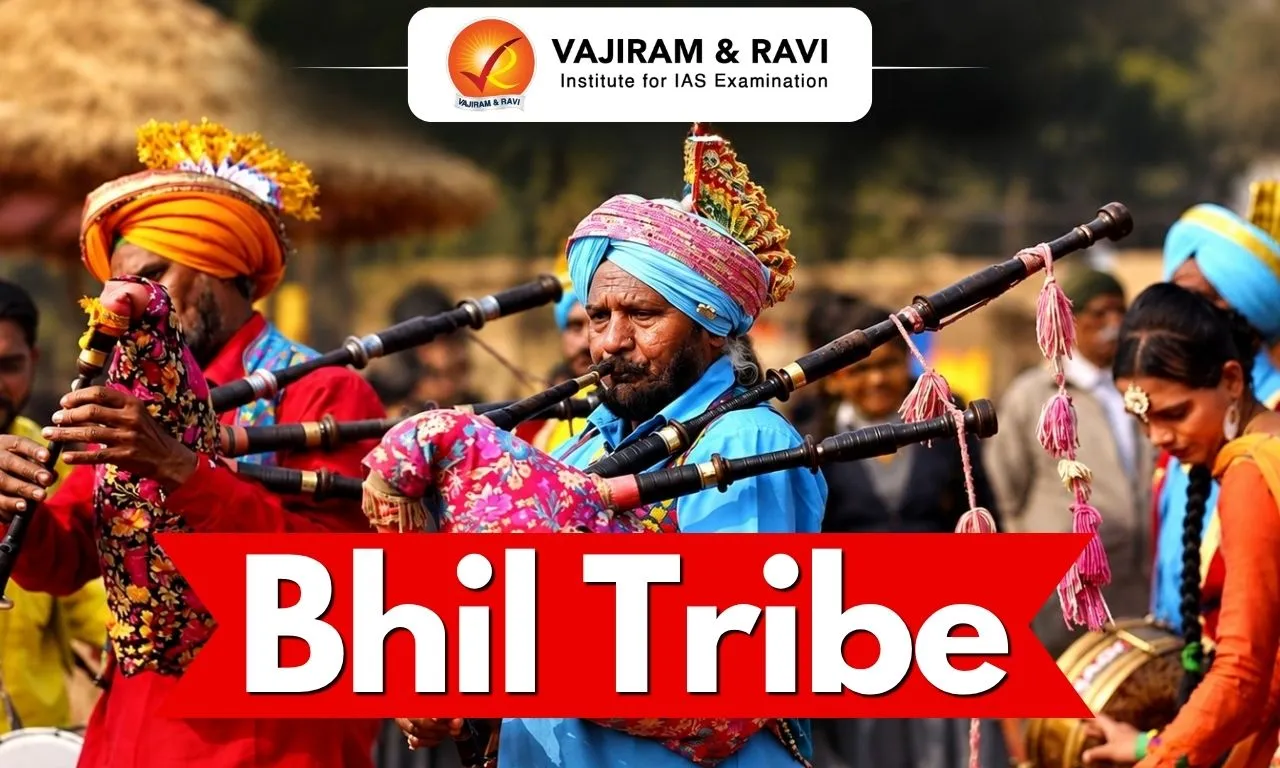
Bhil Tribe

Bhil Tribe

Bhil Tribe Latest News

The Rajasthan High Court recently issued notices to the State government and other authorities on a petition seeking a 9% sub-quota for the Bhil community within the existing 12% reservation for the Scheduled Tribe (ST) category.

About Bhil Tribe

  • The Bhils are considered one of the oldest tribes in India and are identified as one of the Dravidian racial tribes of Western India and belong to the Australoid group of tribes.
  • According to the 2011 census, Bhil is the largest tribal group in India, constituting approximately 38% of the total scheduled tribal population of India.  
  • The name ‘Bhil’ is derived from the word “villu” or “billu”, which, according to the Dravidian language, is known as Bow
  • Their reference is in old literature, Ramayana and Mahabharata.
  • Distribution:
    • They are the most widely distributed tribal groups in India. 
    • They mainly reside in Rajasthan, western Madhya Pradesh, Gujarat and northern Maharashtra. Some families have migrated to other states like Tripura for jobs in tea gardens.  
    • Bhil populations are concentrated in the southernmost hills of the Aravalli Range, the western uplands of the Vindhya and Satpura ranges, and the northernmost hills of the Western Ghats.  
    • Some Bhil groups occupy the nearby river valleys and coastal plains.  
  • Occupation: Nearly all of the Bhil engage in agriculture, some using the slash-and-burn (jhum) method but most employing the plow.
  • Language
    • They speak Bhili, which is an Indo-Aryan language.
    • Bhili dialects show varying degrees of influence of regional languages such as Rajasthani and Marathi, but they all appear to have their origins in Gujarati.  
  • Beliefs:
    • Almost all Bhils practice ethnic religions that have been highly influenced by Hinduism
    • Most of them worship local deities like Khandoba, Kanhoba, Bahiroba, and Sitalmata. Some worship the Tiger God called ‘vaghdev’.
  • Festivals:
    • The Baneshwar fair is the main festival celebrated among the Bhils. This fair is held during the period of Shivaratri in the months of January or February. 
    • The Hindu festivals of Holi and Dusshera are the other major festivals celebrated among the Bhil Tribes in India. 
  • Art and Culture: 
    • The Ghoomar dance, which is a traditional folk dance symbolising womanhood, is one of the popular aspects of Bhil culture.
    • Bhil painting is characterised by the use of multi-coloured dots as in-filling.

News: LAW

Bhil Tribe FAQs

Q1: Which Indian states have major concentrations of the Bhil population?

Ans: Rajasthan, western Madhya Pradesh, Gujarat and northern Maharashtra.

Q2: In which mountain ranges are Bhil populations particularly concentrated?

Ans: The southern Aravallis, western Vindhyas and Satpuras, and northern Western Ghats.

Q3: Which language is spoken by the Bhil people?

Ans: They speak Bhili, which is an Indo-Aryan language.

Q4: Which is the main festival associated with the Bhil tribe?

Ans: Baneshwar Fair.

Q5: Which folk dance is an important aspect of Bhil culture?

Ans: The Ghoomar dance, a traditional folk dance symbolising womanhood, is one of the popular aspects of Bhil culture.

Enquire Now