Chocolate Mahseer

Chocolate Mahseer

Chocolate Mahseer Latest News

Recently, Sikkim Chief Minister released ‘Chocolate Mahseer’ fish into the Rangeet river, underlining the importance of conserving indigenous fish species and protecting the state’s aquatic biodiversity.

About Chocolate Mahseer

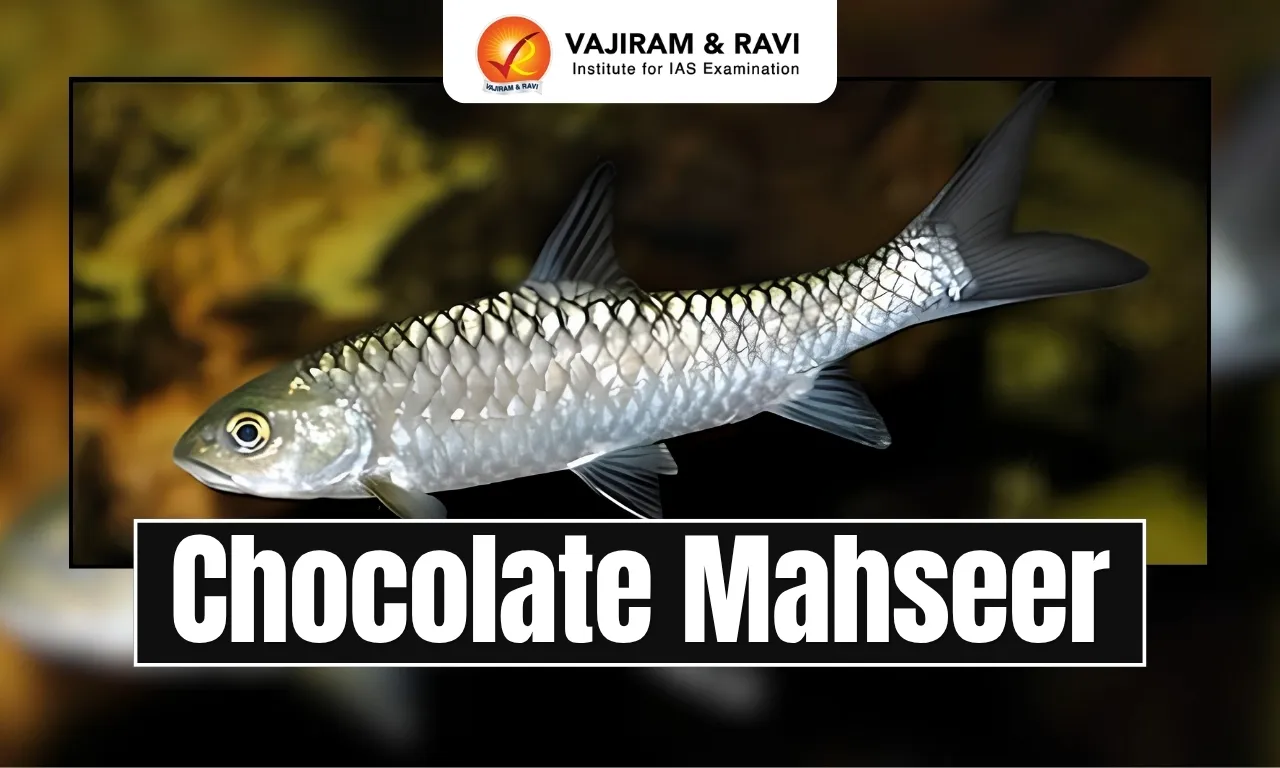
  • Chocolate Mahseer or copper mahseer (Neolissochilus hexagonolepis) is a freshwater fish species.
  • The fish species belonging to the genus Tor and Neolissocheilus under the family Cyprinidae are popularly known as ‘Mahseer’.
  • It is known by the local name ‘kha saw' in Meghalaya.
  • It was officially designated as the state fish of Meghalaya and Sikkim.
  • Distribution: It thrives in nearly all the major rivers and hill-streams of Meghalaya, Assam, Arunachal Pradesh, Sikkim, Manipur, Nagaland, Mizoram, and Tripura.
  • Habitat: The species inhabits clear, fast flowing streams and rivers with stony, pebbly or rocky bottoms.
  • Characteristics
    • It possesses exceptional strength and agility, making it a prized catch.
    • It is equipped with powerful pectoral and dorsal fins, it possesses the remarkable ability to swiftly navigate against strong river currents.
    • Females of this species are larger in size when compared to males in the same age group.
  • It is prized by anglers and is considered an indicator of healthy river ecosystems.
  • Threats: Its populations are in decline due to habitat degradation, overfishing and environmental changes
  • Conservation Status: IUCN Red List: Near Threatened

Source: TP

Chocolate Mahseer FAQs

Q1: Where do we find Chocolate Mahseer?

Ans: It thrives in nearly all the major rivers and hill-streams of Meghalaya, Assam, Arunachal Pradesh, Sikkim, Manipur, Nagaland, Mizoram, and Tripura.

Q2: What is the conservation status of Chocolate Mahseer?

Ans: Near Threatened

Global Initiative on AI for Agri-Food Systems

Global Initiative on AI for Agri-Food Systems

Global Initiative on AI for Agri-Food Systems Latest News

Recently, the telecommunication Engineering Centre (TEC), Department of Telecommunications (DoT), Ministry of Communications, Government of India hosted the Second meeting of the UN Global Initiative on AI for Agri-Food Systems (GI-AI4FS).  

About Global Initiative on AI for Agri-Food Systems

  • It is a UN Global Initiative.
  • It is coordinated by the International Telecommunication Union (ITU), in close collaboration with Food and Agriculture Organization (FAO), International Fund for Agricultural Development (IFAD) and World Food Programme (WFP).
  • This provided a platform for advancing dialogue on the responsible use of AI in agriculture and food systems by promoting trustworthy and interoperable farmer-centric AI solutions.
  • It strengthens international cooperation on governance and standards and identifies opportunities to translate innovation into practical applications.

What is the International Telecommunication Union?

  • It is the United Nations specialized agency for information and communication technologies.
  • Historical Background
  • It is an intergovernmental organization that coordinates between governments and private sector bodies with respect to global telecommunication and information communication technology (ICT) services.
  • Member countries: It has a membership of 194 countries and more than 1000 companies, universities and international and regional organizations.
  • India and ITU: India has been an active member of the ITU since 1869 and has been a regular member of the ITU Council since 1952.
  • Headquarters: Geneva, Switzerland.

Source: PIB

Global Initiative on AI for Agri-Food Systems FAQs

Q1: Which ministry organised Second meeting of the UN Global Initiative on AI for Agri-Food Systems (GI-AI4FS)?

Ans: Ministry of Communications, Government of India

Q2: What is International Telecommunication Union?

Ans: It is the United Nations specialized agency for information and communication technologies.

National Household Travel Survey

National Household Travel Survey

National Household Travel Survey Latest News

The National Statistics Office (NSO) has released the key indicators and findings from the first ever National Household Travel Survey (NHTS).

About National Household Travel Survey

  • It is published by the National Statistics Office (NSO) under the Ministry of Statistics and Programme Implementation (MoSPI).
  • Primary objectives of the survey: To generate robust, data-driven insights into domestic travel patterns and dynamics to support regional transport planning, infrastructure development and evidence-based policy formulation.
  • The survey captures key aspects of domestic travel, including:
    • Purpose of travel: Employment, education, social engagements, cultural and leisure activities, tourism, domestic work, caregiving and other purposes.
    • Mode of transport: Modes of transportation used by different demographic groups for undertaking trips.
    • Travel duration and distance: Average time taken and distances travelled during trips.

Major Findings of National Household Travel Survey

  • Student Mobility: Students in the 15-29 age group recorded the highest regular trip participation for daily travel to educational institutions, at 79.1 per cent in rural India and 73.3 per cent in urban India.
  • Workforce Mobility: Male workers recorded a higher share of daily work trips of more than 1 km, at 61.9 per cent, compared with 41.9 per cent among female workers nationwide.
  • Commuting costs: The average monthly expenditure on commuting to a fixed workplace stood at Rs 785 per worker. Urban workers incurred an average monthly expenditure of Rs 1,044, compared with Rs 612 for rural workers.

Source: PIB

National Household Travel Survey FAQs

Q1: Who published National Household Travel Survey ?

Ans: National Statistics Office

Q2: National Statistics Office works under which ministry ?

Ans: Ministry of Statistics and Programme Implementation (MoSPI).

Exercise KONKAN-2026

Exercise KONKAN-2026

Exercise KONKAN-2026  Latest News

Indian Navy’s guided missile stealth frigate INS Trishul is scheduled to participate in Exercise KONKAN-26 which is to be conducted in Plymouth, United Kingdom. 

About Exercise KONKAN-2026  

  • It is an annual bilateral maritime exercise conducted between India and the United Kingdom (UK).
  • It is fostering enhanced interoperability and mutual understanding in maritime operations between the two Navies.
  • Phases: The exercise is being conducted off Plymouth, UK, in two phases.
    • Harbour Phase: It includes a broad spectrum of professional interactions, cross-deck visits, sports fixtures, cultural engagements.
    • Sea Phase: It will encompass complex maritime operational drills across all three domains – air, surface and sub-surface.
  • The exercise is a reaffirmation of the shared commitment to ensuring secure, open and free seas and exemplifies the Comprehensive Strategic Partnership outlined in the India-UK Vision 2035.
  • The exercise stands as a testament to the enduring bonds between the Indian and UK Navies and their shared commitment to maritime peace and security.

Source: PIB

Exercise KONKAN-2026 FAQ's

Q1: Exercise KONKAN is conducted between which two countries?

Ans: India and the United Kingdom (UK)

Q2: Where is Exercise KONKAN-2026 is being counducted?

Ans: Plymouth, United Kingdom

Global Innovation Index 2026

Global Innovation Index

Global Innovation Index 2026 Latest News

Recently, the Telecommunication Engineering Centre (TEC), Department of Telecommunications (DoT), Ministry of Communications, Government of India hosted the Second meeting of the UN Global Initiative on AI for Agri-Food Systems (GI-AI4FS). 

About Global Innovation Index 2026

  • It is a ranking of countries as per their success and capacity in innovation.
  • It was first launched in 2007, and has become the leading global benchmark for measuring and comparing innovation performance.
  • It is published yearly by the World Intellectual Property Organization (WIPO).
  • It is recognized by the UN General Assembly as an authoritative reference for Science, Technology and Innovation (STI) policies.
  • It tracks global innovation trends through investment patterns, technological progress, adoption rates, and socioeconomic impacts.

Key Highlights of Global Innovation Index 2026

  • The 19th edition of the GII ranks the innovation performance of 139 economies, maps the world’s top 100 innovation clusters, and tracks the main global innovation trends.
  • For the 16th consecutive year, Switzerland is the most innovative economy in 2026 followed by Sweden and the United States.
  • The Republic of Korea and Singapore consolidate 4th and 5th place respectively, China remains 10th, Japan holds 12th and Hong Kong, China climbs to 14th.
  • India ranks 38th among the 139 economies featured in the GII 2026.
  • India ranks 1st among the 36 Lower middle-income group economies and among the 11 economies in Central and Southern Asia.

Source: IE

Global Innovation Index 2026 FAQs

Q1: Which organisation published Global Innovation Index 2026?

Ans: World Intellectual Property Organization (WIPO)

Q2: What is India's rank in Global Innovation Index 2026?

Ans: India ranks 38th among the 139 economies featured in the GII 2026.

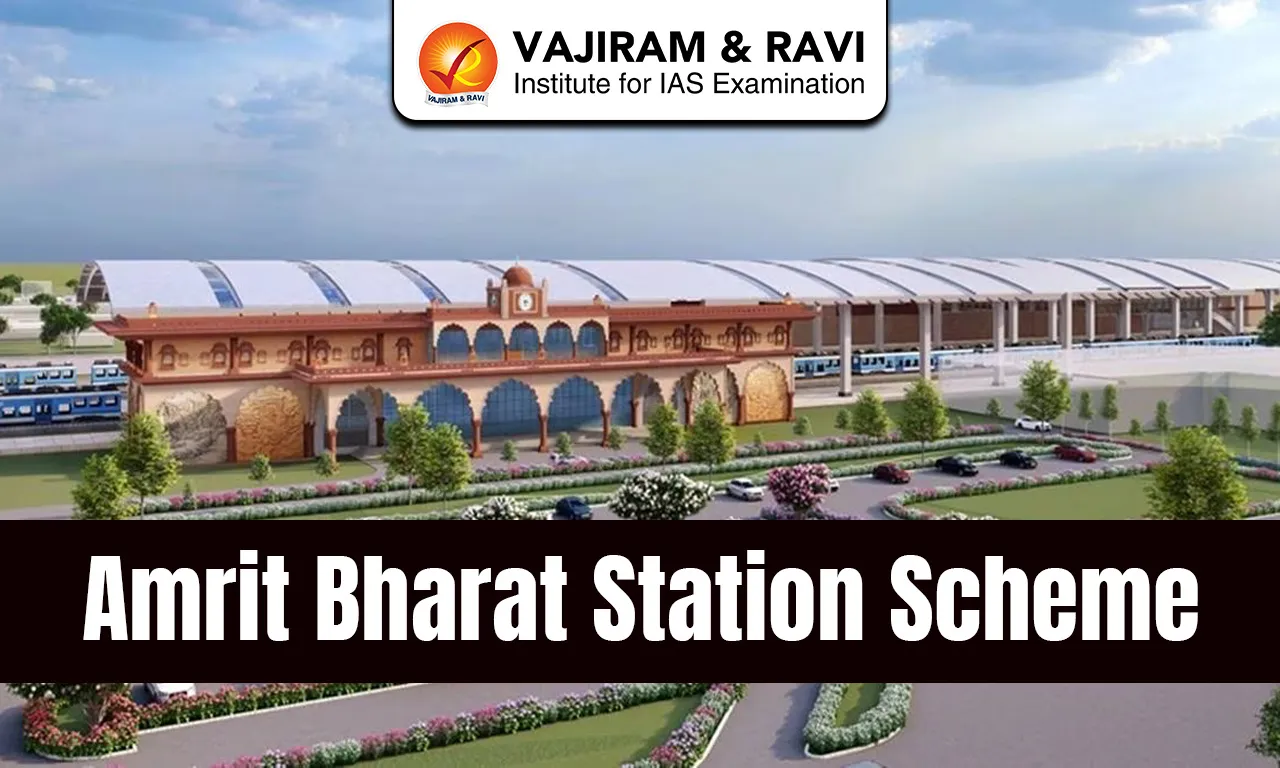
Amrit Bharat Station Scheme

Amrit Bharat Station Scheme

Amrit Bharat Station Scheme Latest News

Recently, the Prime Minister of India inaugurated five redeveloped railway stations in Tamil Nadu which have been modernised under the Amrit Bharat Station Scheme (ABSS). 

About Amrit Bharat Station Scheme

  • It was launched in 2022.
  • It aims at development and upgradation of stations over the Indian Railways (IR) network. 
  • It was launched to improve railway stations and make them cleaner, more comfortable and passenger-friendly.
  • The ABSS has a long-term vision that involves creating master plans, promoting multimodal connectivity, better station accessibility for passengers, etc.

Features of Amrit Bharat Station Scheme

  • Design: One of the significant features of this scheme is that designs of redeveloped station buildings are inspired by local culture, heritage and architecture.
  • Amenities: Under the scheme, stations are being upgraded with better waiting halls, toilets, lifts, escalators, free Wi-Fi, executive lounges, improved access roads and landscaping. Some stations may also have designated spaces for business meetings. 
  • The facilities are planned according to the needs of each station.
  • Local Economy Support: Local products will be sold at kiosks under the ‘One Station One Product’ scheme, and efforts will be made to make stations look greener and more attractive.

Source: IE

Amrit Bharat Station Scheme FAQs

Q1: What is the aim of Amrit Bharat Station Scheme?

Ans: It aims at development and upgradation of stations over the Indian Railways (IR) network. 

Q2: When was Amrit Bharat Station Scheme launched ?

Ans: It was launched in 2022.

Garba Dance

Garba Dance

Garba Dance Latest News

The nine nights of the Navratri festival, marked by dancing the Garba outdoors to welcome the Goddess Ambe Maa, began in Gujarat. 

About Garba Dance

  • It is a ritualistic and devotional dance performed throughout the State of Gujarat, and across India.
  • It is celebrated for nine days during the festival of Navaratri.
  • The festival is dedicated to the worship of the feminine energy or Shakti.
  • The cultural, performative, and visual expressions of this feminine energy are expressed through the Garba dance.
  • The performative and visual celebration of Garba takes place within homes and temple courtyards.
  • Social Impact: It promotes gender inclusivity, community bonding, and social equality across rural and urban spaces.
  • It continues to be inclusive and participative by diverse and marginalized communities, strengthening community bonds.
  • Garba of Gujarat was inscribed on the UNESCO Representative List of the Intangible Cultural Heritage of Humanity in 2023.

Source: IE

Garba Dance FAQs

Q1: Garba Dance is mainly celebrated in which state?

Ans: Gujarat

Q2: What is the significance of Garba Dance?

Ans: It promotes gender inclusivity, community bonding, and social equality across rural and urban spaces.

Exercise INDRA 2026

Exercise INDRA 2026

Exercise INDRA 2026 Latest News

Indian Naval Ship Sahyadri is participating in Exercise INDRA 2026 which is to be conducted at Vladivostok, Russia.

About Exercise INDRA 2026

  • It is a bilateral exercise conducted between the Indian Navy and the Russian Federation Navy (RuFN).
  • Since its inception in 2003, Exercise Indra has epitomised the long-term strategic relationship between the Indian and Russian navies.
  • Phases: It will comprise engagements during the harbour phase followed by coordinated operational activities at sea.
  • Focus: The exercise will include a range of professional interactions and maritime evolutions aimed at enhancing mutual understanding, operational coordination and interoperability between the participating navies.
  • Participation: The participation of INS Sahyadri is in consonance with the Government of India’s vision of MAHASAGAR (Mutual and Holistic Advancement for Security and Growth Across Regions).

Source: PIB

Exercise INDRA 2026 FAQs

Q1: Exercise INDRA is conducted between which two countries?

Ans: Indian Navy and the Russian Federation Navy (RuFN).

Q2: Which Indian naval ship is participating in Exercise INDRA ?

Ans: INS Sahyadri

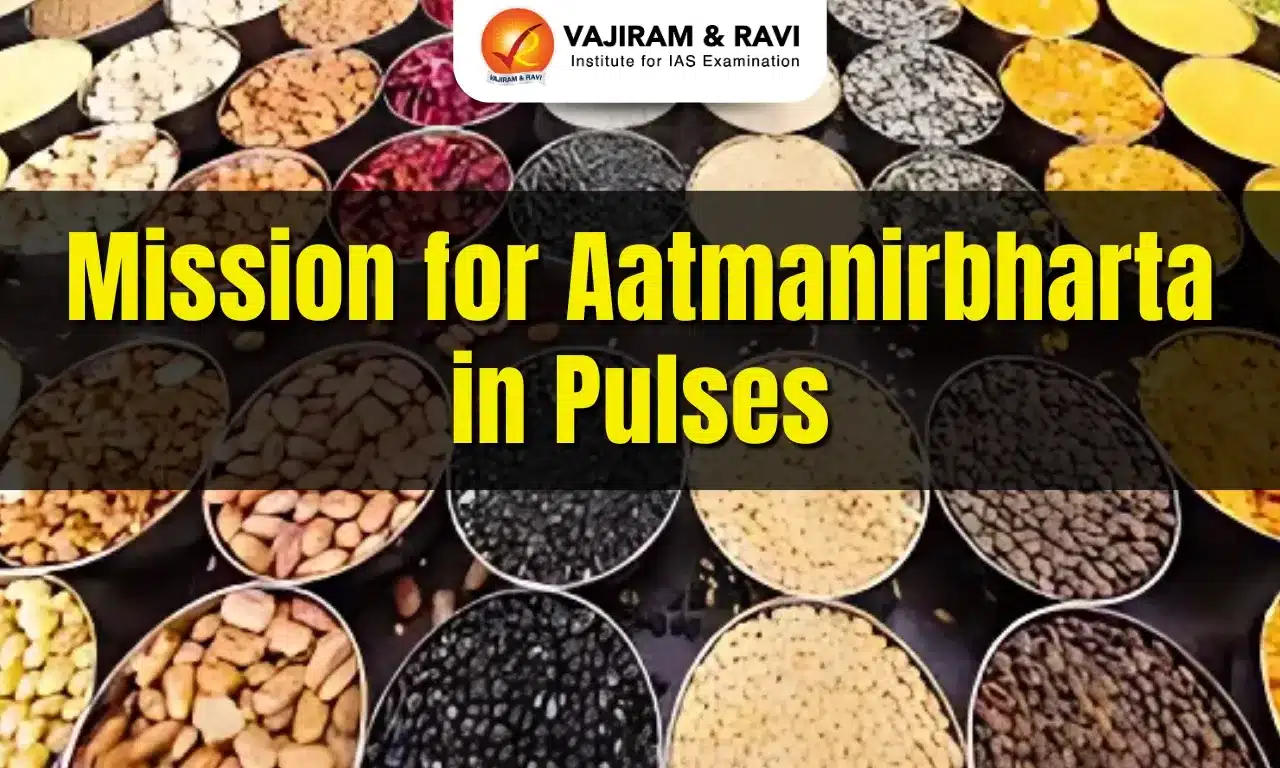
Mission for Aatmanirbharta in Pulses

Aatmanirbharta in Pulses

Mission for Aatmanirbharta in Pulses   Latest News

Recently, it was observed that the early momentum of the Mission for Aatmanirbharta in Pulses is successfully bridging policy intent and ground-level execution.

About Mission for Aatmanirbharta in Pulses  

  • It is aimed at boosting domestic production and achieving self-sufficiency (Aatmanirbharta) in pulses.
  • Time Period: The Mission will be implemented over a six-year period, from 2025-26 to 2030-31.
  • It aims to achieve self-sufficiency in pulses by significantly enhancing domestic production, reducing import dependence, and sustainably improving farmers’ incomes.
  • The Mission plans to expand the area under pulses cultivation by an additional 35 lakh hectares, targeting rice fallows and other suitable lands, while promoting intercropping and crop diversification.

Key Features of Mission for Aatmanirbharta in Pulses

  • Comprehensive strategy: The mission covers research, seed systems, area expansion, procurement, and price stability.
  • Focus on quality seeds: A key focus will be the development and dissemination of high-yielding, pest-resistant, and climate-resilient pulses varieties, supported by a robust seed system.
  • This includes the production and distribution of 126 lakh quintals of certified seeds and the free provision of 88 lakh seed kits to farmers.
  • Seed Production: To ensure availability of premium quality seeds, states will prepare five-year rolling seed production plans.
  • The breeder seed production will be supervised by the Indian Council of Agricultural Research (ICAR).
  • Capacity building: Structured training programmes for farmers and seed growers to promote sustainable techniques and modern technologies.
  • Post-harvest infrastructure:  To strengthen markets and value chains, the Mission will help develop 1000 processing units, thereby reducing crop losses, improving value addition.
  • A maximum subsidy of Rs. 25 lakhs will be available for setting up of processing, packaging units.
  • Cluster-Based Approach: Tailoring interventions to the specific needs of each cluster to enhance productivity, and promote geographic diversification of pulse production.
  • Procurement: Assured maximum procurement of Tur, Urad, and Masoor under Price Support Scheme (PSS) of PM-AASHA.
    • NAFED and NCCF will undertake 100% procurement in participating states for the next four years from farmers who register with these agencies and enter into agreements. 

Source: PIB

Mission for Aatmanirbharta in Pulses FAQs

Q1: What is the aim of Mission for Aatmanirbharta in Pulses?

Ans: It is aimed at boosting domestic production and achieving self-sufficiency (Aatmanirbharta) in pulses.

Q2: What is the time period of Mission for Aatmanirbharta in Pulses?

Ans: The Mission will be implemented over a six-year period, from 2025-26 to 2030-31.

Palamu Tiger Reserve

Palamu Tiger Reserve

Palamu Tiger Reserve Latest News

Recently, villagers from 25 villages in the Garu region of Palamu Tiger Reserve (PTR), Latehar district, voluntarily surrendered 31 country-made guns to support wildlife protection.  

About Palamu Tiger Reserve

  • Location: It is located on the Chhotanagpur plateau in Jharkhand.
  • The reserve forms a part of the Betla National Park. 
  • It is one of the first 9 tiger reserves created in the country at the inception of ‘Project Tiger’.
  • It is the first reserve in the world in which a tiger census was carried out as a pugmark count, as early as 1932 under the supervision of J.W. Nicholson.
  • Terrain: The terrain is undulating with valleys, hills, and plains. The geological formation consists of gneiss and includes granite and limestone. 
  • Rivers: It is drained by three rivers, namely North Koyal, Auranga, and Burha, flowing through the valleys. 
  • Vegetation: The vegetation comprises moist deciduous and dry deciduous forests.
  • Flora: It mainly consists of Sal and bamboo as the major components.
  • Fauna: Some keystone and principal species found in the reserve include Tiger, Asiatic Elephant, Leopard, Grey wolf, Wild dog, Gaur, Sloth bear and four horned antelope.

Source: JSN

Palamu Tiger Reserve FAQs

Q1: Where is Palamu Tiger Reserve located?

Ans: Jharkhand

Q2: Which type of vegetation is found in Palamu Tiger Reserve?

Ans: It comprises moist deciduous and dry deciduous forests.

Enquire Now