
Maritime State Development Council

Maritime State Development Council

Maritime State Development Council Latest News

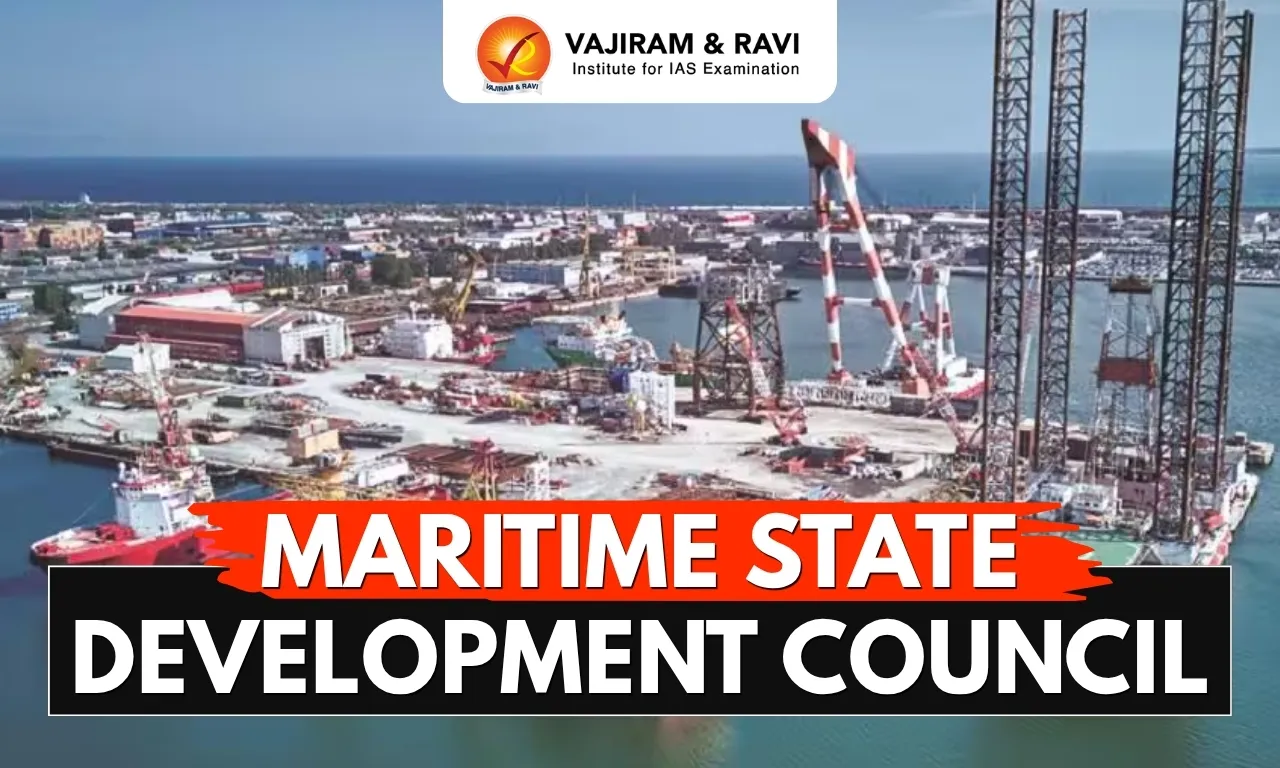
Recently, the 21st Maritime State Development Council (MSDC) concluded in Mumbai with landmark outcomes for India’s maritime sector. 

About Maritime State Development Council

  • It is an apex advisory body which was constituted in May 1997 for the development of the Maritime sector.
  • The Indian Ports Act, 2025 grants statutory status to the Maritime State Development Council.
  • Aim: Its primary aim is to promote the integrated growth of Major and Non-Major ports in close coordination with State governments. 
  • Composition: The Council, chaired by the Union Minister for Ports, Shipping, and Waterways.
  • Composition: It comprises Ministers responsible for ports from all Maritime States, Administrators of UTs, and key stakeholders, including representatives from the Navy, Coast Guard, and other agencies.

Functions of Maritime State Development Council

  • It monitors the development of minor ports, captive ports and private ports in the Maritime States with a view to ensure their integrated development with Major Ports and to assess the requirements of other infrastructure requirements like roads/rail/IWT and make suitable recommendations to the concerned Ministers.
  • It guides data collection and dissemination and transparency across ports, and advises the central government on national planning, legislative reforms, port efficiency, and connectivity.

Source: PIB

Maritime State Development Council FAQs

Q1: What is Maritime State Development Council?

Ans: It is an apex advisory body which was constituted in May 1997 for the development of the Maritime sector.

Q2: What is the aim of Maritime State Development Council?

Ans: Its primary aim is to promote the integrated growth of Major and Non-Major ports in close coordination with State governments. 

Central Electricity Authority

Central Electricity Authority

Central Electricity Authority Latest News

The Central Electricity Authority (CEA) is organising a two-day Brainstorming Conclave on “Making Indian Power Sector AI Enabled” (International Conference-cum-Exhibition) in New Delhi.

About Central Electricity Authority

  • It is a statutory body established under section 3(1) of the Electricity Supply Act 1948.
  • Nodal Ministry: Ministry of Power.

Functions of Central Electricity Authority

  • Advisory Role: Advise the Central Government on matters relating to the national electricity policy, formulate short-term and prospective plans for the development of the electricity system.
  • Specify the technical standards for the construction of electrical plants, electric lines, and connectivity to the grid;
  • Collect and record the data concerning the generation, transmission, trading, distribution and utilisation of electricity and carry out studies relating to cost, efficiency, competitiveness, and such like matters;
  • Promote research in matters affecting the generation, transmission, distribution and trading of electricity;

Central Electricity Authority Organisation Structure

  • It is headed by a Chairman, who is also ex-officio Secretary to the Government of India, and comprises six full-time Members. 
  • They are designated as Member (Thermal), Member (Hydro), Member (Economic and Commercial), Member (Power Systems), Member (Planning) and Member (Grid Operation and Distribution).

Source: PIB

Central Electricity Authority FAQs

Q1: What is Central Electricity Authority?

Ans: It is a statutory body established under section 3(1) of the Electricity Supply Act 1948.

Q2: Central Electricity Authority works under which ministry?

Ans: Ministry of Power

Tele-MANAS

Tele-MANAS

Tele-MANAS Latest News

India’s national mental health helpline, Tele-MANAS, has received nearly 48 lakh calls in four years.

About Tele-MANAS

  • Tele Mental Health Assistance and Networking Across States (Tele MANAS) offers a wide range of mental health services.
  • It was started by the Ministry of Health and Family Welfare in 2022.
  • Aim: To provide universal access to equitable, affordable, and quality mental health care through a 24x7 tele-mental health service, forming a key digital component of the National Mental Health Programme (NMHP).
  • This service is available across all Indian States and Union Territories, with assured linkages to ensure seamless care.
  • Objectives
    • Expanding Access: Scaling up the reach of mental health services nationwide, ensuring that anyone across India can access support at any time through dedicated 24x7 tele-mental health facilities in every State and Union Territory.
    • Building a Comprehensive Mental Health Network: Establishing an integrated system that goes beyond counseling by offering medical and psychosocial interventions, video consultations with specialists, e-prescriptions, follow-up care, and connections to in-person services.
    • Reaching Vulnerable Populations: Prioritizing mental health services for vulnerable and difficult-to-reach groups, ensuring no one is left without essential care.
  • The service is structured in a two-tier system to optimize care delivery and enhance support.
    • Tier 1: It comprises state Tele MANAS cells staffed with trained counsellors and mental health specialists. These professionals provide immediate support through: Tele-Counseling and Tele-Consultation.
    • Tier 2: It comprises specialists from District Mental Health Programme (DMHP) facilities and medical colleges, offering additional resources for physical consultations and audiovisual consultations via e-Sanjeevani.
  • Tele MANAS launched its mobile app and video consultation services to enhance access to mental health support.
  • This app serves as a comprehensive platform offering mental health resources, including self-care tips, stress management strategies, and tools to recognize early distress signals.
  • It is enhanced with Multi-lingual user interface, Chatbot feature (Asmi), Accessibility, Emergency Module. 
  • It will now be available in 10 regional languages, in addition to the English and Hindi languages
  • These languages include Assamese, Bengali, Gujarati, Kannada, Malayalam, Marathi, Tamil, Telugu, Odia, Punjabi.
  •  

Source: TOI

Tele-MANAS FAQs

Q1: What services are offered by Tele-MANAS?

Ans: It provides universal access to equitable, affordable, and quality mental health care through a 24x7 tele-mental health service.

Q2: Which ministry launched the Tele-MANAS?

Ans: Ministry of Health and Family Welfare

Enquire Now

