LineShine Supercomputer

LineShine Supercomputer

LineShine Supercomputer Latest News

China’s LineShine supercomputer retained its top spot in the list of the world’s most powerful supercomputers, whose latest edition was released at the SC26 conference in Chicago recently.

About LineShine Supercomputer

  • It is a Chinese supercomputer installed at the National Supercomputing Center in Shenzhen, South China's Guangdong Province. 
  • It was developed by the Shenzhen Cloud Computing Center.
  • It is the world’s fastest supercomputer.  
  • It has topped the latest TOP500 rankings (November 2026), outperforming its closest rival in the United States.  
    • It first took the top spot in June, when China returned to number one after a nine-year gap. 
    • Released twice a year, the TOP500 ranks the world’s most powerful supercomputers using the Linpack benchmark, which measures how quickly they solve complex mathematical calculations. 
  • LineShine achieved more than 2.19 exaflops, or over two quintillion calculations every second, about 21% faster than the runner-up, the United States' El Capitan. 
  • It is based on China's indigenous LingKun computing platform.
  • Unlike most modern supercomputers, LineShine does not rely on separate graphics processing units (GPUs), which have become essential for artificial intelligence workloads. 
  • Instead, the Chinese system combines traditional computing and AI capabilities within the same architecture using nearly 14 million processing cores and specialised computing units. 
  • LineShine draws approximately 42.2 megawatts of power, for an efficiency of 52.07 Gigaflops/Watt.

News: TH

LineShine Supercomputer FAQs

Q1: What is LineShine Supercomputer?

Ans: It is a Chinese supercomputer installed at the National Supercomputing Center in Shenzhen, Guangdong Province, China.

Q2: Which supercomputer topped the November 2026 TOP500 rankings?

Ans: LineShine Supercomputer.

Q3: What computational performance did LineShine achieve?

Ans: LineShine achieved more than 2.19 exaflops, or over two quintillion calculations every second.

Q4: Does LineShine rely on separate Graphics Processing Units (GPUs)?

Ans: No. It combines traditional computing and AI capabilities within the same architecture without relying on separate GPUs.

Paradip Port

Paradip Port

Paradip Port Latest News

Paradip Port Authority (PPA) successfully carried out a maritime assistance and salvage operation involving the distressed vessel MV Vishva Uday, carrying 27 crew members, approximately 50 nautical miles off Paradip Port.

About Paradip Port

  • It is situated in Paradip, Jagatsinghpur district, Odisha, 
  • It is one of the major ports of India and the only major port in the State of Odisha.
  • It was designated as a "Mega Port" under the Indian Ports Act, 2025, making it the only Mega Port on India's eastern coast among the four ports notified. 
  • It is situated on the Bay of Bengal on the delta of the Mahanadi River at the mouth of one of its branches. 
  • Paradip port enjoys the advantages of soft underwater soil, so that it can be deepened to any depth depending upon the need. 
  • It is strategically situated so as to serve a vast hinterland spreading over the states of Odisha, Jharkhand, Chhattisgarh, Madhya Pradesh, Uttar Pradesh, Bihar, and West Bengal. 
  • It handles various dry and liquid bulk cargo, steel products, project cargo, and containers. 
  • It is managed by the Paradip Port Authority (PPA), an autonomous body under the Ministry of Ports, Shipping & Waterways.
  • The Port is now equipped with 18 berths, 3 Single Point Moorings (SPM), 1 Ro-Ro Jetty, a well maintained Approach and Entrance Channel having 17.1 Mtrs minimum depth.
  • It has a dedicated railway siding that connects it with the main railway network of India.  
  • In 2024-25, Paradip Port achieved a milestone by joining the 150 million metric tonne (MMT) club by recording 150.41 MMT cargo.
  • It has handled its highest ever Annual Traffic throughput of 156.45 MMT in 2025-26. It has become 2nd Major Port among all Major ports in terms of cargo volume.

News:ENG

Paradip Port FAQs

Q1: Where is Paradip Port located?

Ans: Paradip, in Jagatsinghpur district of Odisha.

Q2: Which is the only major port in Odisha?

Ans: Paradip Port.

Q3: What is the significance of Paradip Port's Mega Port designation?

Ans: It is the only Mega Port on India's eastern coast among the four ports notified.

Q4: Which authority manages Paradip Port?

Ans: It is managed by the Paradip Port Authority (PPA), an autonomous body under the Ministry of Ports, Shipping & Waterways.

Q5: How much cargo did Paradip Port handle in 2025–26?

Ans: 156.45 million metric tonnes (MMT).

Voyager 1

Voyager 1

Voyager 1 Latest News

NASA’s Voyager 1 is set to cross a historic threshold in space exploration as it is about to become humanity’s first object to reach one light-day from Earth.

About Voyager 1

  • It is a space probe launched by NASA in 1977.
  • Objective: To explore the outer planets in our solar system. 
  • It is the first spacecraft to travel beyond the solar system and reach interstellar space.
  • It is currently the most distant human-made object from Earth.
  • Voyager 1’s mission has included flybys of Jupiter and Saturn, with the goal of studying their moons, rings, and magnetic fields.
  • Instruments of Voyager 1: Cosmic Ray Subsystem, Plasma Wave Subsystem, Infrared Interferometer Spectrometer and Radiometer (IRIS), etc.
  • Despite being nearly 50 years old, Voyager 1 continues to communicate with NASA using its radio transmitter and the agency's Deep Space Network. 
    • The network uses powerful radio antennas located in California, Spain and Australia to communicate with distant spacecraft.
  • However, Voyager 1's power supply is gradually declining. It relies on radioisotope thermoelectric generators, which produce electricity using heat released by the radioactive decay of plutonium-238. 

LineShine Supercomputer Key Achievements

  • It discovered a thin ring around Jupiter and two new Jovian moons: Thebe and Metis.
  • It also found five new moons and a new ring called the G-ring at Saturn.
  • Its discoveries included active volcanic eruptions on Jupiter's moon Io, providing the first evidence of active volcanism beyond Earth.
  • After completing its planetary exploration, the spacecraft continued travelling towards interstellar space.
  • It was the first spacecraft to cross the heliosphere, the boundary where the influences outside our solar system are stronger than those from our Sun.
  • It crossed into interstellar space in August 2012, making it the first human-made object to venture out of the solar system.
  • It continues to travel through interstellar space, collecting scientific measurements and transmitting valuable information to Earth.

What does one light-day from Earth mean? 

  • A light-day is not a measurement of time but of distance. 
  • It refers to how far light travels through space in 24 hours at approximately 299,792 km/sec. 
  • This distance equals around 25.9 billion kilometres, or 16.1 billion miles.
  • At this point, a signal sent from Earth takes approximately 24 hours to reach Voyager 1.  A response from the spacecraft takes another 24 hours to return. 
  • In other words, engineers must wait nearly two days to receive a response after sending a command to the spacecraft.

News: TH

Voyager 1 FAQs

Q1: What is Voyager 1?

Ans: Voyager 1 is a space probe launched by NASA in 1977.

Q2: What was the primary objective of the Voyager 1 mission?

Ans: To explore the outer planets of our solar system.

Q3: Why is Voyager 1's crossing of the heliosphere significant?

Ans: It became the first spacecraft to enter interstellar space.

Q4: What is Voyager 1 currently doing in interstellar space?

Ans: It continues to travel through interstellar space, collecting scientific measurements and transmitting data to Earth.

Rooppur Nuclear Power Plant

Rooppur Nuclear Power Plant

Rooppur Nuclear Power Plant Latest News

Bangladesh's Rooppur Nuclear Power Plant recently began supplying electricity on a trial basis after successfully completing synchronisation with the national grid.

About Rooppur Nuclear Power Plant

  • It is a 2.4-gigawatt power plant located in Rooppur on the east side of the river Padma, near Ishwardi in the Pabna district of Bangladesh. 
  • Being built with Russian support, it is the first nuclear power plant in Bangladesh. 
  • The project is being implemented by the Bangladesh Atomic Energy Commission (BAEC).
  • This plant uses the process of nuclear fission to generate electricity. 
  • It features two third-generation VVER-1200 reactors being built by the Russian State Atomic Energy Corporation, Rosatom, whose construction began in November 2017. 
    • VVER-1200 is a Russian-designed pressurized-water reactor.
  • The construction is largely funded by a loan from Russia, to be paid back over 20 years. 
  • Indian companies are also participating in the construction of the plant.
  • It will meet around 10–12 percent of Bangladesh’s power demand. 

News: ANI

Rooppur Nuclear Power Plant FAQs

Q1: Where is the Rooppur Nuclear Power Plant located?

Ans: It is located at Rooppur, near Ishwardi in the Pabna district of Bangladesh, on the eastern bank of the Padma River.

Q2: What is the total installed capacity of the Rooppur Nuclear Power Plant?

Ans: 2.4 gigawatts (GW).

Q3: Why is the Rooppur Nuclear Power Plant significant for Bangladesh?

Ans: It is the first nuclear power plant in Bangladesh.

Q4: Which country is providing support for the construction of the Rooppur Nuclear Power Plant?

Ans: Russia.

Andaman Cobra

Andaman Cobra

Andaman Cobra Latest News

The Andaman cobra is highly venomous and, on top of that, is capable of spitting venom as a defence mechanism, raising the probability of people killing it out of fear.

About Andaman Cobra

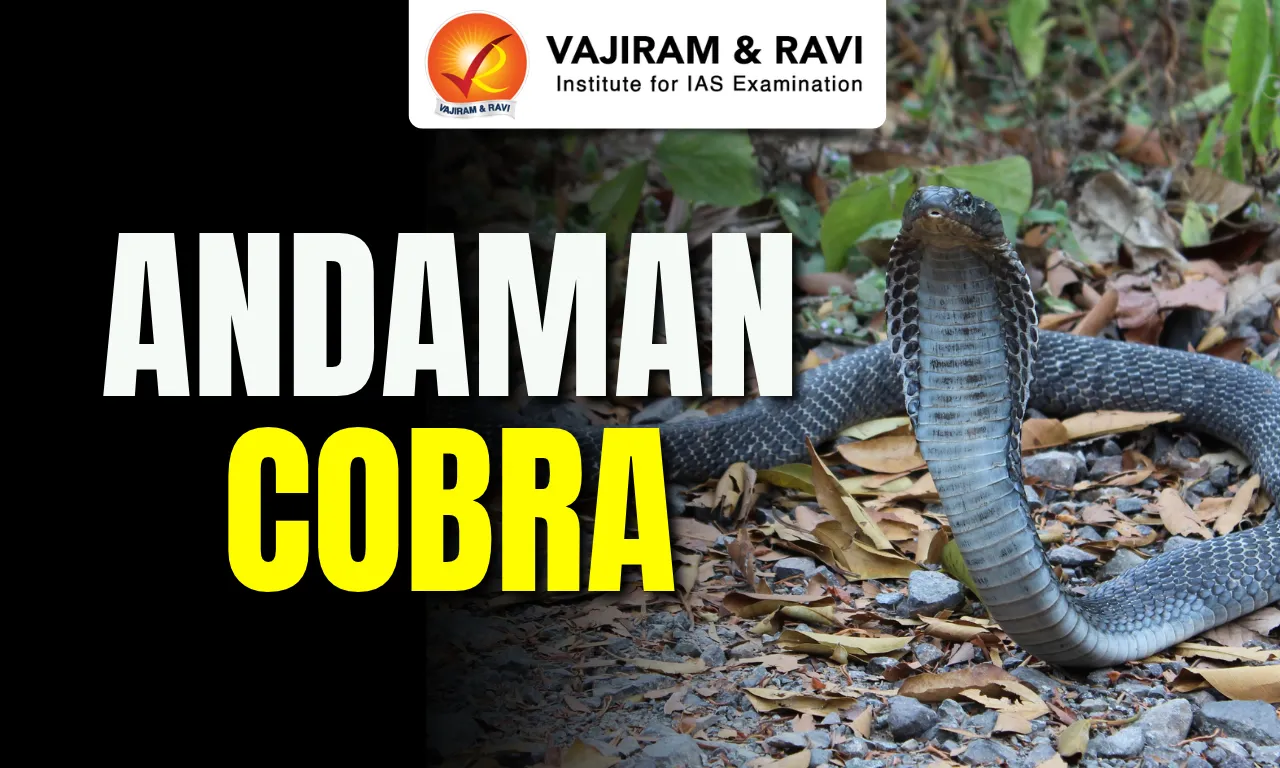
  • The Andaman cobra, also known as the Andaman spitting cobra, is a venomous snake native to India. 
  • It is one of the rarest and least-studied cobra species in the world.
  • Scientific Name: Naja sagittifera 

Andaman Cobra Habitat and Distribution

  • It is endemic to the Andaman and Little Andaman Islands of India. 
  • It is mainly seen in dense rainforests and undisturbed forest areas. 

Andaman Cobra Features

  • It is a large- to medium-sized snake  that usually measures 0.9 to 1.8 meters (3 to 5.9 feet) in length.
  • It has a streamlined, slender body covered in smooth, glossy scales. 
  • Its dominant color is dark brown, accentuated by lighter, arrow-point patterns along its back. 
  • Its head is wide, ever so slightly flattened, and separated from the neck.
  • This reptile lacks prominent limbs but features a hood that flares out when threatened. 
  • A uniquely arrow-shaped marking on the back of its hood sets it apart.  
  • Venom Potency: Its venom is highly potent, causing paralysis and necrosis (death of tissue).
  • Spitting ability: In contrast to actual spitting cobras, it infrequently spits venom and possesses relatively poor aim when it does. 
  • It is a nocturnal and solitary species.  

Andaman Cobra Conservation Status

It is classified as 'Endangered' under the IUCN Red List.

News: TH

Andaman Cobra FAQs

Q1: What is the Andaman cobra?

Ans: It is a venomous snake native to India.

Q2: Where is the Andaman cobra endemic to?

Ans: The Andaman and Little Andaman Islands of India.

Q3: What are the physical features of the Andaman cobra?

Ans: It has a slender, streamlined body covered with smooth, glossy scales.

Q4: What is the dominant body colour of the Andaman cobra?

Ans: Dark brown, with lighter arrow-point patterns along its back.

Q5: What is the conservation status of the Andaman cobra according to the IUCN Red List?

Ans: Endangered.

Exercise JAIMEX

Exercise JAIMEX

Exercise JAIMEX Latest News

Recently, Indian Naval Ship Sahyadri participated in the bilateral naval exercise JAIMEX 2026.

About Exercise JAIMEX

  • It is a bilateral naval exercise conducted between India and Japan.
  • It provided an opportunity for both navies to undertake coordinated maritime engagements and strengthen operational cooperation.
  • Participated by: INS Sahyadri alongside JMSDF Ship JS Ise
  • It involved communication drills and cross-deck landings, providing valuable opportunities for both navies to practise coordinated operations and enhance their understanding of each other's procedures and capabilities.
  • The engagements focused on strengthening operational coordination and interoperability, improving fostering mutual understanding between the participating units.
  • The exercise also provided an opportunity to exchange professional experiences and reinforce established Navy-to-Navy cooperation.
  • It contributes to strengthening mutual trust, enhancing operational familiarity and advancing cooperation in the maritime domain.
  • Other bilateral exercises between India and Japan: Malabar exercise (Naval Exercise), ‘Veer Guardian’ (Air Force), and Dharma Guardian (Army).

Source: PIB

Exercise JAIMEX FAQs

Q1: What is Exercise JAIMEX ?

Ans: It is a bilateral naval exercise.

Q2: The Exercise JAIMEX is conducted between which two countries?

Ans: India and Japan

Ratapani Tiger Reserve

Ratapani Tiger Reserve

Ratapani Tiger Reserve Latest News

Recently, the Madhya Pradesh forest department ordered a probe into a celebration attended by the minister inside Ratapani Tiger Reserve.

About Ratapani Tiger Reserve

  • Location: It is situated in the state of Madhya Pradesh.
  • It runs parallel on the northern side of the Narmada River. The Kolar River forms the western boundary of the reserve. 
  • Two large reservoirs, namely Barna Reservoir and Ratapani Dam (Barrusot Lake) are among the major water bodies adjacent to or inside the reserve.
  • Terrain: The landscape is undulating, with hills, plateaus, valleys, and plains. 
  • The reserve has Bhimbetka, a group of rock shelters and rock paintings, which is one of the ” World Heritage Sites ” declared by UNESCO.
  • It also encompasses many other historical and religious destinations like Ginnourgarh Fort, POW camp, Keri Mahadeo, Ratapani Dam, Jholiyapur Dam, etc.
  • Flora: The forest of Ratapani is a dry deciduous and moist deciduous type, with teak as the main tree species. About 55% of the area is covered by teak.
  • Fauna: Chinkara, Panther, Hyena, Jackal, Indian Fox, Wild Dog, Jungle Cat, Small Indian Civet, Blue Bull, Chinkara, Black Buck, Chausingha, Spotted Deer, Barking Deer, etc.

Source: NIE

Ratapani Tiger Reserve FAQs

Q1: Where is Ratapani Tiger Reserve located?

Ans: Madhya Pradesh

Q2: What type of vegetation is found in Ratapani Tiger Reserve ?

Ans: Dry deciduous and moist deciduous type

Salvadora Alii

Salvadora Alii

Salvadora Alii Latest News

Recently, forest scientists have recorded the presence of a third species, 'Salvadora Alii', in the state for the first time. 

About Salvadora Alii

  • It is an evergreen, highly versatile tree, prized for its delicious, juicy fruits.
  • It is known locally as 'Meetha Jaal' and 'Khari Jaal 'in Rajasthan.
  • It is also known as pilu or khabbar (and sometimes called the white-berry toothbrush tree).
  • It is a species of flowering plant in the family Salvadoraceae.
  • It thrives in arid and semi-arid regions, often found in dry bushland, rocky slopes, and open woodlands.
  • The plant is well-adapted to survive in areas with low rainfall and high temperatures.
  • Characteristics: It is distinguished by its white, juicy, ripe fruits, whereas the two previously known species in Rajasthan bear pinkish-red fruits.
  • It has previously been documented in Gujarat, Madhya Pradesh, Maharashtra and Uttar Pradesh.

Source: ETV

Salvadora Alii FAQs

Q1: What is Salvadora Alii ?

Ans: It is an evergreen, highly versatile tree, prized for its delicious, juicy fruits.

Q2: Where was Salvadora Alii found previously?

Ans: It has been documented in Gujarat, Madhya Pradesh, Maharashtra and Uttar Pradesh.

National Council for Vocational Education and Training

National Council for Vocational Education and Training

National Council for Vocational Education and Training Latest News

Dr. Rajesh Sharma has joined the National Council for Vocational Education and Training (NCVET), Ministry of Skill Development and Entrepreneurship, Government of India, as Executive Member.

About National Council for Vocational Education and Training 

  • It is a regulatory body established by the Ministry of Skill Development and Entrepreneurship (MSDE) in 2018.
  • It is aimed at ensuring quality in the Technical and Vocational Education and Training (TVET) sector.
  • It has taken over the roles previously held by the National Skill Development Agency (NSDA) and the former National Council of Vocational Training (NCVT).
  • The NCVET became fully operational on 1st August 2020. 
  • It functions as an overarching national regulator for setting standards and formulating comprehensive regulations for the vocational education, training, and skilling ecosystem for improving quality and outcomes.
    • It has been entrusted with the development, qualitative improvement, and regulation of vocational education entities involved in both long- and short-term vocational education and training while also establishing minimum standards for their operations. 
  • Mission: To integrate fragmented regulatory systems and infuse quality assurance across the entire vocational education, training, and skilling value chain, leading to the availability of higher-level skilled manpower for better employability and accelerated growth of the Indian economy.
  • The principal functions of NCVET encompass
    • Recognize, monitor, discipline, and de-recognize awarding Bodies, assessment Agencies, Skill Information Providers.
    • Frame guidelines for the approval of qualifications and approve qualifications in the manner set out in such guidelines.
    • Create and monitor a system of redressing grievances against recognized bodies.

Source: PIB

National Council for Vocational Education and Training FAQs

Q1: What is National Council for Vocational Education and Training ?

Ans: It is a regulatory body established by the Ministry of Skill Development and Entrepreneurship (MSDE) in 2018.

Q2: What is the aim of National Council for Vocational Education and Training ?

Ans: It is aimed at ensuring quality in the Technical and Vocational Education and Training (TVET) sector.

Japan

Japan

Japan Latest News

Raksha Mantri will participate in the 4th edition of India-Japan Foreign and Defence Ministers’ Dialogue (2+2) in Japan.

About Japan

  • Location: It is an island nation in East Asia, situated in the Northwestern Pacific Ocean.
  • Maritime borders: It is bordered by the Pacific Ocean (East), Sea of Okhotsk (North), Sea of Japan (West East) and East China Sea (Southwest).
  • Capital City: Tokyo

Geographical Features of Japan

  • Terrain:  Over 80% mountainous, with rugged terrain.
  • Main Islands (north to south): Hokkaido, Honshu, Shikoku, and Kyushu.
  • Climate: It ranges from subarctic in the north to humid subtropical in the south.
  • Volcanic activity: It is located on the Pacific Ring of Fire – a major zone of earthquakes and active volcanoes.
  • Highest peak: Mount Fuji (3,776 m), which is a stratovolcano.
  • Major mountain ranges: Japanese Alps.
  • Major rivers: It is drained by Shinano River (longest), Tone River, Kiso River.
  • Natural Resources: It mainly consists of Coal, iron ore, zinc, lead, copper, sulfur, gold, and silver.

Source: PIB

Japan FAQs

Q1: What is the capital city of Japan?

Ans: Tokyo

Q2: What type of climate is found in Japan?

Ans: It ranges from subarctic in the north to humid subtropical in the south.

Enquire Now