Explosion Hits Russian Ship at Libya’s Benghazi Port, Drone Attack Suspected

Benghazi Port

Benghazi Port Latest News

An explosion and fire were recently reported aboard a Russian ship docked at Libya's Benghazi port, with the eastern-based Libyan government suspecting a drone attack.

About Benghazi Port

  • It is one of the largest commercial ports in eastern Libya, serving the eastern and southern regions. 
  • It is situated on the coast of the Gulf of Sidra, an arm of the Mediterranean Sea in the region of Cyrenaica. 
  • Spanning more than 450,000 sq m, Benghazi port deals with conventional cargo, bulk, and containers. 
  • Major exports include oil, wool, livestock, rugs, while major imports include food, textiles, chemicals, and pottery.  
  • Apart from commercial maritime traffic, Benghazi port also handles humanitarian cargoes such as medicines, etc, destined for other war-torn African nations like Darfur and Chad.  
  • It also houses one of the world’s biggest water desalination plants, which provides fresh water to most of Libya’s cities. 
  • The port is well connected to major cities by roadways. 
  • Benghazi port suffered due to political reasons and was blocked after 2013, resuming port operations in 2018. 

News: MC

Benghazi Port FAQ's

Q1: Where is Benghazi Port located?

Ans: It is located in eastern Libya, on the coast of the Gulf of Sidra.

Q2: What is the significance of Benghazi Port?

Ans: It is one of the largest commercial ports in eastern Libya, serving the eastern and southern regions of the country.

Q3: What are the major exports handled by Benghazi Port?

Ans: Oil, wool, livestock and rugs.

Q4: What are the major imports handled by Benghazi Port?

Ans: Food, textiles, chemicals and pottery.

Madras High Court Allows Bangladesh’s GI Challenge Over Tangail Saree

Tangail Saree

Tangail Saree Latest News

The Madras High Court recently held that Bangladesh's petition challenging India's Geographical Indication (GI) registration of the 'Tangail Saree of Bengal' is maintainable.

About Tangail Saree

  • It is a traditional handwoven cotton saree from Bengal.
  • It began in the Tangail district in present-day Bangladesh, and after Partition, many of its weavers settled in Phulia and nearby villages of West Bengal, so today it is woven on both sides of the border. 
  • Features:
    • Tangail sarees are characterized by their fine texture, detailed designs and local patterns, making each piece a work of art that reflects local social and cultural practices. 
    • It has a fine body scattered with small woven motifs called buti and a decorated border and pallu. 
    • A typical Tangail feels light, smooth, and slightly crisp, because the yarn is fine and the cloth is starched during weaving. 
    • The body is often a soft or pale colour, the buti are spaced across it, and the border and pallu carry most of the colour and pattern. 
    • Silk, tussar, and blended versions exist too, but cotton is what most people mean by a Tangail. 
  • The sarees hold strong cultural value and are often worn during major festivals, weddings, and celebrations. 
  • Men generally lead the main weaving process, including designing, dyeing the yarn, and crafting the fabric using the traditional handloom. 
  • The Tangail Saree of Bengal was officially granted a Geographical Indication (GI) tag on January 2, 2024, by the Indian GI Registry in Chennai, registered in favor of the West Bengal State Handloom Weavers Co-Operative Society Limited.
  • However, the registration triggered opposition in Bangladesh, which subsequently secured a separate GI registration for 'Tangail Sari' under its domestic law in 2024. 
  • In December 2025, UNESCO also inscribed Bangladesh's traditional saree weaving art of Tangail on its Representative List of the Intangible Cultural Heritage of Humanity.

News: BAR

Tangail Saree FAQs

Q1: What is the Tangail Saree?

Ans: The Tangail Saree is a traditional handwoven cotton saree originating from the Bengal region.

Q2: Where did the Tangail Saree originate?

Ans: It originated in the Tangail district of present-day Bangladesh.

Q3: Where is the Tangail Saree traditionally woven today?

Ans: It is woven on both sides of the India-Bangladesh border, particularly in West Bengal and Bangladesh.

Q4: What are the distinctive features of Tangail sarees?

Ans: They are known for their fine texture, intricate designs, local patterns and decorated borders and pallus.

Q5: Why do Tangail sarees have a light, smooth and slightly crisp texture?

Ans: Because they are made using fine yarn and the fabric is starched during weaving.

Nayi Chetna 5.0 to Launch on November 25, Focus on Women’s Economic Empowerment

Nayi Chetna 5.0

Nayi Chetna 5.0 Latest News

The Ministry of Rural Development will launch the fifth edition of its national gender campaign, Nayi Chetna 5.0 under the Deendayal Antyodaya Yojana–National Rural Livelihoods Mission (DAY-NRLM).

About Nayi Chetna 5.0

  • It is an initiative of the Ministry of Rural Development.
  • It is implemented under the Deendayal Antyodaya Yojana–National Rural Livelihoods Mission (DAY-NRLM).
  • It will place women’s economic empowerment at the centre of its approach.
  • It focuses on four interconnected areas: recognising women as economic contributors, strengthening women’s access to and control over assets, promoting safe mobility, and redistributing unpaid care work.
  • It particularly emphasises on addressing barriers that restrict women’s access to livelihood opportunities, markets, financial services, public spaces and essential services, and their ability to move freely, safely and independently.
  • The campaign aims to move beyond awareness generation towards coordinated action and measurable improvements in women’s economic participation, agency and decision-making.
  • The theme of Nayi Chetna 5.0: From Access to Agency: Empowering Women through Livelihoods and Equal Opportunities for a Viksit Bharat,” 

Source: PIB

Nayi Chetna 5.0 FAQs

Q1: Nayi Chetna 5.0 is an initiative of which ministry?

Ans: It is an initiative of the Ministry of Rural Development.

Q2: Under which mission Nayi Chetna 5.0 is being implemented?

Ans: It is implemented under the Deendayal Antyodaya Yojana–National Rural Livelihoods Mission (DAY-NRLM).

SCO Adopts 12-Point Indraprastha Communique at First Civilisational Dialogue Forum

Indraprastha Communique

Indraprastha Communique Latest News

The first SCO Civilisational Dialogue Forum, held in New Delhi, concluded recently with a 12-point outcome document, the ‘Indraprastha Communique’.

About Indraprastha Communique

  • It is a 12-point outcome document adopted at the First Shanghai Cooperation Organisation (SCO) Civilisational Dialogue Forum, held at Purana Qila, New Delhi, from 20–22 November 2026. 
  • It recognises culture as a "vital bridge for friendship, good neighbourliness" among nations.
  • The Communiqué affirmed respecting every civilisation as an equal voice, and acknowledging its identity and contribution to humanity. 
  • It recognised that cultural heritage encompasses monuments, manuscripts, literature, works of art, living traditions, cuisine, performing arts, creative endeavours and knowledge systems passed on through generations. 
  • The document also highlighted the role of technology, including Artificial Intelligence, in making our cultural heritage easier to understand, access and appreciate. 
    • It stressed that these technologies must be used responsibly while respecting the accuracy and cultural importance of our heritage. 
    • The interests of the communities and institutions that preserve it must also be kept in mind.
  • The Communiqué also called for greater efforts to protect cultural heritage from threats such as illegal trafficking, environmental damage and natural disasters. 
  • It underlined the importance of sharing experiences and working together to preserve our rich heritage for future generations.
  • The communique also proposed exploring joint nominations for UNESCO heritage inscription. 
  • The communiqué further records India’s proposal to hold the SCO Civilisational Dialogue every two years, at a venue to be decided by member states at the respective SCO summits.

News: NIE

Indraprastha Communique FAQs

Q1: What is the Indraprastha Communiqué?

Ans: It is a 12-point outcome document adopted at the First Shanghai Cooperation Organisation (SCO) Civilisational Dialogue Forum.

Q2: What is the key theme of the Indraprastha Communiqué?

Ans: Recognising culture as a vital bridge for friendship and good neighbourliness among nations.

Q3: What role does the Indraprastha Communiqué recognise for Artificial Intelligence in cultural heritage preservation?

Ans: It highlights the role of AI and other technologies in making cultural heritage easier to understand, access and appreciate.

Q4: What are the major threats to cultural heritage identified in the Indraprastha Communiqué?

Ans: Illegal trafficking, environmental damage and natural disasters.

Rare Short-Eared Owl Sighting Reported at Karnataka’s Sasihithlu Beach

Short-Eared Owl

Short-Eared Owl Latest News

A short-eared owl was recently spotted at Sasihithlu beach and estuary in Dakshina Kannada, Karnataka, adding to recent unusual bird sightings along the coast.

About Short-Eared Owl

  • It is a medium-sized owl belonging to the family Strigidae. 
  • It is named after its very small ear tufts, which are usually difficult to see.  
  • Scientific Name: Asio flammeus 

Short-Eared Owl Habitat and Distribution

  • It is one of the most widespread owls in the world; can be found on every continent except Australia and Antarctica.
  • Northern populations migrate south for the winter. 
  • Although the species winters in suitable grassland habitat across the Indian Subcontinent, it is most abundant in the western and northwestern parts of the region.  
  • It utilizes a wide variety of habitats that are typically open and have low vegetation with an abundance of small mammals. 

Short-Eared Owl Features

  • It is 13-17 inches (33-43.2 cm) in length and has a wingspan of  33-40 inches (84-102 cm). 
  • It is mottled yellowy-brown above, paler underneath and has dark circles around its yellow eyes. 
  • The upper tail has four or five prominent bars on a sandy background. 
  • Males and females look alike. 
  • They are distinctive in flight, with the wings ‘pushed forward’ on deep, wing beats in a way that is often described as rowing in slow-motion.  
  • It uses its strong beak and talons to snatch up prey while it is in flight. 

Short-Eared Owl Conservations Status

It is classified as 'Least Concern' under the IUCN Red List.

News: TOI

Short-Eared Owl FAQs

Q1: What is the Short-Eared Owl?

Ans: The Short-Eared Owl is a medium-sized owl belonging to the family Strigidae.

Q2: Why is the Short-Eared Owl called so?

Ans: It is named after its very small ear tufts, which are usually difficult to see.

Q3: Which continents are home to the Short-Eared Owl?

Ans: It is found on every continent except Australia and Antarctica.

Q4: What is the typical body coloration of the Short-Eared Owl?

Ans: It is mottled yellowish-brown above and paler underneath.

Q5: What is the conservation status of the Short-Eared Owl according to the IUCN Red List?

Ans: Least Concern (LC).

Genome Language Models: Scientists Use AI to Predict Genetic Changes and Design DNA

Genome Language Model

Genome Language Model Latest News

Scientists are currently using genome language models to help predict the consequences of genetic changes and to generate entirely new sequences. 

About Genome Language Model

  • A genome language model is an AI trained to recognise patterns in Deoxyribonucleic acid (DNA).
  • These are large language models trained on DNA, RNA, and related biological sequences to learn regulatory syntax, gene function, and long-range interactions across genomes.
    • DNA contains four chemical building blocks called adenine, thymine, guanine, and cytosine.
    • Their sequence carries the genetic instructions organisms use to build and maintain themselves.
    • The complete set of instructions is called the genome.
  • Working of Models
    • To train a genome language model, researchers feed an artificial neural network large quantities of DNA sequence data collected from various organisms.
    • The model learns by predicting the next DNA letter in a sequence or filling in missing letters.
    • Once after training, the model will be able to identify patterns of genes and the relationships between them without also learning about all the underlying biological rules.
  • Potential Applications
    • Genome Language Models are helping scientists study and design simple biological systems — together with lab experiments.
    • It could also help scientists to better understand genetic processes and potentially design new treatments.
    • It helps scientists to predict the consequences of genetic changes and to generate entirely new sequences.

Source: TH

Genome Language Model FAQs

Q1: What is Genome Language Model?

Ans: A genome language model is an AI trained to recognise patterns in Deoxyribonucleic acid (DNA).

Q2: What is the application of Genome Language Model?

Ans: It could also help scientists to better understand genetic processes and potentially design new treatments.

Kerala’s First Tribal Panchayat Faces Closure Amid Financial Crisis, Affecting Muthuvan Community

Muthuvan Tribe

Muthuvan Tribe Latest News

Keralam’s first tribal panchayat, Edamalakkudy, established exclusively for the Muthuvan community in Idukki, has shut down due to an acute financial crisis recently.

About Muthuvan Tribe

  • The Muthuvans, or Mudugars, live in the Western Ghats mountains in the Indian states of Kerala and Tamil Nadu.
  • The Muthuvan language belongs to the Dravidian language family.
  • There are two different groups among the Muthuvan, and they speak slightly different dialects. Hence, they call each other Malayalam Muthuvan and Pandi Muthuvan.
  • They are known for coexisting with the wildlife with their traditional knowledge and understanding of hills.
  • They have expertise in traditional medicines, which are very effective, and these medicines and the medicine men are confidentially preserved and passed on to the generations.

Muthuvan Tribe Social Organization

  • The community is subdivided into six matrilineal clans, called kootams. Each koottam is again divided into sub-clans. 
  • The functions of these divisions are mainly for marriage alliances, to keep up the social status, and to indicate descent and ancestry. 
  • The Muthuvan adhere to community endogamy and clan exogamy. 
  • They follow a unique system of governance called the ‘Kani System’.
  • The law and order in the community is handled by a council of elders under the leadership of the Kani, the headman.
  • The elders select the kani. They have various penal codes for breaking their traditions and moral standards.
  • The houses are lined up in parallel rows facing each other to form the kudi or settlement. 

Muthuvan Tribe Religion and Beliefs

  • They are animists and spirit worshippers and also worship the forest gods.
  • They believe that the spirits of their ancestors are to be the first migrants to the hill forests.
  • Nowadays, the Hindu gods and goddesses of the plains are also being worshipped, one of the effects of cultural infiltration.

Muthuvan Tribe Occupation

  • Virippukrishi (a form of shifting cultivation) is their traditional means of livelihood.
  • Traditionally the community is a millet cultivator. Nowadays Muthuvan also cultivates cash crops such as cardamom, pepper, arecanut, lemon grass, etc. 

News: TH

Muthuvan Tribe FAQs

Q1: Who are the Muthuvans?

Ans: The Muthuvans, also known as Mudugars, are an indigenous tribal community living in the Western Ghats of Kerala and Tamil Nadu.

Q2: In which Indian states do the Muthuvans primarily live?

Ans: Kerala and Tamil Nadu.

Q3: What are the two major groups among the Muthuvan community?

Ans: Malayalam Muthuvan and Pandi Muthuvan.

Q4: What religious beliefs are traditionally followed by the Muthuvans?

Ans: They are animists and spirit worshippers who also worship forest gods.

India and Bulgaria Discuss Stronger Bilateral Ties During Foreign Minister’s Visit

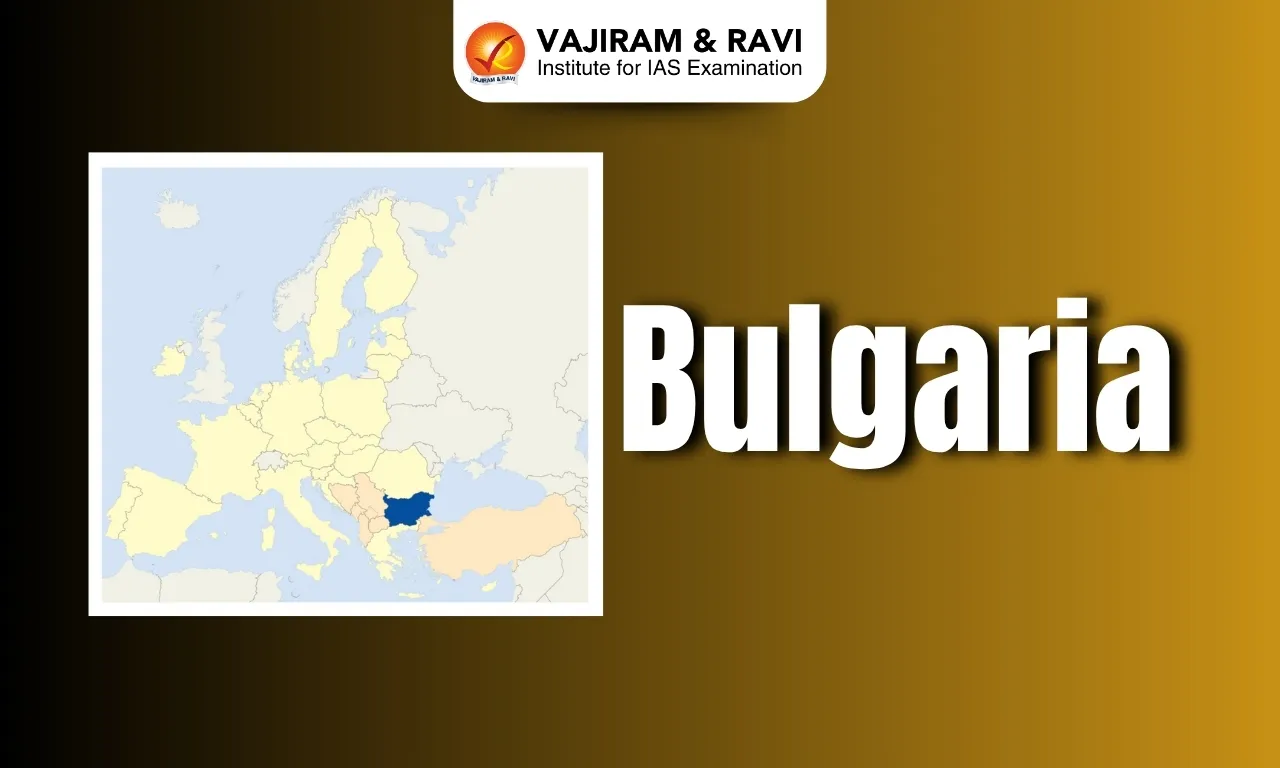
Bulgaria

Bulgaria Latest News

Recently, the Bulgarian Foreign Minister called on the President of India with discussions focusing on expanding cooperation between India and Bulgaria across a range of sectors.

About Bulgaria

  • Location: It is located in the south eastern region of the European continent, occupying the eastern part of the Balkan Peninsula.
  • Bordering Countries: It shares its land border with Romania in the north; by Turkey and Greece in the south; by North Macedonia in the southwest and by Serbia in the west.
  • Maritime Border: It is bounded by the Black Sea in the east.
  • Capital City: Sofia

Geographical Features of Bulgaria

  • Climate: It has a moderate continental climate, which is tempered by Mediterranean influences in the south. 
  • Mountain Ranges: The Balkan Mountains cut across the central part of the country, while the Rhodope Mountains run through southern Bulgaria, along its border with Greece.
  • Highest Point: Musala Mt (at 9,594 ft.) which is located in the Rila Mountains.
  • Major Rivers: Major rivers include the Danube River, Iskur, Maritsa, Struma, Tundzha and Yantra rivers.
  • Natural Resources: It consists of Bauxite, Copper, lead, zinc, coal etc.

Source: DD News

Bulgaria FAQs

Q1: Which sea borders Bulgaria?

Ans: It is bounded by the Black Sea in the east.

Q2: Which type of climate is found in Bulgaria?

Ans: Moderate continental climate

BepiColombo Mission Begins Orbiting Mercury After Eight-Year Journey Through Space

BepiColombo Mission

BepiColombo Mission Latest News

Recently, after an eight-year journey, the European-Japanese spacecraft BepiColombo has begun orbiting the solar system's smallest ​and innermost planet Mercury.

About BepiColombo Mission

  • It was launched on October 20, 2018.
  • It is a joint European Space Agency (ESA) and Japan Aerospace Exploration Agency (JAXA) mission to Mercury.
  • The mission was named after Giuseppe “Bepi” Colombo, an Italian mathematician and engineer who made significant contributions to the understanding of Mercury’s orbit.
  • It is an ambitious and complex mission designed to study Mercury’s surface, composition, magnetic field, and its interaction with the solar environment.
  • Components of BepiColombo
    • Mercury Planetary Orbiter (MPO): It is developed by ESA, carries 11 instruments, including spectrometers and HIS cameras, and will study the interior and surface of the planet Mercury as well as its exosphere.
    • Mercury Magnetospheric Orbiter (MMO): It is developed by the Japanese space agency JAXA, includes 5 scientific instruments, and aims to study the magnetic field, the exosphere as well as waves and particles located in the immediate environment of the planet.
  • Objectives
    • Investigating Mercury’s surface and composition to better understand its geological history and formation processes.
    • Studying Mercury’s magnetic field and magnetosphere to gain insights into its internal structure and how it interacts with the solar wind.
    • Measuring Mercury’s exosphere (a thin atmosphere) and understanding its composition and dynamics.
    • Conducting experiments to test certain principles of general relativity and improve our understanding of gravity.

Source: TH

BepiColombo Mission FAQs

Q1: Which organisations developed the BepiColombo Mission?

Ans: It is a joint European Space Agency (ESA) and Japan Aerospace Exploration Agency (JAXA) mission to Mercury.

Q2: What is the main objective of BepiColombo Mission?

Ans: It is designed to study Mercury’s surface, composition, magnetic field, and its interaction with the solar environment.

Migratory Birds from Siberia and Central Asia Arrive at Telangana’s Kawal Tiger Reserve

Kawal Tiger Reserve

Kawal Tiger Reserve Latest News

The arrival of migratory birds from Siberia, Central Asia and other northern regions has brought renewed attention to the ecological significance of Kawal Tiger Reserve (KTR).

About Kawal Tiger Reserve

  • Location: It is located in the state of Telangana.
  • The reserve is nestled in the Sahyadri Mountain Ranges.
  • Geographically, the reserve is situated at the southernmost tip of the Central Indian Tiger landscape, having linkages with the Tadoba-Andhari (Maharashtra) and Indravati (Chhattisgarh) tiger reserves.
  • Rivers: It is a major catchment of the river Godavari and local rivulets like Peddavagu and Kadam.
  • Terrain: It has diverse habitats comprising dense forests, grasslands, rivers, streams, and water bodies.
  • Vegetation: It mainly consists of Southern Tropical Dry Deciduous Forest.
  • Flora: It consists of teak along with bamboo and other species like Anogeissus latifolia, Mitragyna parviflora, Terminalia crenulata, Terminalia arjuna, Boswellia serrata, etc.
  • Fauna:  The major wild animals include: tiger, nilgai, chousinga, chinkara, black buck, sambar, spotted deer, wild dog, wolf, jackal, fox, leopard,  and the jungle cat.

Source: TH

Kawal Tiger Reserve FAQs

Q1: Where is Kawal Tiger Reserve located?

Ans: Telangana

Q2: What type of vegetation is found in Kawal Tiger Reserve?

Ans: It mainly consists of Southern Tropical Dry Deciduous Forest.

Enquire Now