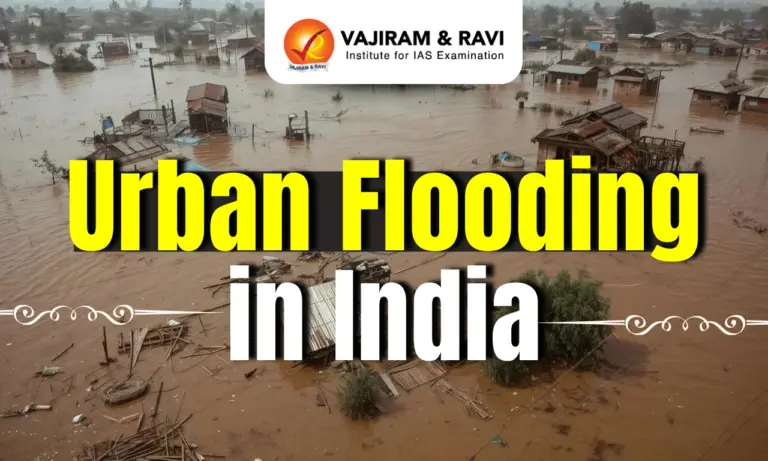
Urban Flooding in India has emerged as a major environmental and governance challenge in India due to rapid urbanization, climate change and increasing high intensity rainfall events. Various cities frequently experience severe waterlogging during monsoon seasons. Encroachment on wetlands, destruction of lakes, outdated drainage systems and excessive concretization have reduced natural water absorption capacity. Urban floods disrupt transportation, damage infrastructure, threaten public health and create large economic losses, making flood resilient urban planning increasingly important.
Urban Flooding in India
Urban Flooding in India has increased significantly because cities are facing extreme rainfall events while drainage and urban planning systems remain inadequate and outdated.
- Rising flood incidents: Major cities including Mumbai, Chennai, Delhi, Hyderabad, Ahmedabad, Bengaluru, Kolkata, Surat and Srinagar have witnessed repeated urban floods since 2000 due to extreme rainfall, rapid urbanization and blocked drainage systems.
- High intensity rainfall events: Delhi recorded 228.1 mm rainfall within 24 hours during 2024, exceeding the city’s average June rainfall and causing severe waterlogging, traffic disruption and flooding across urban areas.
- Chennai floods 2015: Record monsoon rainfall linked to cyclonic circulation over the Bay of Bengal caused devastating floods in Chennai, leading to damages exceeding Rs 15,000 crore and major disruptions in transport and electricity.
- Bengaluru flood crisis: Bengaluru experienced severe flooding during 2024 pre monsoon rainfall due to overflowing lakes, encroached drains and excessive concretization. Around 65% of lakes and nearly 80% of historic water bodies have been degraded or encroached.
- Mumbai flooding pattern: Mumbai’s drainage system, designed during the British period for only 25 mm rainfall per hour, now faces rainfall exceeding 100 mm per hour, causing repeated flooding and large scale economic losses.
- National flood damage statistics: Between 2012 and 2021, floods and heavy rainfall affected millions of people annually. In 2021 alone, 38.56 million people were affected, while total crop, housing and infrastructure damages crossed Rs 49,617 crore.
- Human and economic losses: Floods and heavy rainfall caused 2,754 human deaths in 2019 and 2,063 deaths in 2017. In 2021, damage to public utilities alone exceeded Rs 25,244 crore across India.
- Drainage infrastructure gap: More than 70% of Indian urban areas lack scientifically designed stormwater drainage systems, resulting in widespread waterlogging during monsoon periods.
- Coastal and low lying vulnerability: Cities like Mumbai and Kolkata are naturally vulnerable because they are located in coastal floodplains and delta regions where runoff accumulation and tidal influence increase flooding risks.
- Climate change influence: Increasing frequency of short duration intense rainfall events linked with climate change has intensified flash floods in Indian cities, particularly during monsoon months.
Urban Flooding in India Causes
Urban Flooding in India results from a combination of natural factors, climate related changes and poorly managed urban development activities across cities.
- High intensity rainfall: Short duration heavy rainfall events overwhelm urban drainage systems rapidly, causing waterlogging in cities where drains cannot handle sudden large water discharge volumes.
- Unplanned urbanization: Rapid urban expansion has replaced permeable land with concrete surfaces, reducing groundwater recharge and increasing surface runoff during monsoon rainfall.
- Encroachment of water bodies: Wetlands, lakes, ponds, floodplains and natural drainage channels have been encroached for construction activities, reducing the natural flood absorption capacity of cities.
- Outdated drainage systems: Several Indian cities still rely on colonial era drainage networks designed for low rainfall intensity, making them incapable of handling present extreme precipitation events.
- Solid waste dumping: Plastic waste, debris and untreated garbage clog drains, stormwater channels and nullahs, obstructing water flow and worsening flooding during heavy rainfall.
- Loss of urban lakes: Bengaluru once had more than 1,000 interconnected lakes, but extensive encroachment and degradation destroyed natural rainwater storage systems and increased urban runoff.
- Climate change impacts: Increasing temperatures and changing monsoon patterns have intensified extreme rainfall events, resulting in more frequent urban flash floods across India.
- Deforestation and land degradation: Removal of vegetation in upstream areas increases soil erosion, siltation and runoff, contributing to downstream Urban Flooding in cities such as Guwahati.
- Poor urban governance: Weak coordination among urban local bodies, planning authorities and drainage agencies creates fragmented flood management systems and delayed mitigation measures.
- Sewage and drainage mixing: In many cities, stormwater drains are connected with sewage lines, reducing drainage efficiency and increasing contamination during flooding situations.


Urban Flooding in India Impacts
Urban Flooding in India create serious social, economic, environmental and infrastructural consequences that affect millions of urban residents and city economies every year.
- Loss of human lives: Floodwaters cause drowning, electrocution, injuries and accidents. Between 2012 and 2021, thousands of human deaths occurred annually due to floods and heavy rainfall events.
- Infrastructure destruction: Roads, bridges, metro lines, power supply systems, communication networks and water infrastructure suffer extensive damage during urban floods, disrupting essential services.
- Economic losses: Urban Flooding leads to business closures, transportation disruption and repair expenses. Mumbai floods caused commercial losses exceeding 100 million dollars during major flood events.
- Public health emergencies: Stagnant floodwater increases mosquito breeding and spreads diseases such as malaria, dengue, cholera, typhoid, leptospirosis and hepatitis in affected urban regions.
- Damage to houses: Flooding destroys residential structures, especially informal settlements located near drains and low lying areas, causing displacement and loss of livelihoods.
- Environmental pollution: Floodwaters carry sewage, industrial waste and pollutants into rivers and lakes, damaging aquatic ecosystems and contaminating groundwater sources.
- Social inequality: Urban poor living in slums and unauthorized settlements face disproportionate losses because they often reside in flood prone and poorly serviced areas.
- Traffic and transport disruption: Waterlogging paralyses public transport systems, airports, railway networks and roads, affecting productivity and daily economic activities in cities.
- Psychological stress: Flood victims often experience trauma, anxiety and mental stress due to displacement, financial losses and destruction of homes and personal belongings.
- Reduced groundwater recharge: Excessive concretization and damaged wetlands reduce natural groundwater replenishment, worsening long term urban water scarcity conditions.
Urban Flooding in India Prevention Measures
Effective Urban Flooding in India prevention requires scientific planning, nature based solutions, advanced technology and strong coordination among urban institutions and communities.
- Sponge city approach: Cities should adopt sponge city models using green roofs, permeable pavements, rain gardens, wetlands and green spaces to absorb and store rainwater naturally.
- Restoration of water bodies: Reviving urban lakes, wetlands, ponds and floodplains can improve rainwater retention capacity and reduce flood intensity during monsoon periods.
- Sustainable drainage systems: Bio swales, detention basins, recharge pits and permeable surfaces should be integrated into urban planning to manage runoff efficiently at local levels.
- Scientific flood mapping: Hydrological and hydraulic modelling should identify flood prone zones and guide urban master plans using GIS based drainage mapping technologies.
- Smart drainage technologies: Real time sensors, IoT based monitoring systems and airborne laser terrain mapping can improve drainage management and provide early flood warnings.
- Rainwater harvesting expansion: Mandatory rainwater harvesting systems in residential and commercial buildings can reduce runoff while increasing groundwater recharge capacity.
- Strengthening local governance: Urban Local Bodies require trained staff, financial resources and institutional clarity for effective drainage maintenance and flood management planning.
- Community participation: Public awareness campaigns and involvement of grassroots organizations can improve preparedness, early response coordination and flood resilience in urban areas.
- Protection of recharge zones: Construction activities in wetlands, floodplains, reservoir catchments and aquifer recharge areas should be strictly regulated to maintain natural drainage systems.
- Nature based infrastructure: Urban forests, green corridors and restored wetlands can absorb excess rainfall naturally while improving biodiversity and urban environmental quality.
Urban Flooding in India Government Initiatives
The Union Government has introduced several policies, schemes and technical guidelines to strengthen urban flood management and improve water conservation infrastructure.
- National Disaster Mitigation Fund: The Fifteenth Finance Commission allocated Rs 2,500 crore for integrated urban flood management projects in Mumbai, Chennai, Kolkata, Bengaluru, Hyderabad, Ahmedabad and Pune.
- Chennai flood management project: The Central Government approved Integrated Urban Flood Management activities for Chennai basin costing Rs 561.29 crore, including Rs 500 crore central allocation.
- Jal Shakti Abhiyan: Launched in 2019, the programme promotes rainwater harvesting, watershed management, groundwater recharge structures, afforestation and water conservation across rural and urban areas.
- Master Plan for Artificial Recharge to Groundwater 2020: CGWB prepared a national plan proposing construction of around 1.42 crore rainwater harvesting and recharge structures to harness 185 Billion Cubic Meter water.
- AMRUT and AMRUT 2.0: These schemes support stormwater drainage infrastructure, rejuvenation of water bodies and rainwater harvesting through stormwater drains connected to clean water bodies.
- Stormwater drainage projects: Under AMRUT, 750 stormwater drainage projects worth Rs 1,883 crore have been completed across 19 States and Union Territories, eliminating 3,445 waterlogging points.
- Model Building Bye Laws 2016: MoHUA made rainwater harvesting mandatory for buildings on plots measuring 100 square metres or more, with 35 States and Union Territories adopting these provisions.
- Amrit Sarovar Mission: The mission aims to rejuvenate 75 water bodies in every district for rainwater harvesting, groundwater recharge and strengthening local water conservation systems.
- NDMA Urban Flooding guidelines: National Disaster Management Authority issued comprehensive guidelines promoting proactive, multidisciplinary and participatory approaches for urban flood management planning.
- SOPs and drainage manuals: MoHUA issued Standard Operating Procedures on Urban Flooding in 2017 and published Storm Water Drainage Systems Manual in 2019 for planning, design and emergency response management.

 Last updated on Oct, 2026
→ UPSC 2027 Notification will be released on 13 January 2027 at upsconline.nic.in.
→ Asian Games 2026 are being held in Aichi-Nagoya, Japan, from 19 September to 4 October.
→ Check Nobel Prize 2026 Winners List here.
→ Download PIB PRiSM Monthly Magazine 2026 here.
→ Check UPSC Monthly Current Affairs Magazine The Recitals here.
→ Check out the latest UPSC Syllabus here.
→ Download UPSC Model Answers for Mains 2026
→ UPSC Mains Question Paper 2026 is out now for Essay & GS Paper 1, 2, 3 & 4.
→ UPSC Calendar 2027 has been released.
→ Enroll in Vajiram & Ravi’s UPSC Mains Test Series 2027 for structured answer writing practice, expert evaluation, and exam-oriented feedback.
→ Join Vajiram & Ravi’s UPSC Mentorship Program 2027 for personalized guidance, strategy planning, and one-to-one support from experienced mentors.
→ Go through the UPSC Mains Previous Year Papers to enhance your preparation.
→ UPSC has released UPSC Toppers List 2025 with the Civil Services final result on its official website.
→ Also check Best UPSC Coaching in India
Urban Flooding in India FAQs
Q1. What is Urban Flooding?+
Q2. Which Indian cities frequently face urban floods?+
Q3. What is the main reason behind Urban Flooding in India?+
Q4. Which government scheme supports Urban Flood management?+
Q5. How can Urban Flooding be reduced in cities?+
Tags: geography geography notes urban flooding in india