


Vertical Propellant Mixer Latest News
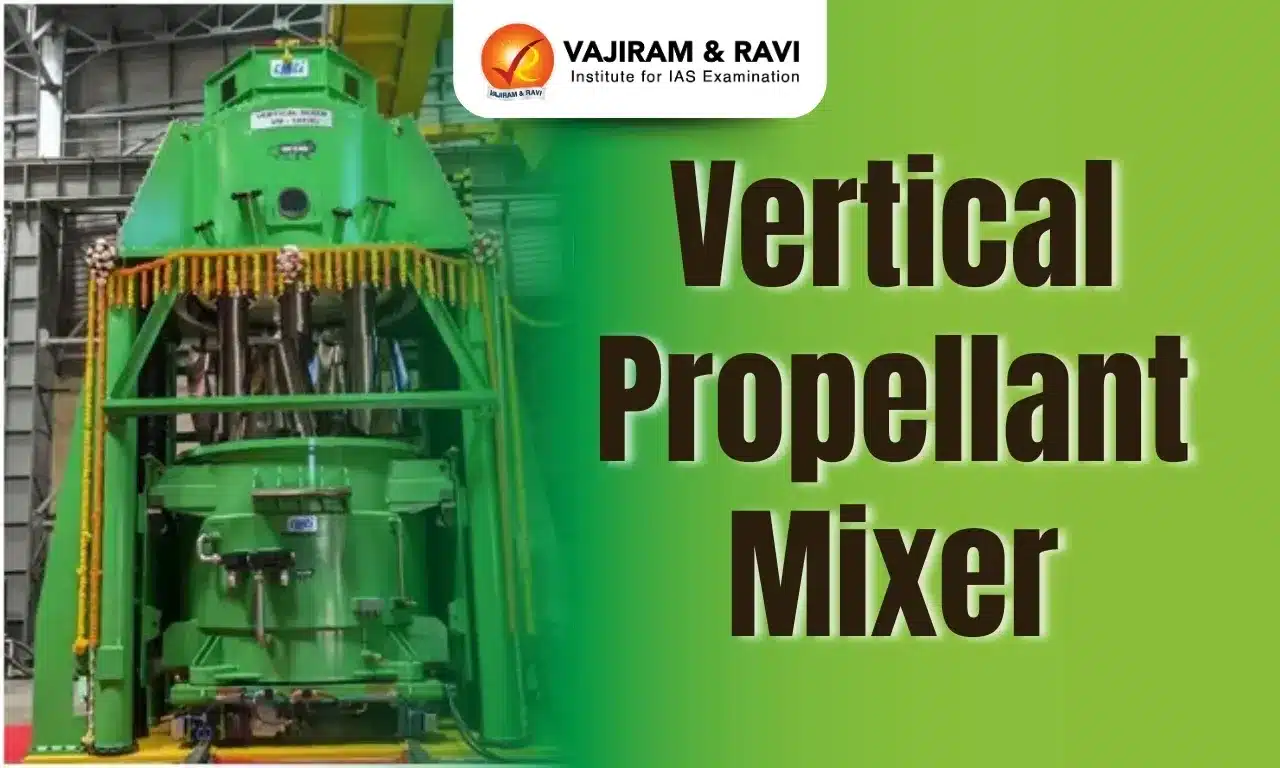
Recently, Indian Space Research Organisation has announced the successful development of a 10-tonne ‘vertical planetary mixer’, the largest of its kind for solid propellants globally.
About Vertical Propellant Mixer
- It is the largest solid propellant mixing equipment globally.
- It is developed and designed by Satish Dhawan Space Centre in collaboration with Central Manufacturing Technology Institute, a Bengaluru-based research and development organisation under the Ministry of Heavy Industries.


Key Features of Vertical Propellant Mixer
- It has high-capacity mixing of propellant ingredients in a single batch
- It has precision and control for quality consistency & performance
- Safety and Reliability for handling highly hazardous materials
- World’s Largest: It weighs approximately 150 tonnes, and measures 5.4m (L) × 3.3m (B) × 8.7m (H).
- Advanced Technology: It is equipped with multiple agitators which are hydrostatic driven and will be remotely operated using PLC based control systems with SCADA stations.
What is a Propellant Mixer?
- A propellant mixer is a machine that mixes the ingredients of rocket propellants, specifically fuel and oxidiser, to ensure a uniform and reliable mixture for solid rocket motors.
- These mixers, such as planetary mixers, are utilised to combine the raw materials that compose rocket propellant.
- The quality of the mixed propellant directly impacts the performance and reliability of the rocket motor.
Vertical Propellant Mixer FAQs
Q1: What is the best solid propellant?
Ans: The most widely used solid rocket propellant for space applications consists of ammonium perchlorate (70%), aluminium (16%) and binder (14%).
Q2: What are the three types of propellants?
Ans: NASA and commercial launch vehicles use four types of propellants: (1) petroleum; (2) cryogenics; (3) hypergolics; and (4) solids.
Q3: What is known as an oxidizer?
Ans: Oxidizing chemicals are materials that spontaneously evolve oxygen at room temperature or with slight heating or promote combustion.
Source: TOI

 Last updated on Oct, 2026
→ UPSC 2027 Notification will be released on 13 January 2027 at upsconline.nic.in.
→ Check Nobel Prize 2026 Winners List here.
→ Download PIB PRiSM Monthly Magazine 2026 here.
→ Check UPSC Monthly Current Affairs Magazine The Recitals here.
→ Check out the latest UPSC Syllabus here.
→ Download UPSC Model Answers for Mains 2026
→ UPSC Mains Question Paper 2026 is out now for Essay & GS Paper 1, 2, 3 & 4.
→ UPSC Calendar 2027 has been released.
→ Enroll in Vajiram & Ravi’s UPSC Mains Test Series 2027 for structured answer writing practice, expert evaluation, and exam-oriented feedback.
→ Join Vajiram & Ravi’s UPSC Mentorship Program 2027 for personalized guidance, strategy planning, and one-to-one support from experienced mentors.
→ Go through the UPSC Mains Previous Year Papers to enhance your preparation.
→ UPSC has released UPSC Toppers List 2025 with the Civil Services final result on its official website.
→ Also check Best UPSC Coaching in India








