What’s in today’s article?
- Introduction
- Trump’s Trade Stance on India
- India’s Economic Ties with the U.S.
- Potential Impact on Key Indian Sectors
- Trump’s Approach to Trade Agreements
- U.S. Tariffs on Steel and Aluminium
- Inflationary Pressures and Its Effect on Indian Exports
- Conclusion
Introduction
- The upcoming U.S. presidential race between Kamala Harris and Donald Trump has significant implications for global policies, including those affecting India.
- While a Harris win would likely maintain continuity with the Biden administration’s approach, a Trump victory could lead to disruption and unpredictability, especially in trade and business policy, which directly impacts India.


Trump’s Trade Stance on India
- Trump has referred to India as a “very big [trade] abuser” and could renew trade tensions by imposing higher tariffs on over $75 billion worth of Indian exports.
- His previous term (2017-2021) witnessed a rise in protectionism, affecting India’s trade.
- In 2019, India lost its preferential trade status under the Generalized System of Preferences (GSP), impacting $5.7 billion of its duty-free exports to the U.S.
India’s Economic Ties with the U.S.
- The U.S. is India’s largest trading partner, with bilateral trade reaching nearly $120 billion in FY24, slightly surpassing India’s trade volume with China.
- This relationship is crucial as it provides India with foreign exchange, with 18% of India’s exports directed to the U.S.
- India’s export portfolio to the U.S. is diverse, spanning textiles, electronics, and engineering products, making the U.S. a vital market.
Potential Impact on Key Indian Sectors
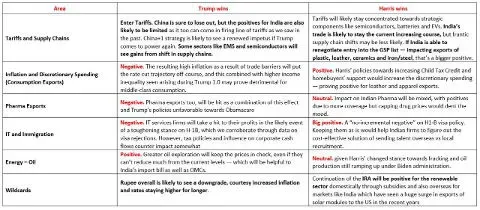
- If Trump returns to office, Indian sectors like pharmaceuticals and IT services could suffer.
- Pharmaceutical exports might face higher scrutiny, and H-1B visa restrictions could reduce opportunities for Indian IT professionals.
- Tax policy changes might impact corporate cash flows, potentially offsetting some negative impacts.
- The rupee could also depreciate due to inflation and elevated interest rates in the U.S.
Trump’s Approach to Trade Agreements
- Under Trump, the U.S. moved away from multilateral trade agreements and undermined the WTO’s dispute resolution function by blocking judge appointments.
- Although Biden has promised reforms, the dispute resolution system remains inactive. Trump’s return could further erode the WTO’s influence and affect global trade dynamics.
U.S. Tariffs on Steel and Aluminium
- During his first term, Trump imposed tariffs on steel (25%) and aluminium (10%) under national security provisions.
- Biden retained these tariffs but negotiated with India and the EU for exemptions.
- Trump has criticized India’s tariff structure, branding it as “high” and calling India a “tariff king.”
- Although India’s tariffs rose to 18.1% in 2022, its government justifies these as measures to support local manufacturing, including sectors under the Production-Linked Incentive (PLI) scheme.
Inflationary Pressures and Its Effect on Indian Exports
- Higher tariffs and protectionist policies in the U.S. could stoke inflation.
- A report from the Peterson Institute for International Economics warns that Trump’s policies might push U.S. inflation up to 9.3% by 2026, from an otherwise projected 1.9%.
- Higher inflation could reduce U.S. demand for Indian labour-intensive exports like textiles, gems, and leather products, impacting Indian jobs tied to these industries.
Conclusion
- The outcome of the U.S. presidential race will play a critical role in shaping India-U.S. trade relations.
- A Trump presidency may renew trade frictions and tariff hikes, challenging India’s export-driven industries, while a Harris victory could provide continuity, though not without challenges given the global shift towards trade protectionism.
Q1. What is Tariff-Rate Quota?
In economics, a tariff-rate quota is a two-tiered tariff system that combines import quotas and tariffs to regulate import products. A TRQ allows a lower tariff rate on imports of a given product within a specified quantity and requires a higher tariff rate on imports exceeding that quantity.
Q2. What is the Most Favoured Nation status?
Most favoured nation status is given to an international trade partner to ensure non-discriminatory trade between all partner countries of the WTO. A country which provides MFN status to another country has to provide concessions, privileges, and immunity in trade agreements.
News: US elections results: What Trump 2.0 could mean for US-India trade

 Last updated on Oct, 2026
→ UPSC 2027 Notification will be released on 13 January 2027 at upsconline.nic.in.
→ Check Nobel Prize 2026 Winners List here.
→ Download PIB PRiSM Monthly Magazine 2026 here.
→ Check UPSC Monthly Current Affairs Magazine The Recitals here.
→ Check out the latest UPSC Syllabus here.
→ Download UPSC Model Answers for Mains 2026
→ UPSC Mains Question Paper 2026 is out now for Essay & GS Paper 1, 2, 3 & 4.
→ UPSC Calendar 2027 has been released.
→ Enroll in Vajiram & Ravi’s UPSC Mains Test Series 2027 for structured answer writing practice, expert evaluation, and exam-oriented feedback.
→ Join Vajiram & Ravi’s UPSC Mentorship Program 2027 for personalized guidance, strategy planning, and one-to-one support from experienced mentors.
→ Go through the UPSC Mains Previous Year Papers to enhance your preparation.
→ UPSC has released UPSC Toppers List 2025 with the Civil Services final result on its official website.
→ Also check Best UPSC Coaching in India