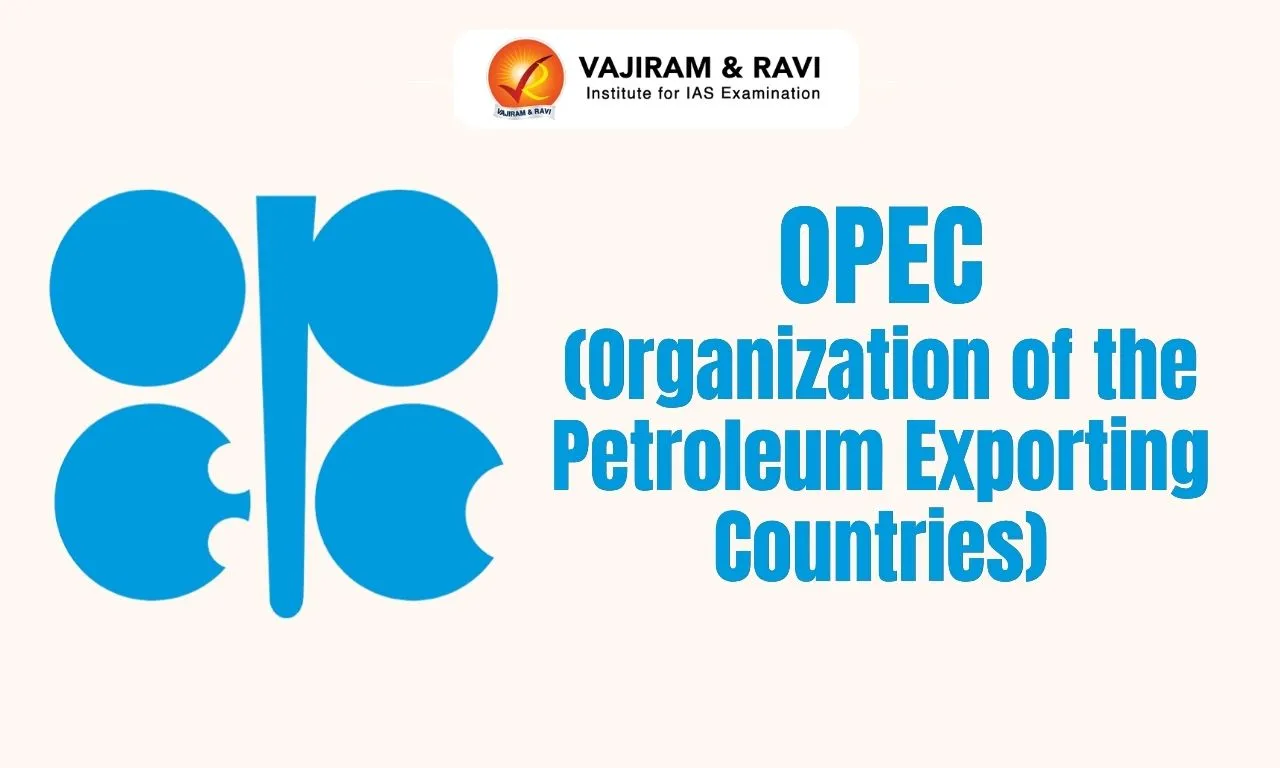
The Organization of the Petroleum Exporting Countries (OPEC) is an intergovernmental organisation established in 1960 to coordinate and unify petroleum policies among major oil-exporting countries. With 12 member countries (as of 2026), OPEC seeks to ensure stable oil markets.
OPEC plays a key role in influencing global crude oil by managing production levels and maintaining market stability. However, it faces challenges such as fluctuating global oil demand, the rise of renewable energy, and increasing non-OPEC oil production (e.g., U.S. shale oil), etc.
OPEC About
Organization of the Petroleum Exporting Countries (OPEC) was established at the Baghdad Conference in 1960, a permanent intergovernmental organisation whose goal is to provide fair and stable pricing for petroleum producers by coordinating and unifying petroleum policy among member nations.
OPEC Full Form
OPEC stands for Organization of the Petroleum Exporting Countries. OPEC was founded by 5 countries, namely Iran, Iraq, Kuwait, Saudi Arabia, and Venezuela.
OPEC Headquarters
The headquarters of OPEC is located in Vienna, Austria. It was first set up in Geneva, Switzerland in 1960, and moved to Vienna in 1965.
OPEC History
OPEC has evolved from a small group of oil-producing nations into a major institution influencing global energy markets through coordinated production policies and market stabilisation efforts.
- Formation (1960): OPEC was established on 14 September 1960 at the Baghdad Conference by Iran, Iraq, Kuwait, Saudi Arabia, and Venezuela to coordinate petroleum policies and strengthen the bargaining power of oil-producing countries.
- Membership Expansion (1960s–2000s): Several oil-exporting countries, including Qatar, Indonesia, Libya, the UAE, Algeria, Nigeria, Angola, Congo, Equatorial Guinea, and Gabon, joined OPEC, expanding its global influence.
- 1973 Oil Embargo: OPEC members imposed an oil embargo during the Arab–Israeli War, causing a sharp rise in global oil prices and highlighting OPEC's strategic influence on the world economy.
- Market Volatility (1980s–2015): In response to drops in oil prices, worldwide recessions, and an increase in non-OPEC output, especially shale oil from the United States, OPEC modified production quotas.
UAE Leaves OPEC
The United Arab Emirates (UAE) officially withdrew from OPEC and OPEC Plus on 1 May 2026, ending nearly six decades of membership to pursue an independent oil production strategy aligned with its national economic and energy priorities.
- Independent Production Policy: The UAE sought greater flexibility to increase crude oil production beyond OPEC's quota system.
- Expand Production Capacity: The country plans to raise its oil production capacity to 5 million barrels per day by 2027, requiring freedom from OPEC production limits.
- National Interest: The withdrawal was described as part of the UAE's long-term economic strategy and evolving energy policy focused on national priorities.
- Reduced OPEC Influence: The exit removed OPEC's third-largest producer, reducing the organisation's share of global production and weakening its collective market influence.
- Higher Oil Revenue: By producing oil independently without OPEC production quotas, the UAE aims to increase crude oil exports and government revenue.
- Growing Friction with Saudi Arabia: Differences over oil production quotas and regional policies within OPEC increased tensions between the UAE and Saudi Arabia, contributing to the UAE's decision to leave the organization.


OPEC Organisation
OPEC has a well-defined institutional structure that enables member countries to coordinate petroleum policies, take collective decisions, and ensure efficient functioning of the organisation.
- OPEC Conference: The supreme decision-making body, comprising oil or energy ministers of all member countries. It meets twice a year.
- Board of Governors: Consists of one Governor nominated by each member country. It oversees the implementation of Conference decisions and approves budgets.
- Economic Commission Board (ECB): A technical advisory body comprising representatives from member states. It analyses global oil market trends and demand-supply conditions and provides economic recommendations to the Conference.
- OPEC Secretariat: Headquartered in Vienna, Austria, the Secretariat is headed by the Secretary General and manages OPEC's day-to-day operations and administration.
- Research Division: Conducts research and analysis on global oil markets, energy demand, supply trends and prices to support evidence-based policymaking.
- Support Services Division: Provides administrative, legal, financial, human resource, and conference management services to ensure smooth functioning of the Secretariat.
- Secretary General: The chief executive officer of OPEC, appointed by the Conference for a fixed term, responsible for implementing decisions and representing OPEC.
OPEC Members
The OPEC Statute distinguishes between the Founder Members and Full Members. There are now 12 Members in the Organisation.
- Membership Qualification: If approved by a majority of three-fourths of Full Members, including votes of all Founder Members, any nation with a significant net export of crude petroleum and similar interests to Member Countries may become a Full Member.
- Members:
- Middle East (5): Iran, Iraq, Kuwait, Saudi Arabia, United Arab Emirates (UAE).
- Africa (6): Algeria, Congo, Equatorial Guinea, Gabon, Nigeria, and Libya.
- South America (1): Venezuela.
OPEC Plus
OPEC Plus is an informal alliance of OPEC members and major non-OPEC oil-producing countries that was formed in 2016 to coordinate oil production policies, stabilise global crude oil markets, and reduce price volatility.
- OPEC Plus Countries: Comprises 12 OPEC countries and 10 non-OPEC producers, including Russia, Kazakhstan, Azerbaijan, Bahrain, Brunei, Malaysia, Mexico, Oman, South Sudan, and Sudan.
- Objective: Coordinate oil production levels to maintain stable oil prices, balance global demand and supply, and ensure a sustainable petroleum market.
- Key Role: Implements production cuts or increases through consensus to address market disruptions caused by events such as the COVID-19 pandemic, geopolitical conflicts, and fluctuations in global demand.
- Importance: OPEC Plus accounts for over 50% of global crude oil production, making it one of the most influential groups in the global energy market.
OPEC Functions
OPEC coordinates petroleum policies among member countries to ensure stable oil markets, fair returns for producers, and a secure supply of crude oil to global consumers.
- Sets Production Quotas: Allocates production targets to member countries to regulate global crude oil supply and prevent oversupply or shortages.
- Stabilises Oil Prices: Adjusts collective output to reduce excessive price volatility and maintain stable international crude oil prices.
- Coordinates Petroleum Policies: Harmonises oil production and export policies among member countries to achieve common economic objectives.
- Publishes Market Intelligence: Releases the Monthly Oil Market Report (MOMR) and the World Oil Outlook (WOO), providing forecasts on demand, supply, investment, and energy trends.
- Promotes Investment in the Oil Sector: Encourages adequate investment in upstream and downstream petroleum industries to ensure long-term energy security.
- Coordinates with OPEC+: Works with major non-OPEC producers, including Russia, to implement coordinated production adjustments and enhance global market stability.
OPEC and India
India is the world's third-largest crude oil importer and consumer, making OPEC a crucial partner for its energy security, trade, and economic stability. Approximately 94% of India's natural gas imports and 85% of crude imports come from OPEC nations.
- Energy Security: Stable oil supplies from OPEC are essential for meeting India's growing energy demand and supporting industrial and economic growth.
- Impact on Inflation: Changes in OPEC's production decisions directly influence global crude oil prices, affecting India's import bill, inflation, and fiscal balance.
- Strategic Energy Partnerships: India has strengthened long-term crude supply agreements and investments with major OPEC members, particularly Saudi Arabia, Iraq, the UAE, and Kuwait.
- Strategic Petroleum Reserves (SPR): To protect against supply interruptions and unexpected price increases brought on by OPEC decisions, India keeps strategic crude oil reserves.
- Diversification of Imports: To reduce dependence on OPEC, India is expanding oil imports from Russia, the USA, Brazil, and Guyana, while also promoting renewable energy and ethanol blending.
- Trade and Investment: OPEC countries are significant investors in India's refining, petrochemicals, and strategic infrastructure, strengthening bilateral economic ties.
OPEC Challenges
OPEC faces multiple challenges in maintaining global oil market stability due to changing energy demand, rising competition, geopolitical tensions, and internal coordination issues.
- Rise of Non-OPEC Producers: Increasing production from countries such as the USA (shale oil), Brazil, Guyana, and Canada reduces OPEC's market share and pricing power.
- Example: The U.S. remained the world's largest crude oil producer in 2025–26
- Energy Transition: Rapid growth of renewable energy, electric vehicles, and decarbonisation policies is lowering long-term demand for crude oil.
- Internal Differences: Divergent production capacities and national interests among member countries often make it difficult to reach consensus on production quotas.
- Example: UAE exited OPEC in May 2026 over production quota disagreements.
- Geopolitical Conflicts: Wars, sanctions, and political instability in oil-producing regions disrupt production and create uncertainty in global oil markets, such as Iran-US tensions.
- Price Volatility: Crude oil prices frequently fluctuate due to pandemics, global economic slowdowns, and unforeseen demand-supply shocks.
- Compliance Issues: Some member countries exceed their agreed production quotas, weakening OPEC's ability to effectively manage supply.
OPEC Way Forward
OPEC must improve cooperation, bolster market stability, and adjust to the global energy transition while protecting the interests of producers and consumers in order to be relevant in the quickly changing global energy scene.
- Strengthen Production Discipline: Improve compliance with production quotas to enhance the credibility and effectiveness of supply management.
- Increase Market Transparency: Strengthen data sharing, market analysis, and demand forecasting through timely reports and consultations.
- Adapt to Energy Transition: Promote investments in cleaner technologies, carbon capture, and low-carbon energy while ensuring a balanced transition.
- Maintain Stable Oil Pricing: Adopt balanced production plans that guarantee reasonable pricing for consumers while giving producers just and steady income.

 Last updated on Oct, 2026
→ UPSC 2027 Notification will be released on 13 January 2027 at upsconline.nic.in.
→ Check Nobel Prize 2026 Winners List here.
→ Download PIB PRiSM Monthly Magazine 2026 here.
→ Check UPSC Monthly Current Affairs Magazine The Recitals here.
→ Check out the latest UPSC Syllabus here.
→ Download UPSC Model Answers for Mains 2026
→ UPSC Mains Question Paper 2026 is out now for Essay & GS Paper 1, 2, 3 & 4.
→ UPSC Calendar 2027 has been released.
→ Enroll in Vajiram & Ravi’s UPSC Mains Test Series 2027 for structured answer writing practice, expert evaluation, and exam-oriented feedback.
→ Join Vajiram & Ravi’s UPSC Mentorship Program 2027 for personalized guidance, strategy planning, and one-to-one support from experienced mentors.
→ Go through the UPSC Mains Previous Year Papers to enhance your preparation.
→ UPSC has released UPSC Toppers List 2025 with the Civil Services final result on its official website.
→ Also check Best UPSC Coaching in India
OPEC (Organization of the Petroleum Exporting Countries) FAQs
Q1. Who are the 5 founders of OPEC?+
Q2. How many countries left OPEC?+
Q3. Is India an OPEC country?+
Q4. Who is the leader of OPEC? +
Q5. Why did the UAE leave OPEC?+
Tags: opec Organization of the Petroleum Exporting Countries quest UPSC International Relations and Institutions Notes