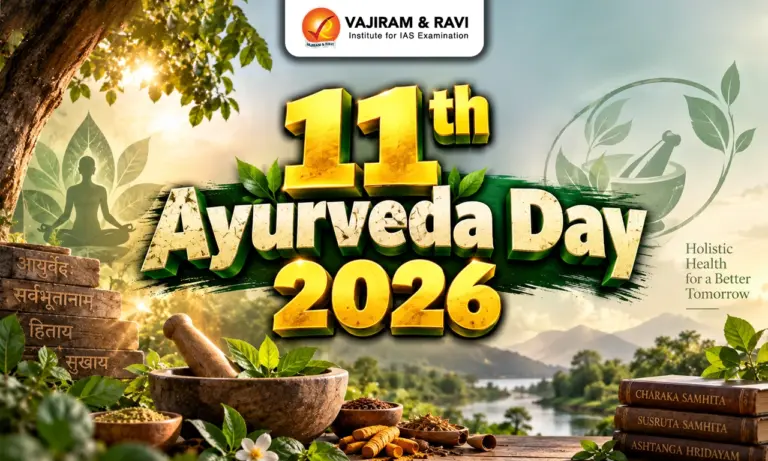
The 11th Ayurveda Day 2026 will be observed on 23 September 2026 with the theme “Ayurveda for a Healthier Tomorrow.” The day highlights India’s ancient Ayurvedic tradition and its growing role in modern healthcare, preventive wellness, scientific research and public health. The 2026 observance is also significant as it marks the first Ayurveda Day celebrated on the newly fixed date of 23 September, following the Government of India’s decision in 2025 to give the occasion a fixed annual date.
11th Ayurveda Day 2026 Date and Theme
The 11th Ayurveda Day 2026 will be observed on 23 September 2026. The theme for this year is “Ayurveda for a Healthier Tomorrow.” The theme highlights the role of Ayurveda in promoting health, preventive care, scientific research and holistic wellbeing.
- More than 9,700 activities have been reported across 30 States and Union Territories as part of the nationwide Ayurveda Day celebrations.
- More than 3 lakh participants have registered through the official Ayurveda Day platform, while around 89 lakh citizens have pledged their support for Ayurveda.
- States such as Uttar Pradesh, Maharashtra, Madhya Pradesh and Chhattisgarh have recorded substantial participation in the celebrations.
- Ayurveda Day 2026 has also received international participation, with activities reported from 10 countries and territories and more than 1,900 participants.
- The participating countries and territories include the United Kingdom, Afghanistan, Bulgaria, Spain, Algeria, Australia, Denmark, Iceland, the United States and the British Indian Ocean Territory.
- The official Ayurveda Day microsite provides a platform for citizens, institutions and organisations to register, participate in and report Ayurveda Day activities.
Why is Ayurveda Day Celebrated?
Ayurveda Day is observed to increase awareness about Ayurveda and highlight its potential contribution to health, wellness and preventive healthcare.
- The observance aims to promote Ayurveda at the national and global level and increase awareness of its traditional principles and practices.
- It seeks to explore how Ayurveda can contribute to national health policies and public health programmes.
- Ayurveda Day focuses on using the potential of Ayurveda to help reduce the disease burden and associated morbidity and mortality.
- It highlights Ayurveda’s holistic approach to maintaining the health and wellbeing of people while also recognising the importance of plants, animals and the environment.
- The celebrations aim to improve public trust and awareness through community participation involving citizens, students, farmers and other groups.
- Ayurveda Day promotes a shift from illness to wellness, with greater emphasis on prevention, healthy living and holistic wellbeing.
- It also seeks to create greater awareness about Ayurveda as a traditional medical system that is increasingly being examined through scientific and evidence-based research.


Ayurveda Day 2026 History
Ayurveda Day was first observed in 2016 to recognise and promote India’s traditional system of medicine.
- Before 2026, Ayurveda Day was generally observed on Dhanteras or Dhanwantari Jayanti, meaning its date changed every year according to the Hindu lunar calendar.
- To give the observance a fixed annual identity, the Government of India issued a Gazette notification in March 2025 declaring 23 September as Ayurveda Day every year.
- Therefore, 2026 is the first year in which Ayurveda Day is being observed on the newly fixed date of 23 September.
- The fixed date is intended to make national and international planning easier and encourage wider participation in Ayurveda Day activities.
- The date of 23 September coincides with the autumnal equinox, when day and night are nearly equal in length.
- The idea of balance associated with the equinox also reflects Ayurveda’s emphasis on maintaining balance between the body, mind and surrounding environment.
- The decision gives Ayurveda Day a more consistent calendar identity and is expected to support its wider recognition at the international level.
11th Ayurveda Day 2026 Significance
The 11th Ayurveda Day 2026 is significant because Ayurveda is increasingly being connected with public healthcare, education, scientific research, digital healthcare, regulation and international cooperation.
Healthcare Infrastructure, Telemedicine and Insurance
The Government is expanding Ayush healthcare services through the National Ayush Mission (NAM) and the National Health Mission (NHM).
- Between 2014-15 and 2025-26, the Central Government released more than ₹6,406.99 crore through NAM to States and Union Territories for the expansion and integration of Ayush healthcare.
- Existing Ayush clinics and dispensaries are being upgraded into Ayushman Arogya Mandirs (Ayush) to provide better-equipped healthcare services.
- As of 19 September 2026, 12,260 Ayushman Arogya Mandirs were functional against a target of 12,500.
- Ayush services are also being provided alongside conventional medical care in 13,249 public health facilities across the country.
- These facilities include 6,302 Primary Health Centres, 3,191 Community Health Centres, 475 District Hospitals and 3,281 other local health facilities.
- The government supports the salaries of 25,322 Ayush doctors and 5,666 Ayush paramedics working across States and Union Territories.
- The government is also upgrading existing hospitals, establishing new integrated hospitals, improving healthcare infrastructure and ensuring the availability of essential Ayush medicines.
- The government’s eSanjeevani platform provides free telemedicine services and has served more than 50 crore patients, including through its Ayush OPD services.
- In 2024, IRDAI directed insurers to offer products or add-ons covering different systems of medicine, including Ayurveda, under board-approved policies.
- On 10 February 2026, the All India Institute of Ayurveda (AIIA), New Delhi, signed a Common Empanelment MoU with the General Insurance Council, covering 32 general insurance companies for cashless treatment.
- AIIA also launched an Ayush Health Insurance Helpline to help beneficiaries with insurance-related queries and improve awareness about Ayush coverage.
Ayurveda Education, Research and Digital Initiatives
The expansion of Ayurveda healthcare is being supported by greater investment in education, research and digital resources.
- Under the National Ayush Mission, the government supports the establishment and expansion of undergraduate and postgraduate Ayurveda institutions, along with pharmacy and paramedical programmes.
- As of 13 March 2026, India had 593 Ayurveda colleges, with 45,245 undergraduate seats and 5,673 postgraduate seats.
- Under NAM, 17 Ayush colleges have been approved for establishment, of which 12 are focused on Ayurvedic education.
- The AYURGYAN Scheme, launched in 2021-22, provides financial support for research and development in traditional medicine.
- Out of ₹17.79 crore across 34 projects, Ayurveda received ₹9.38 crore for 17 dedicated projects.
- The AYUR SWASTHYA Yojana, implemented from 2021 to 2026, supported clinical research, drug research, education, public health initiatives and Centres of Excellence.
- Out of 25 projects supported through late 2025, 22 focused on or included Ayurveda interventions.
- The scheme supported 28 Centres of Excellence, including 22 focused on Ayurveda-related research and healthcare delivery.
- The Central Council for Research in Ayurvedic Sciences (CCRAS) coordinates scientific research through a network of 30 national and regional institutes.
- The SPARK Programme encourages undergraduate Ayurveda students to undertake short-term research projects. Between 2022-23 and 2024-25, 289 Ayurveda colleges benefited from the programme.
- In March 2026, CCRAS partnered with Anuvadini AI, an AI-based translation platform developed by the Ministry of Education’s AICTE, to translate research material and journals into 13 Indian languages.
- This initiative aims to make Ayurveda research and educational resources more accessible to students, practitioners and the wider public.
Quality Standards and Ayurveda Aahara
The Government is also strengthening the regulatory framework for Ayurvedic medicines and traditional dietary products.
- Ayurvedic medicines are regulated under the Drugs and Cosmetics Act, 1940, and Drugs Rules, 1945.
- Manufacturers must follow Good Manufacturing Practices (GMP) and meet applicable safety, efficacy and pharmacopoeial standards.
- Government Drug Inspectors conduct sampling and testing to monitor the quality of Ayurvedic medicines.
- A specialised Ayush vertical within the Central Drugs Standard Control Organisation (CDSCO) supports regulatory oversight.
- The e-Aushadhi portal enables paperless processing and real-time tracking of drug manufacturing licence applications.
- The Food Safety and Standards Authority of India (FSSAI), in collaboration with the Ministry of Ayush, has introduced standards for Ayurveda Aahara.
- The framework provides standards for recognised Ayurvedic dietary products and supports licensing and registration of manufacturers.
- These measures aim to improve product quality, consumer safety, transparency and public confidence in Ayurvedic products.
WHO Recognition and Global Expansion
The international recognition of Ayurveda has expanded through global partnerships, standardisation efforts and cooperation in traditional medicine.
- Ayurveda-related terminology has been included in the World Health Organization’s International Classification of Diseases, 11th Revision (ICD-11) module.
- This allows Ayurveda, Siddha and Unani diagnoses to be recorded using standardised codes.
- Standardised terminology can support health data collection, research, policymaking and health planning.
- India has signed 27 country-to-country MoUs for cooperation in traditional medicine and Homoeopathy.
- It has also signed 16 MoUs with international institutions for Ayush Academic Chairs and 57 institute-to-institute MoUs for collaborative research and academic cooperation.
- India has established 46 Ayush Information Cells across 43 foreign countries.
- The International Ayush Fellowship and Scholarship Programme has provided 104 scholarships to foreign nationals.
- The WHO Global Traditional Medicine Centre in Jamnagar, Gujarat, serves as an important global research and policy hub for traditional medicine.
- India has also worked with WHO on standard training resources for Ayurveda and Unani and participated in international workshops and research programmes.
International Cooperation, Yoga and Medical Value Travel
India is also using international cooperation and cultural outreach to expand awareness of traditional health systems.
- In December 2025, New Delhi hosted the Second WHO Global Summit on Traditional Medicine at Bharat Mandapam.
- The summit brought together delegates from more than 100 countries and 22 health ministers under the theme “Restoring Balance: The Science and Practice of Health and Well-being.”
- The summit resulted in the Delhi Declaration, which encouraged countries to integrate traditional medicine into primary healthcare based on scientific evidence.
- The 11th International Day of Yoga in 2025 saw around 2,000 events across 191 countries, while Yoga activities were also organised at World Expo 2025 in Osaka, Japan.
- India has introduced dedicated Ayush Visa categories for people travelling to India for Ayush-based treatment.
- The M-3 visa is available for patients seeking Ayush treatment, while the M-4 visa is meant for accompanying caregivers.
- These initiatives support India’s efforts to expand Ayurveda and other Ayush systems through international cooperation and medical value travel.
Union Budget 2026-27 and Ayurveda
The Union Budget 2026-27 allocated ₹4,408 crore to the Ministry of Ayush to strengthen healthcare, research, infrastructure and international outreach.
- The Budget provides for the establishment of three new All India Institutes of Ayurveda (AIIA) to strengthen education, clinical services and research.
- It supports the upgradation of Ayush pharmacies and Drug Testing Laboratories to improve quality and standardisation.
- The measures also aim to strengthen the availability of skilled manpower in the Ayush sector.
- The WHO Global Traditional Medicine Centre at Jamnagar is being upgraded to support evidence-based research and international cooperation.
- The allocation reflects the growing focus on Ayush healthcare, scientific research, innovation and global outreach.
Ayurveda for a Healthier Tomorrow
The 11th Ayurveda Day 2026 highlights the changing role of Ayurveda in India’s healthcare system. Along with preserving traditional knowledge, current efforts focus on scientific research, healthcare infrastructure, education, digital access, quality control and international cooperation.
- The expansion of Ayush healthcare facilities is making Ayurveda more accessible through public health institutions.
- Research programmes are working to build stronger evidence on the safety and effectiveness of Ayurvedic interventions.
- Education and training initiatives are expanding the pool of qualified Ayurveda professionals.
- Regulatory measures are strengthening the quality and safety of Ayurvedic medicines and traditional food products.
- Digital platforms such as eSanjeevani are creating new ways for people to access Ayurveda consultations.
- International partnerships are supporting greater recognition of Ayurveda and cooperation in traditional medicine research.
- The overall approach seeks to connect India’s traditional knowledge with contemporary healthcare systems while placing greater emphasis on evidence, quality and responsible integration.
- The theme “Ayurveda for a Healthier Tomorrow” reflects the broader goal of promoting Ayurveda as part of India’s healthcare, research and holistic wellbeing ecosystem

 Last updated on Oct, 2026
→ UPSC 2027 Notification will be released on 13 January 2027 at upsconline.nic.in.
→ Check Nobel Prize 2026 Winners List here.
→ Download PIB PRiSM Monthly Magazine 2026 here.
→ Check UPSC Monthly Current Affairs Magazine The Recitals here.
→ Check out the latest UPSC Syllabus here.
→ Download UPSC Model Answers for Mains 2026
→ UPSC Mains Question Paper 2026 is out now for Essay & GS Paper 1, 2, 3 & 4.
→ UPSC Calendar 2027 has been released.
→ Enroll in Vajiram & Ravi’s UPSC Mains Test Series 2027 for structured answer writing practice, expert evaluation, and exam-oriented feedback.
→ Join Vajiram & Ravi’s UPSC Mentorship Program 2027 for personalized guidance, strategy planning, and one-to-one support from experienced mentors.
→ Go through the UPSC Mains Previous Year Papers to enhance your preparation.
→ UPSC has released UPSC Toppers List 2025 with the Civil Services final result on its official website.
→ Also check Best UPSC Coaching in India
11th Ayurveda Day 2026 FAQs
Q1. When is the 11th Ayurveda Day 2026?+
Q2. What is the theme of Ayurveda Day 2026?+
Q3. Why is Ayurveda Day celebrated?+
Q4. When was Ayurveda Day first observed?+
Q5. Why is Ayurveda Day celebrated on 23 September?+
Q6. What is the significance of Ayurveda Day 2026?+
Tags: 11th ayurveda day 2026 important days 2026