UPSC Daily Quiz 8 October 2025

UPSC Daily Quiz

The Daily UPSC Quiz by Vajiram & Ravi is a thoughtfully curated initiative designed to support UPSC aspirants in strengthening their current affairs knowledge and core conceptual understanding. Aligned with the UPSC Syllabus 2025, this daily quiz serves as a revision resource, helping candidates assess their preparation, revise key topics, and stay updated with relevant issues. Whether you are preparing for Prelims or sharpening your revision for Mains, consistent practice with these Daily UPSC Quiz can significantly enhance accuracy, speed, and confidence in solving exam-level questions.

[WpProQuiz 90]  

UPSC Daily Quiz FAQs

Q1: What is the Daily UPSC Quiz?

Ans: The Daily UPSC Quiz is a set of practice questions based on current affairs, static subjects, and PYQs that help aspirants enhance retention and test conceptual clarity regularly.

Q2: How is the Daily Quiz useful for UPSC preparation?

Ans: Daily quizzes support learning, help in revision, improve time management, and boost accuracy for both UPSC Prelims and Mains through consistent practice.

Q3: Are the quiz questions based on the UPSC syllabus?

Ans: Yes, all questions are aligned with the UPSC Syllabus 2025, covering key areas like Polity, Economy, Environment, History, Geography, and Current Affairs.

Q4: Are solutions and explanations provided with the quiz?

Ans: Yes, each quiz includes detailed explanations and source references to enhance conceptual understanding and enable self-assessment.

Q5: Is the Daily UPSC Quiz suitable for both Prelims and Mains?

Ans: Primarily focused on Prelims (MCQ format), but it also indirectly helps in Mains by strengthening subject knowledge and factual clarity.

Steppe Climate, Meaning, Region, Map, Vegetation, Characteristics

Steppe Climate

The Steppe Climate represents a type of temperate grassland climate found primarily in the westerly wind belt. Characterized by low precipitation, extreme temperature variations, and vast treeless plains, it supports grasslands that are ideal for pastoralism, nomadic herding, and cereal cultivation. The steppe climate is an essential ecological zone in Eurasia and other continental interiors, often referred to as the “granaries of the world” due to extensive wheat production. In this article, we are going to cover Steppe Climate, its distribution, vegetation and economic relevance. 

Steppe Climate Region

The Steppe Climate defines a unique ecological and economic zone characterized by:

  • Treeless grasslands with seasonal variations
  • Continental temperature extremes and low precipitation
  • Vegetation dominated by hardy grasses suitable for grazing
  • Economic activities spanning nomadic herding, wheat cultivation, and livestock rearing

From the Eurasian Steppes to the Pampas, these regions play a pivotal role in sustaining livelihoods, national economies, and global food security. Their combination of agricultural productivity and pastoral potential makes the steppe climate both ecologically significant and economically indispensable.

Read About: Equatorial Climate

Steppe Climate Distribution

Steppe climates are typically continental, occurring far from oceanic influences. They are found between 40° and 55° latitude in both hemispheres. Their global distribution includes:

  • Eurasian Steppes: Russia, Kazakhstan, Ukraine, and Hungary (Pustaz)
  • North American Prairies: United States and southern Canada
  • South American Pampas: Argentina and Uruguay
  • Southern African Velds: Bushveld in the north and Highveld in the south
  • Australian Downs and Canterbury Plains in New Zealand

The defining characteristic of steppe regions is their treeless grasslands, although trees may appear along rivers or in wetter poleward zones where the steppe transitions into wooded landscapes. 

Steppe Climate Region Map

Here is a geographical representation of Steppe Climate on the Map:

Steppe Climate Characteristics

Steppe Climate has the following characteristics:

Temperature

  • The steppe climate experiences distinct seasonal variations:
  • Summers: Warm to hot, often exceeding 30°C.
  • Winters: Cold in the northern hemisphere with snow cover lasting several months; mild in the southern hemisphere due to maritime moderation.
  • Continentality: Northern Eurasian steppes exhibit extreme annual temperature ranges. For instance, Winnipeg in Canada experiences a range far exceeding that of Pretoria, South Africa.
  • Southern hemisphere steppes have mild winters, with temperatures rarely dropping below freezing. Cities like Johannesburg, Buenos Aires, and Mildura exemplify this moderated climate. Oceans play a critical role in tempering temperatures, preventing severe winter extremes.

Precipitation

  • Steppe climates receive low to moderate rainfall, typically 25–75 cm annually, which is insufficient for forests but adequate for grasslands. Rainfall patterns vary:
  • Summer Rains: Generated by convection over heated continental interiors, contributing to crop growth.
  • Winter Precipitation: Minimal, occasionally influenced by westerly depressions.
  • Southern Hemisphere Influence: Warm ocean currents enhance rainfall, often exceeding 50 cm annually in regions like Buenos Aires, supporting livestock grazing.
  • Some steppe regions adjacent to deserts, such as Australia, face pronounced dry seasons, affecting agricultural and pastoral activities.

Local Winds and Temperature Moderation

  • Local winds, such as Chinook winds on the eastern slopes of the Rockies, play a vital role in steppe climates. These warm, dry winds:
  • Accelerate snowmelt on pastures
  • Increase temperatures rapidly (up to 5°C in 20 minutes)
  • Promote early grazing and agricultural activity
  • Similar to the Fohn winds of Switzerland, these winds contribute to the economic viability of steppe regions.

Steppe Climate Vegetation

Steppe regions are dominated by grasses, which vary in height and density depending on rainfall and soil fertility:

  • Sparse Grasslands: Common in the drier continental interiors; ideal for ranching rather than arable farming.
  • Seasonal Changes:
    • Summer: Grasses may yellow or brown due to heat and evaporation.
    • Autumn: Vegetation withers and enters dormancy; snow cover may appear.
    • Spring: Renewal of growth resumes the cycle, supporting livestock grazing.
  • Scarcity of Trees: Limited rainfall and harsh winters restrict tree growth. Only along rivers and watercourses do trees like willows, poplars, or alders appear. In wetter poleward areas, steppe transitions into wooded steppes, eventually supporting conifers.

Read About: Tropical Climate

Economic Activities in Steppe Climate Regions

Steppe climates provide ideal conditions for a combination of agriculture and pastoralism.

1. Nomadic Herding

Steppe regions supported nomadic tribes, including Kirghiz, Kazakhs, and Kalmuks, who moved seasonally in search of grass and water for their cattle, sheep, goats, and horses.

  • Grazing and animal husbandry remain important for livelihoods.
  • Nomadic lifestyles have declined due to modernization but continue in some regions.

2. Extensive Cereal Farming

Steppe regions are renowned for wheat cultivation, benefiting from:

  • Flat Terrain: Facilitates mechanized agriculture.
  • Seasonal Rainfall: Supports grain development during ripening.
  • “Granaries of the World”: Areas like the Eurasian Steppes, Canadian Prairies, and Pampas produce significant portions of global wheat.

Winter Wheat: Suitable for colder regions with snow cover.
Spring Wheat: Suitable for milder climates, such as Canada’s Prairies.
Plant Breeding: Cold-resistant varieties extend cultivation into previously unsuitable northern areas.

3. Pastoral Farming and Ranching

Steppe grasslands are ideal for livestock rearing due to nutritious grasses:

  • Cattle, Sheep, Horses, and Pigs: Thrive in temperate conditions.
  • Export Potential: Pampas and Great Plains became major beef, mutton, and wool exporters.
  • Livestock Improvement: Introduction of alfalfa and European breeds enhanced productivity.
  • Industrial Linkages: Large ranches in Pampas connect with meat-packing factories and ports, supporting global trade.

4. Mechanization and Food Security

Mechanized agriculture has transformed steppe regions into major contributors to global food supply:

  • Flat plains facilitate ploughing, sowing, and harvesting with machinery.
  • Large-scale wheat production supports national food security.
  • Grazing and pastoral activities complement agriculture, providing meat, wool, and hides for export and local use.
Also Check Other Posts
Coastal Regulation Zone Global Plastic Treaty
Nitrogen Cycle Carbon Cycle

Steppe Climate FAQs

Q1: What is the climate in the steppes?

Ans: The steppe climate is semi-arid, with low rainfall, hot summers, and cold winters.

Q2: Which country has a steppe climate?

Ans: Countries like Mongolia, Kazakhstan, and parts of Russia and Ukraine experience a typical steppe climate.

Q3: What type of climate is the steppe climate in India?

Ans: In India, the steppe climate is classified as semi-arid, lying between the desert and humid regions.

Q4: Which states in India have Steppe Climate?

Ans: The steppe climate is found in parts of Punjab, Haryana, Rajasthan, Gujarat, and rain-shadow areas of Maharashtra and Karnataka.

Q5: What are the characteristics of Steppe Climate?

Ans: The steppe climate features low and irregular rainfall, high temperature range, sparse vegetation, and grasslands adapted to drought conditions.

Primary Winds, Types, Formation, Distribution, Circulation Cell

Primary Winds

Primary winds, or planetary winds, are the large-scale, permanent air movements on Earth that blow in fixed directions throughout the year. They form part of the global atmospheric circulation system and play a crucial role in controlling weather, ocean currents, and the global climate.

Primary Winds

Primary winds are driven by differences in atmospheric pressure and temperature between the equator and the poles. They include Trade Winds, Westerlies, and Polar Easterlies, each occupying distinct latitudinal zones. Their pattern results from Earth's rotation (Coriolis effect) and thermal contrast between hemispheres, forming a continuous loop of global circulation.

Primary Winds Types

Primary winds are categorized into three major systems, each with unique characteristics and climatological importance.

  1. Trade Winds
  • Originate in subtropical highs (around 30° N/S) and blow toward the equatorial low.
  • Their meeting zone forms the Inter-Tropical Convergence Zone (ITCZ), characterized by heavy rainfall and thunderstorms.
  • Historically vital for navigation, they influence equatorial climates and drive ocean currents like the North and South Equatorial Currents.
  1. Westerlies
  • Blow from subtropical highs toward subpolar lows between 30°-60° latitudes.
  • They are stronger in the Southern Hemisphere due to the absence of land barriers and dominate oceanic regions like the Roaring Forties and Furious Fifties.
  • Responsible for mid-latitude cyclones and variable weather in Europe, North America, and Australasia.
  1. Polar Easterlies
  • Originate near poles from polar high-pressure zones, moving toward subpolar lows.
  • These winds are cold and dry, contributing to the formation of polar deserts and Arctic anticyclones.
  • They meet westerlies at polar fronts, leading to storm development and the exchange of heat between tropical and polar regions.

Primary Winds Distribution

The Earth’s atmospheric circulation divides into pressure belts and corresponding wind zones. Understanding this spatial distribution helps explain climatic diversity. These wind belts shift slightly north or south with the movement of the Sun during solstices, influencing monsoon and rainfall variations.

Primary Winds Distribution
Latitude Zone Pressure Belt Primary Wind System Direction of Flow

0°-30° N & S

Subtropical High (at ~30° latitude) to the Equatorial Low (at ~0–5° latitude). Air rises at the equator and sinks at 30

Trade Winds

NE to SW (N Hemisphere); SE to NW (S Hemisphere)

30°-60° N & S

Subtropical High to Subpolar Low

Westerlies

From West to East

60°-90° N & S

Polar High to Subpolar Low

Polar Easterlies

From East to West

Formation Mechanism of Primary Winds

The mechanism of primary wind formation is linked to solar heating, Earth’s rotation, and pressure differences.

  1. Unequal Solar Heating
  • The equator receives maximum insolation, creating low pressure, while higher latitudes have high pressure due to cold, dense air.
  • This temperature contrast generates convection cells driving surface winds.
  1. Coriolis Effect
  • Caused by Earth’s rotation, it deflects winds: right in the Northern Hemisphere and left in the Southern Hemisphere.
  • This deflection transforms straight airflows into curved patterns forming trade winds, westerlies, and easterlies.
  1. Pressure Belts and Circulation Cells
  • The Hadley Cell, Ferrel Cell, and Polar Cell together constitute the three-cell circulation model, governing the movement of primary winds.
  • These cells transport heat energy from equator to poles, balancing global temperature gradients.

Circulation Cells of Primary Winds

The primary wind systems arise from three interconnected circulation cells in each hemisphere- the Hadley Cell, Ferrel Cell, and Polar Cell, which together explain the global movement of air.

  1. Hadley Cell
  • Extends between 0° and 30° latitudes.
  • Warm air rises at the equator due to intense heating and moves poleward aloft.
  • It descends at subtropical highs (around 30°), creating high pressure and leading to the formation of Trade Winds at the surface.
  • Responsible for tropical climates and desert belts like the Sahara and Kalahari.
  1. Ferrel Cell
  • Found between 30° and 60° latitudes.
  • Air from subtropical highs moves poleward, meeting cold polar air at the subpolar low.
  • This creates the Westerlies, which dominate the temperate regions.
  • The cell acts as a transition zone between tropical and polar circulations.
  1. Polar Cell
  • Operates from 60° to the poles (90°).
  • Cold, dense air sinks at the poles (high pressure) and flows equatorward at the surface.
  • Where it meets warm air at 60°, the uplift forms the Polar Front, giving rise to cyclones and frontal systems.

Mechanism of Flow of Primary Winds

The mechanism of flow of primary winds involves the interaction of solar energy, Earth’s rotation, and pressure gradients that drive air circulation around the globe.

  1. Unequal Heating of Earth
  • The equator receives maximum solar radiation, creating low pressure, while the poles remain cold and high-pressure zones.
  • This temperature gradient initiates pressure-driven circulation from high to low pressure.
  1. Pressure Gradient Force (PGF)
  • Air moves horizontally from high-pressure to low-pressure regions.
  • The greater the pressure difference, the stronger the wind velocity.
  • PGF is the initial driver of all wind systems.
  1. Coriolis Effect
  • Due to Earth’s rotation, moving air is deflected:
    • Rightward in the Northern Hemisphere
    • Leftward in the Southern Hemisphere
  • This deflection shapes the directions of trade winds, westerlies, and polar easterlies.
  1. Frictional Force
  • Friction with Earth’s surface slows wind velocity, especially near the ground, and reduces Coriolis deflection.
  • Strongest over rugged terrains and weakest over oceans.
  1. Centrifugal and Gradient Forces
  • In curved motion (around pressure centers), winds balance between PGF, Coriolis, and centrifugal forces, maintaining the flow pattern of cyclones and anticyclones.

Primary Winds influence on Ocean Currents

Primary winds are the driving force behind global ocean circulation patterns that regulate marine climates. Key Effects:

  • Trade Winds: The westward movement of water from the trade winds causes it to pile up in the western sections of ocean basins. This creates a small sea-level gradient, which helps power eastward-flowing counter-currents.
  • Westerlies: It drives mid-latitude gyres, influencing warm and cold currents such as the Gulf Stream and Kuroshio Current.
  • Polar Easterlies: It helps form cold currents like the East Greenland Current and Antarctic Drift, maintaining global heat balance.

Primary Winds Impact on Climate

The climatic zones of Earth correspond closely with primary wind belts, influencing rainfall, vegetation, and temperature.

  1. Equatorial Zone: Trade winds converge causing convectional rainfall and forming dense equatorial rainforests.
  2. Subtropical Zones: Descending dry air from Hadley Cells leads to desert formation (e.g., Sahara, Atacama).
  3. Temperate Regions: Westerlies bring cyclonic activity and frequent precipitation.
  4. Polar Regions: Polar easterlies maintain extreme cold and minimal moisture.

Impact of Climate Change on Primary Winds

Modern climate studies highlight significant changes in wind circulation due to global warming. Key Developments:

  • AR6 Synthesis Report (2023) noted shifting Hadley Cell boundaries poleward by ~1° per decade.
  • NASA’s Earth Observatory observed weakening trade winds in the Pacific linked to El Niño intensification.
  • WMO in several reports highlighted increased jet stream variability caused by altered westerly patterns, impacting weather extremes in mid-latitudes.

Primary Winds and Jet Streams

Jet streams are narrow, fast-moving air currents located near the upper troposphere that align with planetary wind systems. Connection of Jet Streams with Primary Winds:

  • Subtropical Jet Streams form at the boundary between trade winds and westerlies (~30° N/S).
  • Polar Jet Streams develop between westerlies and polar easterlies (~60° N/S).
  • Variations in jet stream strength affect aviation, weather prediction, and monsoon patterns over South Asia (as reported by IMD, 2023).

Primary Winds Significance

The global economy and ecosystems depend heavily on the behavior of primary winds.

  1. Renewable Energy
  • Wind energy potential in regions like North Sea and Australian coasts depends on strong westerlies.
  1. Agriculture and Rainfall
  • Shifts in trade winds alter monsoon onset and rainfall patterns affecting crop yields.
  • FAO (2022) linked trade wind anomalies with drought conditions in Sub-Saharan Africa.
  1. Navigation and Transport
  • Knowledge of prevailing westerlies and trade winds optimizes air and sea navigation routes, saving time and fuel.

Primary Winds in India

India’s climate, particularly the monsoon system, is closely related to primary wind circulation. India’s primary winds are mostly the trade winds that reverse direction seasonally to form the monsoon winds. These winds bring over 70% of India’s annual rainfall.

  • Southwest Monsoon (May-September): The trade winds cross the equator and blow as moist southwesterlies, causing heavy rainfall across India. It brings monsoon to the Coromandel Coast.
  • Northeast Monsoon (October-December): Winds reverse to dry northeasterlies due to Coriolis effect, giving heavy rain to areas like Tamil Nadu and Andhra Pradesh.
  • Wind Shifts and Cyclones: IMD’s 2024 data show changing wind flow patterns linked to cyclones and early monsoon onset, affecting rainfall spread across the country.

Primary Winds UPSC

Recent climatological reports underscore how changes in primary wind systems are central to current affairs. The WMO Global Annual to Decadal Climate Update 2025-2029 indicates persistent global warming and altered circulation patterns, which can shift trade winds and mid-latitude wind belts. In India, the IMD’s 2024 monsoon report documented anomalies in low-pressure systems and wind flow over the Bay of Bengal, influencing monsoon onset and rainfall distribution. The resurgence of La Niña conditions projected for late 2025 is expected to strengthen trade winds across the Pacific, thereby affecting global wind dynamics and monsoon variability.

Primary Winds FAQs

Q1: What are Primary Winds?

Ans: Primary winds are planetary air movements like Trade Winds, Westerlies, and Polar Easterlies, blowing permanently due to Earth’s pressure and temperature differences.

Q2: What are the main types of Primary Winds?

Ans: The three types are Trade Winds (0°-30°), Westerlies (30°-60°), and Polar Easterlies (60°-90°), each defining global climatic zones.

Q3: How are Primary Winds formed?

Ans: They form from unequal solar heating, Earth’s rotation (Coriolis effect), and pressure gradients, creating Hadley, Ferrel, and Polar Cells.

Q4: What is the role of Primary Winds in India?

Ans: In India, Trade Winds reverse to form Southwest and Northeast Monsoons, bringing seasonal rainfall and influencing agriculture and climate.

Q5: How do Primary Winds affect global climate?

Ans: Primary winds regulate heat transfer, ocean currents, and rainfall, maintaining climate balance and shaping ecosystems and weather patterns worldwide.


Indian Radio Software Architecture Standard

Indian Radio Software Architecture Standard

Indian Radio Software Architecture Standard Latest News

Recently, the Defence Research and Development Organisation (DRDO), in collaboration with the Integrated Defence Staff and the Tri-Services released Indian Radio Software Architecture (IRSA) standard 1.0. 

About Indian Radio Software Architecture Standard

  • It provides a standardised software architecture defining how different radio systems communicate securely and efficiently.
  • It is India’s first national specification defining a standardized software architecture for Software Defined Radios. 
  • Vision: To position IRSA as a global benchmark — enabling India to shape the future of SDR technology and export IRSA-compliant solutions to friendly nations.
  • It is a comprehensive software specification for Software Defined Radios (SDR), defining standardized interfaces, APIs, execution environments, and waveform portability mechanisms, SDR Interoperability, Certification and Conformance.
  • India’s IRSA now joins the elite group of global SDR frameworks — alongside the US Software Communications Architecture (SCA), Europe’s ESSOR, and NATO’s STANAG SDR standards.
  • It is prepared as per Standardization of Indigenous Software Defined Radio initiative of Directorate of Standardization (DoS) under Department of Defence Production (DDP) in Ministry of Defence (MOD) India.

What is Software Defined Radio?

  • SDR is a radio communication system that employs reconfigurable software-based components for the processing and conversion of digital signals.
  • Unlike traditional radio communication systems, these radio devices are highly flexible and versatile.
  • This is an emerging technology used to connect an ever-increasing wireless world.

Source: PIB

Indian Radio Software Architecture standard FAQs

Q1: When was IRSA Version 1.0 approved?

Ans: It was approved by the High-Level Advisory Committee (HLAC) in 2025.

Q2: What are the benefits of IRSA?

Ans: Enhanced security and interoperability and Increased efficiency and waveform portability.

Online National Drugs Licensing System (ONDLS) Portal

Online National Drugs Licensing System (ONDLS) Portal

Online National Drugs Licensing System (ONDLS) Portal Latest News

While 18 State drug control authorities across the country have adopted the Online National Drugs Licensing System (ONDLS) for processing drug-related licences, no State has yet fully complied with the Corrective and Preventive Action (CAPA) guidelines, confirmed a source in the Union Health Ministry recently. 

About Online National Drugs Licensing System (ONDLS) Portal

  • It is a digital, single-window platform for processing various drug-related licences in India.
  • It is developed by the Centre for Development of Advanced Computing (CDAC) in coordination with the Central Drugs Standard Control Organisation (CDSCO), Directorate General of Health Services, Ministry of Health and Family Welfare,  and State/UT Drugs Regulatory Authorities.
  • It is designed to create a uniform, transparent, and accountable process for drug licensing across all States and Union Territories. 
  • It handles applications submitted by the applicants for issuance of manufacturing and sales licenses, including Blood Banks, and other certificates like COPP, GMP, WHO-GMP, Market Standing certificate, etc., and post-approval changes.
  • ONDLS will help in the establishment of uniformity w.r.t. the requirement of submission of documents for different types of applications as well as issuance of licenses/permissions throughout India.

Source: TH

Online National Drugs Licensing System (ONDLS) Portal FAQs

Q1: What is the primary objective of the Online National Drugs Licensing System (ONDLS) portal?

Ans: To process various drug-related licences through a single digital platform.

Q2: The Online National Drugs licensing system (ONDLS) Portal was developed by which organisation?

Ans: It was developed by the Centre for Development of Advanced Computing (CDAC) in coordination with the Central Drugs Standard Control Organisation (CDSCO).

Q3: What types of licences can be obtained through the ONDLS Portal?

Ans: Manufacturing, sales, and Blood Bank licences.

Marine Stewardship Council (MSC) Certification

Marine Stewardship Council (MSC) Certification

Marine Stewardship Council (MSC) Certification Latest News

About 10 Indian marine and saline fish and shrimp varieties are set to get the global Marine Stewardship Council (MSC) certification soon. 

About Marine Stewardship Council (MSC) Certification

  • The Marine Stewardship Council (MSC) is an international non-profit organisation that sets globally recognised, science-based standards for sustainable fishing and seafood traceability.
  • The MSC certification program recognises and rewards sustainable fishing practices and is helping create a more sustainable seafood market.
  • Assessment: The MSC certification scheme is based on independent third-party assessments and is built on three principles: Stock health, Environmental impacts, Effective management. 
  • This certification is open to all fisheries that wish to voluntarily demonstrate that their operations are sustainable, regardless of their location, size and fishing gear.
  • Validity: The certification is valid for 5 years, but subjected to annual surveillance audits.
  • It is the only wild-capture fisheries certification based on the Food and Agriculture Organisation’s (FAO) Code of Conduct for Responsible Fishing and Guidelines for the Eco-labelling of Fish and Fishery Products from Marine Capture Fisheries.
  • Astamudi clam (Paphia malabarica) is India’s first Marine Stewardship Council (MSC) certified fisheries.

Source: TH

Marine Stewardship Council (MSC) Certification FAQs

Q1: What is the scientific name of the short-neck clam found in Ashtamudi Lake?

Ans: Paphia malabarica

Q2: What is the primary goal of the Marine Stewardship Council (MSC) certification?

Ans: To ensure sustainable fishing practices.

Nesolynx Banabitanae

Nesolynx Banabitanae

Nesolynx Banabitanae Latest News

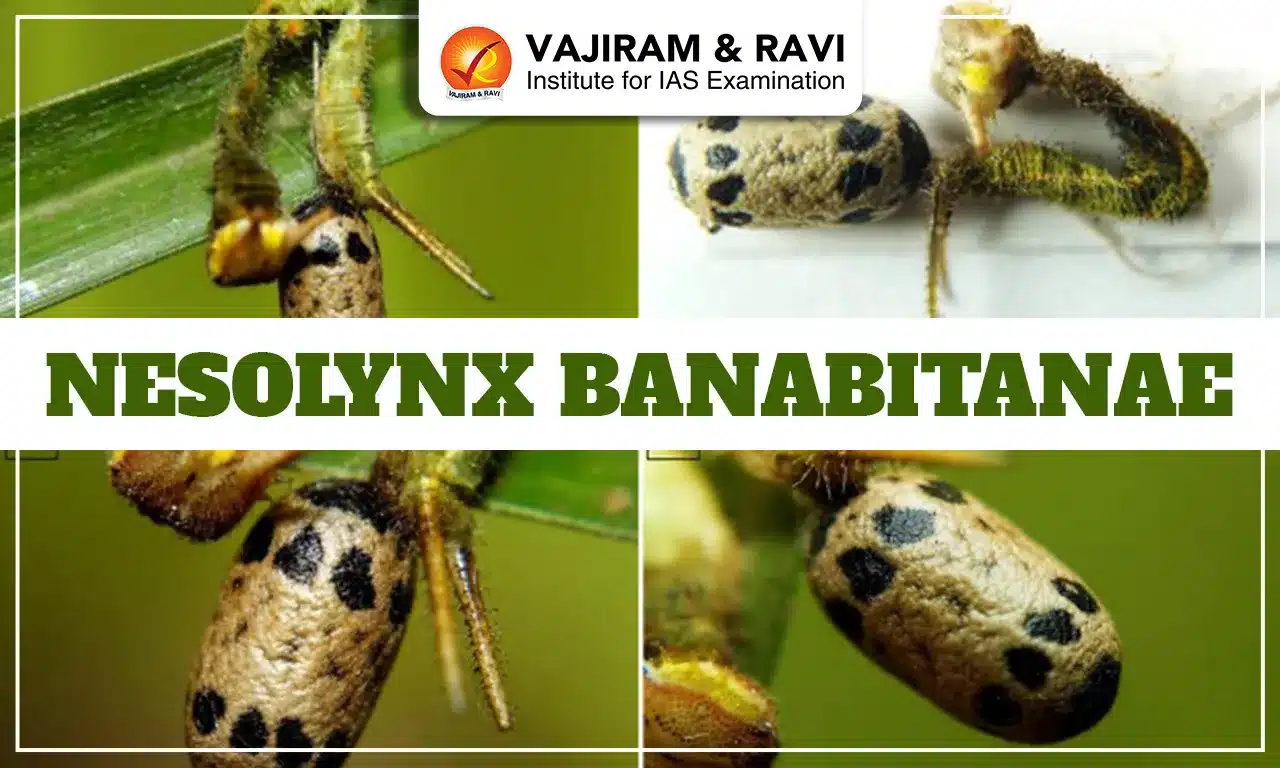
A new species of wasp named Nesolynx banabitanae was recently discovered in Salt Lake, West Bengal.

About Nesolynx Banabitanae

  • It is a new species of wasp.
  • It was found in the lush environs of Central Park, Salt Lake, West Bengal.
  • It was named ‘Nesolynx banabitanae' in honour of Banabitan, the local name for Central Park, where the wasp was first identified. 
  • The discovery marks only the seventh wasp species to be identified in India. 
  • It belongs to the Eulophidae family, a group known for its diverse parasitic behaviours. 
    • This particular species is a hyperparasitoid, meaning it parasitises other parasitoid wasps, adding a complex layer to the ecological interactions within its habitat.
    • The wasp was found to be a hyperparasitoid of the ichneumonid parasitoid Charops aditya, which itself parasitises caterpillars of the common palmfly and Common castor butterflies.

Source: TOI

Nesolynx Banabitanae FAQs

Q1: Nesolynx banabitanae, recently discovered, belongs to which insect group?

Ans: It is a new species of wasp.

Q2: The new wasp species Nesolynx banabitanae was discovered in which Indian state?

Ans: West Bengal

Q3: What type of parasitoid is Nesolynx banabitanae?

Ans: It is a hyperparasitoid, meaning it parasitises other parasitoid wasps.

Nangal Wildlife Sanctuary

Nangal Wildlife Sanctuary

Nangal Wildlife Sanctuary Latest News

About 100 wild boars were found dead in Nangal Wildlife Sanctuary in March this year, and the postmortem report of the dead wild boars indicates that the wild boars might have died due to toxic waste in Nangal Lake, which is part of the sanctuary.

About Nangal Wildlife Sanctuary

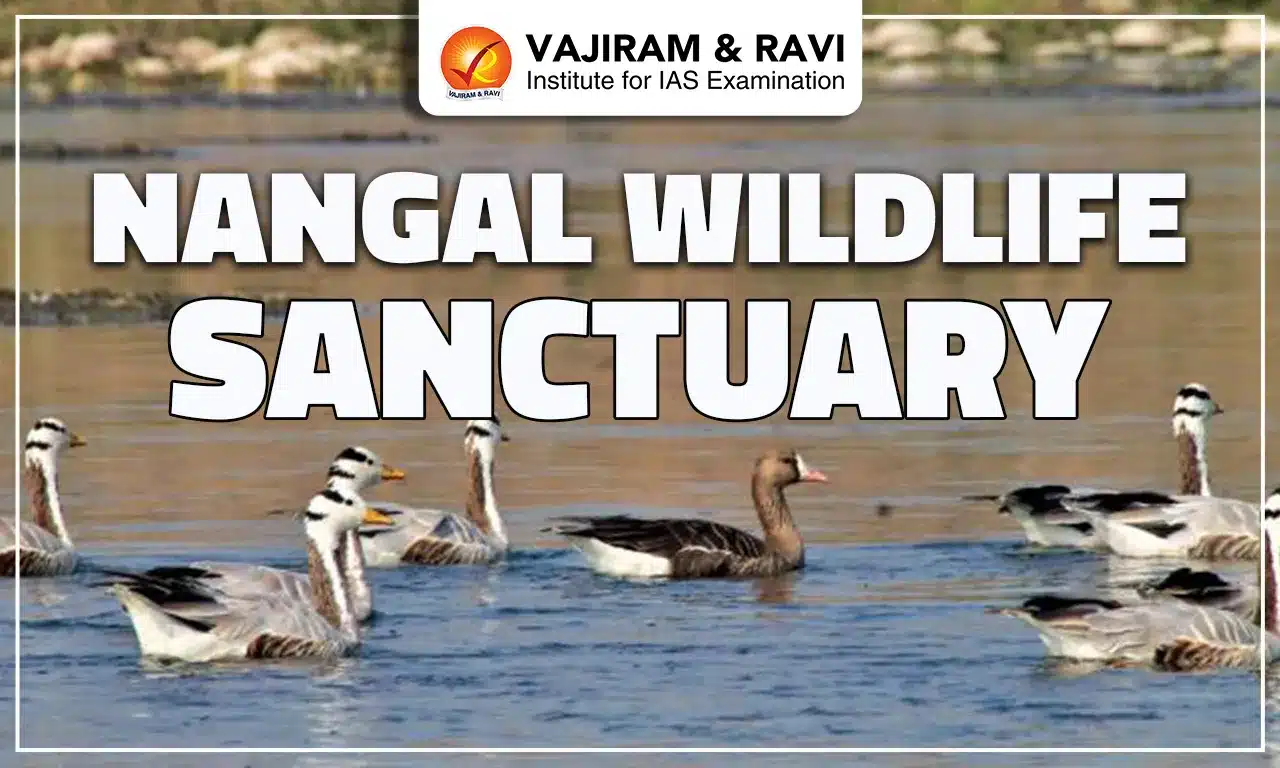
  • It is a protected area located in the foothills of the Shivalik Hills in the Rupnagar district, in the state of Punjab.
  • Established as a sanctuary in 2009, it was designated a Ramsar site in 2019.
  • It spans an area of 116 hectares and forms a part of the larger Nangal Wetland, situated on the banks of the Sutlej River.
  • It occupies a human-made reservoir constructed as part of the Bhakra-Nangal Project in 1961.
  • The site is of historic importance, as the Indian and Chinese Prime Ministers formalized the “Five Principles of Peaceful Coexistence” there in 1954.
  • It supports rich biodiversity, including over 150 bird species and several threatened animals such as the Indian pangolin, Egyptian vulture, and leopards.
  • This sanctuary is a crucial migratory stopover for many bird species, particularly waterfowl.

Source: TRIB

Nangal Wildlife Sanctuary FAQs

Q1: In which state is the Nangal Wildlife Sanctuary located?

Ans: Punjab

Q2: When was the Nangal Wildlife Sanctuary designated as a Ramsar site?

Ans: 2019

Q3: Nangal Wildlife Sanctuary is located on the banks of which river?

Ans: Sutlej River

Q4: The Nangal Wildlife Sanctuary occupies a reservoir created under which project?

Ans: It occupies a human-made reservoir constructed as part of the Bhakra-Nangal Project in 1961.

Indian Air Force Day 2025, Theme, Motto, History, Significance

Indian Air Force Day 2025

The Indian Air Force (IAF) celebrates its 93rd anniversary on 8 October 2025, marking over nine decades of courage, discipline, and technological excellence. Every year, this day honors the brave air warriors who protect India’s skies and ensure the nation’s sovereignty.

Indian Air Force Day 2025, the celebration centers on “Operation Sindoor”, a theme announced by Air Chief Marshal (ACM) A. P. Singh, which highlights India’s growing air power and humanitarian strength across global missions.

Indian Air Force Day 2025

Indian Air Force Day 2025 is celebrated on 8th October, marking the 93rd anniversary of the IAF. The day honors the dedication, courage, and professionalism of air warriors who protect India’s skies. This year, the celebrations focus on Operation Sindoor, highlighting India’s operational reach and humanitarian missions. Air shows, parades, and demonstrations at major air bases showcase the IAF’s modern aircraft, precision, and strategic capabilities. The day inspires pride among citizens and motivates youth to consider a career in the Air Force.

Indian Air Force Day 2025 Overview

Indian Air Force Day 2025 is celebrated on 8th October to honor the establishment of the Indian Air Force (IAF) and its remarkable contribution to safeguarding the nation’s skies.

Indian Air Force Day 2025 Overview
Feature Details

Date

8 October 2025

Purpose / Occasion

Commemoration of IAF personnel & achievements

Type of Events

Air shows, parades, aircraft demonstrations, exhibitions

Intended Audience

Public, youth, veterans, defence watchers

Theme / Emphasis

Modernization, operational readiness, future capability

Core Goals

Honour service, educate the public, inspire youth, showcase strength

Motto of IAF

“Nabhaḥ Spriśaṁ Dīptam” (Touch the Sky with Glory)

Indian Air Force Day 2025 Theme: “Operation Sindoor”

The official theme for Indian Air Force Day 2025 will center around “Operation Sindoor”, as confirmed by Air Chief Marshal A.P. Singh. This operation, which showcased India’s strategic airlift and evacuation capabilities, highlights the IAF’s growing ability to respond swiftly in international crises.

Details:

  • Operation Sindoor demonstrated India’s capability to protect its citizens and interests beyond its borders.
  • The IAF used advanced aircraft like the C-17 Globemaster, C-130J Super Hercules, and Rafale to execute complex missions.
  • The 2025 theme symbolizes strength, precision, global reach, and humanitarian commitment.
  • The focus is also on “Aatmanirbharta” (self-reliance), reflecting the indigenous development of air systems and technology.

Indian Air Force Day 2025 History

The Indian Air Force was officially established on 8 October 1932 as an auxiliary unit of the Royal Air Force. The first squadron became operational on 1 April 1933 with six officers and four Westland Wapiti biplanes.

After independence in 1947, the IAF became a crucial arm of India’s defence, evolving from a small air wing into a modern and powerful aerial force.

Key Historical Milestones:

  • 1932 - Indian Air Force formed.
  • 1947 - IAF participates in Jammu & Kashmir operations post-independence.
  • 1965 & 1971 - Major contributions during Indo-Pak wars; decisive in the 1971 victory.
  • 1999 - Role in Kargil War, showcasing precision air strikes at high altitudes.
  • 2025 - 93rd anniversary marking technological modernization and global outreach.

India Air Force Motto and Emblem

The motto of the Indian Air Force is “Nabhah Spriśam Deeptam” which translates to “Touch the Sky with Glory.” It is derived from the Bhagavad Gita (Chapter 11, Verse 24) and reflects the IAF’s spirit of valor, excellence, and limitless ambition.

The emblem of the Indian Air Force features the Ashoka Chakra at its center, symbolizing righteousness and unity, with wings on either side representing speed, power, and freedom. The national emblem of India (the Lion Capital of Ashoka) sits atop, signifying authority and pride. Together, the motto and emblem embody the IAF’s core values: honor, courage, and dedication to the nation.

Indian Air Force Day 2025 Significance

Indian Air Force Day holds immense national importance as it honors the sacrifices and achievements of the men and women who defend the nation’s airspace. The celebration reaffirms the country’s trust in the IAF’s strength and technological progress.

  • Tribute to Air Warriors: The day honors the courage and sacrifice of officers and personnel who dedicate their lives to national security.
  • Showcase of Power: Grand air displays demonstrate the IAF’s operational strength and technological capabilities.
  • Public Awareness: Citizens witness the power of modern aircraft and appreciate the defence forces’ readiness.
  • National Unity: The event inspires patriotism and unity among Indians.
  • Encouragement to Youth: Motivates young aspirants to join the defence forces and serve the nation.

The Seven Commands of the Indian Air Force

The Indian Air Force operates through seven major commands, each responsible for specific regions or functions. These commands ensure that the IAF can respond swiftly and effectively across India and beyond.

The Seven Commands of the Indian Air Force
Command Headquarters Primary Role

Western Air Command

New Delhi

Air operations in the western sector (Pakistan border)

Eastern Air Command

Shillong

Defence of northeastern India and eastern borders

Central Air Command

Prayagraj

Coordination of central operations and logistics

Southern Air Command

Thiruvananthapuram

Maritime surveillance and coastal air defence

South Western Air Command

Gandhinagar

Defence of Rajasthan and Gujarat sectors

Training Command

Bengaluru

Training of officers, cadets, and airmen

Maintenance Command

Nagpur

Technical maintenance, repair, and logistics of aircraft

Rank Structure in the Indian Air Force

The Indian Air Force (IAF) maintains a well-defined rank structure that ensures discipline, leadership, and a clear chain of command. It is divided into three main categories:

  1. Commissioned Officers (Leadership and Command roles)
  2. Junior Commissioned Officers (JCOs) / Warrant Ranks
  3. Non-Commissioned Officers (NCOs) / Airmen
Rank Structure in the Indian Air Force
Category Rank Description

Commissioned Officers

Marshal of the Air Force

The highest honorary rank, awarded for exceptional service during wartime; equivalent to a five-star rank.

Air Chief Marshal (ACM)

Chief of Air Staff; heads the Indian Air Force and oversees all operations, strategy, and planning.

Air Marshal

Senior Air Officer commanding major commands or serving in senior staff appointments.

Air Vice Marshal

Responsible for significant operational commands, logistics, and training establishments.

Air Commodore

Commands air bases and oversees key administrative or operational functions.

Group Captain

Equivalent to Colonel in the Army; leads flying wings or administrative units.

Wing Commander

Commands flying squadrons and acts as a mid-level operational leader.

Squadron Leader

Supervises flight operations and leads smaller operational units.

Flight Lieutenant

Responsible for executing missions, flight duties, and assisting in command roles.

Flying Officer

The entry-level officer rank after commissioning; undergoes active flying or technical duties.

Junior Commissioned Officers / Warrant Officers

Master Warrant Officer

Senior-most among airmen; assists in training, discipline, and operational management.

Warrant Officer

Acts as a key link between officers and enlisted personnel; ensures discipline and operational readiness.

Non-Commissioned Officers / Airmen

Junior Warrant Officer

Supervises daily technical and maintenance tasks; ensures operational efficiency.

Sergeant

Responsible for team management, equipment handling, and on-field maintenance.

Corporal

Performs specific technical duties and supervises small groups.

Leading Aircraftman

Skilled airman performing trade duties and assisting in technical tasks.

Aircraftman

The lowest rank; undergoes training and assists in basic operations and maintenance work.

How to Join the Indian Air Force?

Joining the Indian Air Force is a matter of pride and ambition for many young Indians. The IAF provides multiple entry routes for different educational levels and career aspirations.

Entry Routes:

  1. After Class 12 (NDA Route): Candidates can appear for the National Defence Academy (NDA) exam conducted by UPSC to join the Air Force as a cadet.
  2. After Graduation (AFCAT): The Air Force Common Admission Test (AFCAT) is the main gateway for graduates to join Flying, Technical, or Ground Duty branches.
  3. Through Technical Entry Schemes: Engineering graduates can apply via the University Entry Scheme (UES) or AFCAT (Technical Branch).

As an Agniveer (Airmen Entry): Candidates can join as Agniveer Vayu under the Agnipath Scheme for technical and non-technical roles.

Indian Air Force Day 2025 FAQs

Q1: When is Indian Air Force Day celebrated?

Ans: Indian Air Force Day is celebrated every year on 8 October to mark the formation of the IAF in 1932.

Q2: What is the theme for Indian Air Force Day 2025?

Ans: The theme is “Operation Sindoor”, announced by Air Chief Marshal A. P. Singh.

Q3: Why is Indian Air Force Day celebrated?

Ans: The day honors the courage, discipline, and achievements of IAF personnel and showcases the force’s strength.

Q4: Who is the current Chief of Air Staff in 2025?

Ans: The Chief of Air Staff is Air Chief Marshal A. P. Singh.

Q5: What is the motto of the Indian Air Force?

Ans: The motto is “Nabhaḥ Spriśaṁ Dīptam” - meaning Touch the Sky with Glory.

Unicorn Company

Unicorn Company

Unicorn Company Latest News

Startups are emerging as the new driving force of India’s defence innovation ecosystem, said Defence Minister recently, while calling upon young entrepreneurs to set new benchmarks and create India’s first defence unicorn.

About Unicorn Company

  • A unicorn company is a privately owned start-up that has been valued at over $1 billion. 
  • It is commonly used in the venture capital industry. The term was first popularized by venture capitalist Aileen Lee in 2013, when she referred to the 39 startups that had a valuation of over $1 billion as unicorns.
  • Key Characteristics of a Unicorn Startup: 
    • Valuation: A billion-dollar valuation or more.    
    • Private Ownership: Not publicly traded on a stock market.    
    • High Growth Potential: Demonstrates rapid growth and innovation.    
    • Disruptive Technology: Often introduces innovative products or services that disrupt existing industries.    
    • Attracts Significant Investment: Secures substantial funding from venture capitalists and other investors. 
  • The valuation of unicorns is not expressly linked to their current financial performance, but largely based on their growth potential as perceived by investors and venture capitalists who have taken part in various funding rounds.
  • Some unicorns choose to go public by launching an initial public offering (IPO); some opt to remain private using their funding rounds to avoid going public; and still others end up getting acquired by bigger companies. 
  • As of July 2025, there are over 1,200 unicorns around the world

What are Gazelles and Cheetahs in the Startup Ecosystem?

  • Gazelle is a startup founded after 2000 with the potential to go unicorn in two years, while “cheetah” may go unicorn in the next four years. 
  • Gazelles have an estimated valuation ranging from $500 million to $1 billion, and the valuation of cheetahs ranges from $200 million to $500 million.

Source: TH

Unicorn Company FAQs

Q1: What is a unicorn company?

Ans: A privately owned startup valued at over $1 billion.

Q2: Who first popularized the term “unicorn” in the startup ecosystem?

Ans: The term was first popularized by venture capitalist Aileen Lee in 2013.

Q3: What is a a “Gazelle” startup?

Ans: Gazelle is a startup founded after 2000 with the potential to go unicorn in two years.

Q4: What is the typical valuation range of a Gazelle startup?

Ans: Gazelles have an estimated valuation ranging from $500 million to $1 billion.

United Nations Educational, Scientific and Cultural Organization (UNESCO)

UNESCO

UNESCO Latest News

Recently, Unesco's executive board has nominated an Egyptian former tourism and antiquities minister, Khaled el-Anani, to be the agency's next director.

About UNESCO

  • The United Nations Educational, Scientific and Cultural Organization (UNESCO) is a specialized agency of the United Nations.
  • Goal: It is dedicated to strengthening our shared humanity through the promotion of education, science, culture, and communication.
  • UNESCO was started in 1945 after World War II. It took over from an older group called the International Committee on Intellectual Cooperation.
  • UNESCO is part of the United Nations Sustainable Development Group.
  • UNESCO focuses on five main areas: Education, Natural sciences, Social and human sciences, Culture, Communication and information.
  • Member countries: UNESCO has 194 member countries and 12 associate members. 
  • Headquarter: Paris, France

Functions of UNESCO

  • It supports member states’ efforts to eliminate illiteracy, encouraging the extension of free education, and acts as a clearinghouse for the exchange of ideas and knowledge. 
  • It also works with many other groups, including non-governmental organizations and private companies.
  • UNESCO designates and maintains a list of World Heritage Sites, which are places of outstanding universal value that deserve protection for future generations.

Source: IE

UNESCO FAQs

Q1: Where is the headquarters of UNESCO located?

Ans: Paris, France.

Q2: What is the World Heritage program of UNESCO?

Ans: A program to protect and preserve cultural and natural heritage sites.

Indian Capital Must Refocus on Domestic Investment

Indian Capital

Indian Capital Latest News

  • Indian private capital is being urged to refocus on domestic investment as experts highlight that sustained economic growth now depends on strengthening internal demand, job creation, and innovation amid rising global uncertainties.

The Evolving Role of Indian Capital

  • Indian private capital has been a cornerstone of the nation’s economic progress, from building industries in the post-independence era to leading the globalisation wave after 1991. 
  • Liberalisation allowed Indian firms to expand abroad, acquire global assets, and compete internationally. However, this global focus must now recalibrate.
  • With rising geopolitical tensions, trade disruptions, and shrinking export demand, global markets are no longer as stable or rewarding as before. 
  • In this context, Indian capital must redirect its focus toward domestic investment to fuel internal growth, create jobs, and sustain India’s ambition of becoming a $10 trillion economy by 2036.

The Need to Refocus on Domestic Investment

  • India’s growth story today is largely being driven by public investment, while private sector capital expenditure remains sluggish
  • The government’s capital outlay rose from Rs. 3.4 lakh crore in FY20 to Rs. 10.2 lakh crore in FY25, growing at an impressive 25% annually. Yet, private investment as a share of GDP has remained stagnant, hovering around 22-23%.
  • Interestingly, Indian corporations have increased their outward foreign direct investment (FDI) at a faster rate, growing by over 12% annually in the last five years, while global FDI has slowed. 
  • This reflects a continued tendency among Indian firms to seek opportunities abroad rather than within India.
  • However, global economic fragmentation, coupled with India’s strong domestic fundamentals, robust infrastructure push, demographic dividend, and policy stability, makes domestic reinvestment a far more viable and strategic option.

Strengthening the Domestic Economic Base

  • Driving Inclusive Growth through Wage Expansion
    • Corporate profits in India are at a 15-year high, yet real wage growth has remained stagnant. This imbalance between profits and wages has constrained household demand, weakening one of the key engines of sustained growth.
    • As per recent estimates, real wages are projected to rise by only 6.5% in FY26, even as productivity and profits climb higher. The growing trend of contractualization in the formal sector further limits wage bargaining power.
    • For India’s growth to be inclusive and self-sustaining, businesses must ensure steady wage growth and job creation, especially in labour-intensive sectors like manufacturing, textiles, and services. 
    • Higher wages expand domestic demand, creating a virtuous cycle of consumption and investment, something India urgently needs amid a slowing global trade environment.
  • Boosting Private Investment and Innovation
    • Private investment has historically been the backbone of India’s industrialisation. However, in recent years, risk aversion, corporate deleveraging, and global uncertainties have led to a cautious investment stance.
    • Yet, the policy environment is now among the most favourable in decades:
    • The corporate tax rate has been reduced to 22% (15% for new manufacturing firms).
    • The Production-Linked Incentive (PLI) scheme covers 14 sectors, offering Rs. 1.97 lakh crore in incentives.
    • Significant improvements have been made in logistics, digital infrastructure, and ease of doing business.
  • Indian firms must seize these conditions to increase domestic capex, not just in core industries but also in emerging sectors such as green energy, semiconductors, electric mobility, and digital technologies.

Strengthening Innovation Ecosystem

  • India’s research and development (R&D) spending remains low at 0.64% of GDP, compared to 2-3% in advanced economies like the U.S., Japan, and South Korea. 
  • The private sector contributes only about 36% of India’s total R&D expenditure, while governments and public institutions account for the rest.
  • In contrast, in developed nations, over 70% of R&D spending is funded by private enterprises. 
  • To remain globally competitive, Indian companies must significantly increase their R&D investments in manufacturing, AI, biotechnology, and green technologies.
  • The success of economies like South Korea and China demonstrates that private innovation, supported by public policy, can transform a developing economy into a high-tech manufacturing hub.

Aligning Private Capital with National Priorities

  • India’s long-term growth will depend on how well private capital aligns with national economic objectives
  • The government has already built the foundation through infrastructure upgrades, fiscal discipline, and investment-friendly reforms. Now, the private sector must:
    • Reinvest domestically in manufacturing and innovation instead of pursuing offshore acquisitions.
    • Partner with public programs like the National Infrastructure Pipeline and green transition initiatives.
    • Support regional development by investing in emerging states and tier-2 cities to decentralise economic growth.
  • Public capital has carried India’s growth momentum so far, but for long-term sustainability, private capital must take the lead. By investing at home, Indian businesses can not only secure better returns but also help strengthen the country’s socio-economic foundation.

The Path Ahead

  • India’s economy is at a crucial inflection point. With steady GDP growth above 7%, strong foreign reserves, and rising infrastructure investment, the country is well-positioned for an economic leap. 
  • However, to maintain this trajectory, domestic private investment must accelerate and complement public spending.
  • Focusing on domestic markets will not only reduce vulnerability to external shocks but also enhance self-reliance, employment, and innovation. 
  • The private sector’s contribution to inclusive, sustainable growth will determine whether India’s economic rise remains resilient in an uncertain global environment.

Source: TH

Indian Capital FAQs

Q1: Why is Indian capital being urged to invest domestically?

Ans: Because global uncertainties and weak export demand make domestic investment vital for sustained economic growth.

Q2: How much of India’s GDP is currently spent on R&D?

Ans: India spends about 0.64% of its GDP on R&D, far below global averages.

Q3: What is the current trend in private sector investment in India?

Ans: Despite high profits, private investment remains subdued, while public investment has grown significantly.

Q4: How can wage growth support India’s economy?

Ans: Higher wages boost domestic consumption, which strengthens internal demand and drives industrial growth.

Q5: What sectors offer high potential for domestic investment?

Ans: Emerging sectors such as green energy, semiconductors, electric mobility, and digital infrastructure hold strong potential.

India–UK Relations Enter a New Growth Phase

India–UK Partnership

India–UK Partnership Latest News

  • British Prime Minister Keir Starmer will visit India for two days — his first official trip since taking office in July 2024
  • He will hold talks with Prime Minister Narendra Modi and attend the Global Fintech Summit in Mumbai.
  • The visit is reciprocal, following Modi’s trip to the UK in July when the two nations signed the India–UK Free Trade Agreement (FTA). 
  • The pact, which enjoys bipartisan support in the UK, reflects the strength and stability of India–UK relations.
  • Starmer and Modi have agreed to work toward the early completion of a mutually beneficial trade agreement, continuing the negotiations initiated under Boris Johnson in 2022.

India–UK: Reliable Partners in an Uncertain World

  • Amid global instability fuelled by US President Donald Trump’s disruptive policies, India and the UK have emerged as reliable, predictable partners
  • Experts note that the FTA is only the foundation of a much deeper partnership.
  • Despite facing political challenges at home, Prime Minister Keir Starmer continues to play an active global role — notably by rallying European and democratic allies, including Australia, Canada, and Japan, to form a Coalition of the Willing after Ukraine’s tense meeting with Trump.
  • This reinforces the UK’s leadership in global diplomacy.

India–UK ‘Living Bridge’ Strengthens Bilateral Partnership

  • The Indian diaspora, making up 2.6% of the UK’s population, plays a vital role in academia, business, politics, and innovation, owning over 65,000 UK-based companies that drive jobs and economic growth. 
  • This dynamic community serves as a “living bridge” connecting the two nations.
  • The India-UK relationship was recently elevated to a new level through two major diplomatic milestones. 
  • In May 2025, the two Prime Ministers announced the conclusion of the India-UK FTA (Free Trade Agreement) and the Double Contribution Convention, a pact aimed at simplifying social security contributions for professionals. 
  • This momentum was solidified in July 2025 during PM Modi's visit to the UK with the formal signing of the Comprehensive Economic and Trade Agreement (CETA), the long-term strategic blueprint Vision 2035 document, and a new Defence Industrial Roadmap
  • The Vision 2035 plan focuses on economic growth, education and skill development, technological innovation, and defence cooperation, charting a comprehensive path for the future of India–UK relations.

Economic Cooperation: Expanding Trade and Job Opportunities

  • The India–UK Free Trade Agreement (FTA) unites the world’s 5th and 6th largest economies, with bilateral trade in goods and services reaching USD 56 billion in 2024. 
    • Trade is projected to double by 2030.
  • The FTA gives Indian businesses better market access in key sectors like textiles, leather, gems and jewellery, etc. while over 650,000 people are employed by Indian and British companies in each other’s countries.
  • The Comprehensive Economic and Trade Agreement (CETA) allows duty-free access to 99% of Indian exports, supporting MSMEs and job creation. 
  • It also promotes growth in IT, finance, education, and professional services, creating high-skill employment.
  • Additionally, the Double Contribution Convention offers a three-year exemption from UK social security for Indian workers on temporary assignments, benefiting over 75,000 professionals and reducing costs for employers.

Defence Cooperation: Strengthening Strategic Collaboration

  • India and the UK have launched a Defence Industrial Roadmap to promote co-design and co-production of defence equipment, addressing growing domestic needs and exploring global export opportunities.
  • A major focus area is the development of jet engine technology. 
  • The partnership also spans joint military exercises, port calls, technological collaboration, exchange of defence experts, training, and defence education, deepening strategic and security cooperation between the two nations.

Education: Building Knowledge and Talent Bridges

  • Education is a key pillar of India–UK relations, with around 170,000 Indian students currently studying in the UK. 
  • Several UK universities, including the University of Southampton, are establishing campuses in India, marking a milestone under the New Education Policy.
  • A 2022 MoU on mutual recognition of academic qualifications ensures that UK degrees are officially recognised in India. 
  • Programmes like the Chevening Scholarships and the Young Professionals Scheme create study-to-work pathways, allowing 3,000 young professionals from each country to live and work in the other for up to two years.

Research and Innovation: Advancing Science and Sustainability Together

  • India and the UK hold a Science and Innovation Council (SIC) meeting every two years to strengthen collaboration in research, technology, and innovation. 
  • The UK is India’s second-largest research partner, with a joint programme worth £300–400 million.
  • A 2023 MoU expanded cooperation in quantum technology, clean energy, pandemic preparedness, and machine learning. 
  • The two nations are also setting up an India–UK Net Zero Innovation Virtual Centre to promote industrial decarbonisation and the use of green hydrogen as a renewable energy source, reinforcing their shared commitment to a sustainable future.

Culture: Strengthening Creative and Cultural Collaboration

  • India and the UK have updated their Film Co-production Framework, enabling producers to access incentives in both markets and boosting jobs in film, VFX, and post-production while helping stories reach global audiences.
  • A new Cultural Agreement promotes the growth of creative industries, supporting festivals, music labels, and artistic projects that create local employment for artists and technicians.

Connectivity: Expanding Links Between India and the UK

  • India and the UK are deepening people-to-people connectivity through improved services and transport links. 
  • New Indian Consulates in Manchester and Belfast now provide passport, OCI, and consular support to Indian communities in Northern England and Northern Ireland, extending access beyond traditional centres like London and Birmingham.
  • Air connectivity has also expanded. IndiGo will launch Delhi–Manchester services from November 15, and Air India continues robust operations connecting multiple Indian cities to London airports.

Source: IE | PIB

India–UK Partnership FAQs

Q1: Why is Keir Starmer visiting India?

Ans: The UK Prime Minister’s visit aims to strengthen bilateral ties, build on the Free Trade Agreement, and advance cooperation in trade, defence, and innovation.

Q2: What is the India–UK Vision 2035?

Ans: Vision 2035 outlines long-term collaboration in economic growth, education, technology, and defence, creating a strategic roadmap for deeper partnership between India and the UK.

Q3: How strong is the India–UK trade relationship?

Ans: Bilateral trade reached USD 56 billion in 2024 and is expected to double by 2030, supported by the Free Trade Agreement and Comprehensive Economic and Trade Agreement.

Q4: What are the key areas of cooperation between India and the UK?

Ans: The partnership spans trade, defence, education, innovation, and culture, with growing collaboration in quantum technology, clean energy, and high-skill workforce development.

Q5: How are India and the UK improving connectivity?

Ans: New Indian consulates in Manchester and Belfast and expanded air routes like Delhi–Manchester flights are enhancing people-to-people and business connectivity.

Nobel Physics 2025: How Quantum Circuits Became Real

Quantum Tunnelling

Nobel Physics 2025 Latest News

  • The 2025 Nobel Prize in Physics went to John Clarke, Michel Devoret, and John Martinis for demonstrating that quantum tunnellingwhere particles cross barriers they shouldn’t be able to — can occur not only in subatomic particles but also in macroscopic superconducting circuits. 
  • Their pioneering work proved that quantum phenomena, once thought to exist only at the atomic and subatomic scale, can also occur in man-made electrical circuits visible to the naked eye. 
  • It paved the way for technologies that could transform computing, sensing, and communication.

Quantum Tunnelling and Energy Quantisation Made Visible

  • The Nobel laureates — John Clarke, Michel Devoret, and John Martinis — demonstrated two of quantum physics’ defining principles, tunnelling and energy quantisation, in a macroscopic electric circuit.

The Josephson Junction: Heart of the Discovery

  • At the core of their experiments lies the Josephson junction, a device where two superconductors are separated by a thin insulating barrier
  • The researchers asked whether the phase difference — a measurable electrical property — across this junction could behave like a single quantum particle.
  • By sending current through the circuit, they observed that when it was small, electrons (in Cooper pairs) were trapped, producing no voltage. 
    • Cooper pairs are pairs of electrons bound together by an attractive force, mediated by lattice vibrations called phonons, that occurs at low temperatures in superconducting materials. 
    • These pairs, which have opposite spins and total zero spin, behave as a single quantum unit called a boson and can flow through the material without resistance, enabling superconductivity. 
  • But sometimes, the current “tunnelled” through the barrier, suddenly flowing freely and generating a measurable voltage. 
  • This confirmed macroscopic quantum tunnelling — a quantum leap happening in an entire electrical circuit.

Solving the Fragility Problem

  • Early efforts to detect quantum tunnelling failed because of environmental noise and microwave interference. 
  • The Berkeley team, led by Clarke, solved this by using special filters, shielding, and ultra-cold, stable setups to isolate the circuit.
  • When cooled to near absolute zero, the system behaved exactly as quantum theory predicted — the rate of tunnelling became independent of temperature, confirming it wasn’t due to thermal noise but a true quantum process.

Revealing Quantum Energy Levels

  • The team then looked for quantised energy states, a hallmark of quantum behaviour. 
  • By shining microwaves of varying frequencies on the junction, they saw that when the frequency matched the energy gap between two levels, the circuit “escaped” more easily from its trapped state.
  • This showed that the circuit absorbed and emitted discrete packets of energy, behaving like a macroscopic atom
  • For the first time, scientists saw quantum behaviour in a system visible to the naked eye.

Blueprint for Quantum Control

  • These experiments proved two key ideas:
    • Macroscopic electrical circuits can exhibit quantum properties when isolated from noise.
    • Their behaviour can be described using standard quantum mechanics.
  • The work also established methods for controlling and reading macroscopic quantum states using bias currents and microwaves — techniques that became the foundation for superconducting qubits and quantum measurement systems.

Bridging the Quantum and the Everyday World

  • For years, scientists questioned how large a system could be and still exhibit quantum effects. Normally, quantum behaviour disappears when many particles interact. 
  • But the Nobel laureates — John Clarke, Michel Devoret, and John Martinis — proved that with superconducting materials, extreme cooling, and precision engineering, even a visible electronic chip can display clear quantum phenomena.

Applications: From Quantum Chips to Sensors

  • The laureates’ findings underpin many modern quantum technologies:
    • Superconducting qubits: Circuits that act like artificial atoms and are the basis of quantum computers by Google, IBM, and others.
    • Quantum sensors: Devices capable of detecting tiny magnetic fields or gravitational variations, useful in medical diagnostics and geophysical exploration.
    • Quantum amplifiers: Boost faint signals without adding noise, vital for space exploration and dark matter detection.
    • Metrology: Josephson junctions now define electrical standards like the volt and ampere with quantum-level precision.
    • Microwave-to-optical converters: Link quantum processors to optical fibre networks for quantum communication.

Turning Fragility into Functionality

  • Ultimately, these devices are powerful because even minute external changes cause large, measurable shifts in the circuit’s quantum state. 
  • The laureates’ work transformed this sensitivity — once a limitation — into a defining feature, creating tools that bridge quantum theory and real-world technology.

Source: IE | TH | IE

Nobel Physics 2025 FAQs

Q1: Who won the 2025 Nobel Prize in Physics?

Ans: John Clarke, Michel Devoret, and John Martinis won for demonstrating quantum tunnelling and energy quantisation in superconducting circuits visible to the naked eye.

Q2: What is quantum tunnelling?

Ans: Quantum tunnelling is when particles cross barriers they lack the energy to climb — a key quantum effect observed by the laureates in superconducting circuits.

Q3: What role does a Josephson junction play?

Ans: A Josephson junction, two superconductors separated by a thin insulator, enables electron pairs (Cooper pairs) to tunnel across, exhibiting macroscopic quantum behaviour.

Q4: Why is this discovery important?

Ans: Their experiments proved that large, man-made circuits can display quantum properties, linking microscopic quantum theory to macroscopic technology like quantum computers and sensors.

Q5: What technologies emerged from their work?

Ans: Their discoveries power superconducting qubits, quantum sensors, amplifiers, and metrology tools, forming the foundation of modern quantum computing and precision measurement systems.

Daily Editorial Analysis 8 October 2025

Daily Editorial Analysis

A Path to Progress That is Paved with Gold

Context

  • Atmanirbharta, or self-reliance, has long been a cornerstone of India’s national philosophy, transcending economic strategy to embody a deeper sense of identity and resilience.
  • From the earliest decades after independence to the present era of global uncertainty, India’s progress has been shaped by its capacity to draw strength from within.
  • Under Prime Minister Narendra Modi, this vision has been revitalised as a defining principle of governance, guiding the nation toward greater independence across multiple sectors.
  • Yet, as the global economic landscape evolves, India now faces a new frontier in its self-reliance journey: achieving financial independence by mobilising its own wealth to sustain its growth.

Historical Foundations of Self-Reliance and The New Frontier

  • Historical Foundations of Self-Reliance

    • The pursuit of Atmanirbharta has repeatedly enabled India to transform crises into capabilities.
    • The Green Revolution of the 1960s secured food independence amid famine. The liberalisation and technological foresight of the 1990s positioned India as a global leader in information technology.
    • More recently, during the COVID-19 pandemic, India demonstrated scientific and manufacturing self-reliance through the rapid development of indigenous vaccines.
    • Each episode underscores a recurring truth, that India’s greatest leaps have occurred when it turned inward for solutions.
    • Self-reliance has been not an isolationist impulse but a dynamic, adaptive strategy that converts adversity into advancement.
  • The New Frontier: Financial Self-Reliance

    • Today, the challenge lies not in food or technology but in finance.
    • Since 2000, India has attracted over a trillion dollars in foreign direct investment, a testament to global confidence in its economy.
    • However, shifting global conditions, declining investment flows, rising costs of capital, and geopolitical fragmentation, have exposed the vulnerability of relying on external funds.
    • As the world retreats from globalisation, India must cultivate a financial model rooted in domestic strength.
    • This entails harnessing the wealth already held within the nation, enabling Bharat to fund Bharat.

Gold: A Hidden Reservoir of National Wealth

  • Among India’s untapped resources, gold stands out as both a cultural and economic powerhouse.
  • Indian households collectively own approximately 25,000 tonnes of gold, a reserve valued at $2.4 trillion, surpassing half of the nation’s GDP.
  • Despite this abundance, India continues to import nearly 87% of its gold demand, making the metal a persistent contributor to the trade deficit.
  • This paradox reflects an opportunity: to convert dormant household assets into active financial capital.
  • However, any effort to monetise gold must respect its deep cultural roots.
  • Coercive measures would undermine trust; instead, a voluntary, transparent, and technology-driven approach is essential.
  • By drawing from international best practices, investing in assaying infrastructure, developing gold-based financial products, and digitising transactions, India can successfully integrate private gold reserves into the formal economy.

The Pathway to Gold Monetisation

  • Infrastructure: expanding hallmarking and purity-testing centres to ensure credibility and accessibility across India.
  • Logistics: nurturing partnerships between banks and certified collection centres to manage the physical and financial flows of gold securely.
  • Digitalisation: enabling citizens to monitor their metal balances through user-friendly platforms, thereby enhancing transparency.
  • Above all, trust is the cornerstone. Policies must eliminate bureaucratic frictions, such as unnecessary taxes and customs scrutiny, and guarantee straightforward returns to depositors.
  • If executed effectively, the cost of funds raised through gold monetisation could be lower than international borrowing rates, providing a sustainable, domestic source of capital for national development.

Conclusion

  • India’s journey toward Atmanirbharta has always been marked by the transformation of challenges into triumphs.
  • By developing trust, innovation, and collective participation, India can build an economy that not only grows but does so on its own terms.
  • The vision of an Atmanirbhar Bharat is thus both pragmatic and profound: a nation confident enough to fund its future from the wealth of its own people.

A Path to Progress That is Paved with Gold

Q1. What is the central theme of the passage?
Ans. The central theme is Atmanirbharta, or self-reliance, as both a guiding philosophy and a practical strategy for India’s economic and financial independence.

Q2. How has India historically demonstrated self-reliance?
Ans. India has shown self-reliance by achieving food security during the Green Revolution, technological strength in the IT era, and vaccine independence during the COVID-19 pandemic.

Q3. Why is financial self-reliance important for India today?
Ans. Financial self-reliance is important because global investment flows are shrinking, and India must reduce its dependence on volatile foreign capital to sustain long-term growth.

Q4. What opportunity does India’s household gold reserve present?
Ans. India’s large household gold reserve, valued at about $2.4 trillion, offers a chance to mobilise domestic wealth and fund national development from within.

Q5. What are the key requirements for a successful gold monetisation scheme?
Ans. A successful gold monetisation scheme requires strong infrastructure, efficient logistics, digital transparency, and public trust supported by simple, fair policies.

Source: The Hindu

Daily Editorial Analysis 8 October 2025 FAQs

Q1: What is editorial analysis?

Ans: Editorial analysis is the critical examination and interpretation of newspaper editorials to extract key insights, arguments, and perspectives relevant to UPSC preparation.

Q2: What is an editorial analyst?

Ans: An editorial analyst is someone who studies and breaks down editorials to highlight their relevance, structure, and usefulness for competitive exams like the UPSC.

Q3: What is an editorial for UPSC?

Ans: For UPSC, an editorial refers to opinion-based articles in reputed newspapers that provide analysis on current affairs, governance, policy, and socio-economic issues.

Q4: What are the sources of UPSC Editorial Analysis?

Ans: Key sources include editorials from The Hindu and Indian Express.

Q5: Can Editorial Analysis help in Mains Answer Writing?

Ans: Yes, editorial analysis enhances content quality, analytical depth, and structure in Mains answer writing.

Supermoon

Supermoon

Supermoon Latest News

Recently, a rare celestial supermoon illuminated the skyline around the world.

About Supermoon

  • A supermoon occurs when a full moon or new moon coincides with the perigee or moon’s closest approach to the earth in its elliptical orbit.
  • Because the moon’s orbit is not a perfect circle, its distance from the earth varies throughout the month by around 50,000 km.
  • When the moon is near its perigee and also directly opposite the sun, the full moon appears about 14% larger and 30% brighter than when it is at its farthest point.
  • The term “Supermoon” was coined by astrologer Richard Nolle in 1979, defining it as a special event when a full moon is within 90 percent of its closest point to Earth.
  • Impact of Supermoon
    • Supermoons influence the tides, creating perigean spring tides.
    • These tides are slightly higher and lower than usual because the moon’s stronger gravitational pull acts in concert with that of the sun.
    • These changes are typically modest, they can exacerbate coastal flooding when combined with storm surges.

Source: TH

Supermoon FAQs

Q1: What is the effect of a Supermoon on Earth's tides?

Ans: Supermoons can cause higher-than-usual tides due to the moon's closer proximity to Earth [5].

Q2: Can a Supermoon occur multiple times in a year?

Ans: Yes, it can occur multiple times in a year.

Enquire Now