Mount Logan, Location, Map, Height, Peaks, Features

Mount Logan

Mount Logan is the Highest Mountain Peak in Canada and the Second Highest Peak in North America, after Denali (formerly known as Mount McKinley) in Alaska. It dominates the Saint Elias Mountains of southwestern Yukon. The mountain lies within Kluane National Park and Reserve which is a vast protected wilderness close to the Yukon-Alaska border. It was named after Sir William Edmond Logan who was the founder of the Geological Survey of Canada. Mount Logan is globally significant for its immense size, extreme climate and scientific value in geology, glaciology and high altitude research.

Mount Logan

Mount Logan is one of the most massive non volcanic mountains on Earth. It forms a vast massif containing eleven peaks above 5,000 metres and ranks as the sixth most topographically prominent mountain worldwide. Due to ongoing tectonic uplift, the mountain continues to rise at about 0.35 millimetres annually. Mount Logan feeds major glaciers, including the Hubbard and Logan glaciers which makes it central to the Saint Elias Icefields.

Read about: Highest Peak in India

Mount Logan Features

Mount Logan is characterised by extreme elevation, harsh climate, massive glaciation, geological importance and a long history of exploration and scientific study as highlighted below:

  • Location: Mount Logan is located in southwestern Yukon within Kluane National Park and Reserve, less than 40 kilometres north of the Yukon-Alaska border, forming a central feature of the rugged Saint Elias Mountains and vast icefields.
  • Height: Its precise height was confirmed in 1992 using GPS by a Geological Survey of Canada expedition to be 5,959 metres tall.
  • Elevation: Active tectonic forces continue to raise its elevation at approximately 0.35 millimetres per year.
  • Massif: The Mount Logan massif includes eleven peaks exceeding 5,000 metres and spread across a massive plateau nearly 19 kilometres long.
  • Peaks: Major Peaks include Philippe Peak, Logan East Peak and Prospector Peak, etc.
  • Base: Mount Logan has the largest base circumference of any non volcanic mountain on Earth. 
  • Prominence: It has a topographic prominence of about 5,250 metres, ranking sixth globally in prominence.
  • Climatic Conditions: Temperatures on the 5,000 metre plateau average around -27°C annually. The temperature usually drops to -45°C in winter and summer temperatures rarely exceed freezing levels.
  • Ice Cap and Glaciation: Extremely low temperatures cause minimal snowmelt, resulting in an ice cap up to 300 metres thick that feeds major glaciers like the Hubbard and Logan Glaciers.
  • Geological Composition: The mountain is largely composed of granodiorite, an intrusive igneous rock, indicating deep crustal geological processes linked to the tectonic collision along the Pacific margin.
  • Discovery: American geologist Israel C. Russell first reported Mount Logan in 1890 and named it after Sir William Edmond Logan, a pioneer of Canadian geological science.
  • First Ascent: The first successful ascent occurred on June 23, 1925, led by Albert H. MacCarthy with an international team, after a 65 day expedition involving extreme cold and severe frostbite.
  • Scientific Research: High altitude medical, meteorological and glaciological research has been conducted on Mount Logan, including long term physiology studies supported by Canadian and American scientific institutions.
  • Climbing Regulations: Due to high rescue costs, Parks Canada banned solo and winter climbs in 2020 and made rescue insurance mandatory, following multiple expensive rescue missions.

Mount Logan FAQs

Q1: Where is Mount Logan located?

Ans: Mount Logan is located in southwestern Yukon, Canada, within Kluane National Park and Reserve, near the Yukon-Alaska border.

Q2: What is the height of Mount Logan?

Ans: Mount Logan has an officially measured height of 5,959 metres, confirmed using GPS technology in 1992.

Q3: Mount Logan was named after whom?

Ans: The mountain was named after Sir William Edmond Logan, founder of the Geological Survey of Canada.

Q4: How many major Peaks are part of the Mount Logan Massif?

Ans: The Mount Logan massif includes 11 major peaks above 5,000 metres which forms one of the largest mountain complexes in North America.

Q5: Which glaciers originate from Mount Logan?

Ans: Mount Logan is the source of major glaciers such as the Hubbard Glacier and the Logan Glacier which are part of the Saint Elias Icefields.

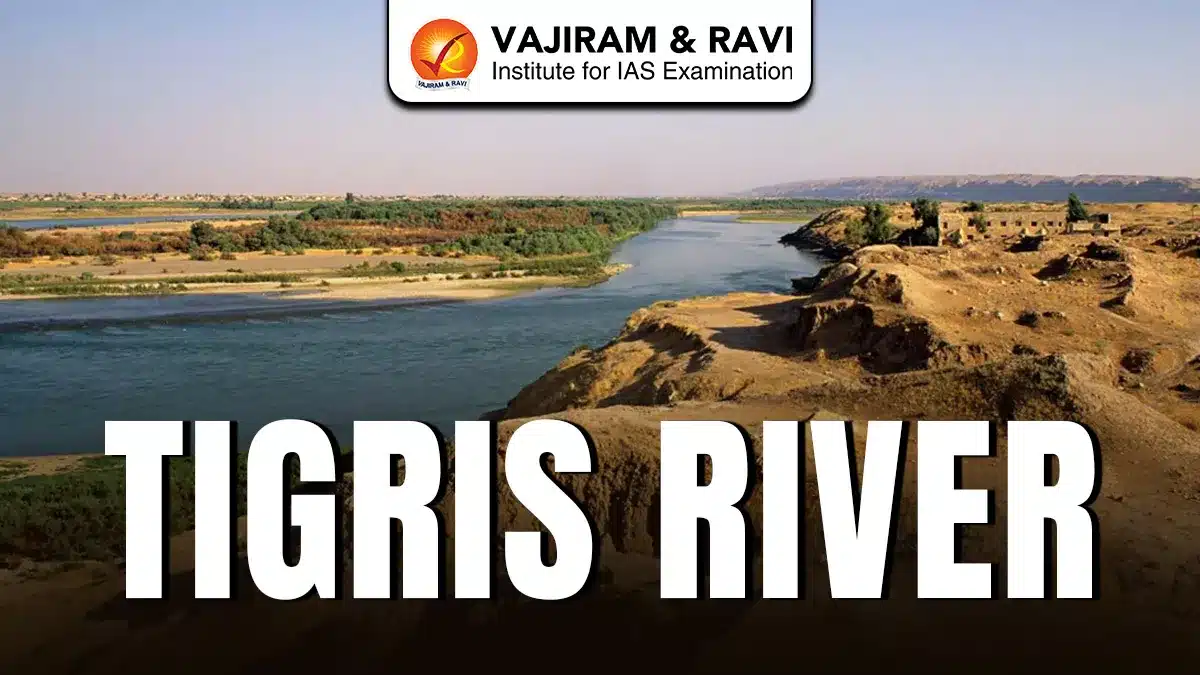
Tigris River, Origin, Course, Countries, Tributaries, Features

Tigris River

The Tigris River is one of the most historically important rivers of Western Asia and a central pillar of the ancient Fertile Crescent. It sustained early agriculture, urban growth and political power in Mesopotamia. Along with the Euphrates, it shaped the rise of Sumerian, Assyrian and later Islamic civilizations by providing water, transport routes and fertile alluvial land. Even today, the Tigris remains vital for drinking water, irrigation, hydropower and cultural identity across multiple urban states.

Tigris River

The Tigris River is the eastern river of Mesopotamia and is about 1,750 kilometers long, making it the second largest river in Western Asia. It rises near Lake Hazar in the Taurus Mountains of southeastern Türkiye (earlier Turkey). It flows southeast through Türkiye and Iraq while briefly touching Syria. The river passes through cities like Mosul, Tikrit, Samarra, Baghdad, and eventually joins the Euphrates near al-Qurnah to form the Shatt al-Arab, which drains into the Persian Gulf.

Also Read: Phalgu River

Tigris River Features

The Tigris River displays unique geographical, historical and cultural characteristics that distinguish it from other major river systems of the region. The key features of this river are highlighted below:

  • Etymology: The name Tigris comes from Sumerian “Idigna,” meaning “swift river,” later adopted into Akkadian as Idiqlat and Old Persian as Tigrā, reflecting its faster flow compared to the Euphrates.
  • Origin: The river originates from the Taurus Mountains of Türkiye.
  • Course and Countries: The river flows around 400 kilometers in Türkiye. It briefly marks the Syria-Türkiye border and then crosses Iraq where more than half of its length lies.
  • Tributaries: Important tributaries include the Greater Zab, Lesser Zab, Diyala, Al-Adhaim and Karkheh rivers, which significantly increase its discharge and support agriculture in northern and central Iraq.
  • Ancient Civilizations: The Tigris supported Assyrian cities such as Nineveh and Ctesiphon, enabling irrigation-based farming, administrative systems and monumental architecture, including reliefs of rulers like Tiglath-Pileser carved along its banks.
  • Cultural Role: The river holds spiritual importance for communities like the Mandaeans, who require naturally flowing water for baptism rituals, linking the river directly to living religious traditions.
  • Urban Importance: Baghdad, the capital of Iraq, is developed on the banks of the Tigris. Ancient Canal Systems around 2900 BCE carried its water to cities like Lagash for large scale irrigation.
  • Water Management and Dams: The river is heavily dammed, including the Mosul Dam, Iraq’s largest, built for flood control, irrigation and power generation, but also raising safety and maintenance concerns.
  • Challenges: Climate change, upstream dam construction, pollution and political tensions have reduced water flow, threatening ecosystems, agriculture and cities, prompting regional cooperation efforts like the Geneva Consensus on river data sharing.

Also Read: Bharathapuzha River

Tigris River FAQs

Q1: Which countries does the Tigris River flow through?

Ans: The Tigris flows through Türkiye and Iraq and briefly forms part of the Syria-Türkiye border before entering Iraq.

Q2: Where does the Tigris River originate?

Ans: It originates near Lake Hazar in the Taurus Mountains of southeastern Türkiye (Turkey).

Q3: Which major cities are located on the banks of the Tigris River?

Ans: Important cities include Mosul, Tikrit, Samarra and Baghdad are located at the bank of Tigris River.

Q4: What are the major tributaries of Tigris River?

Ans: Key tributaries are the Greater Zab, Lesser Zab, Diyala, Al-Adhaim and Karkheh rivers.

Q5: What is the historical significance of the Tigris River?

Ans: It supported ancient Mesopotamian civilizations by providing water for agriculture, transport and early urban development.

UPSC Daily Quiz 6 February 2026

UPSC-Daily-Quiz

[WpProQuiz 85]

UPSC Daily Quiz FAQs

Q1: What is the Daily UPSC Quiz?

Ans: The Daily UPSC Quiz is a set of practice questions based on current affairs, static subjects, and PYQs that help aspirants enhance retention and test conceptual clarity regularly.

Q2: How is the Daily Quiz useful for UPSC preparation?

Ans: Daily quizzes support learning, help in revision, improve time management, and boost accuracy for both UPSC Prelims and Mains through consistent practice.

Q3: Are the quiz questions based on the UPSC syllabus?

Ans: Yes, all questions are aligned with the UPSC Syllabus 2025, covering key areas like Polity, Economy, Environment, History, Geography, and Current Affairs.

Q4: Are solutions and explanations provided with the quiz?

Ans: Yes, each quiz includes detailed explanations and source references to enhance conceptual understanding and enable self-assessment.

Q5: Is the Daily UPSC Quiz suitable for both Prelims and Mains?

Ans: Primarily focused on Prelims (MCQ format), but it also indirectly helps in Mains by strengthening subject knowledge and factual clarity.

Retreating Monsoon, About, Features, Impact, Significance

Retreating Monsoon

The Retreating Monsoon is the period when the monsoon winds start moving back from India. It generally occurs from October to November and brings less rainfall, with clear skies in many places. This season mainly affects the eastern and southern parts of India.

About Retreating Monsoon

  • When the Southwest Monsoon ends, the Northeast Monsoon starts around October.
  • It is also called the Retreating Monsoon because the monsoon winds begin to move back from India.
  • During this time, the land cools faster than the sea, creating high pressure over land and low pressure over the sea.
  • Due to this pressure change, winds change their direction and start blowing from land to sea.
  • These winds pass over the Bay of Bengal, collect moisture, and bring rain to Tamil Nadu, south Andhra Pradesh and parts of Sri Lanka.
  • This rainfall is very important because these areas receive little rain during the Southwest Monsoon and depend on this season for water and farming.

Retreating Monsoon’s Features

  • Time and Season
    • The Northeast Monsoon occurs from October to December.
    • It happens after the Southwest Monsoon and marks the beginning of winter.
  •  Wind Pattern
    • During this season, winds blow from the northeast towards India.
    • These winds are different from the southwest winds of the earlier monsoon.
  • Areas of Rainfall
    • Rainfall mainly occurs along the southeastern coast of India.
    • Tamil Nadu and parts of Andhra Pradesh receive most of the rain.
  •  Nature of Rainfall
    • The rainfall is generally less widespread than the Southwest Monsoon.
    • However, the rain can be heavy in some areas.
  •  Effect on Climate
    • The weather becomes cooler and more pleasant after the hot summer.
    • This season helps reduce heat and humidity.
  • Importance for Water and Agriculture
    • It helps in refilling lakes, tanks and reservoirs.
    • It is very important for farming in regions that get little rain earlier.
  • Uneven Rainfall
    • Some regions receive good rainfall, while nearby areas may remain dry.
    • The amount of rain can change from year to year.

Temperature during Retreating Monsoon

  • As the monsoon winds withdraw, clouds slowly disappear and the sky becomes clear.
  • Because of clear skies, the day temperature begins to fall compared to the rainy season.
  • Nights become cooler, while days can still be warm.
  • Due to the absence of the clouds, the difference between day and night temperature increases.
  • Overall, the weather becomes dry, pleasant and cooler, especially in northern and central India.

Pressure and Winds during the Retreating Monsoon

  • When the monsoon starts withdrawing, the monsoon trough becomes weak and slowly moves towards the south.
  • The difference in air pressure is small, so strong winds are not formed.
  • The beginning of the Northeast Monsoon is not sudden or very clear, unlike the Southwest Monsoon.
  • During this season, winds do not follow any fixed pattern over the whole country.
  • In many places, local pressure conditions decide the wind direction, making the weather calm and dry in most regions.

Precipitation during the Retreating Monsoon

  • After the Southwest Monsoon ends, most parts of India become dry as the humidity and clouds reduce.
  • Tamil Nadu and southern parts of Andhra Pradesh receive most of their rain during this season, making it their main rainy period.
  • Kerala also gets a small secondary rainfall in October-November.
  • The northeast winds pass over the Bay of Bengal, pick up moisture and bring rain to the southeastern coast.
  • Some parts of northeastern India like Assam, Meghalaya, Mizoram, Arunachal Pradesh and Tripura also receive rain.
  • Other areas like the eastern slopes of Western Ghats, northern plains, Odisha, Madhya Pradesh, Andhra Pradesh and Tamil Nadu get rainfall due to this monsoon.
  • Overall, the retreating monsoon replenishes water in regions that get little rain during the Southwest Monsoon and is important for agriculture and water supply.

Cyclone during the Retreating Monsoon

  • During the Retreating Monsoon, tropical cyclones are common, especially in the Bay of Bengal.
  • The most active months for cyclones are October and the first half of November.
  • Usually the cyclones are formed between 8°N and 14°N in the Bay of Bengal and move west or northwest at first, but many later curve northeast.
  • About half of these cyclones hit the eastern coast of India, affecting Tamil Nadu, Andhra Pradesh, Odisha and West Bengal.
  • Some cyclones move across the southern peninsula into the Arabian Sea, where they may weaken first but then gain strength again.
  • Cyclones from the Arabian Sea form slightly northward and mostly move away from the coast, but a few strike Maharashtra or Gujarat.
  • These storms often bring heavy rainfall and can cause serious damage to life, property and agriculture, especially in river deltas like Godavari, Krishna and Kaveri.
  • In northern India, the retreating monsoon season also sees Western Disturbances, which bring cloudy weather, light rain or snow in higher areas like Jammu & Kashmir, Himachal Pradesh and Kumaon Hills.

Impact of the Retreating Monsoon

  • The Retreating Monsoon brings rainfall to southern and eastern India, especially Tamil Nadu, Andhra Pradesh and Kerala, which is very important for farming and crops.
  • It helps fill rivers, lakes, tanks and reservoirs, providing water for irrigation, drinking, and daily needs.
  • The rainfall reduces the heat left after summer, making the weather cooler and more comfortable.
  • Farmers can grow crops like rice, pulses, and sugarcane because of this season.
  • Cyclones sometimes hit the eastern and southern coasts, bringing heavy rain, strong winds and occasional damage to houses, roads, and crops.
  • It helps maintain soil moisture, supports vegetation growth and is important for the regional climate balance.
  • In northern India, lighter rains or snow from Western Disturbances also improve water availability and prevent dry conditions.

October Heat

  • October and November mark the transition from the rainy Southwest Monsoon to the dry winter season.
  • During this time, the monsoon withdraws, skies become clear and daytime temperatures rise.
  • Nights remain cool and comfortable, but the days can feel hot and humid.
  • Since the land is still wet from the monsoon, the combination of heat and moisture makes the weather feel oppressive during the day.
  • This hot and sticky period in October is commonly called “October Heat” and is noticeable especially in northern and central India.

Retreating Monsoon Significance

  • The Retreating Monsoon brings rainfall to regions like Tamil Nadu and Andhra Pradesh  which get less rain during the Southwest Monsoon.
  • It fills rivers, lakes, tanks and reservoirs, ensuring water for drinking, irrigation and farming.
  • The rain supports the growth of winter crops (rabi crops) and helps farmers with agriculture and food production.
  • It cools down the hot weather after summer, making the climate more pleasant.
  • It helps to maintain soil moisture and vegetation, keeping the environment healthy.

It is important for regional climate balance and also affects water availability in both southern and eastern India.

Retreating Monsoon FAQs

Q1: What is a Retreating Monsoon?

Ans: The Retreating Monsoon, which is also called the North-East Monsoon occurs when the Monsoon winds start withdrawing from India, usually during the period of October to December.

Q2: Why is it called a North-East Monsoon?

Ans: It is called the North-East Monsoon because the direction of the winds is from North-east to India.

Q3: Which area gets the Maximum rain during the retreating monsoon?

Ans: The Retreating Monsoon brings rainfall to southern and eastern India, especially Tamil Nadu, Andhra Pradesh and Kerala.

Q4: What is “October Heat”?

Ans: In October, after the monsoon withdraws, the weather can feel hot and sticky because the land is still wet and the sun is strong. This period is called October Heat.

Q5: How does the retreating monsoon affect agriculture?

Ans: It fills rivers, tanks, and reservoirs, provides water for irrigation, and supports winter crops (rabi crops).

SPHEREx Mission

SPHEREx Mission

SPHEREx Mission Latest News

NASA’s SPHEREx mission turned its infrared gaze on interstellar comet 3I/ATLAS recently, adding to the deep pool of information the agency has gathered on what is only the third such object to be discovered passing through our solar system.

About SPHEREx Mission

  • It is a NASA Astrophysics mission launched on March 11, 2025.
  • The Spectro-Photometer for the History of the Universe, Epoch of Reionization and Ices Explorer (SPHEREx) telescope is a megaphone-shaped telescope.
  • It will provide an all-sky spectral survey. 
  • It will survey the sky in optical as well as near-infrared light, which, though not visible to the human eye, serves as a powerful tool for answering cosmic questions.
  • Over a two-year planned mission, the SPHEREx Observatory will collect data on more than 450 million galaxies along with more than 100 million stars in the Milky Way in order to explore the origins of the universe.
  • With this capability, SPHEREx will produce a three-dimensional map of the universe unlike any other. 
  • Scientists will use this map to answer big questions about the early universe, the history of galaxies, and the prevalence of life-sustaining molecules in planet-forming regions of space.
  • It also will identify targets for more detailed study by future missions, such as NASA's James Webb Space Telescope and Wide Field Infrared Survey Telescope.

Source: SCN

SPHEREx Mission FAQs

Q1: What is the SPHEREx Mission?

Ans: SPHEREx is a NASA Astrophysics mission.

Q2: When was the SPHEREx Mission launched?

Ans: It was launched on March 11, 2025.

Q3: What kind of survey will SPHEREx conduct?

Ans: It will provide an all-sky spectral survey.

Q4: How long is the planned mission duration of SPHEREx?

Ans: The planned mission duration is two years.

Q5: What major cosmic questions will scientists address using the SPHEREx map?

Ans: Questions about the early universe, galaxy history, and life-sustaining molecules in planet-forming regions.

Michelangelo

Michelangelo

Michelangelo Latest News

A foot sketch by Michelangelo was recently sold for £16.9 million, exceeding expectations.

About Michelangelo

  • Michelangelo (1475 - 1564) was an Italian Renaissance sculptor, painter, architect, and poet. 
  • He is recognized as one of the most creative and influential artists in the history of Western art.
  • He was active mainly in Florence and Rome, two major cultural and political centers in fifteenth- and sixteenth-century Europe. 
  • He received the support of important patrons, including members of the ruling Medici family of Florence and, for a crucial decade, the leader of the Roman Catholic Church, Julius II. 
  • His creations were revered and coveted particularly for their ingenious compositions and their powerful representation of the muscular human body.
  • Michelangelo worked in marble sculpture all his life and in the other arts only during certain periods.
  • His most celebrated creations have become icons of world culture: the monumental marble David in Florence; the Sistine Chapel ceiling; and the soaring dome of Saint Peter’s Basilica, both in Rome.
  • In addition to his visual art, he engaged in poetry and architectural projects, shaping the cultural fabric of Rome.

Source: MINT

Michelangelo FAQs

Q1: Who was Michelangelo?

Ans: Michelangelo was an Italian Renaissance sculptor, painter, architect, and poet.

Q2: When did Michelangelo live?

Ans: He lived from 1475 to 1564.

Q3: Which powerful family supported Michelangelo in Florence?

Ans: Members of the ruling Medici family supported him.

Q4: Which famous sculpture by Michelangelo is located in Florence?

Ans: The monumental marble David is located in Florence.

Q5: Which famous painted work by Michelangelo is in Rome?

Ans: The Sistine Chapel ceiling in Rome.

Mehao Wildlife Sanctuary

Mehao Wildlife Sanctuary

Mehao Wildlife Sanctuary Latest News

Recently, the Arunachal Pradesh government granted permission to capture the tiger that killed a head constable along the Roing–Mayodia road inside Mehao Wildlife Sanctuary. 

About Mehao Wildlife Sanctuary

  • Location: It is located in the state of Arunachal Pradesh.
  • It is named after its beautiful and mesmerizing ‘Mehao Lake’ situated in the core zone of the sanctuary.
  • Terrain: The terrain is entirely hilly, varying in altitude from 400 m to 3,560 m. 
  • Major perennial rivers and streams that flow through the sanctuary are Ashupani, Deopani, Enjopan, Diphu and Jowe.
  • This Sanctuary consists of four forest types: Tropical Evergreen Forests, Sub-Tropical & Temperate Forests, Temperate Broad Leave Forest and Temperate Conifer Forest 
  • Flora: Important tree species are HollocK, Khokan, Mekai, Simul. The bamboo of the variety Dendrocalamus Hamiltonii is found in abundance.
    • The medicinal plants Coptis Teeta (Mishmi Teeta) is an endemic species and Taxus baccata are available here.
  • Fauna: Clouded leopard, marbled cat, wild dog, spotted linsang, Himalayan Black Bear and Red Panda are some of the prominent species found in the sanctuary.

Source: Hub Network

Mehao Wildlife Sanctuary FAQs

Q1: Where is Mehao Wildlife Sanctuary located?

Ans: Arunachal Pradesh

Q2: What is Mehao Wildlife Sanctuary known for?

Ans: Biodiversity hotspot

Mt Aconcagua

Mt Aconcagua

Mt Aconcagua Latest News

Recently, the Defence Minister flagged off a joint mountaineering expedition to Mount Aconcagua in Argentina from New Delhi.

About Mt Aconcagua

  • Location: It is located in Argentina (near the border with Chile).
  • It is the highest mountain in South America and the tallest mountain outside of Asia.
  • It is one of the mountains in the Principle Cordillera, a mountain range in the Andes making up the boundary between Argentina and Central Chile.
  • It is considered as one of the world's “Seven Summits” (each of the seven tallest mountains in each continent).
    • Aconcagua is of volcanic origin, but it is not itself an active volcano.
  • Formation of Mt Aconcagua: The Mountain was formed when the heavier Nazca Plate dived beneath the South American Plate through a process known as subduction.
  • It is a folded mountain composed of sedimentary and metamorphic rock.
  • Climate Zones on the Mountain: Dry and desert-like with sparse vegetation, Alpine desert zone and arctic conditions at the top.
  • The mountain also contains glaciers, of which Ventisquero Horcones Inferior is the largest.

Source: PIB

Mt Aconcagua FAQs

Q1: Where is Mt Aconcagua located?

Ans: Argentina

Q2: How was Mt Aconcagua formed?

Ans: Subduction of Nazca Plate

Lake Urmia

Lake Urmia

Lake Urmia Latest News

Recently, after the communal prayer in Tehran, the government mounts cloud seeding in the lake Urmia basin.

About Lake Urmia

  • Location: It is one of the largest inland lakes located in northwestern Iran.
  • Its waters have no outlet, they are highly saline and it is one-fourth as salty as the Dead Sea.
  • The basin is surrounded by mountains in the west and north, by plateaus in the south, and by plateaus and volcanic cones in the east.
  • It is located 4,183 feet above sea level.
  • Source of Water: The main water feeding this lake are the Talkheh River in the northeast and the twin rivers Zarīneh and Sīmīneh in the south.
  • Lake Urmia is home to a number of diatoms, phytoplankton (algae). and bacteria.
  • Protection Status: It is designated as a Ramsar Site and part of UNESCO’s Man and the Biosphere Programme (MAB).

Source: DTE

Lake Urmia FAQs

Q1: Where is Lake Urmia located?

Ans: Northwestern Iran

Q2: What is unique about Lake Urmia's water?

Ans: Highly saline

Gulf Cooperation Council

Gulf Cooperation Council

Gulf Cooperation Council Latest News

Recently, India and the Gulf Cooperation Council (GCC) have signed the Terms of Reference for a Free Trade Agreement in New Delhi.

About Gulf Cooperation Council

  • It is a regional political and economic alliance established in 1981.
  • Member countries: It comprises Bahrain, Kuwait, Oman, Qatar, Saudi Arabia, and the United Arab Emirates (UAE).
  • Objective: To foster economic, security, cultural, and social cooperation among its members.
  • Background: It was formed in response to escalating regional tensions, particularly the Iranian Revolution (1979) and the Iran-Iraq War (1980–1988).
  • Headquarters: Riyadh, Saudi Arabia.

Organizational Structure of the Gulf Cooperation Council

  • Supreme council
    • It is the highest authority of the GCC, composed of the heads of the member states.
    • Its presidency rotates alphabetically according to the names of the countries.
    • It convenes in a regular session annually.
  • Ministerial council
    • It is composed of foreign ministers or their representatives from member states.
    • It proposes policies and implements decisions of the Supreme Council.
  • Secretariat general: Its responsibilities include preparing studies to enhance cooperation, coordination, and integration in joint Gulf projects and initiatives.

India –GCC Free Trade Agreement

  • Key exports from India to GCC include engineering goods, rice, textiles, machinery, gems and jewelry.
  • Key sectors of imports from GCC primarily comprise crude oil, LNG, petrochemicals, and precious metals such as gold. 

Source: News On Air

Gulf Cooperation Council FAQs

Q1: What is the Gulf Cooperation Council?

Ans: A regional intergovernmental organization

Q2: What is the primary goal of GCC?

Ans: Enhance economic cooperation among members

Hudson River

Hudson River

Hudson River Latest News

New York and New Jersey recently sued the Trump administration for freezing $16 billion in federal funding for a new rail tunnel under the Hudson River between the two States.

About Hudson River

  • It is a river in New York State, United States. 
  • It flows almost entirely within New York State, the exception being its final segment, where it forms the boundary between New York and New Jersey for 34 km.
  • It was named after British explorer Henry Hudson, who sailed up the river in 1609. 
  • It originates in several small postglacial lakes in the Adirondack Mountains near Mount Marcy (1,629 metres), the highest point in New York, and flows about 507 km through the eastern part of the state. 
  • Lake Tear of the Clouds is regarded as the source of its main headstream, the Opalescent River.
  • The water from the Hudson River flows into the Upper New York Bay that is situated between New York City and New Jersey. 
  • At the New York Harbor, the Hudson River drains into the Atlantic Ocean.
  • Due to the glaciation and the rising sea levels, the lower portion of the river is a tidal estuary that occupies the Hudson fjord.
  • Together with the Mohawk River, its major tributary, it forms one of the US's most important waterways.

Source: TH

Hudson River FAQs

Q1: Hudson River flows through which country?

Ans: It is a river in New York State, United States.

Q2: Who was the Hudson River named after?

Ans: It was named after British explorer Henry Hudson.

Q3: Where does the Hudson River originate?

Ans: It originates in several small postglacial lakes in the Adirondack Mountains near Mount Marcy (1,629 metres), the highest point in New York.

Q4: How long is the Hudson River?

Ans: The Hudson River flows for about 507 km.

Sarus Crane

Sarus Crane

Sarus Crane Latest News

According to a government census conducted across 68 forest divisions of Uttar Pradesh, the population of sarus cranes in the state has gone up by 634 or 3.1% in a year.

About Sarus crane

  • It is the tallest flying bird in the world.
  • Habitat: They live mainly in wetlands such as canals, marshes, and ponds, sometimes near humans.
  • Distribution: They live in Southeast Asia, northern India, and northern Australia.
    • In India, most sarus cranes are widely distributed along the Gangetic plain and in eastern Rajasthan in the northern states of India. Population densities decrease going to the south.
  • This species is not known to be migratory.

Features of Sarus Crane

  • It has a predominantly grey plumage with a naked red head and upper neck and pale red legs.
  • They are regarded as the least social crane species, found mostly in pairs or small groups of three or four. 
  • They are monogamous birds and mate mate for life.
  • Nests are constructed on water in natural wetlands or in flooded paddy fields.
  • Lifespan: It has been estimated that cranes in general can live 30 to 40 years.

Conservation Status of Sarus Crane

  • IUCN: Vulnerable
  • CITES: Appendix II
  • Wildlife (Protection) Act 1972: Schedule IV

Source: HT

Sarus crane FAQs

Q1: What is the conservation status of Sarus Crane in India?

Ans: Vulnerable

Q2: Where is the Sarus Crane mainly found in India?

Ans: Indo-Gangetic Plain

Bharat Taxi Explained: How Bharat Taxi’s Cooperative Model Is Challenging Uber

Bharat Taxi

Bharat Taxi Latest News

  • Union Cooperation Minister Amit Shah has launched Bharat Taxi, India’s first cooperative-based ride-hailing platform, positioning it as an alternative to private cab aggregators. 
  • The initiative is aimed at strengthening the cooperative movement while improving access to affordable and people-centric urban transport.
  • According to the Ministry of Cooperation, Bharat Taxi places drivers—called Sarathis—at the centre of the platform. 
  • Unlike aggregator-led models, drivers will have ownership, operational control, and greater say over earnings, reducing dependence on commission-heavy digital platforms. 
  • The model seeks to enhance driver autonomy and ensure fairer income distribution through a cooperative structure.

What is Bharat Taxi

  • A cooperative-based ride-hailing platform - Bharat Taxi is a ride-hailing app built on a cooperative model, aimed at offering an alternative to privately owned cab aggregators.
  • Drivers at the core - According to the Ministry of Cooperation, the platform places drivers at the centre of ownership, operations, and value creation, allowing them greater control over earnings and day-to-day functioning.
  • Reducing dependence on private aggregators - The model is intended to help drivers move away from exploitative practices often associated with aggregator-led platforms that limit income and autonomy.
  • Not a direct government initiative - While government-backed, Bharat Taxi is not run by the Government of India. It is operated by Sahakar Taxi Cooperative Limited, an independent cooperative entity.
  • Cooperative expertise behind the project - The initiative is supported by individuals who have previously worked with Amul, drawing on experience from one of the world’s most successful cooperative movements.

Bharat Taxi’s Cooperative Business Model

  • Driver-owned structure - Under Bharat Taxi, every driver—called a Sarathi—is a member of the cooperative and holds five shares, giving them a stake in ownership and decision-making.
  • Zero-commission pricing - Unlike private aggregators, Bharat Taxi does not deduct commission per ride. Drivers instead pay a fixed daily fee of ₹30 (₹18/day for auto-rickshaws) to use the platform, addressing long-standing concerns over high commissions and limited autonomy.
  • Lower fares for passengers - With no per-ride commission, cost savings are passed on to riders. Officials estimate fares to be up to 30% cheaper than those charged by platforms like Uber and Ola.
  • Large driver base - Bharat Taxi has stated that it already has over four lakh registered drivers, indicating significant early adoption of the cooperative model.
  • Safety and verification measures - The platform includes in-built safety features, a dedicated helpline, and driver verification. In partnership with Delhi Police, 35 special booths have been set up to quickly address passenger complaints and concerns.
  • Pricing Philosophy - Bharat Taxi aims to offer fair, transparent pricing, avoiding opaque surge pricing. The goal is not to be the cheapest, but the most reasonable and predictable.

Pilot Cities and Expansion

  • Bharat Taxi pilots began in Delhi-NCR and Rajkot in late 2025.
  • The service has since expanded to cities like Ahmedabad, where adoption has been rapid.
  • As per government data:
    • Around 4 lakh drivers are registered.
    • Over 10,000 rides daily are being completed.
  • The aim is nationwide operations by 2029, making it the largest ride-hailing platform in India.

Early Adopters: Hope Mixed with Caution

  • The early adopters have welcomed the zero-commission model but report initially lower earnings due to fewer bookings.
  • Despite this, both drivers remain hopeful that demand will rise as awareness grows.
  • Many drivers say they prefer a driver-owned, cooperative platform over private aggregators that take high commissions.
  • Some passengers report teething troubles, such as:
    • Staff unfamiliar with software at booths.
    • Longer queues.
  • Higher fares at certain locations compared to earlier prepaid services.
  • Officials acknowledge early challenges and say pricing algorithms and operations will improve as more data is gathered.

The Road Ahead

  • Bharat Taxi’s early phase reflects strong government backing, rapid driver onboarding, and high expectations, but also the realities of building scale in a competitive market.
  • Its success will depend on increasing ride volumes, refining pricing, and delivering consistent user experience, while staying true to its cooperative promise.

Source: IE | FE | HT

Bharat Taxi FAQs

Q1: What is Bharat Taxi and how does Bharat Taxi work?

Ans: Bharat Taxi is a cooperative ride-hailing platform where drivers own shares, pay a small daily fee, and keep full earnings, unlike commission-based private cab aggregators.

Q2: How is Bharat Taxi different from Uber and Rapido?

Ans: Bharat Taxi follows a zero-commission cooperative model, while Uber and Rapido deduct per-ride commissions, reducing driver income and limiting driver control.

Q3: Who owns Bharat Taxi and is Bharat Taxi a government app?

Ans: Bharat Taxi is owned by drivers through Sahakar Taxi Cooperative Limited. It is government-backed but not operated directly by the Government of India.

Q4: Why is Bharat Taxi important for Indian drivers?

Ans: Bharat Taxi improves driver autonomy, ensures fair income, reduces dependency on private platforms, and allows drivers to earn dividends through cooperative ownership.

Q5: What challenges does Bharat Taxi face going forward?

Ans: Bharat Taxi faces early adoption issues like lower bookings, pricing consistency, and customer awareness, but aims to scale nationwide by 2029.

End of New START Treaty Explained: US–Russia Nuclear Arms Control Collapse

New START Treaty

New START Treaty Latest News

  • The expiry of the New START Treaty marks the end of five decades of binding nuclear limits between the US and Russia, raising global concerns about strategic stability and the risk of a renewed nuclear arms race.

Cold War Arms Control Efforts

  • In the late 1960s, at the peak of the Cold War, the Soviet Union began expanding its intercontinental ballistic missile (ICBM) arsenal to match the United States. 
  • In January 1967, US President Lyndon B. Johnson warned that Moscow was developing an anti-ballistic missile (ABM) system around its capital, raising fears of a destabilising first-strike capability.

SALT Talks and Early Treaties

  • To curb the escalating arms race, Washington and Moscow launched the Strategic Arms Limitation Talks (SALT) in November 1969. 
  • These negotiations produced two key agreements:
    • The Anti-Ballistic Missile (ABM) Treaty, which capped missile defence systems at 200 (later reduced to 100) per side.
    • An interim SALT accord under which both sides agreed not to expand their ICBM capabilities.

SALT II and Its Collapse

  • Negotiations for a follow-up pact, SALT II, began in 1972 and culminated in a 1979 agreement limiting nuclear delivery vehicles—such as ICBMs, submarine-launched missiles, and strategic bombers—to 2,250 each. 
  • However, after the Soviet invasion of Afghanistan in December 1979, US President Jimmy Carter withdrew the treaty from Senate consideration, and it was never ratified.

Unravelling of Controls

  • Years later, the US unilaterally exited the ABM Treaty in 2002, arguing it constrained defences against terrorist and rogue-state missile threats.
  • This marked an early step in the gradual erosion of Cold War-era arms control frameworks.

Post–Cold War Nuclear Arms Reduction

  • After the Cold War, the US and Russia signed the Strategic Arms Reduction Treaty (START I) in 1991. 
  • It required both sides to cap deployed strategic delivery systems at 1,600 and reduce nuclear warheads to 6,000.
  • Crucially, START I mandated the destruction of excess missiles and bombers, backed by an intrusive verification regime that included on-site inspections, data exchanges, and satellite monitoring. 
  • Because of the Soviet Union’s collapse and efforts to denuclearise former Soviet states, implementation took longer than expected. 
  • The reductions were completed only in December 2001, and the treaty expired in 2009.

START II: An Unfulfilled Follow-on

  • A second agreement, START II, was signed in January 1993. It aimed to cut strategic warheads further, to 3,000–3,500 by 2003. 
  • However, the treaty never entered into force due to delays in ratification in both countries. 
  • After the US withdrew from the Anti-Ballistic Missile Treaty in 2002, Russia formally withdrew from START II, and plans for a START III agreement collapsed.

SORT: A Temporary Bridge

  • In May 2002, the two countries adopted the Strategic Offensive Reductions Treaty (SORT), committing to reduce operationally deployed warheads to 1,700–2,200. 
  • SORT came into force in 2003 after legislative approval in both countries. 
  • It was conceived as an interim arrangement and was later superseded by the New START treaty in 2011.

A New Phase in US–Russia Arms Control

  • In 2010, US President Barack Obama and Russian President Dmitry Medvedev signed the New Strategic Arms Reduction Treaty (New START). 
  • The agreement came into force on February 5, 2011, marking a renewed commitment to nuclear arms control after earlier treaties expired.
  • Key Limits and Reductions
    • Under New START, both countries agreed to cap their strategic nuclear warheads at 1,550 and limit strategic delivery vehicles to 800, including both deployed and non-deployed systems. 
    • These cuts were substantial, requiring about a 30% reduction in warheads and a 50% reduction in delivery vehicles compared to the earlier SORT agreement.
  • Verification and Inspections
    • To ensure compliance, the treaty established a strong verification mechanism. 
    • Each side was permitted to conduct up to 18 on-site inspections per year of the other’s strategic nuclear facilities, along with regular data exchanges.
  • Extension and Expiry
    • The treaty allowed for a one-time extension. In 2021, after President Joe Biden took office, the US and Russia mutually agreed to extend New START by five years, setting its expiry date at February 5, 2026.

After New START: What Lies Ahead

  • End of Legal Limits on Nuclear Arsenals - With the treaty’s expiry, binding caps on US and Russian nuclear warheads cease to exist. As of 2025, the US holds about 5,277 warheads and Russia around 5,449, raising concerns over unchecked expansion.
  • Rising Risks and Loss of Transparency - Experts warn that the absence of arms control increases the danger of accidental or unintended escalation, especially amid regional conflicts involving Russia or China. Ending limits also reduces transparency over nuclear forces.
  • Erosion of Nuclear Deterrence - Analysts argue that traditional nuclear deterrence is weakening as a stabilising force. The breakdown of arms control norms signals a shift toward open-ended strategic competition among major powers.
  • Global Implications and Non-Proliferation Concerns - The lapse could undermine restraint worldwide, just ahead of the 2026 Nuclear Non-Proliferation Treaty review. While rethinking arms control is possible, experts caution that even limited mutual restraint is safer than unconstrained nuclear rivalry.

Source: IE | BBC

New START Treaty FAQs

Q1: What is the New START Treaty and why is it important?

Ans: The New START Treaty limited US and Russian nuclear warheads and delivery systems, ensuring transparency and stability in global nuclear arms control.

Q2: What happens after the New START Treaty expires?

Ans: With the New START Treaty ending, there are no legal caps on US–Russia nuclear arsenals, increasing risks of arms buildup and reduced transparency.

Q3: How many nuclear warheads do the US and Russia have after New START?

Ans: After the New START Treaty expiry, the US has about 5,277 warheads and Russia around 5,449, according to 2025 estimates.

Q4: Does the end of the New START Treaty increase arms race risks?

Ans: Yes. Experts warn that without the New START Treaty, accidental escalation, miscalculation, and open-ended nuclear competition become more likely.

Q5: Why does the New START Treaty expiry matter globally?

Ans: The New START Treaty lapse weakens global non-proliferation norms ahead of the 2026 NPT Review Conference and undermines arguments for nuclear restraint.

Distribution Companies in India – Performance Turnaround and Road Ahead

Distribution Companies

Distribution Companies Latest News

  • India’s electricity distribution companies (DISCOMs) have recorded a notable financial and operational turnaround, though concerns remain over their long-term sustainability. 

Understanding DISCOMs in India

  • Power Distribution Companies, commonly known as DISCOMs, are responsible for the final stage of electricity delivery, distributing power to households, industries, and agricultural consumers. 
  • India currently has 72 DISCOMs, comprising State-owned utilities, private-sector entities, and power departments. 
  • Historically, DISCOMs have been the weakest link in India’s power sector, plagued by inefficiencies, mounting losses, and rising debt.
  • Two indicators define their financial health:
    • Aggregate Technical and Commercial (AT&C) losses, which capture losses from theft, technical inefficiencies, and billing gaps.
    • ACS-ARR gap, the difference between the Average Cost of Supply (ACS) and Average Revenue Realised (ARR).
  • For decades, high AT&C losses and non-cost-reflective tariffs resulted in persistent deficits, forcing State governments to periodically bail out DISCOMs.

Legacy of Financial Stress

  • The roots of DISCOM losses lie in the functioning of earlier State Electricity Boards under the Electricity (Supply) Act, 1948
  • Although the law required utilities to earn modest profits, political interference, subsidised tariffs, and delayed subsidy payments weakened financial discipline.
  • Between 2020-21 and 2024-25, accumulated losses rose from Rs. 5.5 lakh crore to Rs. 6.47 lakh crore, while outstanding debt touched Rs. 7.26 lakh crore. 
  • Non-payment of dues by consumers, delayed State subsidies, and rising power procurement costs worsened the situation.

Signs of a Turnaround

  • Recent years have shown measurable improvement. According to official data, DISCOMs collectively recorded a Profit After Tax of Rs. 2,701 crore in 2024-25, a sharp contrast to losses exceeding Rs. 67,000 crore in 2013-14. 
  • AT&C losses declined from 22.62% to 15.04%, while the ACS-ARR gap narrowed drastically to 0.06 paise per unit, indicating near cost recovery.
  • This turnaround reflects better billing efficiency, improved collections, and stronger enforcement of financial discipline.

Role of Policy Reforms

  • The improvement has been driven by a series of reforms:
    • Revamped Distribution Sector Scheme (RDSS): Links financial assistance to measurable performance outcomes such as feeder metering, loss reduction, and system modernisation.
    • Electricity Rules and Late Payment Surcharge Rules: Enabled DISCOMs to clear legacy dues in instalments, preventing snowballing of unpaid liabilities.
    • Debt Discipline Measures: Since 2022, legacy dues of nearly Rs. 1.4 lakh crore have been substantially reduced through structured repayments.
  • These reforms restored confidence among power generators and fuel suppliers, stabilising the electricity supply chain.

Dependence on State Support

  • Despite improvements, financial sustainability remains fragile. Many DISCOMs have posted profits only after receiving tariff subsidies and loss takeovers from State governments. 
  • For instance, utilities in States like Tamil Nadu and Rajasthan reported profits largely due to direct fiscal support rather than operational surplus.
  • This dependence raises concerns about the durability of the turnaround, especially when future liabilities such as employee pay revisions arise.

Structural Challenges Ahead

  • Unmetered Agricultural Supply: Lack of accurate data on farm power consumption distorts cost recovery.
  • Free or Highly Subsidised Power: Universal free electricity benefits wealthier consumers disproportionately and weakens utility finances.
  • Operational Inefficiencies: Not all States have adopted feeder segregation or smart metering at scale.
  • Without addressing these structural issues, improvements may prove temporary.

Way Forward

  • Long-term sustainability requires deeper reforms. 
  • Expanding feeder segregation, promoting solar pumps in agriculture, improving metering, and ensuring cost-reflective tariffs are essential. 
  • Political commitment and professional management must align to transform DISCOMs into consumer-friendly and financially viable utilities.

Source: TH

Distribution Companies FAQs

Q1: What are DISCOMs?

Ans: DISCOMs are electricity distribution companies responsible for supplying power to end consumers.

Q2: What is AT&C loss?

Ans: AT&C loss measures technical losses, power theft, and inefficiencies in billing and collection.

Q3: What is the ACS–ARR gap?

Ans: It is the difference between the cost of supplying electricity and the revenue earned per unit.

Q4: Which scheme supports DISCOM reforms?

Ans: The Revamped Distribution Sector Scheme (RDSS) supports financial and operational reforms.

Q5: What is the key challenge for DISCOM sustainability?

Ans: Overdependence on State subsidies and non-cost-reflective tariffs remains the biggest challenge.

Daily Editorial Analysis 6 February 2026

Default Image

The Fading of India’s Environmental Jurisprudence

Context

  • From the Aravalli ranges to coastal mangroves, India stands at a profound moral and constitutional crossroads.
  • Amitav Ghosh’s The Hungry Tide offers a powerful metaphor for the present moment: nature remembers what law and power attempt to erase.
  • Environmental safeguards are increasingly diluted in the name of development, raising concerns that the Constitution may become a silent witness to ecological loss. 
  • Such damage is neither abstract nor distant; its consequences, like the tide, return with relentless force.

Policy Shifts and Judicial Retreat in Environmental Protection

  • Recent regulatory changes reflect a weakening of environmental safeguards.
  • On December 18, 2025, non-coal mining projects were permitted to undertake Environmental Impact Assessments (EIA) without specifying land location or area, reversing the principle of prior scrutiny.
  • This was compounded by the Supreme Court’s recall of Vanashakti vs Union of India (2025), which had prohibited retrospective environmental clearances.
  • Although a suo motu stay by Chief Justice Surya Kant temporarily restored institutional credibility, the broader trend reveals increasing judicial leniency, treating environmental law as a procedural formality rather than a substantive safeguard.

The Aravalli Controversy: Redefining Ecology Through Reductionism

  • The Aravalli ranges illustrate this shift most starkly. As the ecological backbone of north-western India, they prevent desertification, recharge groundwater, stabilise soil, and sustain biodiversity.
  • Earlier rulings, notably M.C. Mehta vs Union of India (2004) and subsequent orders up to 2010, recognised irreversible damage caused by unregulated mining and rejected narrow, height-based definitions.
  • However, In issue relating to Definition of Aravalli Hills and Ranges (2025) accepted a 100-metre elevation criterion, ignoring hydrology, ecological continuity, and geomorphology.
  • This reductionist approach departs from the precautionary principle articulated in Vellore Citizens’ Welfare Forum vs Union of India (1996) and effectively removes protection from vast ecologically significant areas.

Constitutional Implications: Articles 21, 48A, 14, and Environmental Rights

  • These developments have serious constitutional implications. 
  • The right to a clean and healthy environment has been read into Article 21, while Article 48A obligates the state to protect and improve the environment, and Article 51A(g) places a corresponding duty on citizens.
  • Judicial interpretations that enable ecological exclusion hollow out these provisions.
  • Moreover, selective protection based solely on altitude creates an arbitrary classification with no rational nexus to ecological goals, violating the equality principle under Article 14.
  • Such arbitrariness undermines both environmental justice and constitutional coherence.

Judicial Leniency and the Erosion of Environmental Deterrence

  • The dilution of protection extends beyond the Aravallis. Courts and regulatory bodies increasingly approve projects based on assurances of mitigation rather than strict enforcement.
  • Despite Common Cause vs Union of India (2017) clearly rejecting the legalisation of environmental violations after the fact, post-facto and conditional clearances have become routine.
  • This erosion weakens the deterrent function of environmental law and signals that compliance is negotiable.

Mangroves, Coastal Ecology, and the Illusion of Compensation

  • The consequences are especially visible in coastal ecosystems. Mangroves function as flood buffers, carbon sinks, and biodiversity reservoirs.
  • Judicial approvals allowing the felling or transplantation of tens of thousands of mangrove trees for infrastructure represent a serious ecological setback.
  • Reliance on compensatory afforestation ignores ecological science: mature mangrove ecosystems take decades to develop and cannot be recreated elsewhere.

Infrastructure in Fragile Ecosystems: The Char Dham Project

  • A similar pattern emerges in the Himalayan region through the Char Dham highway project.
  • A 2025 study identified 811 landslide-prone zones along the route, underscoring the fragility of the Himalayan ecosystem. 
  • Although ecological importance was acknowledged in Citizens for Green Doon vs Union of India (2021), wider roads were permitted on strategic grounds.
  • Subsequent floods and disturbances raise serious questions about this balancing exercise, especially regarding intergenerational responsibility. 

Procedural Inequality and Corporate Advantage

  • Environmental governance increasingly favours economically powerful actors.
  • Large corporations navigate clearance processes with ease, while public objections are marginalised and hearings curtailed.
  • Environmental compliance becomes a checklist, undermining procedural fairness and public trust. This imbalance violates equality guarantees and entrenches perceptions of regulatory capture.

The Judiciary’s Changing Role and the Need for Institutional Reform

  • Indian courts have historically been custodians of environmental rights.
  • In M.C. Mehta vs Kamal Nath (1996), the Supreme Court affirmed the public trust doctrine, recognising natural resources as held by the state for the people.
  • Departures from this jurisprudence necessitate reform, including regular sittings of the Supreme Court’s Green Bench and similar benches in High Courts.

Conclusion

  • Ease of doing business must not become ease of environmental destruction.
  • When law forgets what nature remembers, the Constitution risks standing mute before irreversible loss. Environmental harm is cyclical, cumulative, and unforgiving.
  • Restoring environmental justice requires reaffirming constitutional duties, ecological science, and fairness, recognising development as a process constrained by environmental limits rather than a justification for their erosion.

The Fading of India’s Environmental Jurisprudence FAQs

Q1. Why is environmental justice described as being at a crossroads in India?
Ans. Environmental justice is at a crossroads because development priorities increasingly override ecological protection and constitutional safeguards.

Q2. What was the significance of the Supreme Court recalling Vanashakti vs Union of India (2025)?
Ans. The recall allowed retrospective environmental clearances, weakening the preventive nature of environmental law.

Q3. Why is the 100-metre definition of the Aravalli ranges problematic?
Ans. The height-based definition is problematic because it ignores ecological continuity and excludes large environmentally significant areas from protection.

Q4. How do compensatory afforestation measures fail in the case of mangroves?
Ans. Compensatory afforestation fails because mature mangrove ecosystems cannot be recreated elsewhere within meaningful ecological timeframes.

Q5. What constitutional principle is violated by unequal environmental clearances for corporations?
Ans. Unequal environmental clearances violate the principle of equality and non-arbitrariness under Article 14 of the Constitution.

Source: The Hindu


More Money for Defence, Now Fix the Process

Context

  • India’s latest defence budget represents a notable shift after years of stagnation, marking the first sustained double-digit increase in allocation and reaching 2% of GDP.
  • In an unstable global environment, this increase signals strategic intent and a renewed emphasis on preparedness.
  • However, higher spending alone does not guarantee improved outcomes.
  • The real test lies in whether the allocation can translate into faster acquisition, stronger domestic capacity, and long-term capability through systemic reform rather than incremental adjustment.

Key Feature of the Budget Regarding the Defence

  • A key feature of the budget is the renewed focus on modernisation, particularly through a significant rise in capital expenditure.
  • This shift corrects years of imbalance in which revenue expenses dominated at the cost of future readiness.
  • The Indian Air Force and Army benefit from substantial increases aimed at platforms, heavy vehicles, and weapons, strengthening operational credibility across multiple theatres.
  • At the same time, the weakened currency reduces the purchasing power of these allocations, especially for imported systems, partially offsetting the headline gains.

The good and the bad

  • The emphasis on domestic manufacturing is reinforced by reserving a large share of acquisition spending for local firms, further advancing indigenisation.
  • Defence exports have expanded rapidly over the past decade, reflecting growing industrial competence and policy continuity.
  • This progress shows that domestic production is no longer aspirational but achievable.
  • However, not all services benefit equally. Despite its expanding role in the Indian Ocean, the Navy receives a comparatively modest increase, largely because of its ability to absorb funds efficiently.
  • This exposes a paradox in allocation logic, where institutional efficiency may unintentionally constrain future growth.
  • Another structural issue is the continued burden of pensions, which consume a substantial share of overall spending.
  • Historically treated separately, their inclusion today limits flexibility and distorts comparisons with earlier periods when defence allocations were significantly higher as a share of GDP.

Bureaucracy and delays

  • Beyond allocations, entrenched bureaucracy remains a central obstacle. Procurement procedures, particularly cost-focused procurement norms, favour established firms and disadvantage smaller players critical for innovation in a technology-driven sector.
  • Without assured demand, predictable timelines, and long-term planning, private participation remains constrained.
  • Chronic delays in major acquisition programmes further weaken outcomes.
  • Projects approved decades ago continue to face shifting timelines, eroding deterrence and forcing repeated extensions of legacy platforms.
  • These delays also result in underutilisation of allocated funds, with large sums returning unspent at the end of the fiscal year.
  • The absence of a non-lapsable modernisation fund compounds this problem, allowing short-term fiscal convenience to override sustained capability development.

Challenges and the Way Ahead: R&D lies scattered

  • Investment in R&D has increased, but research remains fragmented and poorly integrated with production and deployment.
  • Despite the dual-use nature of many technologies, translation into operational advantage is limited.
  • Overall spending on research remains low compared to global peers, and private-sector participation is minimal.
  • Without unified direction and stronger collaboration with industry, incremental funding increases are unlikely to yield transformative results.
  • The broader conceptual challenge lies in how defence spending is perceived.
  • Framed narrowly as a trade-off against welfare, its wider contribution to infrastructure, employment, and growth is often overlooked.
  • Programmes such as border connectivity and indigenous shipbuilding demonstrate strong multiplier effects across the economy, supporting long-term development alongside security.

Conclusion

  • The current budget reflects ambition and improved prioritisation, but outcomes will depend on execution.
  • Aligning spending with industrial capacity, accelerating decision-making, integrating research, and revisiting outdated financial structures are essential.
  • If pursued seriously, these changes can convert higher allocations into durable strength, reinforcing national autonomy in an increasingly contested world.

More Money for Defence, Now Fix the Process FAQs

Q1. Why is the recent increase in India’s defence budget significant?
Ans. The increase is significant because it signals strategic intent and restores emphasis on military preparedness after years of declining allocations.

Q2. What major shift has occurred within defence spending priorities?
Ans. Defence spending has shifted toward higher capital expenditure, strengthening long-term modernisation and capability development.

Q3. Why do procurement delays weaken defence preparedness?
Ans. Procurement delays weaken preparedness by postponing the induction of critical platforms and forcing reliance on outdated equipment.

Q4. How does fragmented research and development affect defence capability?
Ans. Fragmented research and development limits the conversion of innovation into operational military advantage.

Q5. Why should defence spending be viewed beyond the “guns versus butter” debate?
Ans. Defence spending should be viewed as a growth driver because it supports infrastructure, employment, and industrial expansion.

Source: The Hindu


Sovereign Gold Bonds (SGBs) - Budget 2026 Undermines Reform Momentum by Retrospective Taxation

Context

  • The Union Budget 2026-27 (Budget 2026) received an unusually high approval rating — over 95% positive commentary — described as “businesslike, calm, short, boring and good.”
  • However, after the initial euphoria settled, a controversial provision emerged - the imposition of a retrospective long-term capital gains (LTCG) tax of 12.5% on Sovereign Gold Bonds (SGBs) effective April 2026.
  • The episode reopens an old debate in Indian fiscal policy — retrospective taxation, investor confidence, and policy credibility.

The “Googly” - Retrospective Tax on Sovereign Gold Bonds (SGBs)

  • Background of SGB scheme

    • It was introduced in 2015–16 when global gold prices were stable or low.
    • Objective:
      • Reduce physical gold imports
      • Improve Current Account Deficit (CAD)
      • Provide investors paper gold with 2.5% annual interest
    • Original understanding: Capital gains tax exemption if held till maturity, and the investor bears gain or loss.
    • The scheme was discontinued in 2024, prior to the global gold price surge.
  • What has changed? From April 2026, retrospective LTCG tax (12.5%) will be imposed on capital gains from SGBs. It applies even to bonds purchased under earlier tax-exempt terms.

Why the Move is Problematic

  • Retrospective taxation (A policy red flag)

    • Retrospective taxation violates the principle of tax certainty, undermines predictability in fiscal policy, and damages rule of law and investor trust.
    • India has past scars. For example, the 2012 retrospective tax amendment, which was widely criticized internationally, hurting India’s investment climate.
    • The current move revives those concerns.
  • Marginal revenue gain, disproportionate cost

    • For example, this new tax will net about Rs 200 crore a year — about .005% of India’s tax receipts in 2025-26.
    • In contrast, SGBs reportedly saved substantial forex by reducing gold imports, improved CAD and supported rupee stability.
    • The government made an estimated fiscal gain of Rs 50,000 crore from borrowing from the investor (at an annual rate of 2.5%) rather than 7% from the market.
    • This trade-off appears economically inefficient.
  • Impact on investor confidence

    • Investor confidence depends on stability, contract sanctity, and policy continuity.
    • The move signals the government may alter terms ex post facto when gains accrue to investors.
    • This is particularly damaging at a time when -
      • Private investment share in GDP has fallen from about 30% peak to 20%,
      • Net FDI is barely positive,
      • Recent quarterly net FDI flows are negative, and
      • The FDI as a percentage of GDP is at its lowest since the 1990 crisis.
    • The retrospective tax may further worsen India’s investment climate.

Broader Structural Issues Highlighted

  • Decline in private investment

    • Persistent stagnation in domestic private capital formation, capital flight tendencies (Indians investing abroad), and foreign investors are cautious.
    • Reasons cited:
      • 2012 retrospective tax amendment.
      • Model Bilateral Investment Treaty (BIT), 2015: Provides for a 5-year cooling period (meaning a divorce agreement between a foreign and a domestic firm could only be achieved after 5-years), and restrictive dispute resolution (mandatory domestic adjudication).
      • Revised BIT (3-year cooling, possible international arbitration) shows partial correction.
    • The deeper problem is policy overconfidence and bureaucratic rigidity.
  • Budget-making process - The secrecy question

    • The economists criticizes: Colonial-era legacy of secretive Budget preparation. Lack of collaborative and consultative policymaking.
    • Suggested reform: Open, participatory budget process; pre-budget consultations with stakeholders, and greater transparency in tax changes.
    • Major reforms today (GST, trade deals, deregulation) are increasingly happening outside the Budget — a structural shift in governance style.

Positive Features of Budget 2026 Excluding Retrospective Tax

  • Policy continuity: Income tax reforms announced earlier, ongoing GST rationalization, deregulation backed by NITI Aayog.
  • Trade openness: New trade agreements, increased economic openness, movement away from aggressive “self-reliance” rhetoric toward pragmatic integration.
  • Structural reforms outside budget: Trade and regulatory reforms de-linked from Budget speech, more continuous reform process (unlike 1991’s one-shot Budget reform).

Key Challenges for India

  • Restoring private investment momentum
  • Reversing FDI decline
  • Ensuring tax certainty and contract sanctity
  • Reforming BIT framework
  • Improving regulatory predictability
  • Strengthening institutional decision-making processes

Way Forward

  • Make retrospective taxation legally impermissible: Amend tax law to prohibit ex post facto taxation, institutionalize tax stability principles.
  • Improve budget governance: Transparent, consultative budget drafting; white papers before major tax changes; strengthen Parliamentary scrutiny.
  • Reform investment framework: Further liberalize BIT provisions, fast-track dispute resolution, strengthen commercial courts and arbitration mechanisms.
  • Focus on investment revival: Improve ease of doing business, reduce compliance burdens, encourage domestic capital formation, strengthen financial sector depth.
  • Signal policy credibility: Reverse or grandfather retrospective SGB tax, restore investor trust proactively.

Conclusion

  • Budget 2026 stands as a paradox. On the surface, it reflects administrative maturity, fiscal stability, and reform continuity. Yet, the retrospective taxation of Sovereign Gold Bonds (SGBs) introduces a serious credibility risk.
  • In an economy grappling with declining private investment and weak FDI flows, policy certainty is more valuable than marginal tax revenue. Economic growth depends not merely on macro numbers but on trust between state and investor.
  • India aspires to become Viksit Bharat. That journey demands not just bold reforms — but predictable, principled policymaking. And in taxation, certainty is not a luxury. It is the foundation.

Sovereign Gold Bonds (SGBs) FAQs

Q1. How does retrospective taxation affect investor confidence in an emerging economy like India?

Ans. Retrospective taxation undermines tax certainty and contract sanctity, thereby eroding investor confidence.

Q2. What is the role of Sovereign Gold Bonds (SGBs) in India’s macroeconomic stability?

Ans. SGBs reduced physical gold imports, improved the current account balance, and stabilized the rupee.

Q3. Why is policy predictability critical for reviving private investment in India?

Ans. Policy predictability reduces regulatory risk, enhances ease of doing business, and encourages long-term capital formation.

Q4. What is the impact of India’s Model Bilateral Investment Treaty (2015) on FDI inflows?

Ans. The restrictive provisions of the 2015 Model BIT increased dispute resolution uncertainty, contributing to declining FDI inflows.

Q5. How can reforms in the Budget-making process strengthen fiscal governance in India?

Ans. A transparent and consultative budget process can improve policy credibility, enhance accountability.

Source: IE

Daily Editorial Analysis 6 February 2026 FAQs

Q1: What is editorial analysis?

Ans: Editorial analysis is the critical examination and interpretation of newspaper editorials to extract key insights, arguments, and perspectives relevant to UPSC preparation.

Q2: What is an editorial analyst?

Ans: An editorial analyst is someone who studies and breaks down editorials to highlight their relevance, structure, and usefulness for competitive exams like the UPSC.

Q3: What is an editorial for UPSC?

Ans: For UPSC, an editorial refers to opinion-based articles in reputed newspapers that provide analysis on current affairs, governance, policy, and socio-economic issues.

Q4: What are the sources of UPSC Editorial Analysis?

Ans: Key sources include editorials from The Hindu and Indian Express.

Q5: Can Editorial Analysis help in Mains Answer Writing?

Ans: Yes, editorial analysis enhances content quality, analytical depth, and structure in Mains answer writing.


Repo Rate, Meaning, Importance, Impact, Current Rate, Latest News

Repo Rate

Repo Rate News

The Reserve Bank of India (RBI) conducted its first Monetary Policy Committee (MPC) meeting of 2026, during which RBI Governor Sanjay Malhotra announced that the key policy rate, known as the repo rate, will remain unchanged at 5.25%. The inflation for FY 2025-26 is at 2.1%.

Basis Points Meaning

  • Basis points (bps) are a standard financial unit used to measure small changes in interest rates, yields, or other percentage-based values.
  • They provide precision when expressing movements in financial indicators. For example, a 25 bps hike means a 0.25% increase.
  • Basis points are widely used to describe changes in interest rates on loans, savings, bonds, and other financial instruments, ensuring clarity where even minor shifts matter.

RBI Repo Rate

  • The repo rate is the interest rate at which the RBI lends short-term funds to commercial banks against government securities. 
  • It serves as a primary tool for the RBI to regulate liquidity, control inflation, and influence overall economic activity.
  • By adjusting the repo rate, RBI can either encourage banks to borrow more (by lowering the rate) or discourage borrowing (by raising the rate), thus influencing the money supply in the economy.
  • The reverse repo rate is the interest rate at which the central bank (such as the RBI) borrows surplus funds from commercial banks, thereby absorbing excess liquidity from the system. 
    • It is the opposite of the repo rate, where commercial banks borrow from the central bank.

Also Read: RBI Monetary Policy 2025

Impact of RBI Repo Rate Cut

  • Lower Borrowing Costs: Commercial banks benefit from reduced borrowing costs, enabling them to offer loans at more competitive interest rates.
  • Fixed Deposit (FD) Interest Rates: Banks likely lower FD rates after a repo rate cut, as their own cost of funds decreases. This means new FDs may offer lower returns, while existing FDs remain unaffected until maturity
  • Enhanced Credit Flow: Lower interest rates encourage increased borrowing by businesses and consumers, stimulating investment and consumption.
  • Boost to Real Estate and Infrastructure: Due to more affordable financing options, sectors like real estate and infrastructure may see heightened activity.
  • Support Amid Global Challenges: The RBI's accommodative stance aims to bolster the Indian economy against global uncertainties, such as increased U.S. tariffs impacting exports.

Repo Rate FAQs

Q1: What is the repo rate?

Ans: The repo rate is the interest rate at which commercial banks borrow money from the RBI by pledging government securities.

Q2: What is the current repo rate?

Ans: As of December 05, 2025, the RBI repo rate is 5.25%.

Q3: What is the repo rate of RBI in 2025?

Ans: In December 2025, the RBI reduced the repo rate to 5.25% during its December Monetary Policy Committee meeting.

Q4: What is the current reverse repo rate?

Ans: As of December 05, 2025, the reverse repo rate is 3.35%.

Jagannath Temple

Jagannath Temple

 Jagannath Temple Latest News

The president, who is on a six-day tour to Odisha and Chhattisgarh, offered prayers at the Shree Jagannath Temple in Puri recently.

About Jagannath Temple

  • It is a Hindu temple located in Puri, Odisha.
  • It is dedicated to Lord Jagannath, a form of the Hindu deity Vishnu.
  • It is believed to have been built during the reign of King Anantavarman Chodaganga Deva, of the Eastern Ganga dynasty, in the 12th century.
  • However, the completion of the temple happened in 1230 AD under Anangbheema Deva III, who also installed the deities in the shrine.
  • Ratha Yatra is a Hindu festival associated with Lord Jagannath temple.
  • It is also one of the four sacred pilgrimage sites, known as the Chaar Dhaams, that hold great significance for Hindus.

Jagannath Temple Architecture

  • It is a striking example of Kalinga architecture, a distinct style prevalent in the Odisha region.
  •  The entire temple complex is enclosed within two concentric walls.
  • The temple complex includes shrines, gardens, and sacred tanks, creating a serene atmosphere for devotion.
  • The main temple is located at the center of the inner courtyard on a raised platform.
  • It is constructed in such a way that no shadow of the temple falls on the ground at any time of the day.
  • At the pinnacle of the temple, there is a 20-foot-high chakra (wheel) that is positioned in a way to be visible from any part of the city.
  • Unlike other temples of the region, the carvings on the temples are predominantly of gods and goddesses.

Source: NOA

Jagannath Temple FAQs

Q1: Where is the Jagannath Temple located?

Ans: The Jagannath Temple is located in Puri, Odisha.

Q2: During whose reign was the Jagannath Temple built?

Ans: It was built during the reign of King Anantavarman Chodaganga Deva.

Q3: Which major Hindu festival is associated with the Jagannath Temple?

Ans: The Ratha Yatra festival is associated with the temple.

Q4: Which architectural style does the Jagannath Temple represent?

Ans: It is an example of Kalinga architecture.

Enquire Now