Which Is the Highest Mountain Peak in India?
The answer depends on the geographical definition being used:
- K2 (8,611 metres): The highest peak in the Karakoram Range, located in territory administered by Pakistan and claimed by India.
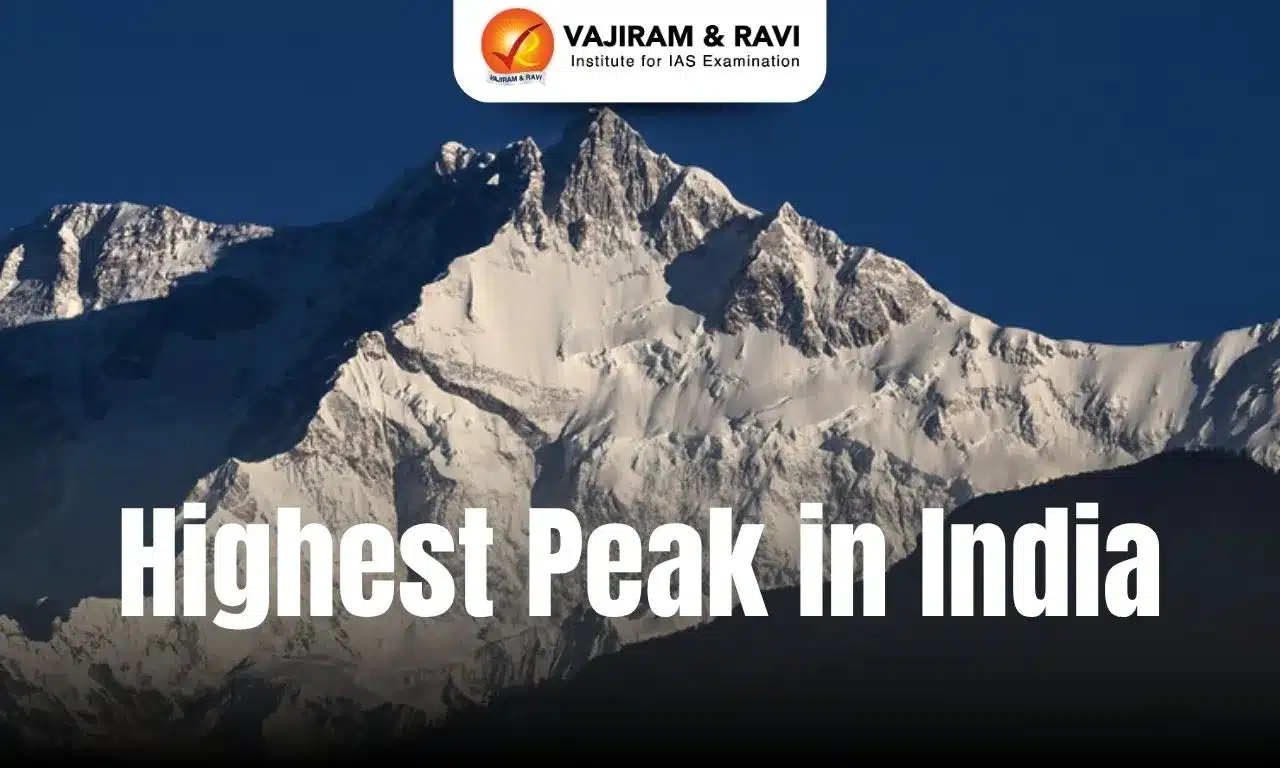
- Kangchenjunga (8,586 metres): The highest peak on the India–Nepal border and commonly identified as India’s highest mountain.
- Nanda Devi (7,816 metres): The highest mountain located entirely within India’s internationally recognised territory.
List of Highest Peak in India 2026
The List of Highest Peaks in India 2026, their heights, and the states they are in are shown in the table below.
| List of Highest Peaks in India 2026 | ||||
|---|---|---|---|---|
| Rank in India | Mountain Name | Mountain Range | Height (m) | State/UT |
| 1 | K2 (Godwin-Austen) | Karakoram Range | 8611 | Territory administered by Pakistan and claimed by India |
| 2 | Kangchenjunga | Himalayas | 8,586 | Sikkim |
| 3 | Nanda Devi | Garhwal Himalaya | 7,816 | Uttarakhand |
| 4 | Kamet | Garhwal Himalaya | 7,756 | Uttarakhand |
| 5 | Saltoro Kangri (K10) | Saltoro Karakoram | 7,742 | Ladakh |
| 6 | Saser Kangri I (K22) | Saser Karakoram | 7,672 | Ladakh |
| 7 | Mamostong Kangri (K35) | Rimo Karakoram | 7,516 | Ladakh |
| 8 | Saser Kangri II East | Saser Karakoram | 7,513 | Ladakh |
| 9 | Saser Kangri III | Saser Karakoram | 7,495 | Ladakh |
| 10 | Teram Kangri I | Siachen Karakoram | 7,462 | Ladakh |
| 11 | Jongsong Peak | Kangchenjunga Himalaya | 7,462 | Sikkim |
| 12 | K12 | Saltoro Karakoram | 7,428 | Ladakh |
| 13 | Kabru North | Kangchenjunga Himalaya | 7,412 | Sikkim |
| 14 | Ghent Kangri | Saltoro Karakoram | 7,401 | Ladakh |
| 15 | Rimo I | Rimo Karakoram | 7,385 | Ladakh |
| 16 | Teram Kangri III | Siachen Karakoram | 7,382 | Ladakh |
| 17 | Kirat Chuli | Kangchenjunga Himalaya | 7,362 | Sikkim |
| 18 | Mana Peak | Garhwal Himalaya | 7,272 | Uttarakhand |
| 19 | Apsarasas Kangri | Siachen Karakoram | 7,245 | Ladakh |
| 20 | Mukut Parbat | Garhwal Himalaya | 7,242 | Uttarakhand |


Top 10 Highest Peaks in India 2026
Here are the Top 10 Highest Peaks in India 2026, each with its own story and breathtaking elevation.
1. K2 (Godwin-Austen)
- State: Ladakh
- Height: 8,611 meters
- It is disputed highest mountain peak in india located in Ladakh region of India but controlled under PoK by Pakistan.
2. Kangchenjunga
- State: Sikkim
- Height: 8,586 meters
- Known as the “Five Treasures of Snows,” this is India’s tallest mountain and the third-highest in the world, standing majestically on the India-Nepal border.
3. Nanda Devi
- State: Uttarakhand
- Height: 7,816 meters
- The tallest peak entirely within India, Nanda Devi is revered locally and stands as a symbol of Uttarakhand’s natural beauty.
4. Kamet
- State: Uttarakhand
- Height: 7,756 meters
- The highest peak in the Zaskar range, Kamet is remote and challenging, making it a favorite among seasoned mountaineers.
5. Saltoro Kangri
- State: Jammu & Kashmir
- Height: 7,742 meters
- This peak dominates the Saltoro range in the Karakoram, known for its closeness to the Siachen Glacier.
6. Saser Kangri
- State: Jammu & Kashmir
- Height: 7,672 meters
- Located in the Saser Muztagh range, this peak is one of five towering summits that add to the beauty of the Karakoram.
7. Mamostong Kangri
- State: Jammu & Kashmir
- Height: 7,516 meters
- Rising in the Rimo range, Mamostong Kangri is known for its proximity to Siachen and is India’s sixth-highest peak.
8. Rimo
- State: Jammu & Kashmir
- Height: 7,385 meters
- Near the Karakoram Pass, Rimo I is the tallest of the Rimo peaks, historically part of ancient trade routes.
9. Hardeol
- State: Uttarakhand
- Height: 7,151 meters
- Often called the “Temple of God,” Hardeol stands in the Kumaon Himalayas, neighboring the Nanda Devi sanctuary.
10. Chaukhamba
- State: Uttarakhand
- Height: 7,138 meters
- The highest peak in the Gangotri group, Chaukhamba is recognized for its four-pointed structure and scenic prominence in Garhwal.
Highest Peak of the Himalayas in India
Kangchenjunga (8,586 metres) is the highest peak of Himalayas in India. It is located on the India-Nepal border. It lies in the eastern Himalayas, with its Indian side in Sikkim.
Kangchenjunga is the third-highest mountain in the world, after Mount Everest and K2. The mountain is sacred to communities in Sikkim and Nepal and is part of the ecologically sensitive eastern Himalayan region.
Highest Peak in South India: Western and Eastern Ghats
Anamudi (2,695 m) is the highest peak in South India and the Western Ghats. Located in Kerala’s Idukki district within Eravikulam National Park, it supports rich biodiversity, including the endangered Nilgiri tahr. The region is also known for Neelakurinji (Strobilanthes kunthiana), a flower that blooms en masse at intervals of about 12 years, covering the hillsides in purple-blue blooms.
The Eastern Ghats are a discontinuous mountain range along eastern Peninsular India. Arma Konda (Jindhagada Peak), at approximately 1,680 m in Andhra Pradesh, is commonly identified as their highest peak.
Significance of Mountain Peaks in India
India’s mountain peaks are vital for ecological stability, water security, climate regulation and national security.
- Climate regulation: The Himalayas influence monsoon patterns and act as a barrier against cold winds from Central Asia.
- Water security: Himalayan glaciers and snowfields sustain major river systems, including the Ganga, Indus and Brahmaputra.
- Biodiversity: Mountain ecosystems support unique flora and fauna, including endangered species such as the Nilgiri tahr.
- Strategic importance: The Himalayas and Karakoram are crucial for India’s border security and defence.
- Cultural significance: Peaks such as Nanda Devi and Kangchenjunga hold religious and cultural importance for local communities.
Challenges Facing Mountain Regions
Mountain ecosystems are fragile and increasingly vulnerable to environmental degradation and climate change.
- Climate change: Rising temperatures accelerate glacier retreat and increase the risk of glacial lake outburst floods (GLOFs).
- Natural disasters: Landslides, avalanches, earthquakes and flash floods threaten lives, infrastructure and livelihoods.
- Unplanned development: Road construction, tourism and hydropower projects can destabilise slopes and damage habitats.
- Biodiversity loss: Deforestation, habitat fragmentation and human activity threaten mountain species and ecosystems.

 Last updated on Oct, 2026
→ UPSC 2027 Notification will be released on 13 January 2027 at upsconline.nic.in.
→ Check Nobel Prize 2026 Winners List here.
→ Download PIB PRiSM Monthly Magazine 2026 here.
→ Check UPSC Monthly Current Affairs Magazine The Recitals here.
→ Check out the latest UPSC Syllabus here.
→ Download UPSC Model Answers for Mains 2026
→ UPSC Mains Question Paper 2026 is out now for Essay & GS Paper 1, 2, 3 & 4.
→ UPSC Calendar 2027 has been released.
→ Enroll in Vajiram & Ravi’s UPSC Mains Test Series 2027 for structured answer writing practice, expert evaluation, and exam-oriented feedback.
→ Join Vajiram & Ravi’s UPSC Mentorship Program 2027 for personalized guidance, strategy planning, and one-to-one support from experienced mentors.
→ Go through the UPSC Mains Previous Year Papers to enhance your preparation.
→ UPSC has released UPSC Toppers List 2025 with the Civil Services final result on its official website.
→ Also check Best UPSC Coaching in India
Highest Peak in India 2026 FAQs
Q1. Which is the Highest Peak in India K2 or Kanchenjunga 2026?+
Q2. What is the height of Kanchenjunga 2026?+
Q3. Is k2 the highest mountain peak in India 2026?+
Q4. Which is the highest mountain peak in the world 2026? +
Q5. Which is the 2nd highest peak in India 2026?+
Tags: geography highest peak in india