Dams have been pivotal in India's development, providing crucial irrigation for agriculture, clean hydroelectric power, and flood control. According to the 7th Schedule of the Indian Constitution, water management falls under state jurisdiction. There are more than 5,000 major dams in India, making it one of the countries with the largest number of large dams in the world after China and the United States.
However, a recent study by the United Nations University- Institute on Water, Environment and Health (UNU-INWEH) raises concerns about sediment accumulation, predicting a 26% loss in storage capacity for around 3,700 Indian dams by 2050.
Major Dams in India Types of Dams
A dam is a massive barrier built across a river to retain, store, or redirect water for consumption, irrigation, and power generation. The different types of dams are primarily classified by their structural design, construction materials, and use.
- Gravity Dams: These massive concrete or masonry structures rely entirely on their own weight to resist water pressure. Example: Bhakra Nangal Dam.
- Arch Dams: These curved concrete walls transfer water load sideways directly into strong canyon walls. Example: Idukki Dam.
- Embankment Dams: Constructed from compacted earth or rock, these broad barriers suit wide valleys. Example: Tehri Dam and Hirakud Dam.
- Masonry Dams: Built using stone blocks bound with mortar, these structures provide high compressive strength. Example: Nagarjuna Sagar Dam.
- Buttress Dams: These features consist of a sloping concrete deck supported downstream by triangular concrete buttresses.
- Barrages: Built across rivers to divert water into irrigation canals, these low-head structures utilize adjustable gates. Example: Farakka Barrage
- Storage Dams: These barriers collect and store water for municipal supplies, farming, and power generation.
Major Dams in India List
Dams are massive structures used for reservoirs, water supply, and flood control. They are gravity-based, earth-fill dams, and arch dams, which are curved structures that transfer water force horizontally. They are critical components of a country's water management infrastructure.
The table below shows important dams in India, their connected rivers, and the states where they are located:
|
Dam |
River |
State |
|
Tehri Dam |
Bhagirathi |
Uttarakhand |
|
Lakhwar Dam |
||
|
Ramganga Dam |
Ramganga |
|
|
Koteshwar Dam |
Bhagirathi |
|
|
Idukki Arch Dam |
Periyar |
Kerala |
|
Cheruthoni Dam |
Cheruthoni |
|
|
Kakki Dam |
Kakki |
|
|
Idamalayar Dam |
Idamalayar |
|
|
Mattupetty Dam |
Muthirapuzha River (tributary of Periyar) |
|
|
Nizamsagar Dam |
Manjira |
Telangana |
|
Nagarjuna Sagar Dam |
Telangana/ Andhra Pradesh |
|
|
Srisailam Dam |
Krishna |
|
|
Polavaram Project |
Andhra Pradesh |
|
|
Supa Dam |
Kali Nadi |
Karnataka |
|
Krishnarajasagar Dam |
||
|
Tungabhadra Dam (Pampa Sagar) |
Tungabhadra River (a tributary of the Krishna) |
|
|
Mullaperiyar Dam |
Periyar |
Tamil Nadu |
|
Mettur Dam |
Cauvery |
|
|
Vaigai Dam |
Vaigai |
|
|
Bhakra Dam |
Satluj |
Himachal Pradesh |
|
Chamera Dam |
Ravi |
|
|
Pong Dam (Maharana Pratap Sagar) |
Beas |
|
|
Nathpa Jhakri Dam |
Sutlej |
|
|
Koyna Dam |
Koyna |
Maharashtra |
|
Bhandardara Dam |
Pravara |
|
|
Jayakwadi Dam |
Godavari |
|
|
Sardar Sarovar Dam |
Narmada |
Gujarat |
|
Ukai Dam |
Tapi |
|
|
Dantiwada Dam |
Banas |
|
|
Hirakud Dam |
Mahanadi |
Odisha |
|
Mandira Dam |
Sankh |
|
|
Rihand Dam |
Rihand |
Uttar Pradesh |
|
Indira Sagar Dam |
Madhya Pradesh |
|
|
Omkareshwar Dam |
Narmada |
|
|
Gandhi Sagar Dam |
Chambal |
|
|
Ranjit Sagar Dam |
Ravi |
Punjab |
|
Bhakra Dam |
Satluj |
|
|
Harike Barrage |
Confluence of the Beas and Sutlej |
|
|
Baglihar Dam |
Chenab |
Jammu & Kashmir |
|
Salal Dam |
Chenab |
|
|
Uri Dam |
Jhelum |
|
|
Subansiri Dam |
Subansiri |
Arunachal Pradesh |
|
Dibang Dam |
Dibang |
|
|
Kameng Dam |
Bichom and Tenga (Kameng tributaries) |
|
|
Hasdeo Bango Dam |
Hasdeo |
Chhattisgarh |
|
Dudawa Dam |
Mahanadi |
|
|
Rana Pratap Sagar Dam |
Chambal |
Rajasthan |
|
Bisalpur Dam |
Banas |
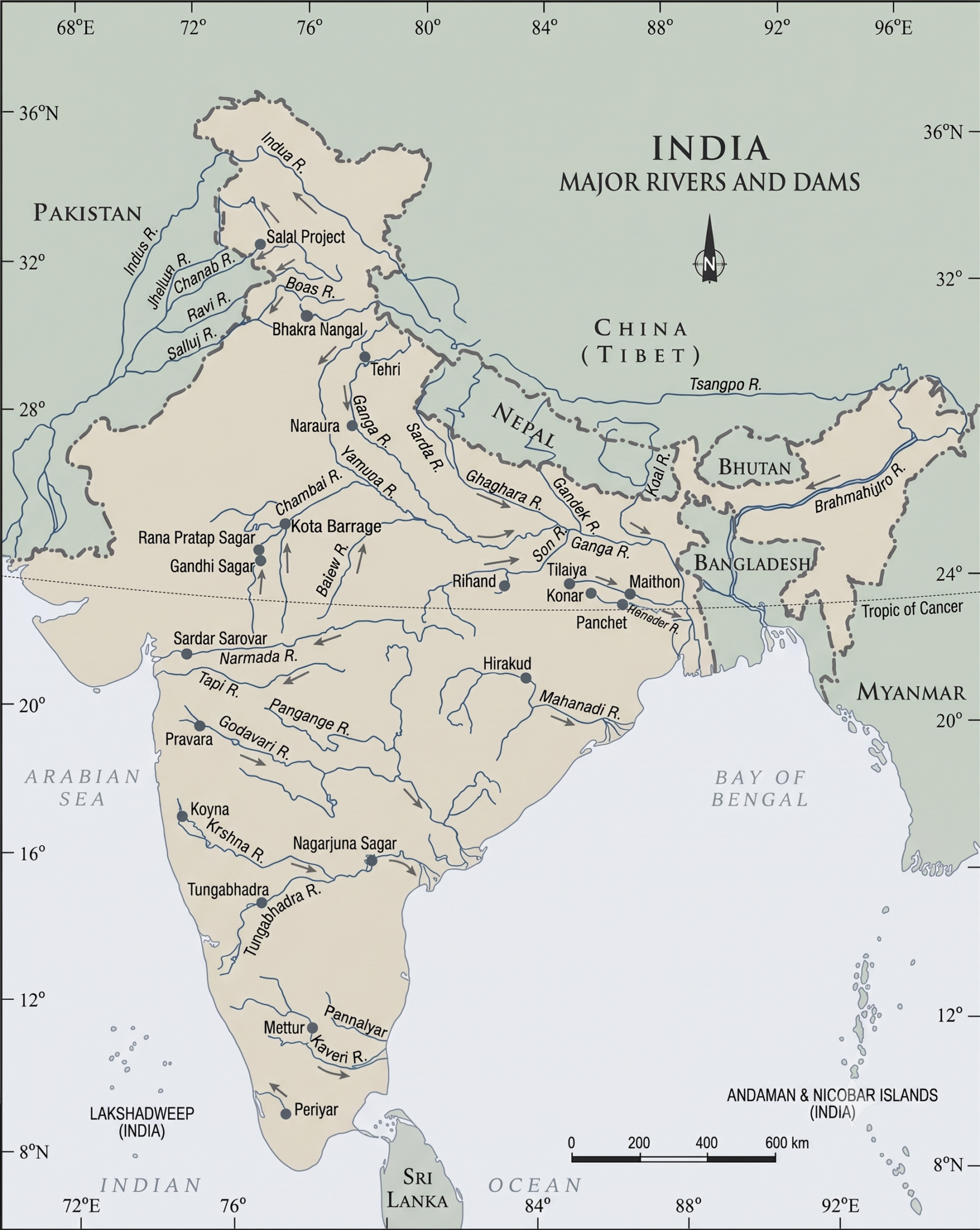
Major Dams in India Map
The map of major dams in India visually highlights key water reservoirs across the nation's river basins.\


Major Dams in India Significance
Dams are critical to India's water management and development efforts. They offer significant benefits, including:
- Renewable Energy Source: Many dams have turbines installed to generate electricity from the regulated water flow. These hydroelectric dams are a vital source of renewable energy for the country.
- For instance, in 2026, a hydropower capacity of about 52,064 MW (megawatts) accounted for roughly 11% of power generation capacity in India.
- Irrigation: Large dams have played a crucial role in improving irrigation facilities, increasing the area under cultivation, and boosting agricultural productivity, contributing to India's self-sufficiency in food grain production.
- Flood control and water supply: During heavy rainfall, dams can prevent floods by controlling water release. Conversely, they maintain a reliable water supply during dry conditions.
- Efficient land use: While large dams submerge land, they do so relatively sparingly compared to alternative small dams. They utilise land more efficiently and are capable of irrigating larger areas, providing multiple benefits including irrigation and power generation.
Major Dams in India Impact
Major dams in India drive agricultural growth and hydroelectric power, but they simultaneously create severe ecological disruptions, community displacement, and long-term adverse impacts.
- Irrigation: Projects like the Bhakra Nangal Dam powered the Green Revolution by providing a steady water supply across Punjab and Haryana.
- Clean Energy: Hydroelectric turbines generate vital renewable energy, contributing around 11% of India's total power capacity.
- Flood Control: Large reservoirs like the Hirakud Dam regulate heavy monsoons to control extreme downstream flooding.
- Human Displacement: Reservoir flooding submerged vast lands, displacing millions of vulnerable indigenous people and residents.
- Ecological Damage: Barriers disrupt river ecosystems, block migratory fish routes, and destroy surrounding wetlands.
- Storage Loss: Continuous silt accumulation inside reservoirs degrades total water-holding capacity over time.
Major Dams in India Challenges
India's vast dam network faces critical structural, environmental, and governance hurdles that jeopardize future water security, regional flood control, and downstream public safety.
- Aging Infrastructure: Over 80% of India's 5,700+ large dams exceed 25 years of operation, heightening structural fatigue and failure risks.
- Severe Siltation: Rapid sediment accumulation reduces reservoir storage by 20% to 30%, diminishing water availability for farms and power generation.
- Hydrological Stress & Climate Change: Unpredictable monsoons, cloudbursts, and extreme weather strain traditional spillways designed for legacy weather patterns.
- Social & Ecological Costs: Mega-projects fragment aquatic biodiversity and leave long-standing delays in community rehabilitation.
- Governance & Data Deficits: Institutional fragmentation and weak real-time monitoring hinder proactive maintenance and safety management.
Major Dams in India Safety
India ranks third in the world with over 6,600 specified dams, but challenges such as ageing infrastructure and sedimentation mandate safety upgrades.
- The Dam Safety Act, 2021: Enacted to establish a statutory framework for the surveillance, inspection, operation, and maintenance of specified dams. It mandates a four-tier institutional structure - National Committee on Dam Safety, National Dam Safety Authority, State Committees, and State Dam Safety Organisations.
- Mandatory Compliance & Inspections: Dam owners are legally bound to conduct mandatory pre-monsoon and post-monsoon safety audits, establish dedicated dam safety units, and earmark maintenance funds.
- Emergency Action Plans: Mandates the preparation of localized disaster mitigation strategies and joint mock drills with emergency management agencies.
- Dam Rehabilitation and Improvement Project (DRIP): A multi-phase initiative aimed at structural repairs, spillway modernization, and upgrading operational performance of existing vulnerable dams.
- Digital Tools & Monitoring: Utilizes advanced systems like DHARMA (Dam Health and Rehabilitation Monitoring Application) alongside real-time instrumentation for ongoing health checks and risk assessments.
Major Dams in India UPSC PYQs
Q1: Dam failures are always catastrophic, especially on the downstream side, resulting in a colossal loss of life and property. Analyze the various causes of dam failures. Give two examples of large dam failures. (UPSC Mains 2023)
Q2: Suppose the Government of India is thinking of constructing a dam in a mountain valley bound by forests and inhabited by ethnic communities. What rational policy should resort to in dealing with unforeseen contingencies? (UPSC Mains 2018)
Q3: Consider the following pairs : (UPSC Prelims 2022)
Reservoirs-States
- Ghataprabha - Telangana
- Gandhi Sagar - Madhya Pradesh
- Indira Sagar - Andhra Pradesh
- Maithon - Chhattisgarh
How many pairs given above are not correctly matched?
(a) Only one pair
(b) Only two pairs
(c) Only three pairs
(d) All four pairs
Ans: (c)

 Last updated on Oct, 2026
→ UPSC 2027 Notification will be released on 13 January 2027 at upsconline.nic.in.
→ Check Nobel Prize 2026 Winners List here.
→ Download PIB PRiSM Monthly Magazine 2026 here.
→ Check UPSC Monthly Current Affairs Magazine The Recitals here.
→ Check out the latest UPSC Syllabus here.
→ Download UPSC Model Answers for Mains 2026
→ UPSC Mains Question Paper 2026 is out now for Essay & GS Paper 1, 2, 3 & 4.
→ UPSC Calendar 2027 has been released.
→ Enroll in Vajiram & Ravi’s UPSC Mains Test Series 2027 for structured answer writing practice, expert evaluation, and exam-oriented feedback.
→ Join Vajiram & Ravi’s UPSC Mentorship Program 2027 for personalized guidance, strategy planning, and one-to-one support from experienced mentors.
→ Go through the UPSC Mains Previous Year Papers to enhance your preparation.
→ UPSC has released UPSC Toppers List 2025 with the Civil Services final result on its official website.
→ Also check Best UPSC Coaching in India
Major Dams in India FAQs
Q1. Which are the major dams in India?+
Q2. Is Bhakra Nangal Dam the largest?+
Q3. How many dams exist in India?+
Q4. What is the largest dam in the world as of 2026?+
Q5. What is the rank of India in building large dams?+
Tags: list of major dams in india quest UPSC Geography Notes